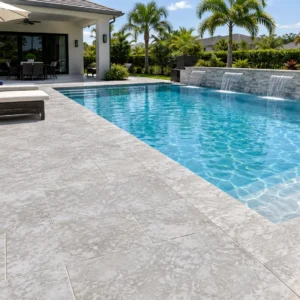
Gustavia is the Caribbean’s most unlikely capital: a Swedish town on a French island, named for a Swedish king, wrapped around a harbor that now hosts the world’s most photographed yachts. Sweden held St. Barths from 1784 to 1878 and left the town its grid, its fort sites and its name; France restored the tricolor and the modern island built the rest. Working stone into this town means working inside that layered inheritance – and inside the busiest commercial register the island has.
The Swedish Bones
The colonial century left durable marks: the harbor-mouth forts – Gustav, Karl and Oscar’s sites ringing the entrance – the stone remnants of the free-port warehouses, and the walled discipline of a town laid out for trade. The surviving masonry sets a register modern work answers to: coursed stone, modest heights, red roofs above pale walls. New commercial fit-outs that respect the register read as Gustavia; those that ignore it read as anywhere, which on this island is a commercial mistake before it is an aesthetic one.
The Retail Quarter’s Brief
The blocks behind the harbor carry flagship retail at metropolitan standard, and their stone brief is precise:
- Entrance thresholds take the season’s full traffic in sandals and deck shoes – dense stone, textured enough for rain, elegant enough for the brand.
- Facade bases and sills clean to respectability after cruise-tender days and cloudbursts alike.
- Interior floors run honed and pale, photographing the merchandise rather than competing with it.
- Repairs happen overnight or not at all – attic stock per premises is the quarter’s unwritten lease clause.
another harbor capital’s stonework manners describes the same balance of heritage register and commercial duty one island group north, and the playbooks agree on nearly everything.
Quayside: The Hardest-Working Meters
The harbor-front walk is the island’s promenade and its loading dock at once – güests, provisioning trolleys, charter crews and evening crowds sharing the same surface. Quayside stone runs the full commercial canon: density against abrasion, texture against wet, tones that hide a working day and clean up for the evening passeggiata. Detailing leans marine – falls shedding wash and rain fast, joints tight against grit, fixings and edge steel specified for salt air at meters from the water.
The Townhouse Renovation Wave
Above and behind the shops, Gustavia’s townhouses cycle through renovations that are the town’s quiet construction economy: courtyards opened into outdoor rooms, roof terraces added within the height discipline, entrances upgraded to the retail quarter’s standard. The stone work is jewel-scale – a courtyard here, a stair run there – and rewards the same disciplines as the villas: one material family, single-batch orders, spares held, drainage taken seriously on lots that shed water onto neighbors if they shed it carelessly.
Building Around the Season
The town’s calendar is the island’s, intensified: from the first regatta to the last charter, Gustavia is full, and its lanes and quays have no room for a works site. The building window is the quiet season, the same September rhythm the villas keep, and commercial projects book their stone against it with even less flexibility – a shop that misses its opening misses its year. Orders confirmed in spring, landed by late summer, installed before the harbor fills: the sequence is not advice here; it is the lease schedule.
Heritage as a Working Asset
Gustavia’s stone past is not a museum layer – it is the setting that makes the town’s commerce worth its rents. The practical etiquette follows:
- New work near the fort sites and old walls stays visually quiet and structurally separate.
- Pale limestone and coursed detailing echo the register without pastiche.
- Anything uncovered during groundwork in the old town is reported, not cleared – the Swedish century is still underfoot.
The Working Morning
Gustavia’s commercial day has a rhythm worth building around: the working morning, before the shops open and the quay fills, when deliveries land, floors get their wash, and any small repair happens in the two quiet hours the town allows. Premises detail for that rhythm – service doors and delivery thresholds specified as seriously as the front entrance, floor drainage that lets a full washdown dry before the first customer, and repair-friendly stone layouts where a single flag lifts without disturbing its neighbors. The morning is also when the town’s stone shows its maintenance honesty: surfaces chosen well need only the wash and the occasional resand of a joint, while surfaces chosen badly demand the kind of attention no seasonal business has time to give. Fit-out schedules borrow the same window at project scale – noisy work in the closed months, finishing trades in the shoulder weeks, and the last coat of sealer cured before the season’s first tender. The town rewards businesses that respect its rhythm with the only currency that matters here: mornings that run smoothly all season long.
The Capital’s Ledger
The town’s brief, condensed: heritage register respected, commercial duty met, season calendar obeyed. It is the same working arithmetic every port town runs – the working port-town ledger shows it at a bigger, rougher scale – refined here to boutique tolerances. Build Gustavia to its Swedish bones and its French polish, and the hardest-working stone on the island will also be its best-photographed.
Rain on the Town
Gustavia’s rain arrives the island’s way – rarely, then all at once – and the town’s streets have to pass a cloudburst downhill to the harbor without flooding a single threshold on the way. Commercial stone work participates in that drainage choreography whether it plans to or not.
- Thresholds sit proud of the walk by a deliberate step, with falls shedding away from the door – the difference between a wet mat and a wet stockroom.
- Entrance landings drain to the street line, never into the premises’ own footprint.
- Courtyards behind the retail rows carry their own gullies; the town’s slope will not wait for undersized outlets.
- Textured surfaces keep the after-rain minutes safe – the sun returns fast, but the first customers arrive faster.
The town’s stone shows its quality in the hour after the squall: well-detailed premises are dry-doored and open while the shortcuts are still sweeping water. In a settlement this compact the rain audit is public, immediate and remembered – one more way Gustavia keeps its builders honest.
A harbor that still works for a living
The waterfront here is not a promenade with boats parked on it. The IEDOM territorial report records the port handling 822 cargo vessels and 6,845 twenty-foot equivalent units unloaded in a year, alongside roughly 194,000 port entries counting ferry, yacht and cruise arrivals. That is a commercial quay, a passenger terminal and a luxury marina occupying the same small basin. Ground surfaces around it therefore take pallet trucks and provisioning trolleys in the morning and evening crowds in fine shoes a few hours later, and they have to be credible in both roles.
- Bedding depth set by the heaviest wheel load, not by footfall
- Continuous edge restraint where loaded trolleys turn
- Service covers set flush and rated for what crosses them
- Cleaning method agreed with the port operator, not improvised
- Repairs designed to happen overnight between arrivals
The Swedish grid is still the plan
Gustavia was laid out during the Swedish period that gave the town its name, and that inheritance is still legible in the street pattern, the plot widths and the relationship of the buildings to the water. Working within it is mostly a matter of restraint: modest unit scale, quiet color, and modern components kept small enough not to compete with the frontages. New work that respects the module reads as part of the town; new work that imposes a larger grid never quite settles.
- Unit scale matched to the historic module rather than to modern pallets
- Color kept quiet so the building frontages carry the interest
- Modern drainage components made small and recessive
- Level changes handled as deliberate elements, not corrections
Choosing gustavia harbour stone for a working waterfront
The frontage will be opened repeatedly for services, moorings and repairs, so the build-up matters more than the pattern. Guidance on detailing natural stone paving for lasting durability is clear that installation method drives long-term performance, and on a quay that means a system which can be lifted and closed again without a visible scar.
- A build-up that can be reopened without breaking units
- One documented reinstatement detail issued to every trade
- Shared stock of matching units held for the whole waterfront
- Non-ferrous fixings throughout, since salt reaches everything here
Our St Barths stone supply guide sets out the formats, finishes and lead times that suit this island. A town this small survives on repairs that nobody notices.