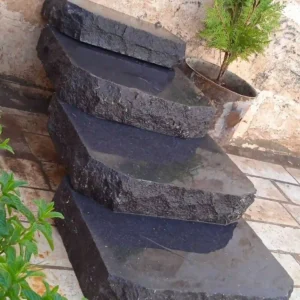
Bermuda’s freight profile is unique in this cluster: the shortest ocean leg we serve, feeding the most exacting import regime. The island sits a few sailing days off the US East Coast — closer to Carolina than to any Caribbean neighbor — and receives its cargo through systems refined by centuries of depending on them. Landing stone here is fast; landing it correctly is a discipline, and this guide covers both.
The Atlantic advantage
Proximity changes the planning arithmetic: sailings run frequent and short, replacement or supplementary shipments arrive in days rather than the month-scale cycles deep-Caribbean islands budget, and program buffers can be honest without being heroic. The advantage compounds for phased work — a reserved batch can drip-feed on short notice as phases mature — and for the renovation market’s rhythm, where a spring order comfortably makes a summer season. None of this excuses late ordering: production time is unchanged, and the island’s own calendar, not the ocean, sets the real deadlines.
Duty, declared early and priced without flinching
Bermudian import duty is the stack’s headline line — among the most substantial rates in the region, applied knowledgeably by a customs service that has seen everything. The professional response is transparency at speed: a fully itemized commercial invoice, honest valuations, and your Bermudian broker engaged at quote stage so duty and landed cost are settled numbers before the vessel sails. Attempted cleverness meets an institution older than most countries; documentation meets brisk, predictable clearance. The choice is not difficult.
- Consolidate into one consignment, because duty and clearance are charged per entry rather than per pallet.
- Value the shipment accurately, since a correction after arrival is slower than getting it right first.
- Use a broker who handles building materials regularly rather than a general agent.
- Add attic stock to the same entry, as a later top-up carries the same overhead on a far smaller order.
The paper standard
Bermuda’s import machinery runs on documents that reconcile: one description across invoice, packing list and bill of lading; values consistent with the quote; the consignee correctly the importer of record; and — where planning consents govern a project’s materials — the paperwork trail that connects what was approved to what arrived. Heritage and planning-sensitive projects benefit from the connection being explicit: batch records and datasheets filed with the project’s documentation satisfy both the authorities’ interest and the owner’s future repairs.
Island distribution: small lanes, careful moves
Bermuda’s roads are narrow, its vehicle limits real, and its pace deliberate — the last miles reward smaller trucks, planned routes and booked delivery windows, especially in Hamilton’s working core and the heritage lanes of St. George’s. Estate deliveries confirm gate widths and staging before the sailing; hillside drives above the south shore plan their offloading like everywhere steep in this cluster. The island’s couriers and haulers are exact professionals; crates packed to sensible weights meet a system that handles them gently.
Weather windows, gales and the wise calendar
Bermuda’s shipping weather is Atlantic: hurricane season brushes the island from a different angle than the Caribbean’s, and the winter gale season adds its own port-pause days. The planning response is the cluster’s standard buffering with local tuning — autumn arrivals land before the gale season settles in, summer programs order in spring, and cargo insurance stays non-negotiable year-round. Stone’s patience is an asset again: crated material waits out any blow without complaint, indoors or out.
- Land material outside the winter gale window wherever the program allows.
- Expect a missed sailing to cost more than a fortnight once weather backs up a schedule.
- Store crates above ground and covered, since winter here is genuinely wet.
- Confirm site access before the container leaves, not while it stands on the quay.
Arrival, verification and the record
The close runs the standard fifteen minutes: crates counted against the packing list, transit questions photographed before anything moves, one crate per stone type opened against the approved samples, escrow releasing on confirmation for new clients. Bermudian projects file the record with characteristic thoroughness — and the Bermuda supply page sets the whole route up in one conversation: short seas, serious standards, no surprises.
Licensed trades, small island: the Bermudian working culture
Bermuda’s construction community is small, licensed, multigenerational and very good — a trades culture where firms carry century-old names, standards are enforced by reputation as much as regulation, and everyone genuinely does know everyone. For stone projects the culture shapes practicalities worth knowing early. Capacity is finite and booked: the island’s masons and landscape contractors plan seasons ahead, and a program that secures its crew at design stage proceeds while the improvised one queues. Standards run high and documentation is expected — drawings, specifications and samples move approvals through both professionals and planning — and the craft pride is real: Bermudian stonework tradition descends from generations who sawed the island’s own blocks, and crews handle fine material with inherited respect.
Costs reflect the island honestly — skilled labor at Bermudian rates rewards packages that arrive maximally prepared: stone cut to final dimension rather than adjusted on site, specials manufactured rather than fabricated locally, crates sequenced so crews install rather than sort. The social fabric matters too: neighbors are known, noise and access courtesies are observed as standards rather than gestures, and a project’s conduct travels the island as quickly as its results. The reward for meeting the culture is the culture itself: work executed to the standard the island’s four-century building stock demonstrates, by crews whose grandfathers built the walls next door — and a finished terrace that joins Bermuda’s long conversation between craft and stone, which was always the point of importing the right material for it.
Why the standards here are unlike the tropics
Bermuda builds to a level almost nowhere else in the Atlantic matches, and the reason is historical. Research published by Moody’s on Bermuda disaster resilience traces the modern building tradition to a run of four hurricanes in 1712, 1713 and 1715, after which wooden structures were replaced by walls of massive reef limestone blocks under roofs tiled with thick slabs of coral stone. The island now runs what that assessment calls a robust and well-policed building code ensuring adequate wind resistance for all new construction.
- Expect the specification to be scrutinized rather than accepted, which raises the standard of evidence needed.
- Assume fixings and restraint details will be checked, since wind resistance is the code priority.
- Read the tradition as prescriptive, because three centuries of storms shaped what is considered acceptable.
- Budget for a properly detailed submission rather than a descriptive one.
- Treat the code as an asset, since it is a large part of why property here holds value.
Buying material that will actually pass
A specification written in adjectives invites questions on an island that checks things. The Natural Stone Institute testing program supplies the vocabulary that closes them: ASTM C97 for absorption and bulk density, C170 for compressive strength, C880 for flexural strength, C1353 for abrasion resistance and ANSI A326.3 for slip. On Bermuda those figures are not a nicety, they are how a submission gets approved without a second round.
- Quote the standard and the required value rather than naming a look.
- Attach certificates for the actual batch, not for the quarry in general.
- Read absorption carefully, because this island freezes nothing but soaks everything through a wet winter.
- Use flexural strength to justify large formats where handling is difficult on narrow lanes.
A short crossing with a long lead time
The ocean leg to Bermuda is genuinely short by Caribbean standards, and that fools people into treating the whole chain as quick. Sailings are scheduled rather than frequent, the island is small enough that a missed connection has no alternative, and the winter months add weather delay on top. The practical lead time is driven by the calendar, not by the distance.
- Work backward from the sailing schedule rather than from a transit time in days.
- Build in one missed sailing as a planning assumption, not as a contingency.
- Order long-lead formats first and let quick items catch up behind them.
- Insure to replacement landed cost rather than invoice value, since re-supply is slow.
Getting shipping stone to Bermuda right the first time
A short crossing into a strict jurisdiction rewards preparation over speed. One consolidated entry, test data attached, formats sized for narrow lanes, and a schedule built around sailings rather than around distance. Our Bermuda stone supply guide sets out the formats, finishes and lead times that suit this island. The ocean leg is the easy part; the paperwork and the calendar are what actually decide the date you finish.