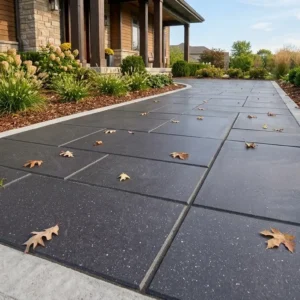
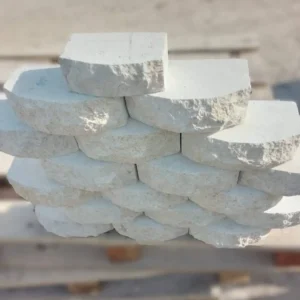
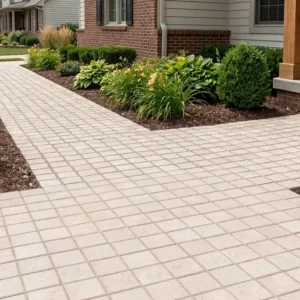
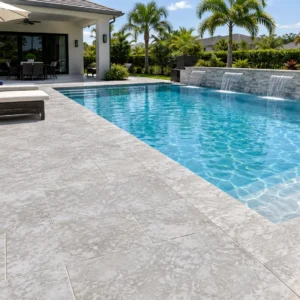
Antigua is full of good stone having a bad decade: terraces gone gray, pool surrounds slick with biofilm, copings crusted with salt. The owners assume replacement; the truth is that dense natural stone is almost always recoverable — because unlike coatings and concrete, its beauty goes all the way through. Here is the revival sequence.
Diagnose before you scrub
Read the surface before you touch it, because four problems look similar and want different answers:
- Gray-black film — usually organic algae, mildew or traffic grime, and it releases with the right cleaner
- White crusts near the sea — salt
- Whitish blooms near planters — mineral efflorescence
- Pitting or powdering — a porous stone that has suffered salt crystallization, recoverable in appearance but worth a density check before investing, and the physics is in the porosity explainer
The revival wash
Work in this order, testing a hidden patch first: dry sweep; soak with fresh water; apply pH-neutral stone cleaner (never acid on limestone — it etches on contact); agitate with a stiff synthetic brush; rinse thoroughly. For organic growth use a stone-safe outdoor biocide and give it dwell time, then rinse. Pressure washers: wide fan, moderate pressure, sensible distance — close-range jets scar soft joints and open surfaces.
Joints, the forgotten half
Neglected paving usually means failed joints: washed-out sand, cracked mortar, weeds mining the gaps. After cleaning, re-sand or re-point — joints lock the surface structurally and shed water; renewing them is half the like-new effect.
Restore the grip
Slipperiness on old stone is usually biofilm plus polished-by-traffic smoothness. Biocide handles the first. If a genuinely smooth finish is the problem around water, this is the moment to upgrade: replace the wet-zone course with textured-finish stone — often just the coping line and the first deck course — rather than the whole surface.
One caution is worth repeating, because it is the most common way a good floor gets ruined. Limestone is calcium carbonate, so mild acids attack it; the Natural Stone Institute is blunt that these stones are vulnerable to alteration by mild acids. That single fact rules out most supermarket descalers, rust removers and generic patio cleaners.
Seal into the good state
Once clean and dry, renew an impregnating sealer (test patch first). Sealing dirty stone locks the problem in; sealing revived stone locks the revival in, and on dense limestone the cycle is years long.
When replacement really is the answer
Soft porous stone that pits again each season, slabs cracked through, or a surface wrong for its job (polished around a pool) argue for targeted replacement — often course-by-course rather than wholesale. Dense replacement stock, cut to match, ships to St. John’s with samples first: the Antigua supplier guide covers the path, and new-project owners can avoid this article entirely by choosing density on day one.
Triage: sorting the terrace before touching it
Walk the neglected surface with three buckets in mind:
- Cosmetic — organic film, salt crust, stained joints. Full recovery, weekend scale
- Structural but local — rocking units, open joints, a cracked tread. Recover with re-bedding and spot replacement
- Material-terminal — soft porous stone powdering through its section, or widespread lamination. No wash fixes this
The restoration weekend, hour by hour
For the cosmetic eighty percent, one honest weekend transforms the surface:
- Saturday morning — clear, dry-sweep, first neutral-cleaner wash with synthetic brushes
- Saturday afternoon — biocide on shaded and green zones, left to dwell per label
- Sunday morning — second wash on stubborn zones, thorough rinse, joint inspection while everything is clean
- Sunday afternoon — re-sand joints, dress any chips, photograph the result
Installation method matters as much as the stone itself. Industry guidance separates mortar-set work, sand-set exterior paving and pedestal systems, and stresses that drainage, movement and substrate condition drive long-term performance more than the material name does — the detailing guidance is worth reading before you specify.
Matching new stone into old fields
Replacement units meet weathered neighbors, and the join can whisper or shout. The disciplines: source dense stone in the original format and finish (cut to match from a sample of the existing); expect the new piece to read slightly brighter for a season — weathering is honest and quick in Antiguan sun; distribute replacements rather than clustering them where possible; and where a whole course is going, take the opportunity to upgrade the wet-zone texture while the bedding is open. A year later, visitors cannot point to the repairs — that is the standard.
When the problem is underneath
Some “stone failures” are bedding failures wearing stone’s clothes: units rocking on washed-out screed, efflorescence tracking moisture from a leaking irrigation line, joints opening over a settling corner. Fix causes before faces — relay on corrected bedding, reroute or repair the water source, compact and re-support the settlement — or the restored surface simply re-fails on schedule. The diagnostic tell: damage that maps to a zone or a line is structural; damage sprinkled randomly is surface. Read the map before spending on the finish.
Protecting the investment you just made
Restoration without a maintenance change is a subscription to restoration. Close the project by installing the routine that prevents the sequel: the weekly sweep, monthly rinse, quarterly wash-and-walk, annual service — plus the two-line staff card and attic stock now that you know its worth. A restored terrace with a standing routine ages like new work; without one, the photographs from your restoration weekend become the “before” pictures of the next.
Budgeting a revival: the three-band estimate
Restoration quotes confuse owners because scope hides in diagnosis, so band it:
- Band one — the cosmetic weekend: cleaners, biocide, jointing sand, a hired washer. Materials money, plus owner labor or a day of help
- Band two — local surgery: re-bedding rockers, repointing runs, swapping damaged units into or out of attic stock. A mason-week in scale
- Band three — course replacement: wet-ring upgrades and matched new stock into old fields
Briefing local masons for stone revival
Antigua’s masons know their craft, and revival succeeds when the brief respects it while adding the stone-specific rules:
- Neutral chemistry only — hand over the products, not just the instruction
- Lime-appropriate mortars on heritage walls
- Bedding repairs compacted and drained rather than simply re-stuck
- Replacement units distributed through the field rather than clustered
Walk the triage map together before work starts.
Joint surgery: the techniques that last
Failed joints sink revivals when they are patched cosmetically, so specify the real repairs:
- Rake failed mortar to sound depth before repointing — surface smears fail by the end of the season
- Match joint mortar strength to the stone: softer than the units, never harder
- Re-sand kiln-dried sand into clean dry joints, compacted in passes
- Renew movement-joint sealant full-depth on backer rod, not as a bead over the corpse of the old one
What restoring stone in Antigua can and cannot recover
Photograph the revival like it matters, because it does: wide befores from fixed points, details of the worst zones, the same frames after. The pair earns three ways — it anchors the maintenance habit (nobody lets the after slide back), it documents condition for insurers and future buyers, and for rental villas it refreshes listing photography at restoration cost rather than renovation cost. A revived terrace with proof in the folder is an asset upgraded twice: once in stone, once on paper.