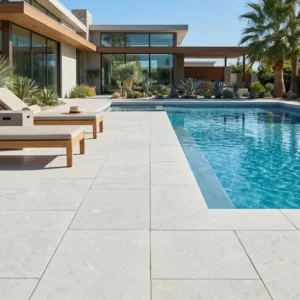
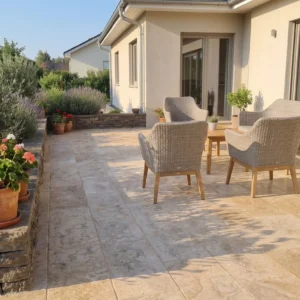
Resort work multiplies every stone decision by thousands of square meters and years of program. On Antigua — where materials cross an ocean and phases open to paying guests while later phases build — three disciplines separate smooth stone packages from expensive ones: batch control, program integration, and mock-ups that mean something.
Batch control at resort scale
Color drift between deliveries is invisible on a villa and glaring down a 200-meter pool promenade. Three contract clauses prevent it:
- Single-batch production per continuous surface
- Hand inspection at the factory rather than machine-line pass-through
- Phased call-offs cut from reserved block, so phase three laid two years later still matches phase one
Write retained attic stock of 2–3 percent into the contract as well; future repairs on an operating resort cannot wait for a new production run.
The program is a supply chain
Container quantities — roughly 280–320 square meters of 3 cm stone each — arrive on vessel schedules, not site wishes. Map stone packages to the construction program at design freeze: pool zones before rainy-season close-in, guest-facing phases sequenced so crates land labeled per zone. Our Antigua freight guide covers the port mechanics at St. John’s; at resort scale the principle is simply earlier and in writing.
Mock-ups that earn their cost
A meaningful mock-up meets four conditions:
- Laid outdoors on the actual bedding, not on a showroom floor
- Built with the specified finish per zone
- Wetted daily for a fortnight
- Signed by owner, operator and architect together
It settles color range, joint width, slip feel and maintenance response before thousands of meters commit, and it becomes the quality benchmark every later delivery is judged against.
Zone engineering, not one-stone-everywhere
Resorts live in zones: bush-hammered grip on pool surrounds and external stairs, finer brushed textures on promenades, honed under roofed spas, profiled copings at every water edge. One stone family across zones keeps the visual language coherent while each surface meets its safety case — and consolidates procurement into one accountable supply line.
The charges on an Antiguan import are more numerous than most budgets allow for, and the Customs and Excise Division lists them openly: import duty, a throughput levy, a disposal or environmental levy, the national solid waste levy, the revenue recovery charge and the Antigua and Barbuda Sales Tax — the division publishes the full set it collects. Ask your broker to price every line rather than the headline duty rate alone.
Operator handover
Close the package with an O&M sheet the housekeeping team will actually use: neutral cleaners only, rinse cadence for salt exposure, sealer renewal cycle, attic-stock location. A resort deck maintained correctly from day one never becomes a restoration line-item.
Volume pricing against cutting lists, batch reservation and program scheduling run architect-and-developer-direct: kareem@citadelstone.us, or start at the Antigua supplier guide.
Tender language that filters suppliers
Resort tenders get the suppliers they specify for. Ask only for “limestone pavers” and the returns range from excellent to alarming. Ask instead for evidence:
- Density and absorption figures
- Range samples from the actual production batch
- Named finish processes rather than adjectives
- Single-batch capacity for the full program quantity
- Export track record to the Eastern Caribbean
The QC pyramid from block to laid floor
Quality at resort scale is checkpoints, not hope:
- Block selection at the quarry
- Slab inspection after sawing
- Piece-level inspection after finishing — where hand inspection matters, because machine lines pass what human eyes catch
- Crate-level verification against the packing list
- Arrival sampling on the island
- The laid mock-up as the standing site referee
Each gate is cheap; the absence of any one of them is how a resort ends up arguing about a floor.
Installation method matters as much as the stone itself. Industry guidance separates mortar-set work, sand-set exterior paving and pedestal systems, and stresses that drainage, movement and substrate condition drive long-term performance more than the material name does — the detailing guidance is worth reading before you specify.
Phasing stone through a live resort
Half of Antigua’s resort work happens beside operating rooms and occupied beach chairs, which adds logistics to metallurgy: crate deliveries scheduled to service corridors and low-occupancy windows; laying zones hoarded and re-opened in guest-ready condition (no half-grouted frontiers at breakfast); dust-wet cutting stations sited downwind of F&B; and the batch logic held across phases so the wing finished this winter matches the promenade finished two years ago. The stone itself is the easy part — the batch and mock-up disciplines earlier in this guide are what make phased delivery invisible to guests.
Lifecycle costing for the finance committee
Stone survives value-engineering when it is priced as a lifecycle rather than a line:
- Installed cost
- Annual maintenance labor
- Expected refurbishment cycle
- Replacement provision across a ten-year horizon
Dense natural stone scores precisely where operating budgets bleed — no annual recoating, damage repaired by the unit, cleaning by neutral wash rather than specialist cycles.
Handover as a product
Close a resort stone package like a product launch:
- The operations and maintenance sheet — neutral cleaners, rinse cadence, sealer cycle
- The attic-stock manifest, and where it is stored
- Signed mock-up photographs as the standing quality reference
- Supplier contact for future phases
- A one-hour walkthrough with engineering and housekeeping together
Operators renew contracts with packages that hand over cleanly, and the supply relationship that started with one phase carries into the next.
Defending the spec through value engineering
Every resort stone package meets the VE meeting, and survival is preparation: bring the lifecycle table (install cost plus ten years’ operations, where dense stone beats cheap alternatives on labor alone), the incident math (one slip claim outweighs the texture upgrade it would have prevented), and pre-priced de-scope options that protect the core — reduce back-of-house areas, phase a garden zone, but never swap the guest-facing material or split batches. A spec defended with numbers and options survives; one defended with adjectives becomes porcelain by Thursday.
Absorption is the number that separates one limestone from another. The Natural Stone Institute records a range running from under one percent to over ten across the family, and notes that dolomitic stones generally carry higher density, lower absorption and better abrasion resistance — the industry variety data sets this out. That spread is why two stones sold under the same broad name can behave nothing alike underfoot.
Governing the supply relationship
Resort programs run on relationships with metrics: agreed lead times per package, piece-rejection rates at arrival sampling, response time on technical queries, and attic-stock delivery riding scheduled containers. Put them in the supply agreement — not as legal weaponry but as shared dashboard — and review at each phase gate. Suppliers worth resort work welcome the scoreboard; the principal-direct model exists precisely so the person accountable for the metrics is the person answering the phone.
Stone in the wet amenities: spa, F&B, arrival
Beyond pools, resorts deploy stone where codes and brand standards concentrate: spa wet areas (honed-but-textured light stone, relentless drainage, chemical-tolerant sealing), F&B terraces (dense stone against staining service traffic, furniture-pad discipline at scale), and the arrival experience — porte-cochère and lobby thresholds where first impressions justify the finest finishes the maintenance regime can support. Each zone inherits the same batch-and-mock-up governance; only the finish assignments change. One material system, resort-wide, is the operational win hiding inside the aesthetic one.
Where resort stone specification succeeds or slips
International flags audit surfaces: slip-resistance documentation for wet zones, material specifications on file, maintenance programs evidenced. Build the stone package’s compliance file from day one — finish specifications with their texture documentation, the signed mock-up record, the O&M sheet, quarterly maintenance logs — and flag audits become filing exercises. Operators notice which owners hand over binders versus excuses; renewal conversations remember it too.