Almost every villa and resort project in Antigua & Barbuda comes down to the same pool-edge decision: precast concrete coping from a regional supplier, or natural stone coping cut to order. Both hold water back. They age very differently — and the edge of a pool is the most looked-at, most touched, most safety-critical stone on the property.
What precast concrete coping gives you
Consistency and availability. Precast units are molded, so every piece matches and lead times are short. The trade-offs show up later:
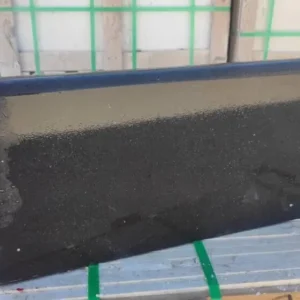
- The surface reads as concrete rather than stone
- The arris — the edge your hand grips and your feet feel — wears and exposes aggregate
- Chips reveal gray material under the tinted face
- Darker tints get uncomfortably hot in Antigua sun
What natural limestone coping changes
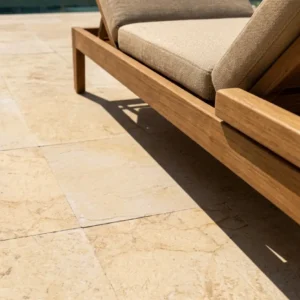
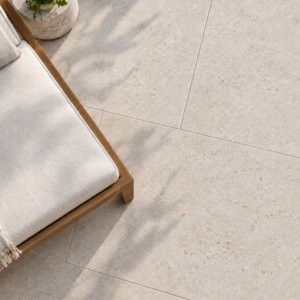
Limestone coping is sawn from solid stone: the color runs through the full thickness, so a chip can be dressed out rather than patched with mismatched filler. A light limestone stays markedly cooler for bare hands and feet, and the coping can be cut in the same stone as the deck — so the pool surround reads as one design instead of an assembly of parts. See white limestone pool coping for profiles and details.
Choosing a profile: bullnose, square, eased
Three profiles cover almost every Antiguan pool:
- Bullnose, a full rounded edge — the classic resort choice: comfortable to grip, soft against skin, forgiving with children in the pool
- Square-edge, for the crisp architectural line modern villa design favors — specify a lightly eased arris so the edge is sharp to the eye but kind to the hand
- Eased or chamfered, sitting between the two
All are cut to order, so the profile follows your drawing rather than a catalog.
Dimensions that work
Coping typically runs 300–600 mm deep front-to-back depending on the design, in thicknesses from 30 mm for a refined edge to 50 mm for a more substantial one. Two functional details matter more than any dimension: a slight fall away from the water so splash drains to the deck, and an overhang with a drip groove on the underside so water releases cleanly instead of tracking back under the coping toward the pool shell.
Absorption is the number that separates one limestone from another. The Natural Stone Institute records a range running from under one percent to over ten across the family, and notes that dolomitic stones generally carry higher density, lower absorption and better abrasion resistance — the industry variety data sets this out. That spread is why two stones sold under the same broad name can behave nothing alike underfoot.
Slip resistance where it matters most
The coping is the wettest stone on the property. Specify a textured finish — brushed or bush-hammered — rather than a smooth face; every texture in our range is photographed on real production stock in the Stone Finishes Gallery. Save honed and polished faces for interiors, where their smoothness is a pleasure instead of a hazard.
Installation notes for a coastal pool
Coping succeeds or fails at installation, and three details carry it:
- Full mortar bedding with no voids — hollow spots crack under point loads and telegraph as a drummy sound
- Movement joints carried through the coping line
- Sealed joints at the shell, so chlorinated splash cannot migrate into the bedding
None of this is exotic, and any competent pool contractor in Antigua does it daily — but it belongs in the specification rather than left to site habit.
Retrofit or new build
Replacing tired precast coping on an existing pool is one of the highest-impact upgrades a villa can make: the shell stays, the edge changes, and the whole pool reads as new. For new builds, deciding coping and deck stone together — same material, same finish logic — is what separates a coherent surround from one that looks assembled from parts.
Installation method matters as much as the stone itself. Industry guidance separates mortar-set work, sand-set exterior paving and pedestal systems, and stresses that drainage, movement and substrate condition drive long-term performance more than the material name does — the detailing guidance is worth reading before you specify.
Decide with samples, not brochures
Ask for a coping sample and put it next to a precast unit: compare weight, surface temperature after an hour in the sun, and how each edge feels in your hand. Samples arrive within 3 working days. For materials, freight to St. John’s and how island orders work end to end, see our Antigua & Barbuda stone supplier guide.
Reading a coping section like a fabricator
A coping drawing carries five decisions worth understanding:
- Width, typically 300–600 mm — wider reads more generous and covers more shell
- Thickness, 30–50 mm — visual weight and chip resistance at the arris
- Front profile — bullnose, half-bullnose or eased square, which is the hand’s experience
- Overhang of 20–40 mm with a drip groove — the water manager
- Back edge, square, to meet the deck joint cleanly
Coping for spas, raised walls and water features
The pool is rarely the only wet edge on an Antiguan property:
- Raised spa walls take a narrower coping of the same family, often 250–300 mm, with the same drip discipline
- Infinity-edge weirs want dead-flat, sharp-arris stones cut to tighter tolerance — precision work, so say so when ordering
- Fountain surrounds and reflecting pools borrow the identical logic at garden scale
Temperature, measured honestly
The barefoot argument deserves numbers you can feel. Surface temperature under Caribbean sun tracks color: dark surfaces routinely reach the genuinely-painful range on cloudless afternoons while pale limestone stays in the walkable band — the same physics that makes light car interiors bearable and dark dashboards not. The honest test costs nothing: two samples, one hour of noon sun, one palm on each for three seconds. Do it once and the specification argument ends; every villa guest’s feet repeat the experiment daily thereafter.
The installer’s checklist for a perfect edge
Hand your pool contractor this list and watch them nod:
- Full mortar beds, no voids — tap-test each unit, because hollow means relay
- Joints consistent and pointed or sealed per system
- Flexible sealant at the shell junction, never rigid mortar
- Expansion joints carried through the coping line
- Falls away from the water on every unit
- Drip grooves clear of mortar snots
- A wash-down before the sealant cures
Getting pool coping in Antigua right the first time
Every argument in this guide converges on a single principle: the pool edge and the deck around it should be conceived as one surface with two duties. Same stone, same batch; textures assigned by duty (coarsest at the wet edge); profiles chosen for hands; colors that read continuous from the water line to the loungers. Order them together from the same cutting list and the pool photographs like architecture; order them separately and the seam shows forever. One design, one order, decades of edge.