

Pattern Geometry and Load Distribution
Limestone cobblestone paving patterns do more structural work than most specifiers credit — the orientation and layout of each unit directly influences how point loads transfer through the surface into the base course below. The complete paver laying patterns guide diagrams each of these layouts side by side. A running bond or herringbone paver pattern, for example, distributes vehicle loads diagonally across multiple units simultaneously, which dramatically reduces the risk of individual unit rocking under traffic. Crazy paving pattern arrangements, by contrast, rely on tight joint contact between irregular units to achieve load transfer, which means your mortar or compacted bedding sand does far more of the structural work.
The Four Primary Layout Patterns
Your choice of limestone cobblestone paving patterns should be driven by application first, aesthetics second. Each pattern has a performance profile — and understanding those profiles prevents expensive callbacks.
- Herringbone at 45° or 90°: the strongest interlocking pattern for trafficked surfaces; each unit is mechanically restrained by its neighbours in two axes, making it the preferred layout wherever vehicular loads are a concern
- Running bond: clean, linear, and easy to install, but offers single-axis restraint — best for pedestrian walkways and garden paths where loads are light and uniform
- Circular fan or radial layouts: visually dramatic and suited to feature plazas or courtyard focal points, though they demand precision cutting and generate the most waste of any stone pattern
- Crazy paving pattern: the most forgiving of irregular unit sizes and shapes, often used with tumbled or reclaimed limestone cobblestones — requires tighter quality control on bedding depth to compensate for unit thickness variation
The pattern you select also determines your cutting loss factor, which feeds directly into your material order quantity. Herringbone at 45° to a rectangular space typically runs 10–15% waste, while radial layouts can hit 20–25%. Order accordingly, and check warehouse availability before locking in a project timeline — pattern-specific cutting waste means you genuinely need the buffer stock on site before work begins.
Stone Pattern Sizing and Module Selection
Standard limestone cobblestones arrive in nominal modules of 100×100mm, 100×200mm, and 150×150mm — but the actual pattern outcome depends on how those modules interact at the joint. A 100×200mm unit in herringbone reads very differently from the same unit in running bond, and that visual scale difference becomes pronounced in smaller courtyard settings. Your stone pattern selection should be mocked up at full scale on a flat surface before any permanent bedding work begins — it takes an hour on site and saves days of rework.
Thickness matters here too. Limestone cobblestone paving patterns for pedestrian use typically spec at 50–60mm nominal thickness, while driveway or light vehicle applications push to 80–100mm. The NSI limestone technical specifications confirm that limestone units in this thickness range, when properly bedded, achieve the compressive performance needed for most residential and commercial hardscape applications. Verify the specific absorption rating of your chosen limestone — units with absorption above 7% by weight warrant an impregnating sealer before grouting to prevent joint staining during the installation phase itself.
Herringbone Paver Patterns in Detail
Herringbone paver patterns earn their dominant position in trafficked limestone cobblestone applications because of one mechanical principle: lateral restraint. Each unit in a 45° herringbone is surrounded by units oriented perpendicular to it, which means the pattern locks itself against the horizontal forces that cause individual cobblestones to migrate over time. Poorly installed straight-bond driveways develop creep — a slow migration of units toward the low point of any cross-fall — within three to five years. A properly executed herringbone doesn’t exhibit that behaviour because the geometry prevents it.
- 90° herringbone runs parallel to boundaries and simplifies edge cuts — use this where your perimeter is a clean rectangle
- 45° herringbone creates a dynamic diagonal flow and is structurally superior for driveways, but generates more cutting waste at all four edges
- Double herringbone (two rows treated as a single wide unit) works well with larger 100×200mm limestone cobblestones and gives a bolder visual rhythm suited to wide driveways or forecourts
- Herringbone paver patterns require consistent unit thickness tolerance — specify ±3mm for limestone cobblestone to maintain a level riding surface without excessive screeding
Base Preparation and Code Requirements
Pattern selection only performs as intended when the structural base underneath it is engineered correctly. Building departments in freeze-thaw regions often require base depths of 200–300mm of compacted aggregate below the bedding layer — not the 100–150mm that light-duty residential specifications sometimes permit. Your project’s frost line depth, which varies considerably across the country, governs the minimum excavation required, and failing to meet it is a code violation regardless of how well the surface pattern is executed. Check the applicable jurisdiction’s building code before you finalise your base specification.
Load-bearing requirements also dictate base aggregate specification. A pedestrian limestone cobblestone pathway can often sit on 100mm of compacted Class II aggregate, but a residential driveway application demands 150–200mm minimum, with some codes requiring a geotextile separation layer between subgrade and aggregate to prevent fines migration. Edge restraint is equally code-relevant in many jurisdictions — in high-seismic zones, mechanical edge restraints anchored into the base course are often mandated rather than optional. Review the relevant sections of your local IBC amendments and any adopted landscape or hardscape ordinances before specifying. The USGS limestone composition data provides useful context on limestone’s compressive and density characteristics that inform base design decisions.
Crazy Paving Pattern Execution
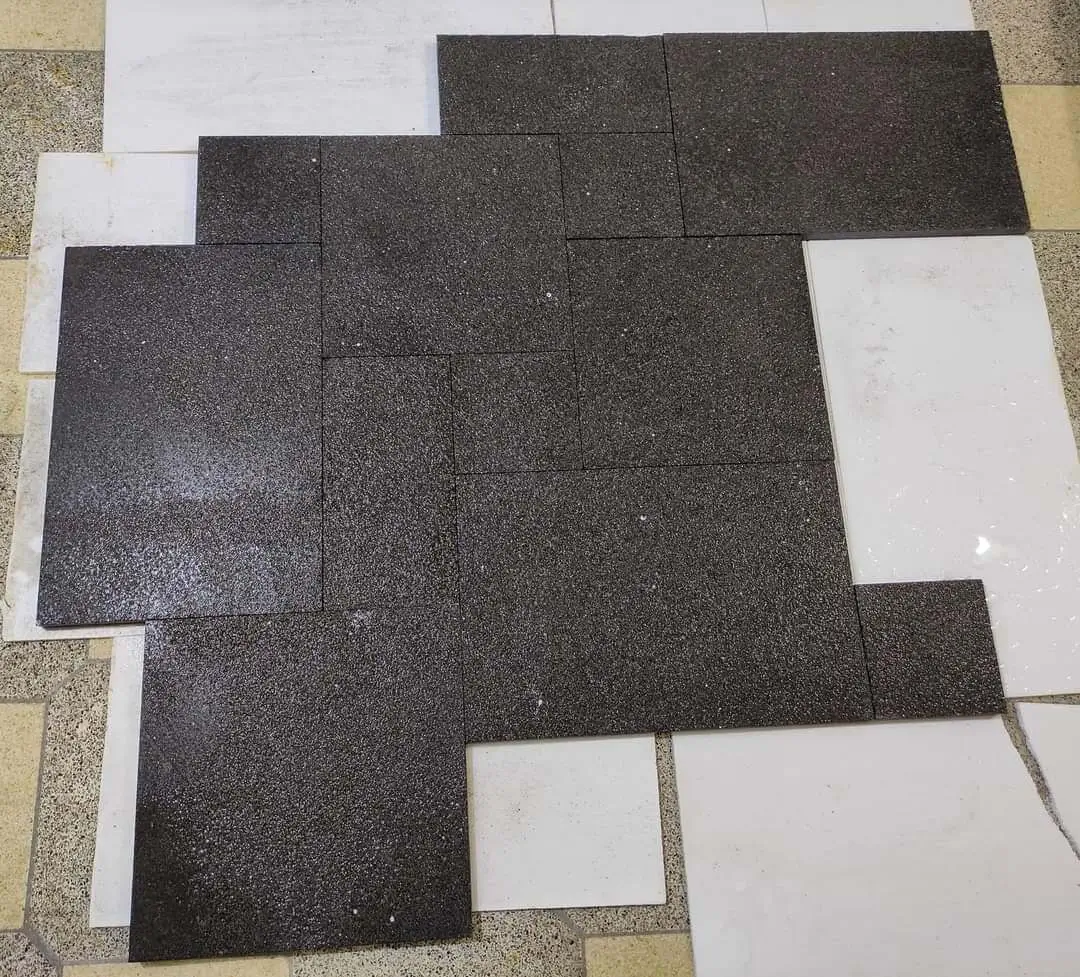
The crazy paving pattern gets underestimated — regularly treated as the beginner’s layout because it looks informal and accommodates irregular shapes. In practice, it’s one of the most demanding patterns to execute well. The challenge is achieving a cohesive joint width across units that vary in both plan shape and thickness. Aim for a joint width of 15–25mm throughout, and resist the temptation to force large units together to minimise cutting. The joints are what give a crazy paving pattern its structural integrity — narrow, inconsistent joints create weak planes that crack under differential settlement.
Explore our limestone cobblestone range for tumbled finish options that suit crazy paving arrangements particularly well — the rounded arris on tumbled units makes the irregular joint widths read as intentional rather than misaligned. Unit selection for crazy paving should favour pieces with at least two reasonably straight edges to give you anchor points for pattern assembly. Pieces that are entirely round or triangular are difficult to integrate without generating small, thin shims that crack within the first season.
Joint Sand, Grouting, and Sealing
Your jointing material choice interacts with your pattern selection in ways that aren’t always obvious at specification stage. Polymeric jointing sand works well with close-jointed herringbone and running bond layouts where joints are 5–10mm wide and consistent. For crazy paving pattern applications with wider, irregular joints, a semi-dry mortar mix (typically 4:1 sand-to-cement, dampened to a crumbly consistency) gives better control of joint depth and is less likely to bleed across the limestone surface during application.
- Apply jointing material in two passes — fill the lower two-thirds first, allow initial set, then top-dress to finish grade
- Avoid flushing limestone cobblestone surfaces with water during polymeric sand activation in temperatures above 35°C — the sand cures too rapidly and won’t achieve full hardness at depth
- Impregnating sealers should be applied after grouting cure (minimum 28 days for mortar joints) and reapplied every 3–5 years depending on traffic and UV exposure
- Sealing a crazy paving pattern requires attention to pooling in low-joint areas — apply sealer with a low-pressure roller rather than a brush to maintain even film thickness across varying surface levels
Material Ordering and Logistics
Limestone cobblestone paving patterns create specific ordering challenges that flat-slab projects don’t face. Because each pattern orientation generates a different waste factor, you can’t use a single coverage formula across your whole specification. Calculate cutting waste per zone — a herringbone field area, a radial feature zone, and a soldier-course border all have different waste percentages and need to be ordered as separate line items rather than blended into a single average.
Citadel Stone maintains national warehouse inventory across its limestone cobblestone range, which means your lead time is typically 1–2 weeks from confirmed order rather than the 6–8 week import window that affects direct-from-quarry purchasing. Confirm stock levels before your contractor mobilises — pattern-specific cutting requirements mean that arriving on site short of material mid-installation creates visible colour variation if a second batch arrives from a different quarry block. Truck delivery scheduling should also factor into your project plan: confirm site access dimensions and any weight restrictions on access roads before dispatch, since full pallets of 80–100mm limestone cobblestone run heavy.
According to the Britannica limestone entry, limestone’s sedimentary formation from calcium carbonate deposits creates natural colour variation between quarry blocks — a characteristic you should communicate to clients early, because it affects batch matching expectations across large pattern installations.
Before You Specify Limestone Cobblestone Paving Patterns
The decisions that determine long-term performance in limestone cobblestone paving patterns are made before a single unit is set. Pattern orientation, unit thickness, base depth, edge restraint specification, and jointing material selection all interact — get one wrong and the others can’t compensate. Match your pattern geometry to your load case, confirm your base depth against local code requirements, and specify unit thickness that genuinely suits the application rather than defaulting to the lightest stock option. As you plan your broader hardscape scope, related material decisions can sharpen your overall specification — how cobblestone compares to other natural stone covers the material trade-offs worth reviewing before you commit to limestone for every element of a complex project. For walkways demanding a more organic look, Citadel Stone offers limestone setts that adapt readily to crazy paving arrangements with minimal cutting waste.