

Choosing a river rock supplier is one of those decisions that looks straightforward until you’re standing on a job site with the wrong gradation, the wrong color consistency, and a delivery that arrived in loads too mixed to sort economically. The supplier vetting process matters far more than most project managers give it credit for — and the gaps between a competent supplier and a mediocre one show up fast once material hits the ground. This article walks you through a head-to-head evaluation framework so you can compare suppliers on the criteria that actually drive project outcomes.
What Supplier Evaluation Actually Means
Most buyers approach choosing a river rock supplier as a price comparison exercise. That’s a mistake. Price is the last variable you should lock in — not the first. The real comparison happens across sourcing consistency, size grading reliability, stock depth, and delivery logistics. A supplier who quotes 15% lower but ships mixed gradations will cost you more in labor and rework than you saved on material.
Start your evaluation by requesting a physical sample batch — not just a photo. River rock varies significantly by origin point, and the same “grey river rock” label can mean anything from a tightly distributed 2–4 inch cobble to a wild mix of colors and sizes that reads as grey only in aggregate. Your sample request tells you immediately how organized a supplier’s quality control actually is.
- Request a 20–30 piece sample minimum — small samples don’t reveal gradation consistency
- Check for color uniformity within stated size range, not just average appearance
- Weigh a sample batch and compare to the supplier’s stated tonnage per cubic yard — discrepancies reveal loose sourcing standards
- Ask where the material originates — riverbed, quarry wash, or recycled aggregate supply chains have meaningfully different consistency profiles
Grading Standards and Size Consistency
The single most common field complaint in river rock installation involves size inconsistency — and it’s almost always a supplier-side failure, not a spec-writing failure. You can write a tight specification calling for 3–5 inch rounded river cobble, but if your supplier doesn’t operate with mechanical screening equipment and documented grade tolerances, you’ll receive material that runs from 1.5 inches to 7 inches in the same load.
Mechanical screening gives you size-sorted material within defined tolerances, typically ±0.5 inches for standard decorative grades and ±0.25 inches for precision landscape and drainage applications. Hand-sorted material sounds appealing but rarely delivers at scale. Ask suppliers directly: “Is this material mechanically screened or hand-graded?” The answer changes your confidence level significantly.
- Mechanically screened river rock holds tighter tolerances and performs more predictably in drainage beds
- Oversized material in a drainage application creates void irregularities that compromise hydraulic conductivity
- Undersized material in decorative applications shifts and migrates under foot traffic or water flow
- Request the supplier’s stated tolerance range in writing before signing a purchase agreement
According to Natural Stone Institute stone variety specifications, consistent grading is a baseline quality indicator for any natural stone material — and the same principle applies directly to river rock sourced for commercial or residential projects. A supplier who can’t provide documented screening tolerances is operating without the quality controls your project depends on.
Evaluating Stock Depth and Warehouse Capacity
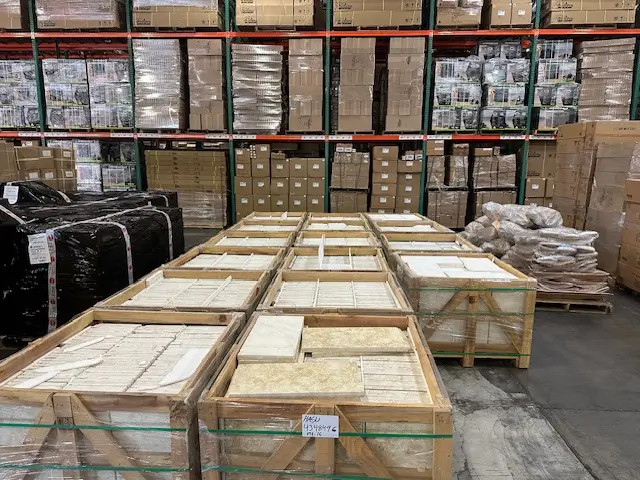
Stock depth is a dimension of supplier evaluation that buyers almost always underweight — until a project stalls mid-installation waiting on a resupply. Your supplier’s warehouse capacity directly affects your ability to stage material, maintain schedule, and avoid the cost of multiple mobilizations for the same scope of work.
A capable supplier maintains sufficient warehouse inventory to fulfill your full project quantity from a single pull, not across multiple shipments sourced from rotating supply lines. Rotating supply lines mean color lot variation — the second truckload of grey river rock won’t match the first if the supplier is pulling from different source batches. For decorative applications where visual consistency matters, this is a critical failure point. Ask the supplier: “Can you fulfill my full order quantity from a single source lot?” If the answer is uncertain, that’s a real risk signal.
- Confirm available warehouse stock before committing your project timeline
- Request source lot documentation for color-sensitive decorative applications
- Ask how quickly the supplier can replenish if your project requires phased delivery
- Understand lead times for specialty sizes — big river rocks in the 6–10 inch range typically require longer lead times than standard 1–3 inch decorative grades
Drainage Performance and Material Selection
River rock performs a functional role in most installations — drainage, erosion control, dry creek bed management — and the material’s performance in these applications is directly tied to the supplier’s ability to deliver correct gradation for your hydraulic design. Projects in high-rainfall zones, areas prone to seasonal flooding, or landscapes designed around stormwater detention require tighter gradation control than purely decorative applications.
For drainage bed applications, your specification should call for washed, single-size or narrow-range material. Unwashed river rock retains fine particles — sand and silt — that progressively clog void space in drainage layers, reducing hydraulic conductivity over time. A supplier who delivers washed, size-sorted material is giving you a drainage system that holds its performance for years. One who delivers field-run material without washing is giving you a drainage layer with a built-in failure mode.
- Washed river rock removes fine particles that reduce long-term drainage performance
- In monsoon or heavy-rainfall climates, drainage bed void stability is critical — oversized or undersized material compromises stormwater management capacity
- Dry creek bed designs using big river rocks in the 4–8 inch range require supplier confirmation of rounded, stable profile — angular material shifts under high-velocity water flow
- Drought-cycle landscapes using river rock as mulch substitute require UV-stable coloration — ask suppliers about color retention under prolonged sun exposure
The ASLA permeable surfaces guidance reinforces that material selection for drainage and stormwater management applications depends on consistent gradation and void ratio — both of which trace directly back to supplier quality controls. Reviewing that guidance alongside your supplier vetting process helps you frame the right technical questions before you commit to a material source.
You should also review our graded river rock range — washed and size-sorted inventory that meets the hydraulic and decorative performance requirements most landscape and drainage projects demand.
Delivery Logistics and Truck Access Planning
Your project’s truck access conditions shape the entire delivery conversation — and this is an area where supplier capability varies enormously. A supplier with a strong warehouse operation but limited delivery flexibility may not be able to reach your site with the load size and equipment type your project requires. Evaluate this before you need it, not the day before delivery.
Bulk river rock typically ships on flatbed or dump truck configurations. Standard deliveries run 20–25 ton loads, which require adequate site access, turning radius, and ground bearing capacity at the drop point. If your site has restricted access — narrow drives, weight-restricted roads, or overhead clearance issues — you need a supplier who can accommodate split loads or smaller truck configurations without significant cost penalties.
- Confirm maximum truck load size and whether split deliveries are available at reasonable cost
- Ask whether the supplier uses their own fleet or third-party freight — direct fleet control typically means better schedule reliability
- Understand the supplier’s delivery radius and whether your site falls within standard service range
- Clarify site access requirements the supplier needs from you in advance — ground conditions, overhead clearance, designated drop zones
At Citadel Stone, we coordinate truck delivery logistics nationally, which means your site conditions get factored into the delivery plan before the load departs — not discovered on arrival. That kind of upfront coordination prevents the costly rescheduling and restocking fees that catch buyers off guard when they’re working with less organized suppliers.

Evaluating Product Range and Specialty Availability
A supplier’s product range tells you how much sourcing infrastructure they actually have. Suppliers who carry only one or two standard gradations are typically reselling from a single quarry wash operation. Suppliers with a broad range — from fine pea gravel through medium decorative cobble to large-format landscape boulders — are maintaining more complex sourcing relationships and inventory systems. That operational depth usually correlates with better consistency and reliability across your project lifecycle.
For projects that mix decorative and functional river rock applications — a dry creek bed feeding into a drainage swale, for example — you want a supplier who can source multiple grades from consistent origins. Color harmony across sizes matters in visible landscape applications. Grey river rock in your 1–2 inch ground cover should visually match your 4–6 inch accent cobble, which only happens when both grades come from compatible source material.
- Ask whether different grades in your project scope can be sourced from the same quarry region for color harmony
- Verify that specialty sizes like big river rocks in the 6–12 inch range are in regular stock, not special-order only
- Check whether the supplier offers washed and unwashed variants — drainage applications need washed, decorative mulch applications may use either
- Confirm availability of round versus angular profiles — drainage and erosion applications typically specify rounded material for stability
According to USGS dimension stone production data, natural stone supply chains operate across a diverse range of quarry types and processing operations — and that diversity in the supply chain is exactly why evaluating your supplier’s sourcing depth matters as much as evaluating their listed product range.
Pricing Structure and Total Cost of Supply
Price per ton is the number buyers anchor on — but total cost of supply is the number that actually matters. Total cost includes material price, delivery, minimum order requirements, restocking fees, and the labor cost of dealing with inconsistent gradation. A supplier quoting $45/ton who delivers mixed loads requiring hand-sorting costs more than a supplier at $52/ton who delivers mechanically graded, ready-to-place material.
Minimum order thresholds deserve attention early in the evaluation. Many bulk river rock suppliers require 5–10 ton minimums for delivery, which may exceed your project’s needs or require you to stage excess material. Suppliers with warehouse flexibility to fulfill smaller pulls — particularly for phased installations — give you better project control than those locked into large minimum loads.
- Calculate total delivered cost per ton including freight, not just material price
- Factor labor cost of gradation sorting when comparing suppliers with different quality controls
- Understand restocking fees for returned or unused material — these can be 15–25% of material value
- Ask about volume pricing thresholds if your project scope allows you to optimize order quantity
- Clarify payment terms — net-30 versus payment-on-order affects your project cash flow meaningfully on large tonnage purchases
References, Documentation, and Supplier Accountability
The most revealing part of choosing a river rock supplier is the documentation conversation. A supplier with genuine quality systems can produce material specs, screening tolerances, wash certifications, and source origin documentation quickly. A supplier without those systems will deflect, generalize, or offer to send “something” later. Later usually means never.
Request project references specifically for applications similar to yours — drainage installations, decorative landscape projects, erosion control work. Speaking with a previous buyer who managed a similar project scope tells you more than any product sheet. Ask references directly about gradation consistency between deliveries, responsiveness to problems, and whether the material performed as specified over time.
- Request written gradation specifications and wash certification documentation before ordering
- Ask for 2–3 project references in similar application categories — not just general references
- Verify the supplier’s process for handling delivery disputes or material quality complaints
- Confirm whether the supplier provides a single point of contact for your project or routes you through a general order queue
Your Action Plan for Choosing a River Rock Supplier
Choosing a river rock supplier comes down to grading consistency, stock depth, delivery reliability, and honest documentation — in that order. Price matters, but it belongs at the end of your evaluation, not the beginning. Your project outcome is determined by whether the material arrives correctly sized, washed, and color-consistent — and that’s entirely a function of who you chose to source from and how carefully you vetted them before the first load shipped.
Start by requesting physical samples and written gradation tolerances from every supplier on your shortlist. Eliminate anyone who can’t produce documentation quickly. Then compare warehouse stock depth, delivery logistics, and total delivered cost. The supplier who survives that process is the one worth committing your project to. As you plan your project budget alongside your material sourcing decisions, river rock supplier pricing breakdown covers the cost variables worth understanding before you finalize your supplier agreement.
Stone for nationwide projects moves through Citadel Stone in washed, size-sorted loads suited to drainage and decorative use.
Related reading: choosing river rock suppliers · river rock suppliers · how to install river rock.