

What Base Preparation Actually Decides
Every paving stone driveway guide worth following starts with the same discipline: base depth determines whether an installation lasts five years or twenty-five. Your material selection, your pattern, your finish choice — none of it compensates for a base that moves. The compressive strength of natural stone pavers routinely exceeds 10,000 PSI, which means the stone itself almost never breaks down first. The base gives way, and the stone follows it.
Understanding how base dynamics interact with your specific soil type is the first discipline of a well-executed paving stone driveway project. Clay-heavy soils expand and contract with moisture cycling at rates that can shift a 4-inch aggregate base by half an inch over a single wet season. Granular or sandy soils drain faster but require deeper compaction lifts to achieve stable load distribution. Before your project reaches the material specification phase, a soil assessment should already be driving your base thickness decisions.
Material Families and Their Driveway Suitability
Natural stone pavers for driveways aren’t interchangeable — each material family performs differently under vehicle loads, freeze-thaw stress, and surface abrasion. Your selection should start with performance criteria, not aesthetics. The visual outcome follows from the right structural choice, not the other way around.
The four material families worth serious consideration for driveway use each carry distinct trade-offs:
- Granite pavers offer compressive strength in the 15,000–25,000 PSI range, extremely low water absorption (typically under 0.5%), and surface hardness that resists tire abrasion over decades — making them the performance benchmark for heavy-use driveways
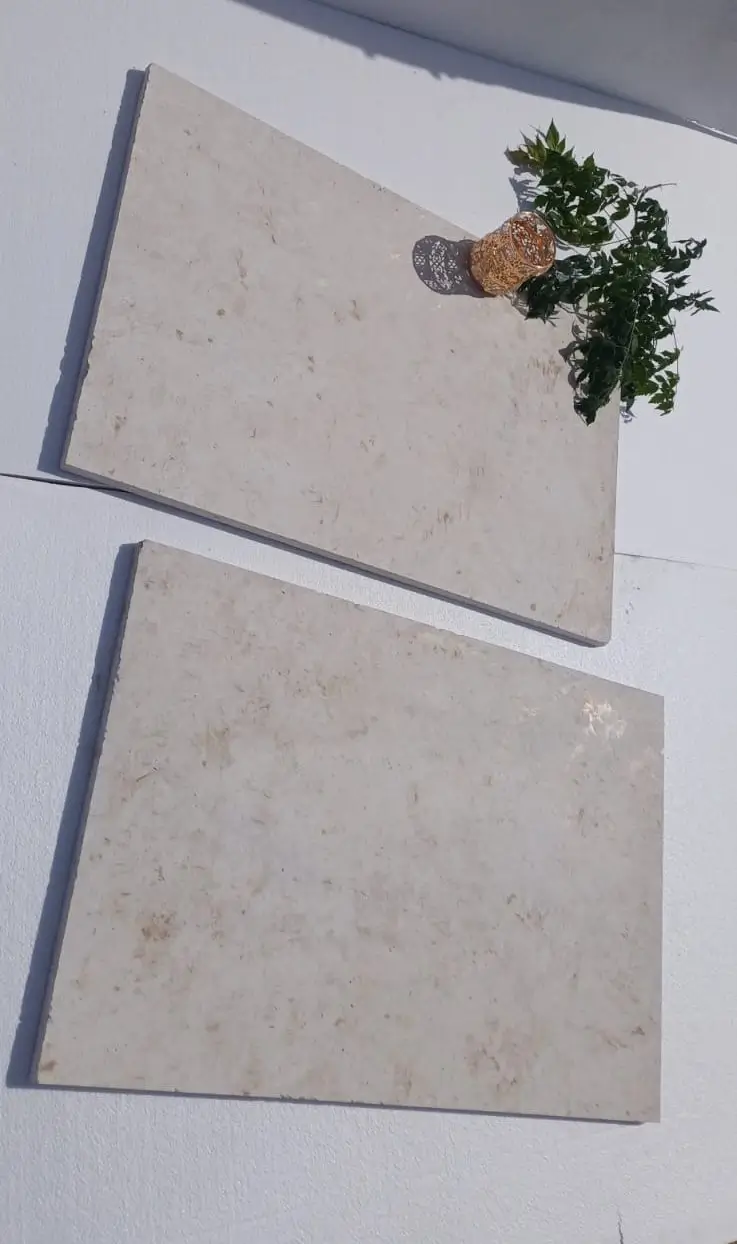
- Limestone pavers deliver 6,000–12,000 PSI compressive strength with moderate absorption rates; they require sealing in areas with heavy rainfall or road salt exposure but reward you with a warm, refined aesthetic that weathers attractively
- Basalt pavers combine volcanic density with a fine-grained surface that holds up under consistent vehicle traffic; honed finishes on basalt provide coefficient-of-friction values in the 0.6–0.8 range, appropriate for driveway grades up to 8%
- Cobblestone pavers — whether granite setts or tumbled limestone — distribute point loads across irregular bearing surfaces, making them naturally effective in freeze-thaw regions where rigid flat surfaces are more vulnerable to heave
According to Natural Stone Institute stone variety specifications, absorption rate is one of the most critical performance factors for exterior paving — lower absorption correlates directly with better freeze-thaw resilience and reduced staining susceptibility. Run that comparison across your shortlisted materials before finalizing your specification.
Stone Thickness and Load Capacity
Your driveway’s traffic profile determines minimum stone thickness more reliably than any aesthetic preference. Passenger vehicle driveways typically perform well with 2-inch nominal thickness pavers, but the calculation changes the moment you introduce heavier loads — delivery trucks, service vehicles, RVs, or heavy SUVs with tow ratings above 8,000 lbs.
For standard residential driveways carrying passenger vehicles and light trucks, the specification baseline looks like this:
- 2-inch (50mm) pavers on a 6–8 inch compacted aggregate base with a 1-inch bedding sand layer — adequate for passenger vehicles under 6,000 lbs gross weight
- 2.5-inch (60mm) pavers on an 8–10 inch base — appropriate for mixed use including light service vehicles and occasional heavy deliveries
- 3-inch (75mm) or greater pavers on a 10–12 inch base — required when regular truck access is part of the driveway’s function
- Edge restraints are non-negotiable at all thicknesses — they prevent lateral creep that undermines joint stability regardless of how well the interior field is compacted
A detail that often gets missed in residential specifications: the bedding sand layer must be non-compactable, screeded to a uniform 1-inch depth before stone placement. Pre-compacting the bedding sand eliminates the settlement allowance the layer is designed to provide. That single installation error accounts for a significant share of decorative stone driveways that develop surface irregularities within the first two winters.
Drainage Design and Water Management
Regardless of which natural stone you select, water management is the variable that separates a 10-year installation from a 25-year one. Your driveway surface needs a consistent cross-slope of 1–2% minimum to direct runoff toward collection points, swales, or perimeter drains. The slope sounds modest, but it’s the difference between water moving off your driveway and water infiltrating your base.
Drainage planning becomes more critical in regions that experience concentrated rainfall events — heavy summer monsoons, prolonged wet-season rainfall, or storm systems that deliver 3–5 inches in 24 hours. In those conditions, your driveway isn’t just handling steady percolation; it’s managing sheet flow volumes that an undersized drainage profile simply cannot process. The result is hydrostatic pressure building beneath the base, which accelerates base saturation, freeze-thaw susceptibility, and eventually surface deformation.
Two drainage strategies apply directly to decorative stone driveways:
- Permeable jointing systems — using open-graded aggregate in joints rather than polymeric sand — allow rainfall to percolate through the paver field and into a free-draining base, reducing surface runoff volumes significantly in moderate storm events
- Conventional impermeable jointing with surface drainage channels works better in high-traffic areas where joint stability under tire loading is the priority — polymeric sand maintains joint integrity but requires surface drainage infrastructure to compensate
- A French drain or linear channel drain at the driveway’s low point should be sized for your region’s 10-year storm event, not typical rainfall — undersizing this element is a chronic specification error in residential driveway projects
- In drought-cycle climates, expansive soils that dry out in summer and absorb rainfall rapidly in autumn create a specific sub-base saturation risk — your base depth should account for this moisture cycling, not just the peak rainfall event
The ASLA guidance on permeable paving materials provides detailed direction on how stone paving configurations interact with drainage performance — a reference worth reviewing during your drainage specification phase.
Surface Finish Selection for Driveways
The finish on your natural stone pavers affects slip resistance, maintenance frequency, staining susceptibility, and long-term appearance — and for driveways specifically, the finish decision intersects with safety in ways that indoor applications don’t require you to consider.
Honed finishes offer a flat, matte surface with consistent COF values in the 0.5–0.7 range when dry. They provide excellent traction for pedestrian use and manageable grip for vehicle tires. The trade-off is that honed surfaces are more porous at the surface layer, making sealing important in areas with oil exposure from vehicle drip or heavy rainfall carrying organic material.
Flamed or thermal finishes create a roughened surface texture through high-temperature treatment that opens the crystal structure of the stone. For granite pavers, flaming produces a COF above 0.8 in wet conditions — appropriate for driveways with grades above 5% where wet-surface traction becomes a functional requirement.
Tumbled finishes on limestone or cobblestone pavers create rounded edges and irregular surface texture that reads as naturally aged. The surface texture on tumbled stones provides inherent grip, but the irregular profile means cleaning requires more attention — debris collects in low points and joint sand migration is slightly higher than with flat-format pavers.
The Paving Stone Driveway Planning Sequence
A clear planning sequence prevents the specification errors that generate callbacks. Working through each phase in order produces reliable outcomes across driveway projects of every scale:
- Establish traffic loads first — identify the heaviest vehicle type that will regularly use the driveway, not just occasionally
- Assess soil conditions — determine whether you have clay, sand, or mixed-fill soils, and adjust base depth accordingly before selecting materials
- Set drainage parameters — calculate your driveway’s catchment area, determine the drainage outlet location, and size your edge or channel drains before laying out the paver field
- Select stone type based on performance criteria — compressive strength, absorption rate, freeze-thaw rating, and COF — then refine for aesthetics within the qualified material group
- Determine finish and format — thickness, surface treatment, and joint width based on application and traffic type
- Confirm material availability and lead times — warehouse stock levels at your supplier determine whether your project timeline is realistic or needs adjustment
- Plan pattern layout to minimize cuts at edges and manage pattern breaks at drainage structures
At Citadel Stone, we work through this sequence with specifiers and contractors before orders are placed — the goal is eliminating specification gaps that only become visible during installation, when correcting them is expensive.
Patterns, Formats, and Landscaping Stone Blocks
The pattern you choose for landscaping stone blocks on a driveway isn’t only aesthetic — it directly affects the structural performance of the paved surface. Running bond, herringbone, and basketweave patterns each distribute vehicle loads differently across the joint network, and some patterns are significantly more appropriate for driveway use than others.
Herringbone — specifically the 45-degree herringbone orientation relative to the driveway’s travel direction — is the performance benchmark for interlocking natural stone driveways. The diagonal orientation means no continuous joint line ever runs parallel to the direction of vehicle travel, which prevents the progressive joint widening that causes rutting in weaker pattern configurations. Field experience consistently shows herringbone installations maintaining joint stability 30–40% longer than running bond configurations under equivalent traffic loads.
Running bond is visually appealing and installs quickly, but its continuous joint lines parallel to the traffic direction create a structured failure path under repetitive load cycling. It’s acceptable for low-traffic residential applications where vehicles travel slowly and loads are light, but it isn’t the right choice for primary driveways with regular truck access.
Explore our paving stone driveway materials to review the format and thickness options available for each stone type — understanding the standard sizes before finalizing your pattern choice avoids layout complications during installation.
Joint Sand Selection and Edge Restraint
The joint system is where driveway paving stone installations most commonly underperform. Two products are responsible for joint integrity: the joint sand and the edge restraint. Both are frequently underspecified on residential projects, and both are capable of undermining an otherwise excellent material and base specification.
Polymeric sand — jointing sand treated with polymer binders that activate with water — is the standard for driveway applications. It resists washout from rainfall and surface irrigation, inhibits weed germination, and discourages ant and insect colonization in joints. Application requires dry conditions, correct joint depth (typically 1.5–2 inches from the surface), and thorough compaction of the paver field before filling. Polymer sand that’s applied over incompletely compacted pavers will crack at the surface as the field settles — the cracking pattern makes the installation look failed even when the structural performance is sound.
Edge restraints must be mechanically anchored into the aggregate base — not just placed against the edge pavers. Spike-anchored plastic restraint systems perform adequately for pedestrian areas but require closer spike spacing (every 12–18 inches rather than 24 inches) in driveway applications where lateral force from turning vehicles is a recurring load. For natural stone pavers installed against concrete borders or existing hardscape, the restraint function is inherent in the adjacent structure, but the transition joint still needs correct sand fill to prevent undermining.
Sealing and Long-Term Maintenance
Your maintenance protocol for a paving stone driveway depends primarily on the stone type, regional rainfall patterns, and the driveway’s exposure to vehicle fluids. A sealing schedule that works well for a dry-climate granite installation will be insufficient for a limestone driveway in a region with heavy, prolonged wet seasons.
The baseline maintenance schedule for sealed natural stone driveways breaks down as follows:
- Initial seal application 30–60 days after installation — this allows residual moisture from the base and bedding sand to dissipate before you lock surface porosity with a sealer coat
- Resealing every 2–3 years for limestone and softer natural stones in climates with significant rainfall or freeze-thaw cycling
- Resealing every 3–5 years for granite and basalt, which have lower inherent absorption rates and greater surface hardness
- Joint sand top-up every 3–4 years regardless of stone type — joint sand settles and erodes over time, and maintaining joint depth above 70% of nominal prevents weed establishment and joint creep
- Annual inspection of edge restraints and drainage channels — debris accumulation in linear drains is a common cause of localized ponding that accelerates base saturation
According to ASTM compressive strength standards for driveway paving stone, dimensional stone used in vehicular applications should be tested for both compressive strength and water absorption before specification — these two values together determine whether a stone will maintain performance under the combined stress of traffic loads and moisture cycling.
Ordering, Logistics, and Project Timeline
Natural stone driveway projects have longer material lead times than concrete or composite paving alternatives, and your project schedule needs to account for this realistically. Standard warehouse stock of popular formats — 12×12, 16×16, and 24×24 in granite and limestone — typically ships within 1–2 weeks. Custom sizes, specialty finishes, or less-common stone types may require 4–6 weeks from the point of order confirmation.
Your material quantity calculation should include a 10% overage on all cut units and a 7–8% overage on field units. Driveway projects generate more cuts than patio projects because of the linear run lengths and the need to work around drainage structures, curb connections, and garage aprons. Running short of material mid-installation is a significant problem with natural stone — batch variation means a second order may not match the color profile of your first delivery, even from the same quarry source.
Truck access to your site affects delivery scheduling more than most homeowners anticipate. A standard flatbed truck delivering palletized stone needs a clear turning radius of at least 40 feet and a travel path with overhead clearance of 13.5 feet minimum. Sites with narrow driveways, low-hanging trees, or limited street access may require smaller delivery vehicles, which affects per-unit delivery cost and the number of deliveries required to complete the order. Flag these access constraints when you place your order — it prevents scheduling delays on delivery day.
Citadel Stone maintains warehouse inventory of driveway paving stone across a range of formats and materials, which keeps lead times competitive and allows you to inspect material samples before committing to a full order volume.

Getting Your Paving Stone Driveway Specifications Right
A paving stone driveway guide is only as useful as the decisions it actually changes — and the decisions that matter most in driveway projects aren’t the ones most homeowners and even some contractors spend the most time on. Material aesthetics are the easy part. Base engineering, drainage geometry, thickness specification, and joint system selection are where long-term performance is won or lost.
Your specification checklist should cover soil assessment before base depth is committed, stone selection validated against compressive strength and absorption data, drainage profiled for your site’s worst-case rainfall scenario, and a maintenance schedule established before installation is complete. Projects that work through each of these systematically — rather than defaulting to whatever the last project used — consistently outperform on longevity.
As you plan the broader hardscape context around your driveway, complementary stone applications on your property can inform your material palette decisions. natural stone patio design ideas explores how Citadel Stone materials perform in connected outdoor living spaces, offering useful context for specifiers working across multiple zones of a single property. Base depth, drainage slope, and stone thickness all affect driveway longevity, and Citadel Stone provides technical data sheets to support installers during the planning phase.
Related reading: natural stone landscaping · landscape stones prices · stone landscape edging installation.