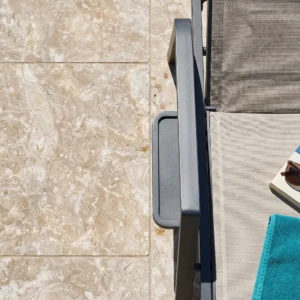
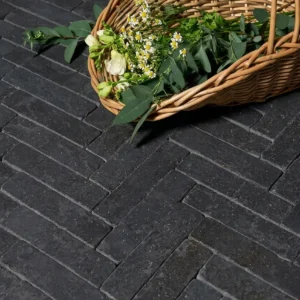
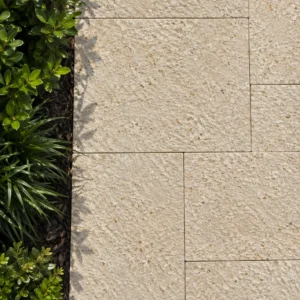
What Flagstone Pavers Actually Are
Flagstone pavers are split or sawn slabs of sedimentary or metamorphic rock — typically sandstone, limestone, slate, or quartzite — selected specifically because they cleave into relatively flat, workable pieces that can bear surface loads without engineered composite construction. The term “flagstone” doesn’t describe a single mineral; it describes a formation behavior. Rocks that naturally separate along bedding planes produce the thin, wide slabs that have surfaced walkways, patios, and public plazas for centuries. That geological characteristic — not color, not hardness, not origin — is what separates a true flagstone paver from a cut block or a manufactured concrete unit. Understanding flagstone paver material characteristics at this foundational level is what drives better specification decisions.
Your project’s performance over time depends on understanding that distinction. Flagstone paver stone types and material characteristics vary significantly between species: a dense quartzite carries compressive loads differently than a porous sedimentary sandstone, and their tolerance for freeze-thaw cycling, point loading, and base movement reflects those underlying mineralogical differences. Choosing the right material starts with knowing what category of rock you’re actually working with.
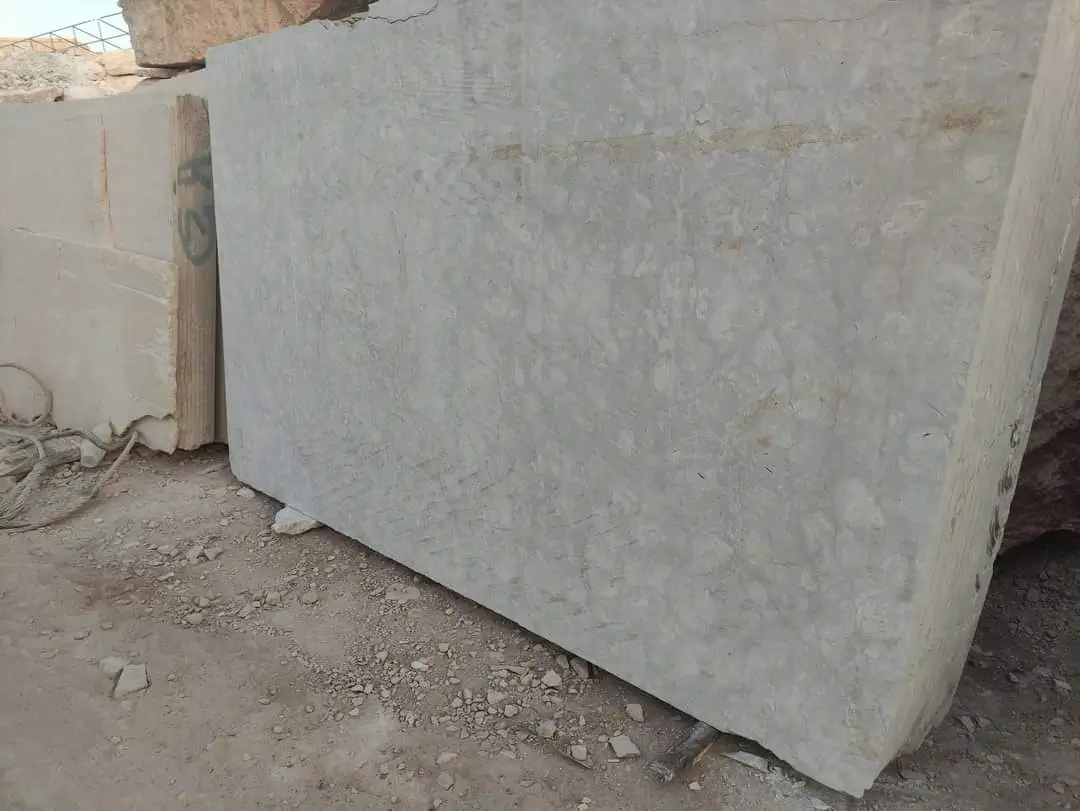
Flagstone Rock Types and Their Structural Properties
The four primary rock families used as flagstone pavers each bring distinct structural signatures to a project. Understanding the types of natural flagstone stone isn’t academic — it directly affects base design, thickness specification, and long-term maintenance commitment.
- Sandstone: A sedimentary rock with compressive strength typically ranging from 5,000 to 15,000 PSI depending on grain cementation. It cleaves easily, produces irregular shapes well, and offers excellent aesthetic warmth — but its open grain structure means higher water absorption rates, which matters considerably in freeze-thaw regions.
- Limestone flagstone: Dense limestone can exceed 12,000 PSI compressive strength and offers moderate to low absorption. It’s one of the most dimensionally stable options for large-format irregular paving. Softer varieties, however, show surface wear under high foot traffic and acid exposure.
- Slate: A metamorphic rock that cleaves along very consistent planes, producing some of the most uniform thickness of any natural flagstone. Compressive strength ranges from 10,000 to 20,000 PSI. Slate’s laminar structure is its strength and its vulnerability — delamination along cleavage planes is possible if installed in a mortar bed that doesn’t allow even stress distribution.
- Quartzite: The hardest common flagstone paver, with compressive strengths often exceeding 20,000 PSI. Formed from sandstone under heat and pressure, quartzite is extremely dense, low-absorption, and highly resistant to chemical attack. Its hardness also means it’s less forgiving during cutting and shaping.
According to flagstone sedimentary rock characteristics and paving use, the geological splitting behavior along stratification planes is the defining characteristic that makes certain rocks suitable for flat paving applications — and that behavior is precisely what installers depend on when specifying irregular-cut flagstone for complex surface geometries.
How Flagstone Differs from Other Pavers
Here’s what most specifiers miss when comparing flagstone to concrete or brick alternatives: the performance gap isn’t just aesthetic — it’s structural and behavioral. Manufactured concrete pavers are engineered to uniform dimensions, uniform strength, and predictable absorption values. Flagstone is a natural material, which means your specification must account for inherent variability across a single shipment.
How flagstone differs from other pavers becomes most apparent in three specific areas. First, dimensional variation: flagstone thickness can range 20–35% within a single pallet, requiring base preparation that accommodates that variation — typically a screeded sand bed or a mortar setting bed with adjustable depth. Concrete unit pavers are dimensionally consistent to ±1/16 inch and assume a consistent base depth. Second, load distribution: manufactured pavers derive structural capacity from their engineered cross-section. Flagstone derives capacity from its mineral density and thickness — a thinner piece of the same stone carries meaningfully less load. Third, thermal response: natural stone expands at rates governed by its mineralogy. Sandstone expands at roughly 6.0 × 10⁻⁶ per °F; quartzite at approximately 5.5 × 10⁻⁶ per °F. Concrete pavers are formulated to manage expansion through admixtures — natural flagstone requires physical joint spacing to accommodate thermal movement.
The USGS flagstone and dimension stone paving data confirms that natural dimension stone for paving continues to be classified separately from manufactured masonry precisely because its structural behavior requires different design assumptions — a distinction your project specifications need to reflect explicitly.
Building Code Requirements and Structural Specifications
Code compliance for flagstone paver installations is where many residential and commercial projects encounter their first serious challenges. Jurisdictions apply varying requirements based on load classification, base depth mandates, and whether the installation is classified as a structural surface or an incidental landscape feature. Treat these distinctions seriously — misclassifying a flagstone installation can create liability exposure and trigger costly remediation orders.
The International Building Code (IBC) and its residential counterpart (IRC) address exterior stone paving through several intersecting sections. Load-bearing requirements for pedestrian surfaces typically mandate a minimum compressive strength of 2,500 PSI at the subbase level — and flagstone specifications should be checked against IBC Section 1804 (soil investigation) and Section 1901 (concrete and masonry material standards) to confirm that your base design meets the applicable load class. For vehicular flagstone applications, the load requirements escalate significantly, and base depth minimums often increase to 8–12 inches of compacted aggregate depending on soil type and applicable frost line depth.
- Frost line depth: In colder regions, the frost line can reach 36–48 inches, requiring base materials to extend below that depth or employing insulating drainage strategies that prevent heave from disturbing the stone surface.
- Edge restraint: Most jurisdictions that adopt IBC or local equivalents require positive edge restraint for loose-set flagstone installations — typically a concrete border or a steel restraint system capable of resisting lateral movement under cyclic thermal loading.
- Minimum thickness for structural flagstone: The generally accepted minimum for pedestrian-load flagstone is 1.5 inches nominal thickness; vehicular applications typically require 2.5 inches or greater depending on stone density and span between support points.
- Seismic considerations: In high-seismic zones (ASCE 7 Seismic Design Categories D, E, F), rigid mortar-set flagstone installations require movement joints at code-specified intervals to prevent mass cracking during lateral ground movement.
Your local building department is the authoritative source on frost depth, soil classification, and whether a permit is required for your flagstone installation. Don’t assume residential landscape paving is exempt — many jurisdictions now require permits for any paved surface exceeding a specified square footage threshold, and inspections verify base depth and material compliance.
Flagstone Paver Material Overview: Thickness and Finish
A solid flagstone paver material overview has to address the relationship between finish type and structural performance — because those two variables interact in ways that directly affect your specification decisions.
Thickness drives structural capacity. For pedestrian-only pathways with a compacted aggregate base, 1–1.5 inch flagstone is generally adequate for most stone types with compressive strength above 8,000 PSI. Pool surrounds and patios with occasional point loading (furniture legs, patio equipment) should specify 1.5–2 inch minimum. For driveway or mixed vehicular-pedestrian applications, 2.5–3 inch flagstone on a properly engineered base provides the necessary load distribution. The important nuance: these thicknesses assume proper mid-span support — when you’re setting irregular flagstone with unsupported spans exceeding 18 inches between contact points in a sand bed, even thick pieces can develop stress fractures over time.
- Natural cleft (split face): The most common finish for flagstone pavers — the natural fracture plane. It leaves an open, textured face, and that texture is what governs performance underfoot; wet DCOF test reports are available for the finishes specified on accessible routes. Surface texture variation is high.
- Thermal finish: A flame-applied texture that opens the grain slightly for additional traction. Particularly useful for limestone flagstone in wet environments where a natural cleft surface may become smooth with foot traffic over time.
- Sawn and honed: Produces a flatter, more consistent surface — better for mortar-bed formal installations. SCOF values in wet conditions can drop to 0.40–0.50, which requires careful application context evaluation.
- Tumbled edges: Common in smaller format flagstone pavers, tumbling rounds edges and softens the surface slightly. Primarily aesthetic, but it does reduce edge chipping risk during delivery and installation handling.
The ASLA natural stone and flagstone outdoor paving guidance reinforces that finish selection should be evaluated alongside drainage design — permeable surface textures that allow water infiltration reduce runoff loads and often simplify local stormwater compliance requirements, particularly on larger flagstone installations.
Base Preparation: The Variable That Determines Longevity
The stone itself rarely fails first — the base does. Base preparation for flagstone paving is where most installation failures originate, and the detail that most separates a 10-year installation from a 25-year one is whether the base was engineered for the actual soil conditions beneath it, not just the surface load above it.
Start your base design with a soil assessment. Expansive clay soils can move 1–2 inches vertically through a seasonal moisture cycle — that movement is sufficient to crack a rigid mortar-set flagstone installation without any freeze-thaw involvement at all. For clay-heavy soils, a geotextile separation layer between the native soil and the compacted aggregate base is not optional — it’s the detail that keeps the base from infiltrating downward and losing bearing capacity over time.
- Compacted aggregate base depth for pedestrian flagstone: Minimum 4 inches over stable, non-expansive soil; 6–8 inches over moderate clay content; 10–12 inches where frost depth or expansive soil demands greater isolation.
- Setting bed for sand-set: 1 inch of coarse concrete sand (not mason sand — grain size matters here) screeded to a consistent depth. Fine mason sand migrates under cyclic load; coarser gradations resist displacement better.
- Setting bed for mortar-set: 3/4 to 1.5 inch mortar bed, polymer-modified for flexibility. In installations subject to thermal cycling, polymer modification is the specification decision that prevents the mortar bed from becoming a rigid failure plane.
- Drainage slope: 1/8 inch per foot minimum away from structures. Surface water that pools beneath flagstone joints accelerates base saturation and, in freeze-thaw regions, dramatically increases heave risk.
Reviewing the flagstone materials sourced by Citadel Stone gives you a practical reference point for thickness ranges and material density data when you’re calculating base depth requirements for specific stone selections.
Flagstone Paving Stone Characteristics and Performance Factors
Flagstone paving stone characteristics that affect long-term performance go beyond compressive strength. Water absorption rate, thermal mass behavior, and surface chemistry all influence how a specific stone species performs in your application context. These are the flagstone paving stone characteristics that separate an appropriate specification from a costly one.
Water absorption is expressed as a percentage of weight gain after saturation. For exterior paving, a maximum absorption of 3–5% is the target for installations in freeze-thaw regions; limestone flagstone that absorbs above 7% in saturated conditions will experience surface spalling as absorbed water expands during freezing. Quartzite and dense slate typically fall below 1% absorption, making them the preferred specification in harsh freeze-thaw regions. Sandstone varies widely — from 3% in silica-cemented varieties to over 12% in softer, carbonate-cemented types.
Thermal mass is a flagstone paving stone characteristic that creates real installation implications most homeowners don’t anticipate. Dense stone like quartzite or dense limestone absorbs and holds heat during daylight, releasing it slowly after sunset. In hot, dry climates, flagstone surfaces can retain significant warmth well into the evening hours — a relevant consideration for barefoot use on patios and pool surrounds. Lighter, more porous sandstone has lower thermal mass and cools more quickly after sun exposure.
- Surface hardness (Mohs scale): Quartzite 7+, sandstone 6–7, limestone 3–4, slate 3–4. Softer flagstone types show surface wear under heavy foot traffic within 10–15 years; harder types maintain finish integrity for 25+ years with appropriate maintenance.
- Chemical resistance: Limestone and marble-veined flagstones are calcareous — they react with acid, including diluted cleaning agents and acid rain. Avoid using acid-based cleaners on any calcareous flagstone, and seal regularly to reduce acid exposure at the surface.
- Joint spacing and movement: Irregular flagstone installations should maintain minimum 3/8 inch joints in sand-set applications to accommodate thermal movement without creating stress concentration points at stone edges.
Ordering, Logistics, and Project Planning
Your project timeline depends on understanding how flagstone moves through the supply chain. Unlike manufactured concrete pavers — which are produced domestically on short lead cycles — natural flagstone is typically quarried, processed, and shipped in bulk. Warehouse stock levels at your supplier determine whether your project starts on schedule or sits waiting for a material delivery.
Citadel Stone maintains national warehouse inventory across multiple flagstone varieties, which typically means available lead times of 1–2 weeks for in-stock material rather than the 6–10 week cycle you’d face ordering direct import. Before committing project timelines to contractors, verify current warehouse availability on the specific stone species and thickness you’ve specified — availability varies by material and season.
Truck delivery logistics also require advance planning. Flagstone ships on pallets typically ranging from 900 to 1,400 pounds per pallet. Your delivery site needs adequate truck access — a standard flatbed or liftgate truck requires a firm surface capable of supporting the loaded vehicle weight, typically 40,000–60,000 pounds gross, and sufficient clearance for a forklift or pallet jack to position material close to the installation area. Factor in that flagstone cannot be unloaded by hand for most full-pallet orders — equipment access at delivery is a project planning constraint, not an afterthought.
- Order quantity: Add 10–15% overage to your calculated square footage for flagstone. Irregular cuts, fitting losses, and the inevitable breakage during handling and installation will consume that buffer. Ordering too close to exact coverage creates the risk of material shortfall mid-project when reorder lead times can delay completion by weeks.
- Staging: Flagstone pallets should be staged on a firm, level surface — not directly on soft ground. Uneven staging causes pallet lean and increases breakage risk from stone shifting during storage.
- Moisture acclimation: Flagstone delivered from a cold warehouse to a warm installation environment may carry residual moisture. Allow adequate time for acclimation before cutting to reduce the risk of stress fractures during the cut.
Sealing, Maintenance, and Long-Term Performance
The sealing decision for flagstone pavers is where many installers take the wrong shortcut — and where the difference between a 15-year and a 30-year installation gets decided. Sealing isn’t universal for all flagstone types, and applying the wrong sealer to the wrong stone creates problems that are expensive to correct.
Penetrating sealers (silane-siloxane chemistry) are the correct specification for most exterior flagstone applications. They penetrate the stone matrix, reduce water absorption, and preserve the natural surface appearance without creating a film layer that traps moisture beneath it. Film-forming acrylic sealers can work indoors but create a maintenance trap outdoors — they degrade under UV exposure, create surface sheen that changes the natural look, and require complete removal before reapplication. On exterior flagstone pavers, you’ll fight that maintenance cycle indefinitely.
- Resealing schedule: Penetrating sealers on exterior flagstone typically require reapplication every 2–4 years depending on foot traffic and UV exposure. Conducting a simple water bead test annually tells you when absorption has increased past the effective threshold — water that soaks in rather than beading indicates it’s time to reseal.
- Cleaning: pH-neutral cleaners only on calcareous flagstone (limestone, some sandstone). Quartzite and slate tolerate mild acidic cleaners, but pH-neutral products remain the safest universal choice across all flagstone types.
- Joint maintenance: Sand-set flagstone requires periodic joint sand replenishment. Polymeric sand in joints extends the interval between maintenance by resisting ant activity and water wash-out, but standard concrete sand performs well when replenished every 2–3 years.
- Efflorescence management: White mineral deposits on flagstone surfaces are common in the first 12–18 months after installation, particularly in mortar-set applications. They’re cosmetic, not structural, and typically reduce with time and weathering. Diluted white vinegar addresses minor efflorescence on non-calcareous stone; specialized efflorescence removers are required for limestone and calcareous types.
Professional Summary
Flagstone pavers succeed or fail based on decisions made well before the first stone is placed. Material selection must account for compressive strength, absorption rate, and finish characteristics relative to the actual load conditions and exposure your installation will face — not just aesthetic preference. Base preparation must address what’s beneath the surface: soil type, applicable frost depth, drainage geometry, and the mechanical behavior of your specific stone species under cyclic loading.
Code compliance deserves serious attention from the earliest planning stage. Base depth, edge restraint, material thickness, and movement joint spacing all have code touchpoints that vary by jurisdiction and load classification. Treating flagstone as a purely landscape element — outside code scrutiny — is an assumption that creates liability exposure and remediation risk. At Citadel Stone, we provide technical guidance on material selection and thickness requirements to help your project meet structural performance standards from the specification stage forward.
For project inspiration that builds on sound material selection, flagstone landscaping ideas and design applications covers how different flagstone types perform across a range of residential and commercial settings. Across every project type — walkways, patios, pool surrounds, or driveways — the structural fundamentals covered here determine whether your flagstone installation performs at its full potential for decades. Understanding how flagstone differs structurally from manufactured pavers helps buyers make informed choices, and Citadel Stone’s product range reflects that material diversity clearly.