
Arizona’s monsoon season rewrites the rules for every outdoor paving decision you make. The paver block vs stone tile Arizona debate shifts dramatically once you account for how water moves — or doesn’t — across your surface during those intense summer storms that can dump two inches of rain in under an hour. Drainage geometry, surface permeability, and base saturation resistance aren’t secondary considerations here; they’re the variables that determine whether your installation is still performing cleanly in year fifteen or showing settlement cracks and joint washout by year five.
How Arizona’s Water Patterns Drive Material Selection
Most people assume the desert means drainage is easy — the ground just absorbs it all. That’s one of the more costly misconceptions you’ll encounter in Arizona paving. Caliche layers, which are calcium carbonate hardpan formations common throughout the state, create near-impermeable sub-base conditions that can trap water directly beneath your installation. The monsoon delivers moisture fast and furiously, and if your paver system can’t move that water laterally and away before the caliche layer reflects it back upward, you get hydrostatic pressure building right at the bedding plane.
Your drainage design needs to front-run this. A 1.5% to 2% cross-slope isn’t a guideline here — it’s a structural requirement. Projects in Yuma, which receives most of its modest annual rainfall in intense monsoon bursts between July and September, show particular vulnerability to flash ponding when installers spec the slope at the same 1% they’d use in a temperate climate. The water has nowhere to drain slowly — it arrives fast and demands an equally fast exit path.
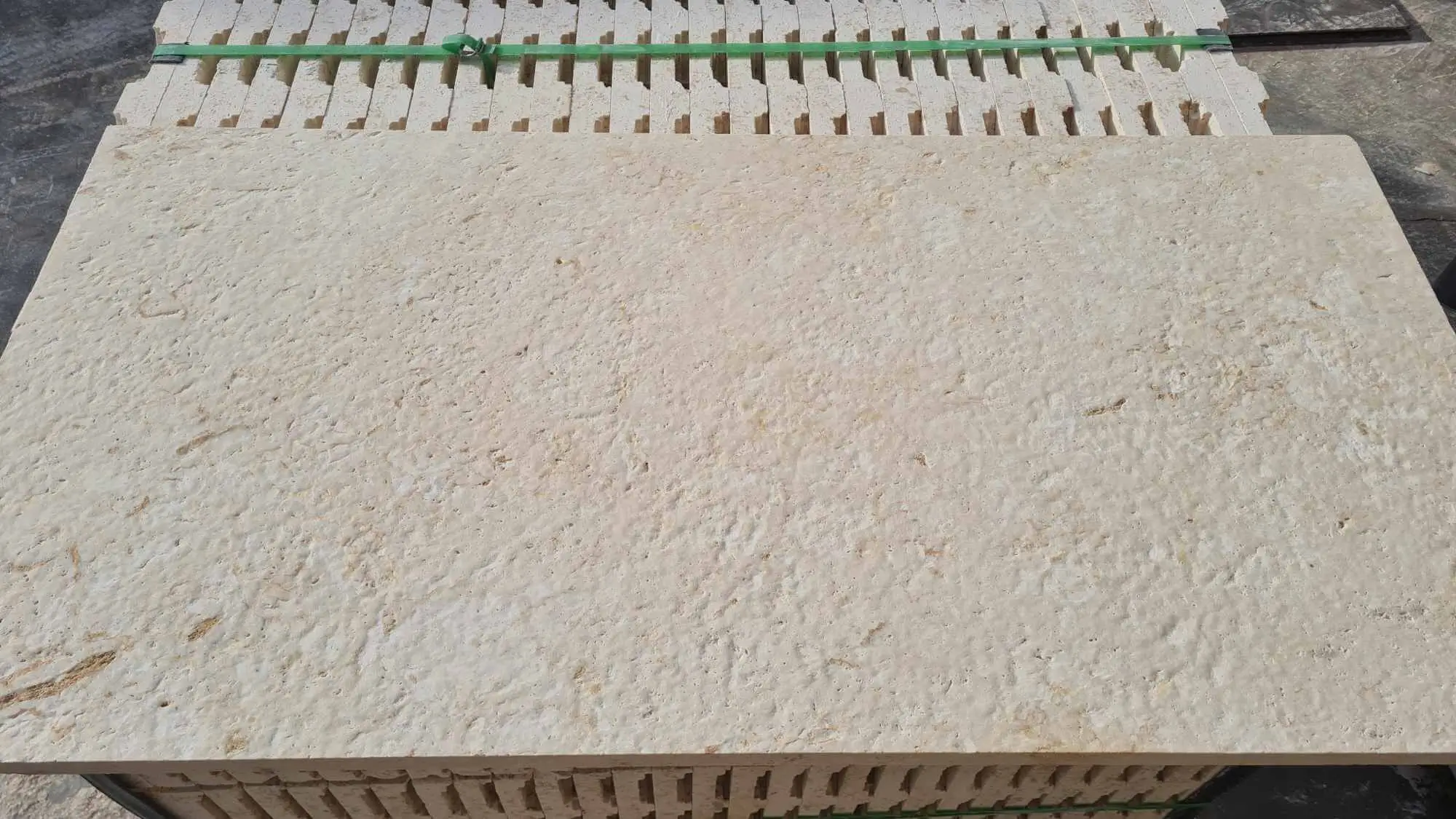
Paver Block vs Stone Tile Arizona: Drainage Performance in Desert Conditions
Manufactured concrete paver blocks offer a drainage advantage that often goes underappreciated: the joint system. Standard 3mm to 5mm joints filled with polymeric sand create a distributed drainage network across the entire surface. During heavy monsoon rainfall, that network lets water infiltrate through joints rather than channeling it entirely to perimeter edges. The result is a lower peak flow rate at collection points, which reduces erosion risk at transitions to lawn, gravel, or planting beds.
That said, concrete versus natural stone pavers in Arizona reveals a critical trade-off with paver blocks: polymeric sand joint material degrades under extended UV exposure and thermal cycling. Arizona’s combination of 300+ sun days annually and monsoon-driven moisture cycling is genuinely hard on joint compounds. You should plan for joint material inspection every two to three years and targeted replenishment on any section showing sand loss greater than 25% of joint depth. Once the joint opens up, weed infiltration and further erosion accelerate quickly.
- Standard 3mm–5mm joints provide distributed surface drainage during monsoon events
- Polymeric sand requires inspection every 2–3 years under Arizona UV and moisture cycling
- Concrete paver blocks maintain dimensional stability across wet-dry cycles better than lower-density alternatives
- Permeable paver block systems can achieve infiltration rates above 100 inches per hour in clean installations, reducing surface runoff significantly
- Base depth under paver blocks should increase to 8–10 inches of compacted aggregate in caliche-heavy soils to compensate for the impermeable sub-layer beneath
Natural Stone Tile and Moisture Management
The manufactured paver block options across Arizona dominate commercial projects for good logistical reasons — consistent thickness, predictable absorption rates, and faster truck delivery from regional supply points. But natural stone tile brings a moisture management characteristic that concrete simply can’t replicate: interconnected pore structures that allow vapor transmission through the material itself, not just around it.
Travertine and certain limestone varieties used as stone tile have open porosity ratings in the 8–15% range. That porosity means the tile body can absorb modest amounts of surface water and release it slowly through evaporation — which in Arizona’s low-humidity environment happens quickly. The practical effect is reduced surface ponding during light rainfall events. However, this same porosity becomes a liability if the stone tile is installed over a setting bed that traps water. A non-permeable tile adhesive over a concrete substrate with no drainage mat creates a situation where monsoon moisture enters the stone from above, can’t exit downward, and instead migrates laterally — eventually manifesting as efflorescence, tile lifting, or grout joint cracking.
- Natural stone tile porosity (8–15% for travertine) allows vapor transmission that concrete blocks cannot match
- Drainage mat membranes between setting bed and stone tile are not optional in Arizona — they’re essential waterproofing infrastructure
- Sealed stone tile surfaces shed water efficiently, but sealant must be reapplied every 2–3 years to maintain that performance
- Heat-resistant paver tiles AZ homeowners trust most share one characteristic: they’re installed over a properly drained substrate, not just a solid slab
- Avoid setting natural stone tile directly over cracked concrete without addressing those cracks first — monsoon moisture exploits every hairline fracture beneath the tile
Base Preparation: Where Both Materials Win or Lose
Here’s what most specifiers get wrong about the paver block vs stone tile Arizona decision: they treat material selection as the primary variable when base preparation is actually more deterministic for long-term performance. Both materials can fail if you don’t account for Arizona’s soil behavior under wet-dry cycling.
Projects in Mesa frequently encounter expansive clay beneath the caliche layer — soil that swells measurably during monsoon moisture infiltration and contracts again during the dry season. That movement translates directly to surface deformation unless your aggregate base is deep enough and well-graded enough to buffer it. For paver blocks, 8 inches of compacted aggregate base (Class II, ¾-inch minus) over geotextile fabric is a reliable minimum in clay-influenced soils. For stone tile installations, you’re looking at a concrete slab substrate with a minimum 4-inch thickness, proper control joints at 8–10 foot intervals, and either a drainage mat or slope-to-drain configuration built into the slab design.
- Expansive clay soils require deeper aggregate bases — don’t accept a 4-inch base specification for paver blocks in Mesa or Phoenix clay zones
- Geotextile fabric beneath aggregate prevents fine soil particles from migrating upward into your base during monsoon saturation events
- Concrete slab substrates for stone tile need control joints designed before pour — retrofitting control joint cuts after cracking appears is expensive and often inadequate
- Both systems benefit from perforated pipe drainage integrated at the base layer in low-slope applications
- Excavation depth for either system should probe below caliche to assess what’s beneath — sometimes that caliche is your best sub-base, sometimes it’s hiding soft material
Thermal Performance as a Supporting Factor
Temperature matters in Arizona — nobody’s pretending otherwise. But it’s the second variable, not the first, and understanding how it interacts with your drainage design is where the nuance lives. Concrete paver blocks absorb and retain heat at higher rates than most natural stone tiles. Surface temperatures on dark concrete blocks can exceed ambient air temperature by 40–60°F during peak afternoon exposure. That thermal mass doesn’t just affect comfort — it affects the moisture cycling you’ve designed around.
High-surface-temperature materials drive faster evaporation, which sounds beneficial for drainage but actually accelerates efflorescence. As water wicks upward through permeable materials under heat-driven evaporation, it carries dissolved salts toward the surface. White mineral deposits appear on concrete blocks within two to three years in high-traffic areas where residual moisture frequently contacts the surface. Natural stone tiles with lower thermal mass don’t drive this evaporation cycle as aggressively, which is one practical reason the Arizona outdoor paver block material comparison often tilts toward natural stone in applications where aesthetics matter long-term. When concrete versus natural stone pavers in Arizona comes down to surface comfort and long-term appearance, lower thermal mass is a meaningful differentiator.
High-Desert Conditions and Architectural Context
The red rock country surrounding Sedona introduces a precipitation pattern that differs meaningfully from the low-desert monsoon experience. Elevation ranges from roughly 4,000 to 4,500 feet, which brings both increased annual rainfall and occasional winter freeze events. Stone tile specifications for this zone need to address freeze-thaw cycling alongside the monsoon drainage demands you’d address anywhere in Arizona. Travertine with absorption rates above 12% is not the right call here — denser stone with absorption below 6% minimizes freeze-thaw spalling risk.
Paver block specifications in high-desert zones like Sedona should confirm freeze-thaw durability ratings per ASTM C1645. Not every concrete paver block on the market is rated for freeze-thaw exposure — this is a specification detail that gets missed when contractors pull standard Phoenix-area specs and apply them directly to higher-elevation projects. Verifying warehouse stock that carries freeze-thaw certified paver blocks before finalizing your supplier saves significant rescheduling headache if you discover the issue mid-project.
Cost, Lead Times, and Logistics
The practical reality of the paver block vs stone tile Arizona comparison includes a logistics dimension that specifications alone don’t capture. Manufactured paver block options across Arizona move through the supply chain faster when sourced from regional producers — truck delivery from Arizona-based production facilities typically runs 5–10 business days for stock profiles. Natural stone tiles sourced from domestic or international quarries can carry lead times of 4–8 weeks depending on the specific material and whether your order quantity justifies a dedicated run.
For large commercial projects, that lead time difference can impact your critical path meaningfully. Build stone tile procurement into your schedule at least six weeks ahead of installation start, with a warehouse confirmation of available stock before base preparation begins. Running ahead of schedule on base work only to wait three weeks for stone tile delivery creates real carrying costs. At Citadel Stone, we recommend confirming material availability before finalizing installation contracts — this is where projects run into trouble most often, and a quick warehouse verification call prevents it entirely.
Cost comparisons between the two systems are more nuanced than raw material pricing suggests. For Citadel Stone stone tile options Arizona, the installed cost difference between paver blocks and natural stone tiles narrows considerably when you account for the additional setting materials, drainage mat components, and skilled labor that stone tile requires. Paver blocks are more forgiving of installers with moderate experience; natural stone tile over a proper substrate system demands tighter craftsmanship tolerances.
- Paver block truck lead times: 5–10 business days for standard profiles from regional facilities
- Natural stone tile lead times: 4–8 weeks depending on material and order volume
- Installed cost gap between systems narrows when drainage mat, setting materials, and skilled labor are factored in
- Replacement cost for failed stone tile installations — particularly those lacking proper drainage — typically exceeds the cost of doing it right the first time by 30–50%
Joint Sealing and Long-Term Maintenance
Maintenance program design differs significantly depending on which system you choose, and Arizona’s climate accelerates every maintenance interval relative to temperate-zone expectations. Paver block systems require joint sand monitoring as the primary maintenance task — monsoon season is particularly aggressive at washing polymeric sand from joints in any area that experiences concentrated runoff. Areas at downslope transitions or where gutters discharge onto paver surfaces will show joint loss faster than field areas.
Stone tile maintenance centers on sealant integrity. A quality penetrating sealer applied at installation should be tested annually with the simple water-bead check — pour a small amount of water on the tile surface. If it beads, protection is intact. If it absorbs within 30 seconds, resealing is needed. Arizona’s UV intensity degrades sealant chemistry faster than most sealant manufacturers’ published reapplication schedules account for, which are typically calibrated for temperate climates. Plan for resealing every two years in full-sun exposures, not the three-to-four-year intervals you might see on product documentation. The Arizona outdoor paver block material comparison extends into maintenance too — both systems demand discipline, but the failure modes differ enough that your maintenance calendar should be tailored to the specific material you’ve installed.
- Polymeric sand joint replenishment: inspect after every monsoon season, replenish where joint depth loss exceeds 25%
- Stone tile sealant check: annual water-bead test, reapply every 2 years in full-sun Arizona exposures
- Both systems benefit from perimeter edge restraints that prevent lateral creep — monsoon soil movement can shift unsupported paver edges over time
- Clean drainage channels and perimeter gutters before monsoon season to ensure your drainage design functions as intended
What Matters Most in the Paver Block vs Stone Tile Arizona Decision
Choosing between paver block and stone tile for Arizona outdoor spaces ultimately comes down to how honestly you’ve assessed your drainage conditions, your maintenance commitment, and your installation quality controls. Paver blocks offer forgiveness in base preparation and faster procurement cycles, but they demand consistent joint maintenance and sealant management to perform over the long term. Natural stone tile delivers superior thermal comfort and aesthetic longevity when installed correctly — but that “correctly” is a higher bar, and it starts with a drainage-ready substrate, not just a concrete slab.
The paver block vs stone tile Arizona comparison is never really one material versus another in isolation. It’s a system-level decision where your base design, drainage slope, material choice, and maintenance program all have to work together. A well-drained paver block installation will outperform a poorly drained stone tile installation every time — and vice versa. Get the drainage fundamentals right first, then let material selection follow from your project’s specific use patterns and aesthetic priorities. For a comprehensive breakdown of specification factors across both product categories, the How to Choose Paver Block Tiles in Arizona: Buyer’s Guide covers the full decision framework in useful detail. Citadel Stone helps Arizona contractors in Phoenix, Flagstaff, and Yuma evaluate heat absorption differences between manufactured paver blocks and natural stone tiles before committing to large outdoor installations.