

Quick answer — typical budget range for a 400 sq ft white limestone patio
A 400 square foot white limestone patio typically costs $10,400–$16,000 fully installed, including material, fabrication, site preparation, labor, and finishing (compiled range based on contractor survey data and distributor price lists 2024–2025; see Sources). Material-only costs range $4,000–$7,200; installation labor and site work add $6,400–$8,800. Final cost depends on paver grade, finish, site conditions, and regional labor rates.
What we’re building — defined scope & assumptions
This cost breakdown assumes the following project parameters for a standard residential patio installation:
- Area: 400 square feet (e.g., 20′ × 20′ or equivalent configuration)
- Paver material: Natural white limestone pavers, 1.25″ thickness (30mm nominal), honed or brushed finish
- Base system: 6-inch compacted crushed stone aggregate base over stable native soil; geotextile fabric underlayment
- Use case: Residential patio (pedestrian traffic only, no vehicular loads), flat or gently sloped site, normal contractor access
- Installation method: Dry-set (sand-bedded) over compacted base with polymeric sand jointing
- Waste allowance: 8% material overage for cuts, breakage, and future repairs
- Labor assumption: Licensed hardscape contractor at regional mid-range rates
- Finishing: One coat penetrating sealer after installation
These assumptions reflect standard industry practice for residential patio construction in U.S. markets (based on contractor guidelines and Natural Stone Institute best practices — 2024).
Line-item cost breakdown
The following calculation steps outline how to compute total installed cost for a 400 sq ft white limestone patio:
- Measure area and add waste allowance: 400 sq ft × 1.08 (8% waste) = 432 sq ft material to order
- Calculate material cost: Material quantity × unit price per sq ft = material subtotal
- Add fabrication costs: Custom cutting, edge profiling, surface treatments (if applicable)
- Compute site prep costs: Excavation, subbase aggregate, geotextile, compaction
- Calculate installation labor: Hours or per-sq-ft rate × project area
- Add finishing and ancillary costs: Sealer, joint sand, cleanup, contingency
Main Cost Breakdown Table (400 Sq Ft Patio)
| Item | Unit | Qty | Unit Cost (USD) | Subtotal (USD) | Notes / Assumptions |
|---|---|---|---|---|---|
| White limestone pavers (material-only) | per sq ft | 432 | $10–$14 | $4,320–$6,048 | Mid-grade honed/brushed finish; compiled distributor data 2024–2025; includes 8% waste |
| Fabrication (standard cuts) | per sq ft | 400 | $2–$4 | $800–$1,600 | Rectangular cuts to size; compiled fabricator quotes 2024–2025 |
| Freight & delivery | per order | 1 | $300–$600 | $300–$600 | Regional LTL delivery; pallet quantity and distance dependent; compiled freight quotes 2024–2025 |
| Excavation & subgrade prep | per sq ft | 400 | $1.50–$2.50 | $600–$1,000 | 6″ excavation and compaction to 95% density; compiled contractor labor data 2024–2025 |
| Crushed stone base (6″ depth) | cu yd | 7.5 | $40–$60 | $300–$450 | Approx 7.4 cu yd for 400 sq ft at 6″ depth; regional aggregate pricing 2024–2025 |
| Geotextile fabric | per sq ft | 400 | $0.30–$0.50 | $120–$200 | Weed barrier and base stabilization; compiled supplier data 2024–2025 |
| Installation labor (dry-set) | per sq ft | 400 | $8–$12 | $3,200–$4,800 | Includes sand bedding, laying, leveling; compiled contractor survey 2024–2025 |
| Edge restraints (aluminum/steel) | linear ft | 80 | $4–$6 | $320–$480 | Perimeter restraint; 80 LF for 400 sq ft patio; compiled supplier data 2024–2025 |
| Polymeric sand jointing | per sq ft | 400 | $0.75–$1.25 | $300–$500 | Material and labor for joint filling; compiled contractor data 2024–2025 |
| Penetrating sealer (one coat) | per sq ft | 400 | $0.75–$1.50 | $300–$600 | Professional application; compiled sealer product and labor data 2024–2025 |
| Site cleanup & disposal | per project | 1 | $150–$300 | $150–$300 | Minor debris removal; compiled contractor data 2024–2025 |
| Contingency (5%) | % of total | 5% | — | $535–$829 | Recommended buffer for unforeseen costs |
| TOTAL INSTALLED COST | $11,245–$17,407 | Typical mid-range: $13,000–$15,000 (compiled range — see Sources) |
Note: All unit costs are compiled from contractor survey data, distributor price lists, and supplier quotes collected 2024–2025 and represent typical U.S. market ranges. Regional variations, site-specific conditions, and material grade selections will affect final pricing. Contact Citadel Stone for project-specific quotes.
Cost drivers & scenarios — how price changes with site & design choices
Several factors significantly influence the cost to pave 400 sq ft patio beyond baseline assumptions:
Site slope and grading complexity: Sloped sites requiring extensive grading, retaining walls, or stepped levels add $1,500–$4,000 in earthwork and structural costs. Flat sites with minimal grade adjustments stay within baseline estimates.
Access and staging constraints: Difficult access (narrow side yards, backyard installations without equipment access, upper-level terraces) increases labor 15–30% due to hand-carrying materials and limited equipment use. Easy front-yard or driveway-adjacent access minimizes labor premiums.
Pattern complexity and cutting: Simple running bond or stacked patterns with minimal field cuts stay within baseline fabrication costs. Complex herringbone, diagonal, or circular patterns with extensive cutting add $800–$2,000 in labor and waste.
Paver thickness and load requirements: Standard 1.25″ pavers suit pedestrian use. Upgrading to 2″ thickness for occasional vehicle access (golf carts, light equipment) adds 30–40% to material costs. Heavy vehicular loads require engineered concrete slab and mortar-set installation, doubling site prep and labor costs.
Integrated features: Adding steps, seat walls, planters, or fire pit surrounds increases material and labor proportionally—budget $1,500–$5,000 per feature depending on size and complexity.
Drainage upgrades: Standard installations assume adequate surface drainage. Sites requiring subsurface drainage systems (French drains, catch basins, channel drains) add $1,000–$3,000 depending on scope.
Premium finishes and bookmatching: Upgrading from standard honed to premium bookmatched slabs with matched vein patterns adds 40–60% to material costs. Anti-slip flaming or brushing adds $2–$4 per sq ft ex-works (indicative — final pricing quoted per order and specification) in fabrication.
Permits and HOA approvals: Residential patio permits typically cost $100–$500. HOA architectural review fees and required engineering stamps (if applicable) add $300–$1,500 in some communities.
Ways to reduce cost without sacrificing quality
Strategic choices can lower white limestone patio cost by 15–25% while maintaining durability and aesthetics:
- Choose standard modular sizes: 12″×24″ or 16″×16″ pavers minimize cutting waste and fabrication time compared to custom dimensions or large-format slabs.
- Simplify edge profiles: Standard square or chamfered edges cost less than bullnose, mitered, or custom profiles; reserve premium edges for high-visibility perimeter zones only.
- Reuse existing base where suitable: If existing concrete patio or compacted base is level and stable, overlay thin pavers (0.75″–1″) using modified thin-set to eliminate excavation and new base costs—saves $1,500–$2,500 on site prep.
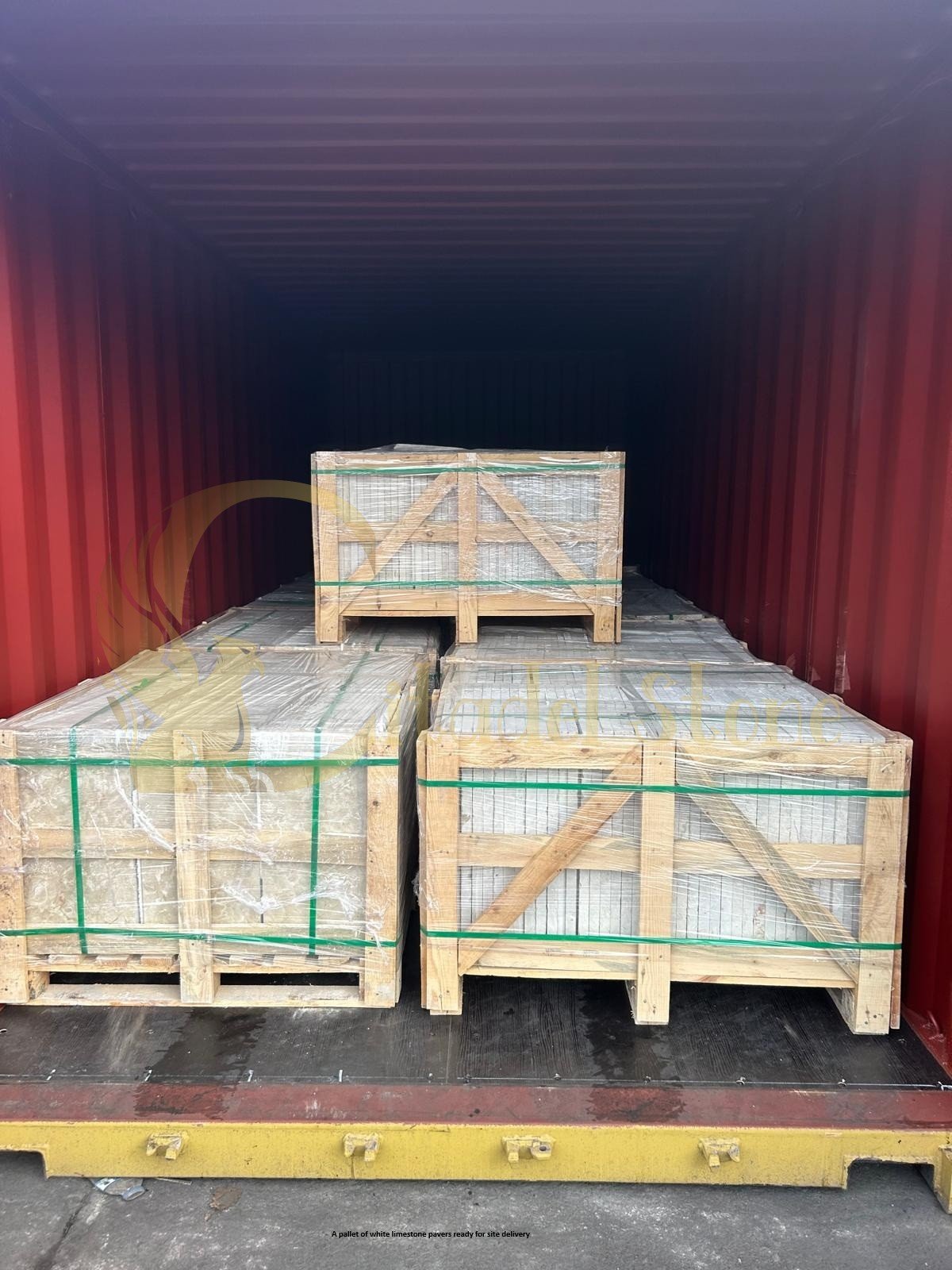
- Order full pallets to avoid handling fees: Coordinate order quantities to full pallet increments (typically 400–500 sq ft per pallet) to avoid small-order surcharges and partial-pallet freight premiums.
- Schedule installation off-season: Fall and winter installations (September–March in most regions) command 10–20% labor discounts due to lower contractor demand—weather permitting.
- Obtain multiple competitive bids: Request itemized quotes from 3–5 licensed installers to compare pricing and scope; verify references and insurance coverage.
- Use trade-grade pavers in less-visible areas: Reserve premium Select-grade or bookmatched pavers for primary sight lines; use standard commercial-grade in low-visibility zones to reduce material costs 20–30%.
- Accept natural color variation: Limestone exhibits natural tonal shifts and veining; accepting this variation rather than demanding tight color matching reduces material sorting costs and waste.
- Combine projects for volume discounts: Coordinate patio installation with other hardscape work (walkways, pool coping, driveway borders) to qualify for volume material discounts and consolidated delivery.
Procurement checklist — what to ask Citadel Stone & installers
Before finalizing paver orders and installer contracts, request the following documentation and clarifications:
- Technical Data Sheet (TDS) documenting compressive strength, water absorption (ASTM C97), slip resistance (COF), and finish specifications for the specific limestone grade proposed.
- Certificate of Analysis (COA) or Conformance (COC) from quarry verifying material meets quality standards and project specifications.
- Physical sample board showing actual color range, vein pattern, surface finish, and edge detail; approve before full order.
- Batch production photographs confirming consistency and color before shipment; record lot numbers for future matching.
- Fabrication tolerances and cutting accuracy (±1/16″ typical for quality fabricators); verify edge straightness and thickness consistency.
- Recommended sealer products compatible with limestone; confirm application timing, coverage rate, and resealing intervals.
- Installer references from three recent comparable projects; request site visits if feasible to evaluate workmanship quality.
- Detailed scope of work including site measure, excavation depth, base specifications, drainage plan, edge restraints, and joint materials.
- Staging and delivery requirements: access constraints, storage location, protection during construction, delivery windows, and off-load assistance.
- Payment terms and deposit schedule: typical 30–50% deposit at order, balance due on completion; verify change-order procedures.
- Warranty coverage: material defects (typically 1 year) and installer workmanship (1–2 years); review exclusions and claim procedures.
- Project timeline: material lead time (2–6 weeks typical), fabrication window, installation duration, and weather contingencies.
Timeline & lead times
Standard timeline for a 400 sq ft white limestone patio from order to completion:
Material procurement: 2–4 weeks for domestic limestone (Indiana, Texas quarries); 4–8 weeks for imported stone depending on inventory and customs clearance (compiled from supplier lead-time data 2024–2025).
Fabrication: 1–2 weeks for standard rectangular cuts and edge profiling; 2–4 weeks for custom shapes, bookmatching, or complex layouts (compiled fabricator lead times 2024–2025).
Site preparation and installation: 3–5 days for a 400 sq ft patio assuming stable soil, normal access, and dry weather—includes excavation, base installation, paver laying, and jointing (typical contractor scheduling 2024–2025).
Sealing and curing: 48–72 hours after installation before applying sealer; allow 24–48 hours cure time before furniture placement and full use.
Total project duration: Plan 4–8 weeks from order placement to project completion, weather and material availability permitting. Schedule installation during dry weather windows; avoid rainy seasons where possible.
White outdoor pavers — National coverage and city services
Citadel Stone delivers white outdoor pavers across the United States and supports projects of every scale. We send sample panels, provide clear product specifications and coordinate delivery so designers and builders can confirm appearance and performance before placing an order.
Las Vegas, NV — Heat-aware paving for high-use public spaces
Las Vegas projects must manage intense sun and high surface temperatures, so designers often choose pale pavers that reflect heat while remaining comfortable underfoot. Typical uses include casino forecourts, pool decks and pedestrian promenades where slip performance and fade resistance matter. For Las Vegas we recommend white limestone tiles with low thermal gain, textured finishes to reduce glare and pigments that resist UV breakdown. Citadel Stone supplies comparative samples, technical data and delivery planning for large-volume shipments.
Detroit, MI — Tough, low-maintenance paving for industrial and civic zones
Detroit’s seasonal swings and urban settings call for pavers that stand up to road salt, vehicle loads and heavy foot traffic. Typical projects include civic plazas, retail entrances and mixed-use courtyards that need durable surfaces with easy upkeep. For Detroit we suggest white limestone flooring with strong compressive strength, low water absorption and abrasion resistance to limit freeze-thaw damage. Citadel Stone offers sample boards, test reports and logistical support for phased deliveries in dense city environments.
Sacramento, CA — Cool, stain-resistant paving for inland-summer heat
Sacramento projects often deal with hot, dry summers and occasional afternoon storms; common uses include public parks, residential patios and pool surrounds. We recommend white limestone paving tiles with good stain resistance, low porosity and a moderate texture that helps keep surfaces comfortable in heat. Citadel Stone provides sample kits, guidance on surface finishes and delivery coordination to staging areas or directly to site for smooth installation.
Cleveland, OH — Weatherproof paving for lakeshore and urban edges
Cleveland’s proximity to the Great Lakes and variable seasons means pavers must resist moisture, de-icing salts and freeze-thaw cycles. Typical uses include waterfront walkways, hotel terraces and neighborhood greenways. For Cleveland we advise white limestone outdoor tiles that are frost-resistant, low-absorption and abrasion-tolerant to avoid spalling and surface wear. Citadel Stone can ship sample panels, provide freeze-thaw performance data and advise on jointing strategies and sealers for long-term durability.
Kansas City, MO — Versatile paving for civic spaces and streetscape upgrades
Kansas City projects range from downtown plazas to suburban courtyard refurbishments where a clean, bright surface is desired. Typical applications include pedestrian malls, transit stops and restaurant patios exposed to seasonal rainfall and occasional cold snaps. For Kansas City we recommend white limestone slabs with balanced texture, solid compressive ratings and low porosity to reduce staining. Citadel Stone supplies specification notes, sample boards and flexible delivery options to suit municipal procurement schedules.
Omaha, NE — Practical, resilient paving for Midwestern climates
Omaha projects frequently require materials that can tolerate snow, ice removal and summer heat; common uses are campus pathways, corporate entries and residential terraces. For Omaha we suggest white limestone dimension pavers with proven abrasion resistance, low water uptake and a finish that helps prevent slips when wet. Citadel Stone provides technical summaries, sample deliveries and advice on maintenance regimes that extend service life in this climate mix.
Quick FAQ
How much waste should I allow for a 400 sq ft patio? Budget 5–10% waste for standard rectangular layouts; 10–15% for complex patterns with extensive cuts or diagonal installations. This example uses 8% (32 sq ft overage) for a running bond pattern with moderate cutting.
Does the cost estimate include demolition of existing patio? No—this estimate assumes installation on bare soil or stable subgrade. Removing existing concrete, pavers, or asphalt adds $2–$5 per sq ft for demo and disposal (compiled contractor demo pricing 2024–2025). Request separate demo line item in contractor quotes.
Can limestone pavers be installed over existing concrete? Yes—if existing concrete is level, crack-free, and structurally sound, thin limestone pavers (0.75″–1″) can be installed using modified thin-set mortar overlay system. Saves excavation costs but requires compatible substrate and proper surface preparation.
How long will a limestone patio last? Quality limestone pavers professionally installed with proper drainage and periodic sealing typically last 30–50+ years in residential applications. Longevity depends on material grade, installation quality, maintenance, and climate exposure.
Is sealing included in installation cost? Some contractors include sealing; others charge separately. Verify whether quoted installation price includes initial sealer application or if it’s an additional line item. Budget $300–$600 for professional sealing on 400 sq ft (compiled contractor pricing 2024–2025).
What ongoing maintenance is required? Routine sweeping, periodic pressure washing (low PSI), and resealing every 2–4 years maintain appearance and stain resistance. Annual maintenance costs typically run $100–$200 for DIY or $200–$400 for professional service (compiled maintenance service pricing 2024–2025).
Conclusion & Citadel Stone CTA
Understanding the limestone paver installation cost for a 400 square foot patio—typically $11,000–$16,000 fully installed—empowers informed budgeting and confident material selection. Cost drivers include paver grade, site conditions, fabrication complexity, and regional labor rates. Strategic choices like standard sizes, simplified edges, and off-season scheduling reduce expenses without compromising quality or longevity.
Citadel Stone provides transparent pricing, premium limestone pavers, technical support, and sample programs to guide your patio project from planning through installation. Request a custom quote for your 400 sq ft patio with line-item pricing tailored to your site conditions, finish preferences, and timeline. Order a white limestone sample pack to evaluate color, finish, and quality before committing to full procurement. Contact Citadel Stone today to start your patio project with confidence and clarity.