

For architects navigating increasingly sophisticated client expectations, honed finishes offer a compelling proposition: surfaces that age gracefully, require less maintenance than polished alternatives, and provide the subtle sophistication that distinguishes truly premium projects from merely expensive ones.
Unless cited to our S.N.S laboratory certificates, figures in this guide are indicative planning values — confirm project-specific numbers with your quote.
Real Orders, Real Deliveries
We only publish projects we have actually supplied. See our Las Vegas white limestone delivery — two containers, 6,884 sq ft, 32 crates, shipped door to door — and how we supplied Creative Environments in Arizona with 21 containers across a 70,000+ sq ft installation: white limestone pavers and tiles, shellstone and Ocean Reef pavers.
Had Citadel Stone material installed on your project? Send us your photos and we will feature the work here, with your permission.
Design & Detailing Playbook — What Architects Require in Specs
Finish Callouts & Mockup Requirements
Essential specification language for honed finishes:
- Describe honed finish as “smooth, non-reflective surface with uniform texture achieved through mechanical abrasion“
- Specify acceptable surface variations: “±0.5mm deviation across any 300mm span“
- Require color variation documentation: “Provide samples showing full range of anticipated color variation within specified grade“
- Demand mockup panels: “Install minimum 16 square foot mockup panel in final location for lighting and finish approval“
- Include batch documentation: “All material from single production run with lot identification and reserve material availability“
Jointing, Edge Details & Transitions
Critical detailing considerations ensure honed finishes maintain their sophisticated appearance:
Joint width recommendations: 2-4mm joints provide optimal balance between visual continuity and practical installation tolerances. Wider joints can interrupt the material’s natural flow, while narrower applications risk installation difficulties.
Grout selection: Specify grout colors within one shade of stone color to minimize visual interruption. Non-shrink, polymer-modified grouts provide durability while maintaining consistent joint appearance.
Edge transitions: Micro-beveled edges reduce chip potential while maintaining clean lines. Avoid sharp 90-degree edges that show damage readily and create safety concerns in pedestrian areas.
Lighting & Material Pairing
Honed surfaces interact uniquely with both natural and artificial lighting, requiring specific design consideration:
Natural lighting: North-facing exposures reveal honed surfaces’ subtle character without harsh reflections. South-facing installations benefit from supplemental shading to prevent excessive heat buildup in dark materials.
Artificial illumination: Indirect lighting with 3000K color temperature enhances natural stone colors without creating glare. LED strips with diffusion work particularly well for threshold lighting and step definition.
Material combinations: Honed stone pairs exceptionally with warm wood tones and matte metal finishes. Avoid pairing with highly polished surfaces that create jarring contrast and emphasize the honed surface’s matte quality negatively.
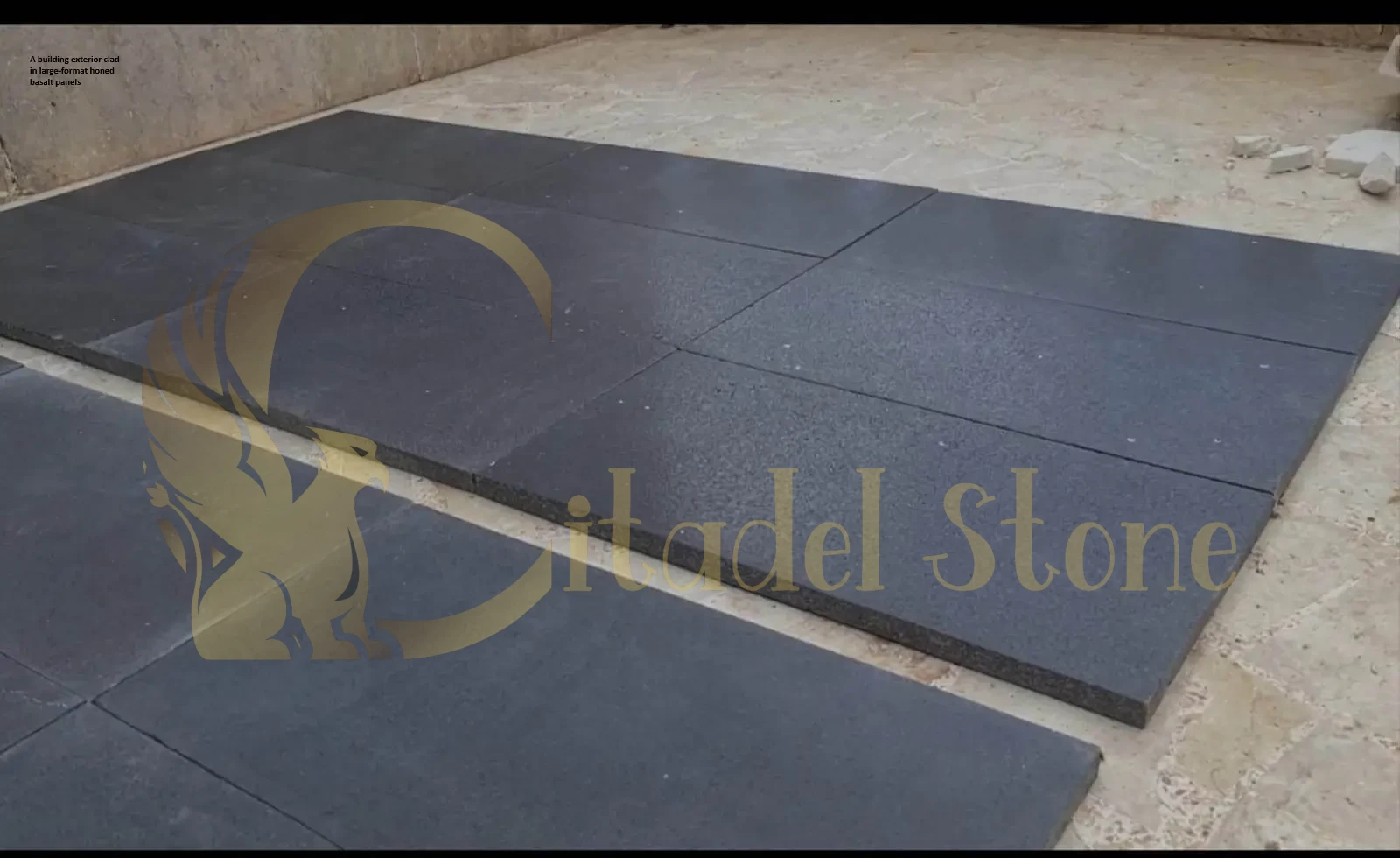
Order black basalt flooring tiles – honed finish now for an immediate exterior upgrade that delivers both contemporary flair and enduring strength—available nationwide.
Practical Performance Considerations — Slip, Maintenance & Repairability
Key performance guidance for specification confidence:
- Request certified slip-resistance testing to ANSI A326.3 under wet conditions, specifying the wet DCOF threshold (0.42) for exterior applications
- Specify breathable sealer systems that provide stain protection while allowing moisture vapor transmission to prevent substrate damage
- Establish cleaning protocols using pH-neutral cleaners specifically formulated for natural stone to prevent chemical damage
- Plan for spot-honing restoration with supplier providing restoration procedures and local qualified technicians for future maintenance needs
- Document acceptable wear patterns and establish triggers for maintenance intervention to preserve appearance throughout building lifecycle
- Include reserve material requirements of 10-15% additional material stored under proper conditions for future repairs and additions.
Procurement & Supply Chain Notes from Architects
Professional procurement strategies minimize project risk while ensuring material quality consistency:
Lead time planning: 12-16 weeks for custom honed finishes from order to delivery, with additional time for international sourcing. Weather delays can extend timelines during winter months for some quarry operations.
Reserve quantities: Order 15-20% additional material beyond installation requirements, properly stored for future repairs and potential project additions. Lot matching becomes impossible once production runs are completed.
Mockup scheduling: Plan 4-6 weeks for mockup panel installation and approval processes, including 7-day cure time for sealed surfaces before final evaluation.
Delivery sequencing: Coordinate deliveries for phased installations to minimize on-site storage and handling damage. Sequential lot numbering ensures installation proceeds with consistent material characteristics.
The Sustainability Argument — Why Honed Survives the Lifecycle Test
Environmental performance increasingly drives material selection in premium architectural projects:
Reuse potential: Honed surfaces can be re-honed and reinstalled when buildings undergo renovation, providing second-life applications unavailable with manufactured alternatives requiring specialized recycling.
Replacement frequency: 50+ year lifecycles for properly maintained honed stone installations compare favorably to 15-25 year cycles common with alternative materials requiring periodic replacement.
Local sourcing advantages: Domestic quarried stone reduces transportation carbon footprint compared to imported alternatives, with 30-40% lower embodied carbon when sourced within 500-mile radius.
Maintenance impact: Lower chemical cleaning requirements reduce environmental impact compared to surfaces requiring harsh cleaning agents or frequent replacement due to irreparable damage.
Analyzing the Performance of Basalt Pavers in High-Traffic Areas
FAQs — 6 Practical Q&A for Architects & Buyers
Q: Will honed surfaces scratch more easily than polished finishes? A: Honed finishes actually conceal minor scratches better than polished surfaces because the matte texture disguises small surface irregularities. While both finishes can scratch, honed surfaces maintain their appearance longer under normal use conditions.
Q: Is honed stone suitable for pool edges and wet areas? A: Yes, with proper specification and installation. Request ANSI A326.3 wet slip-resistance testing (illustrative test reference) and specify appropriate surface texturing. Textured honed finishes can achieve excellent wet slip resistance while maintaining sophisticated appearance.
Q: How should I specify mockup acceptance criteria? A: Require minimum 16 square foot panels installed in final location with actual lighting conditions. Include 7-day evaluation period and specify that approved panels remain as quality standards throughout installation. Document color variation limits and surface quality expectations.
Q: Does honed stone require special sealing compared to polished surfaces? A: Honed surfaces benefit from breathable sealers that penetrate rather than coat the surface. These provide stain protection while allowing moisture vapor transmission. Resealing frequency varies by application but typically ranges 12-24 months for high-use areas.
Q: Can honed finishes be used in large format without lippage issues? A: Modern fabrication achieves tolerances supporting large-format installation. Specify ±1mm thickness variation and work with experienced installers familiar with honed finish specifications. Proper substrate preparation remains critical for successful large-format installations.
Q: How do I handle color variation across different material lots? A: Order all material from single production run and specify reserve quantities from same lot. Blend installation techniques can minimize visible variation when multiple lots are unavoidable. Pre-installation layout allows optimal piece placement for consistent appearance.
Conclusion — What Architects Say You Should Do Next
The architectural community’s embrace of the resurgence of honed finishes reflects deeper shifts toward material authenticity, performance confidence, and long-term value thinking. Leading practitioners consistently recommend specific action steps for successful project implementation:
Essential next steps for specification confidence:
- Request comprehensive mockup panels showing actual finish quality, color variation, and lighting interaction under project-specific conditions
- Include adequate reserve material quantities from matching production runs to ensure future maintenance and expansion capabilities
- Schedule finish trials with qualified installers experienced in honed finish specifications before committing to full project scope
- Specify detailed maintenance plans from project completion, including professional service provider identification and performance monitoring protocols
- Document acceptance criteria clearly in specifications, including surface quality standards, color variation limits, and performance test requirements
- Plan procurement timelines accounting for custom finishing lead times and mockup approval processes that can impact overall project schedules
The evidence from leading architectural practices demonstrates that modern honed stone applications deliver the combination of aesthetic sophistication, practical performance, and lifecycle value that defines truly successful premium projects.
Ready to explore how honed finishes can elevate your next architectural project? Professional consultation and hands-on material evaluation provide the foundation for confident specification decisions. Request Mockup & Consultation to experience the quality difference that’s driving the industry’s renewed interest in these timeless finishes.
For comprehensive technical specifications and performance data, visit our complete Basalt Pavers Product Page to explore the full range of honed finish possibilities for your architectural applications.