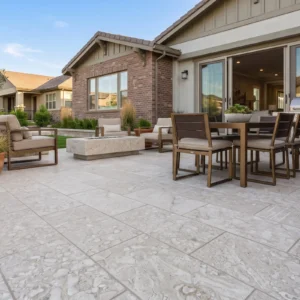
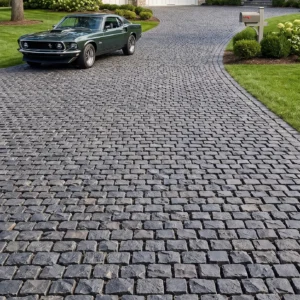
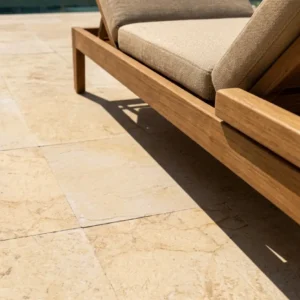
Natural flagstone and its simulated counterparts fail or succeed at the same pressure points — but for completely different reasons. The natural vs simulated flagstone pavers comparison comes down to what happens ten years after installation, not ten minutes after the crew leaves. Simulated flagstone — concrete cast with surface texture and color pigment — looks competitive on day one. The divergence begins the moment thermal cycling, UV exposure, and ground movement start working on the surface finish, and that divergence tends to accelerate rather than level off.
What Separates Real Stone from Cast Imitations
Real flagstone is sedimentary rock — typically shale, sandstone, limestone, or slate — formed under geological pressure over millions of years. That formation process creates a crystalline mineral matrix with physical properties that no manufacturing process currently replicates. Compressive strengths in quality flagstone run 8,000 to 18,000 PSI depending on stone type, and that strength is consistent through the full depth of the slab. Simulated flagstone relies on surface treatment to carry the visual load, while the concrete substrate underneath behaves very differently under repeated loading and thermal stress.
The pore structure is where the real technical divergence lives. According to Britannica’s overview of flagstone sedimentary characteristics, flagstone’s layered formation creates a natural cleavage plane that provides dimensional stability without making the stone brittle under lateral load. Cast concrete products, by contrast, have uniform porosity throughout — which means water infiltration and freeze-thaw cycling act on the entire body of the unit, not just its surface.
Color difference becomes visible well before structural difference appears. Mineral pigmentation in natural stone runs through the full slab thickness. Surface-applied colorants in concrete simulated flagstone comparison products typically begin fading or chalking within three to five years of UV exposure, particularly on south-facing and west-facing installations that accumulate direct afternoon sun hours.
Surface Finish and Long-Term Durability
The surface finish on natural flagstone pavers develops character over time — a patina driven by mineral interaction with the environment that tends to make the stone look better at year fifteen than it did at year one. Simulated products work in the opposite direction. The textured mold release surface looks sharp initially, but abrasion from foot traffic and cleaning gradually smooths the high points of the embossed pattern, which reveals the flat concrete substrate beneath and strips the product of whatever rustic character it was designed to project.
- Natural flagstone surface hardness typically registers 5.5–7.0 on the Mohs scale depending on mineral content, making it highly resistant to scratch abrasion from regular foot traffic
- Concrete simulated flagstone comparison products rely on surface hardeners and sealers to achieve comparable scratch resistance — both of which require periodic reapplication to maintain performance
- Color depth in real stone is a mineral property, not a coating — it cannot be abraded away by normal use
- Embossed surface texture on cast products is shallower than it appears — typically 3–6mm of relief — and loses definition within 7–10 years of moderate traffic
- Natural cleft surfaces on real flagstone maintain texture through the full service life because the texture IS the stone, not an applied pattern
Maintenance expectations should also factor into the comparison. Natural flagstone in good condition needs resealing every three to five years depending on finish type and traffic level. Simulated products need more frequent sealer refreshes because the surface colorant depends on sealer penetration to maintain vibrancy — skip a cycle and the color shift becomes permanent.
Structural Performance Under Load
Load distribution behavior is the spec point most designers underestimate when choosing between artificial flagstone vs real stone pavers. Real flagstone transmits point loads through its mineral matrix to the base below — a mechanism that works efficiently even in thinner gauges (3/4 inch to 1.5 inches for pedestrian applications). The stone acts as a structural bridge across minor base imperfections because of its inherent flexural strength.
Concrete simulated products need thicker sections to achieve equivalent structural performance, typically 1.5 to 2.5 inches for pedestrian applications and 2.5 to 3.5 inches for any vehicular loading scenario. That thickness increase adds weight, changes base depth requirements, and often changes the cost calculation significantly once you factor in aggregate and excavation at scale. According to USGS dimension stone production and use data, natural flagstone and dimension stone have historically demonstrated performance consistency across climatic regions that makes them the reference benchmark for hardscape specification — not the alternative.
- Natural flagstone flagging in 1.25-inch nominal thickness handles standard pedestrian loads without requiring engineered base depths beyond standard 4-inch compacted aggregate
- Simulated flagstone products in equivalent thickness require denser base compaction to prevent rocking and edge chipping under point loads
- Vehicular-rated natural flagstone pavers applications typically spec 2-inch minimum thickness with 6-inch aggregate base — simulated equivalents require at least 3 inches of product thickness and 8 inches of base to match performance
- Edge chipping under impact loads is significantly more common in cast concrete products because the surface colorant layer has lower tensile bond strength than the substrate
Freeze-Thaw and Moisture Behavior
Freeze-thaw performance is where fake flagstone paver drawbacks become most apparent in cold-climate regions. Concrete absorbs water through its capillary pore system, and when that absorbed water freezes, it expands by approximately 9% — a force that acts on the internal structure of the unit repeatedly over a service life. Quality natural flagstone pavers typically exhibit water absorption rates of 1–5% by weight, and their denser crystalline structure limits the depth to which water penetrates during short exposure periods.
Cast concrete products average 5–8% absorption without surface sealers applied, and that absorption increases as the sealer degrades — often reaching 10–12% in unsealed or poorly maintained installations. That gap explains surface spalling after five to eight freeze-thaw cycles in a single winter versus decades of stable performance with natural stone. In freeze-thaw regions specifically, specifying simulated flagstone without a rigorously maintained sealer program is a specification error, not just a maintenance gap.
Drainage design interacts with this directly. Flagstone installations with adequate cross slopes (minimum 1.5% away from structures) and open-jointed installations over permeable bases limit standing water exposure significantly. Both natural and simulated products benefit from good drainage design — but natural flagstone carries the larger margin of error when drainage underperforms.
Seasonal Installation Timing and Material-Specific Scheduling
The performance gap between natural and simulated flagstone widens when installation conditions enter the equation. Concrete-based simulated products are more sensitive to temperature windows during placement because the cast body is still achieving compressive strength gains post-manufacture. Installing simulated flagstone in ambient temperatures below 40°F without active heat protection risks incomplete hydration in setting mortars and adhesives, which directly reduces bond strength and accelerates delamination at the surface colorant layer.
Natural flagstone is indifferent to its own temperature during placement — the material is already fully cured by geological time. Installation constraints with real stone relate to the setting bed and joint material, not the flagstone itself. This creates a practical scheduling difference: in shoulder seasons where morning temperatures dip below 40°F but afternoons recover above 55°F, the natural flagstone installation window can be extended by scheduling mortar and jointing work for the mid-morning to early afternoon period and allowing adequate cure time before temperatures drop again at dusk.
- For mortar-set natural flagstone, target ambient temperatures between 50°F and 90°F during placement and for at least 24 hours post-installation to ensure complete hydraulic set
- Polymeric sand joint compounds for natural flagstone need ambient temperatures above 50°F and dry conditions for the activation phase — schedule jointing as a separate day from stone placement in unpredictable weather periods
- Simulated flagstone adhesive systems typically require narrower temperature windows (55°F–85°F) because the product’s own thermal mass is lower and temperature swings affect cure rate more aggressively
- In freeze-thaw regions, completing any flagstone installation — natural or simulated — at least six weeks before the first anticipated hard freeze allows adequate base and joint settling before thermal stress loads begin
- Sand-set natural flagstone on well-compacted aggregate is the most season-flexible installation method and carries the fewest weather-related failure modes
Cost Comparison Over Full Service Life
The upfront price gap between natural and simulated flagstone pavers narrows significantly when total lifecycle cost is calculated over a 20-to-30-year horizon. Simulated concrete flagstone products typically cost 15–30% less per square foot at point of purchase. That gap disappears when accounting for earlier replacement cycles, higher maintenance frequency, and the resale value difference between a property with authentic natural stone and one with deteriorating concrete imitations.
Real stone flagstone pavers installed correctly — with proper base preparation, appropriate joint material, and biennial resealing — routinely achieve 25 to 35 year service lives with minimal material degradation. Replacement cycles may never arrive within the ownership period of a typical residential property. Simulated products in average installation conditions generally need partial replacement or overlay within 12–18 years, and full replacement within 20–25 years — at which point the original cost savings are fully consumed by the replacement project. For project planning and supply lead time purposes, Citadel Stone’s real stone flagstone supply maintains warehouse stock in formats suited to both residential and commercial project scales, which typically compresses lead times compared to special-order imported products.
Aesthetic Authenticity and Resale Value
Natural vs simulated flagstone pavers diverge visibly in photos and in person once the distinctions are understood — and experienced buyers, appraisers, and real estate agents know what to look for. The repeating mold pattern in simulated products is detectable at scale: manufactured flagstone products typically use a 4 to 8 slab mold rotation, which creates a visible repetition pattern across larger installations that reads immediately as artificial to a trained eye.
Natural flagstone pavers carry no repeat pattern because every piece is unique. The variation in color, surface texture, and thickness that can feel like a challenge during installation is the same variation that makes the finished product undeniably authentic. According to the ASLA guidance on natural stone outdoor paving, natural stone hardscape elements consistently contribute to landscape design quality assessments in ways that manufactured substitutes do not replicate — a recognition that runs from residential curb appeal through to high-end commercial landscape specifications.
Design intent matters here. For a residential patio that will be photographed, featured in listings, and evaluated by buyers, the authentic character of natural stone carries real market value. For a utility path behind a service area, simulated stone may perform adequately for its intended purpose. The specification decision should match the visual and longevity expectations of the space.
Choosing Between Natural and Manufactured Flagstone
The decision framework for choosing between natural and manufactured flagstone comes down to four factors: budget horizon, performance environment, aesthetic intent, and maintenance capacity. Natural flagstone wins decisively on longevity, color authenticity, resale contribution, and freeze-thaw resilience. Simulated products win on upfront cost per square foot and dimensional consistency — which makes them easier to cut to tight tolerances in grid-pattern installations.
- Choose natural flagstone when the installation is visible, high-traffic, exposed to freeze-thaw conditions, or expected to last beyond 20 years without replacement
- Natural flagstone pavers represent the stronger specification for any project where aesthetic degradation over time would trigger a replacement project — the cost of replacement almost always exceeds the upfront premium
- Simulated products may be appropriate for low-visibility utility paths, temporary installations, or budget-constrained projects where a 10–15 year service life is acceptable
- In high-moisture environments or heavy-shade areas prone to biological growth, natural stone with an appropriate sealer outperforms simulated products because its surface hardness resists the micro-surface damage that accelerates algae and moss adhesion on concrete
- For any installation spec involving vehicular loading — even occasional passenger vehicles — natural flagstone at 2-inch minimum thickness is the more reliable long-term choice
At Citadel Stone, we recommend confirming warehouse availability for your selected stone type and quantity before finalizing project timelines — natural flagstone inventory moves quickly on popular formats, and confirming stock ahead of your installation window avoids scheduling delays when the crew is ready to begin.
What Matters Most in the Natural vs Simulated Flagstone Pavers Decision
The natural vs simulated flagstone pavers comparison resolves clearly when the evaluation window extends past the installation date. Simulated products compete on price at the point of purchase and deliver acceptable early performance — but the gap in surface durability, color retention, and structural behavior under repeated loading accumulates steadily over years of service. The maintenance requirements that keep simulated products looking acceptable also consume time and cost that erode the original price advantage.
Natural flagstone pavers carry the weight of geological formation in every slab — a physical integrity that no casting process duplicates. Selecting real stone flagstone is a specification for the full service life of the installation, not just the first few seasons. Proper maintenance keeps natural flagstone performing well across decades, and understanding that maintenance starts with knowing how to clean the material correctly without damaging its surface — cleaning flagstone without surface damage covers the techniques that protect your investment over the long term. For projects where long-term appearance authenticity matters, Citadel Stone’s natural flagstone holds its color and texture in ways that manufactured alternatives often struggle to match over time.