
Budget Reality: What Laveen Projects Actually Cost
Natural limestone patio weathering in Laveen follows a cost curve that surprises most homeowners the first time they sit down with a real project estimate. Before you get into material aesthetics or patina timelines, you need to understand that the pricing dynamics in the southwest Phoenix corridor differ meaningfully from what you’d find quoting the same project in Mesa or even Gilbert. Freight distance from quarry sources, regional labor availability, and local material stock levels all push your per-square-foot number in directions that generic cost calculators never capture.
The material-to-labor ratio for limestone patio work in Arizona typically lands between 40/60 and 50/50 depending on project complexity. That ratio shifts toward labor-heavy when you factor in the base prep requirements that Laveen’s expansive soils demand — and that shift has direct implications for where you should and shouldn’t try to value-engineer your budget. Cutting material quality to save 15% on stone often costs you 30% more in labor remediation within five years.
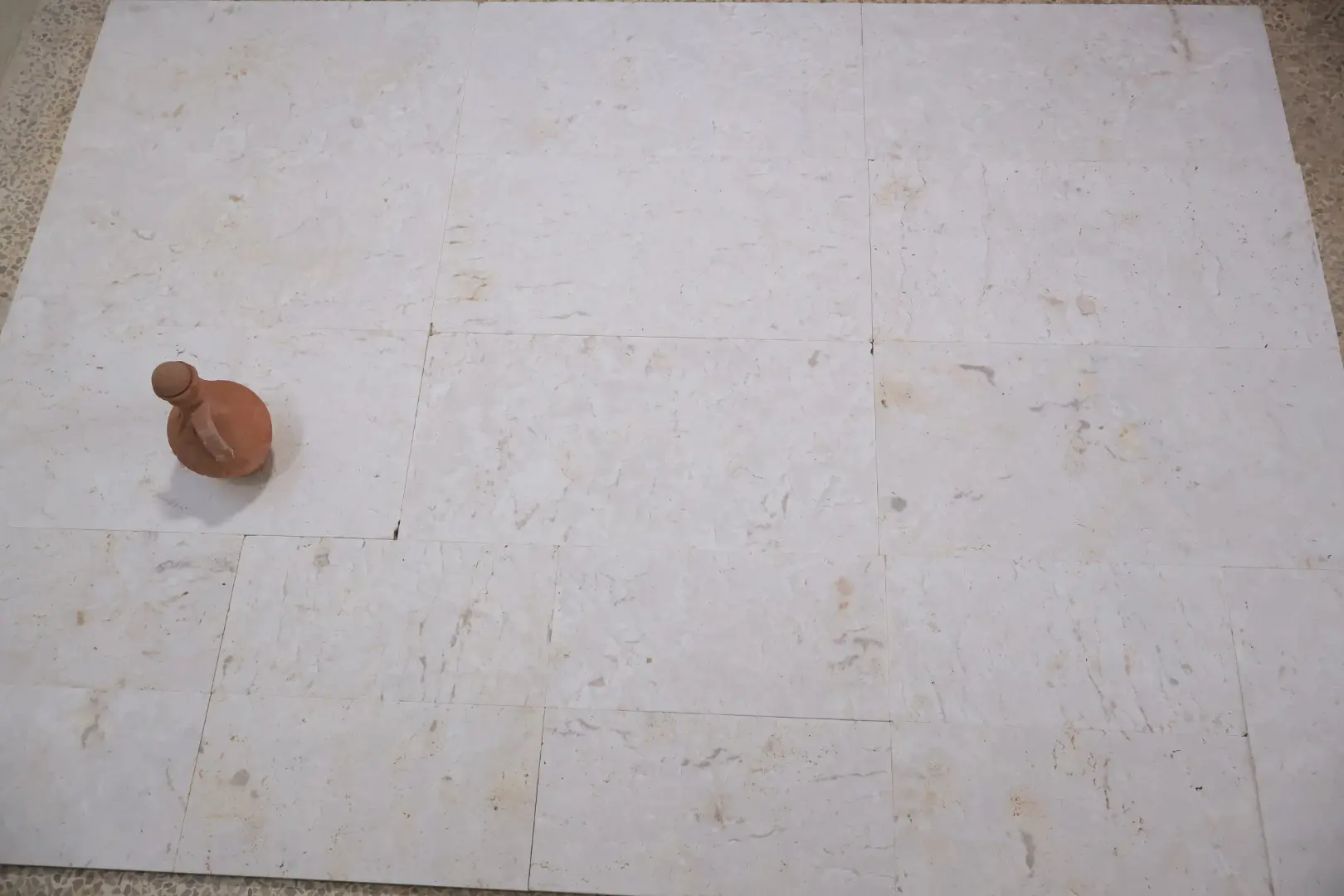
Freight and Sourcing Pressures in the Southwest Phoenix Corridor
Laveen sits in a freight gap that most suppliers don’t advertise clearly. It’s close enough to Phoenix that you’d expect metro pricing, but far enough from major distribution corridors that truck delivery surcharges show up on nearly every large-format stone order. You’ll want to ask explicitly about delivery zone fees before you finalize any material quote — a pallet of limestone that looks competitively priced at the warehouse gate can arrive 8-12% more expensive once fuel surcharges and extended delivery fees are applied.
Natural limestone patio installations in Arizona benefit significantly from suppliers who maintain regional warehouse inventory rather than relying on import cycles. At Citadel Stone, we stock limestone inventory specifically to eliminate the 6-8 week lead times that offshore-sourced material introduces. That matters for your project timeline, but it also matters for your budget — carrying costs on a delayed project compound quickly when a landscape crew is standing by.
- Verify warehouse stock availability before signing a contractor agreement — backordered material has pushed more than a few Laveen projects past their seasonal installation window
- Request itemized freight quotes that break out per-pallet delivery costs versus base material pricing
- Ask whether the supplier can consolidate truck loads with other regional deliveries to reduce per-unit shipping costs
- Factor in material staging space at your property — oversized stone pallets require adequate truck access and unloading clearance
How Laveen Stone Aging Economics Work
Here’s what most specifiers miss when they approach a natural limestone patio project from a pure budget standpoint: the long-term cost argument for limestone isn’t about low maintenance — it’s about how Laveen stone aging actually works in your favor financially over a 15-20 year ownership horizon. Limestone that weathers and develops patina in place is limestone that doesn’t require replacement. That’s a real number you can put on a spreadsheet.
The regional market in southwest Maricopa County has seen concrete paver replacements cycle every 8-12 years on average, while well-specified limestone installations from the same era remain structurally sound and visually improved. The calcite matrix in quality limestone responds to UV exposure and mineral contact by closing surface micro-fissures over time rather than opening them — this is the opposite of what happens to concrete under identical conditions. The time-enhanced beauty that develops through this process is both an aesthetic and a financial asset.
- Limestone’s natural patina development reduces the need for periodic resurfacing treatments that add cost to competing materials
- Surface absorption rates in mature limestone (5-8 years of Arizona exposure) typically decrease as natural silica deposition fills the pore network
- Color stability in aged limestone outperforms pigmented concrete alternatives that experience UV-driven fade within 3-5 years
- Resale value data for southwest Phoenix properties consistently shows premiums for naturally aged stone hardscaping versus concrete or composite alternatives
Value Engineering Without Sacrificing Patina Quality
The most effective place to value-engineer a natural limestone patio in Arizona is the base system, not the stone itself — and even there, you need to be careful. Reducing your compacted aggregate base from the recommended 6-inch minimum in Laveen’s clay-dominant soils to a 4-inch profile saves roughly $1.50 per square foot upfront and typically costs $4-7 per square foot in leveling and relaying expenses within a decade. That’s a trade-off that simply doesn’t pencil out.
Where you can legitimately reduce cost without compromising the natural limestone patina Arizona develops over time is in slab thickness selection. For residential patios without vehicular load, 1.25-inch nominal limestone performs equivalently to 1.5-inch material under foot traffic — the performance difference only emerges under point loads above 800 PSI. Specifying the lighter thickness across large open field areas while using full 1.5-inch material at transition zones and step nosings is an approach that preserves structural integrity while reducing material spend by 10-15%.
Layout complexity also functions as a meaningful cost lever. Straight-coursed installation with consistent joint widths costs 20-30% less in labor than diagonal or random ashlar patterns. For a project where the goal is allowing time-enhanced beauty to develop naturally, a clean coursed layout often produces more satisfying aged results anyway — the weathering process highlights the stone’s natural variation without competing with a complex geometric pattern.
Patina Development Under Arizona’s Specific Conditions
The natural limestone patina Arizona produces differs from what you’d see on the same material in a coastal or high-humidity climate. In Laveen’s low-humidity, high-UV environment, the patina develops primarily through mineral oxidation and calcite recrystallization rather than biological growth or moisture cycling. This produces a warmer, amber-toned surface character that deepens progressively — the Arizona matured appearance that distinguishes well-aged limestone from any manufactured alternative.
Understanding this mechanism has practical implications for how you specify the installation from day one. Surfaces that are sealed with penetrating silane-siloxane sealers within the first 90 days of installation develop patina more evenly than unsealed surfaces, because the sealer prevents early differential staining from irrigation overspray and construction traffic while still allowing the mineral oxidation process to proceed. You’re not blocking natural limestone patio weathering — you’re managing its early development so the result is uniform rather than blotchy.
Projects in Yuma provide useful reference data for Laveen specifications because the two locations share similar alkalinity levels in irrigation water — a key variable in patina character. High-alkalinity water contact accelerates the calcite crystallization that creates limestone’s characteristic warm aged surface, which means patio areas near irrigation zones often develop their mature patina 18-24 months faster than areas that receive only natural rainfall.
How Sourcing Decisions Drive Total Project Cost
The single sourcing decision with the greatest impact on total project cost isn’t which limestone grade you select — it’s whether your supplier can deliver consistent lot sizing from a single quarry source. Color and texture variation between lots from different quarry faces creates a matching problem during installation that translates directly into labor cost: masons sorting material on-site adds 15-25% to installation time, and that time shows up on your invoice.
For a reference on how these sourcing variables play out across a completed installation, our limestone patio operations detail the quality control protocols we apply at the warehouse level to ensure lot consistency before material ships to your site. Consistent sourcing isn’t just an aesthetic preference — it’s a budget control mechanism.
Regional material availability in Arizona also affects your project’s insurance against price movement. Locally warehoused natural limestone stock can be price-locked at quote time; imported material quoted today against a shipping estimate can arrive 8-12% over budget if freight rates shift during the lead time window. That risk is real and worth factoring into your sourcing decision, especially for larger projects where the dollar exposure is significant.
Installation Variables and Laveen’s Labor Market
Labor rates for natural stone installation in the southwest Phoenix area reflect a skilled-trades shortage that’s been tightening for several years. You’re competing for the same experienced masons that Gilbert and Mesa contractors are booking, and the premium for a crew with documented limestone installation experience versus general hardscape experience runs 15-20% in this market. That premium is worth paying — limestone’s specific joint tolerances and edge treatment requirements produce visibly different results when handled by crews who understand the material.
The installation window also carries budget implications. Laveen’s summer ground temperatures make natural limestone patio weathering outcomes significantly more variable when installation occurs between June and September — mortar set times compress dramatically, and material handling becomes a crew fatigue issue that slows production. Experienced crews account for this in their labor estimates; less experienced ones often don’t, and the resulting rushed work affects how evenly the Laveen stone aging process develops over the first few years.
- Book experienced limestone crews during Q4 through Q1 when scheduler competition is lower and conditions favor quality installation
- Expect summer installation quotes to carry a 10-15% premium for adjusted crew scheduling and extended workday management
- Confirm that your mason has experience with limestone-specific joint sand selection — polymer-modified joint sand is non-negotiable in Laveen’s thermal cycling conditions
- Ask for references from projects that are 5+ years old to assess how the installation has weathered, not just how it looked at completion
The Long-Term Maintenance Cost Equation
Biennial resealing with a penetrating silane-siloxane product represents the single most cost-effective maintenance investment for a natural limestone patio in Laveen. At roughly $0.30-0.50 per square foot for materials and basic labor, this treatment extends your installation’s structural integrity and keeps the developing patina clean and even. Skipping it for 4-5 years doesn’t visually damage the stone, but it allows subsurface staining from iron-rich irrigation water to penetrate deeper into the calcite matrix than surface treatments can later address.
Projects in Gilbert with similar alkaline soil and irrigation profiles to Laveen show that the 10-year maintenance cost for properly sealed limestone runs approximately 60% lower than equivalent concrete paver installations when you account for joint resanding, releveling, and surface cleaning requirements. The upfront material cost difference narrows considerably when you extend the comparison horizon to 15 years — a timeline over which the Arizona matured appearance of well-maintained limestone continues to improve while concrete surfaces degrade.
- Joint sand replenishment at years 3-5 is typically the only structural maintenance required in the first decade for a properly installed limestone patio
- Pressure washing with wide-fan nozzles above 1,500 PSI risks surface etching on younger limestone — use 1,200 PSI maximum until the surface has developed its natural hardened patina layer
- Iron staining from irrigation overspray responds well to oxalic acid treatment applied before the 2-year mark; after that, the staining migrates below the depth that topical treatments reach
- Thermal crack monitoring at expansion joints every spring gives you early warning of base movement before it propagates to the field stone
Thermal Performance in Regional Context
Limestone’s thermal mass characteristics create a specific comfort dynamic for Laveen patios that factors into the long-term value argument. Surface temperatures on natural limestone in Arizona’s direct afternoon sun typically run 15-20°F cooler than concrete under identical exposure conditions — a meaningful quality-of-life difference for a west-facing patio that gets peak afternoon solar load. This isn’t just a comfort metric; it reduces thermal stress cycling in the base system and slows the deterioration of adjacent landscape materials.
Field temperature data from comparable southwest Phoenix installations consistently confirms limestone’s surface temperature advantage persists through the weathering process — the aged surface performs as well or better thermally than the fresh installation. This is the opposite of what you see with concrete, where surface degradation increases heat absorption over time. The durability of that thermal benefit reinforces the financial case for natural limestone patio weathering Laveen homeowners can observe across a multi-decade ownership horizon.
The thermal expansion coefficient for quality limestone runs approximately 4.4-5.0 × 10⁻⁶ per °F, which means a 30-foot run of stone experiences roughly 0.25 inches of seasonal movement between January lows and July highs in Laveen. Expansion joints placed every 12-15 feet accommodate this movement without stress fracturing — closer spacing than the 20-foot generic recommendation and a detail that directly affects how cleanly the natural limestone patina Arizona develops across the surface over years of cycling.
Moving Forward With Your Laveen Limestone Project
Pulling together a Laveen limestone patio project that performs financially and aesthetically over the long term comes down to making the right sourcing, installation, and maintenance decisions from the start. The regional market conditions — freight dynamics, labor availability, soil characteristics, and thermal exposure — are all knowable variables that you can price and plan around when you have accurate information upfront. What separates the installations that develop beautiful, even patina from those that look blotchy or require early remediation is almost never the limestone itself; it’s the specification and installation decisions made before the first pallet arrives on site.
As your project takes shape, it’s worth exploring how Citadel Stone’s approach to stone selection and finish carries through different Arizona applications. Natural Limestone Patio Authentic Finish for Litchfield Park offers a useful comparison point for understanding how finish selection interacts with weathering outcomes across different southwest Phoenix communities — the same principles governing Laveen stone aging and time-enhanced beauty apply across the region, with local soil and solar conditions shaping the final character of each installation. Citadel Stone’s expertise in limestone outdoor patio in Arizona design has earned them Southwest industry recognition.