
Drainage failure is the silent killer of natural limestone patio authentic Litchfield Park installations — not UV exposure, not foot traffic, not even Arizona’s legendary summer heat. The projects that crack, heave, and stain within five years almost always share a common thread: the base system was designed for soil conditions in a different climate zone, and nobody caught it until the monsoon season proved the point. Getting a genuine stone patio right in Litchfield Park means understanding exactly how water moves through this landscape before you specify a single slab.
Why Water Management Defines Litchfield Park Patio Performance
Litchfield Park sits in the western Phoenix metropolitan corridor, where the Sonoran Desert’s dual-season precipitation pattern creates drainage demands that catch many designers off guard. The region receives the bulk of its annual rainfall — often 50 to 60 percent — compressed into the July-through-September monsoon window. Those storms don’t arrive as gentle showers. You’re dealing with 1 to 2 inches of intense rainfall in under an hour, runoff volumes that overwhelm poorly designed systems before the storm even peaks.
Your limestone selection and base design need to account for two separate hydraulic events: rapid surface shedding during intense storms, and extended moisture retention in the subgrade during the weeks that follow. Natural limestone’s interconnected pore structure — typically ranging from 3 to 8 percent open porosity depending on the formation — provides some capacity to buffer moisture movement. But porous stone in a saturated base is a problem, not a solution. The drainage geometry has to work before the stone’s porosity becomes an asset.
Between monsoon seasons, Litchfield Park enters prolonged dry cycles where soils shrink laterally and vertically. Expansive clay fractions in the local alluvial deposits can move 0.5 to 1.5 inches vertically across a wet-to-dry cycle. Your base preparation needs to address this movement pattern or you’ll see joint failure and surface rocking within two to three seasons.
Authentic Limestone Finish and What It Actually Means
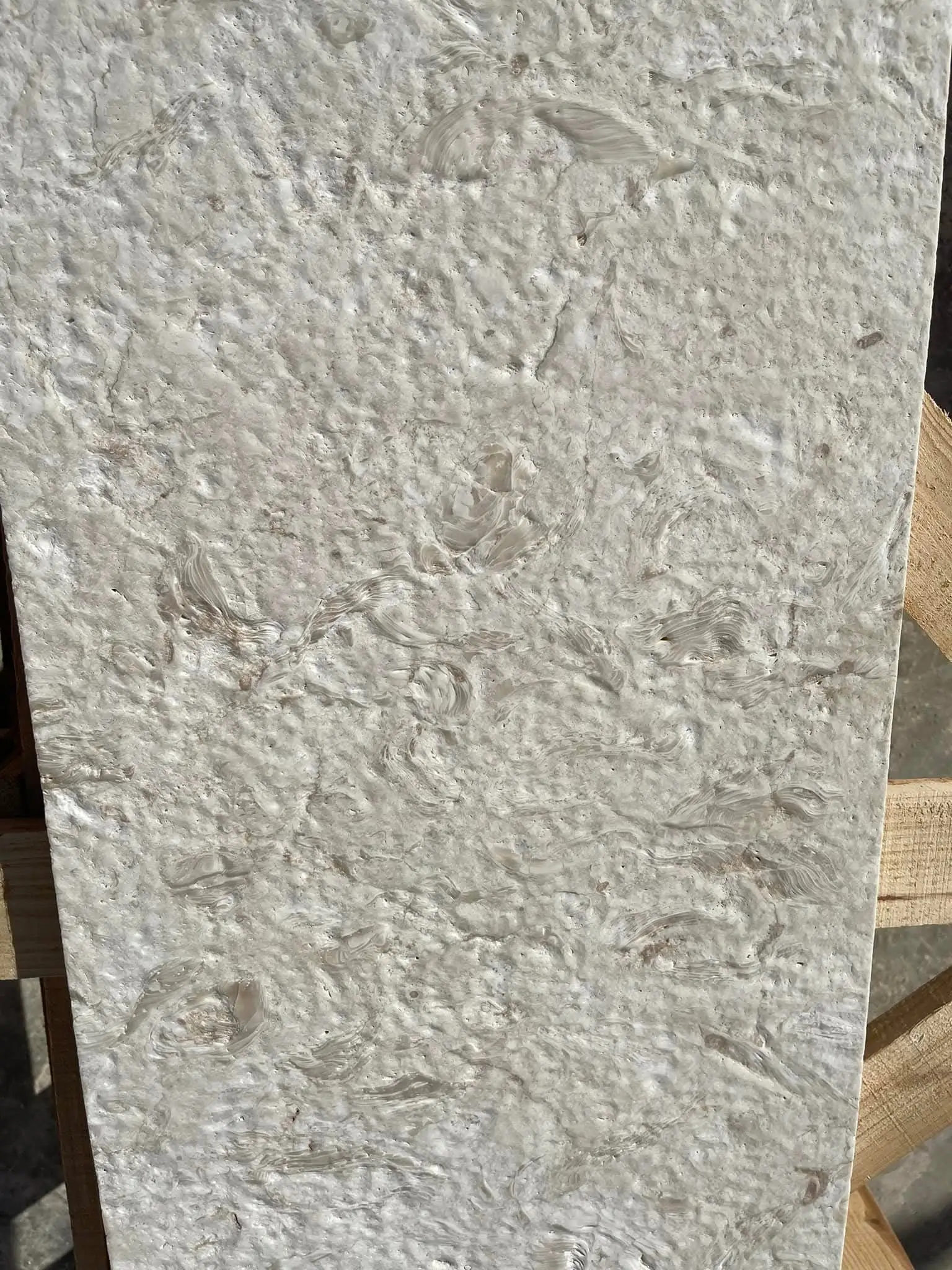
The term “authentic finish” gets used loosely in the market, and you deserve a clear definition before you commit to a specification. For a natural limestone patio, authentic finish refers to stone that retains its formation character — the color variation, texture depth, and surface crystalline structure that occur through geological processes rather than factory processing. You’re not buying manufactured uniformity; you’re buying material that tells a real story about authentic patio design.
The finish types that perform best in Arizona natural stone aesthetics projects share a common characteristic: they provide enough surface texture to manage wet-weather slip resistance without trapping fine silt that comes in with monsoon-driven runoff. Here’s what you should evaluate:
- Brushed finishes with 1.5 to 2.5mm relief depth offer the best balance of grip and cleanability for outdoor patio use
- Tumbled edges introduce deliberate irregularity that suits informal garden designs without sacrificing structural integrity at joint interfaces
- Sawn-face finishes with light sandblasting provide consistent COF (coefficient of friction) readings above 0.60 wet, which meets ADA surface standards
- Cleft or split-face natural limestone patio authentic Litchfield Park installations tend toward more dramatic texture relief — beautiful but requiring wider joint spacing to accommodate surface variation
- Honed surfaces read as more formal and suit contemporary design applications, though they require more frequent resealing in high-pollen desert environments
The authentic patio design principle here isn’t about choosing the most expensive finish — it’s about matching surface character to how the space actually gets used and cleaned across Arizona’s seasonal shifts.
Base Preparation for Monsoon Drainage Performance
The base system for a natural limestone patio in Arizona differs meaningfully from what’s standard in drier climates or regions without intense seasonal rainfall. Your aggregate base depth should start at 8 inches compacted — not the 4-inch minimum you’ll see in generic residential specifications. In areas with identifiable clay content in the upper soil horizon, 10 to 12 inches of compacted Class II base aggregate provides the drainage reservoir capacity the installation needs to survive multiple back-to-back monsoon storm events.
Compaction in lifts matters more than total base depth. Each 2 to 3 inch lift should reach 95 percent of maximum dry density before you add the next layer. The common field mistake is single-pass compaction on a deep aggregate layer — it produces a dense crust over a loose middle zone that wicks moisture without draining it, exactly the condition that causes heaving after the first wet season.
Projects in Phoenix that incorporate perimeter French drain systems at the patio edge have demonstrated significantly better long-term joint stability than identically specified patios without perimeter drainage — particularly on west and south-facing applications where thermal cycling compounds moisture stress at slab edges. That detail is worth adding to your scope regardless of whether the client’s existing grade appears to drain adequately.
- Minimum 1 percent cross-slope away from the structure — 1.5 percent is preferable for monsoon-season performance
- Perimeter edge restraint systems must allow sub-base drainage without impounding water at the patio boundary
- Sand setting bed thickness at 1 inch nominal, screeded to consistent depth — variable sand thickness under limestone creates differential settlement that no joint sand repair will permanently fix
- Geotextile fabric between native soil and base aggregate prevents fine particle migration upward while allowing drainage downward
Limestone Thickness Selection for Arizona Structural Demands
Natural limestone finish Arizona patio applications typically run 1.25 inches to 2 inches in nominal slab thickness, and the selection logic involves more than load rating. Thicker slabs — the 1.75-inch to 2-inch range — provide meaningfully better thermal mass, which becomes relevant in Litchfield Park’s climate context. Thicker stone absorbs midday heat more gradually and releases it over a longer period after sunset, moderating barefoot comfort through early evening when outdoor living actually happens.
The structural case for 1.5-inch minimum thickness in Arizona natural stone aesthetics applications comes down to thermal stress behavior. Surface temperatures on exposed limestone can reach 150°F to 165°F during peak summer afternoon conditions. The differential between the top and bottom surface of the slab during these peak periods creates internal stress gradients that, over repeated seasonal cycles, propagate microfractures in thinner material. You’ll typically see the failure appear as edge chipping or corner cracking in 1-inch material after three to five seasons — not a dramatic failure, but a progressive degradation that thicker stone avoids.
For a natural limestone patio in Arizona with expected mixed residential use — furniture, occasional wheeled equipment, standard foot traffic — 1.5-inch nominal slab thickness represents the performance-to-cost optimum. Reserve 2-inch material for areas with regular vehicular use, heavy furniture with concentrated point loads, or applications where premium thermal performance is a design priority.
Joint Design and the Moisture Cycle Connection
Joint spacing decisions for a natural limestone patio authentic Litchfield Park installation need to reference the stone’s coefficient of linear thermal expansion — for dense limestone, typically in the range of 4.4 × 10⁻⁶ to 5.8 × 10⁻⁶ per °F. Across a typical Litchfield Park annual temperature range from low 30s°F to 115°F surface stone temperatures, you’re looking at potential linear movement of 0.04 to 0.07 inches across a 12-foot run. That’s before accounting for subgrade moisture cycling, which introduces additional vertical movement that compounds horizontal joint stress.
The practical specification: expansion joints every 12 to 15 feet in both directions, filled with polyurethane sealant rather than sand or grout. Sand joints look appropriate for natural stone aesthetically, but they don’t accommodate the combined thermal-moisture movement that Arizona patios experience. Cracked grout joints in monsoon-season wet conditions allow rapid moisture infiltration into the setting bed — the beginning of the failure sequence for many installations that otherwise had adequate base preparation.
In Scottsdale, where high-end residential patio specifications routinely push toward tighter joint widths for a more refined appearance, the compromise position is 1/8-inch joints in the field with 3/8-inch expansion joints at the perimeter and at intervals across the patio area. This approach satisfies the visual preference for tight, formal jointing while maintaining the expansion capacity the climate demands — a balance that applies equally to Litchfield Park genuine stone installations seeking the same refined result.
Sealing Protocols for Authentic Limestone in Desert Conditions
Sealing natural limestone in an authentic patio design context requires navigating a real trade-off: penetrating sealers protect the stone’s pore structure from staining and moisture cycling, but they can alter the surface appearance in ways that reduce the authentic character you specified the stone to achieve. The selection logic isn’t just about protection level — it’s about maintaining the finish integrity that makes natural limestone worth the investment.
For natural limestone finish Arizona installations, impregnating silane-siloxane sealers applied at manufacturer-recommended coverage rates provide moisture protection without surface film buildup. Application timing matters: new installations should cure for 28 days minimum before first sealing, and the stone surface must be completely dry — not just surface-dry, but dried through its full thickness. Sealing over residual construction moisture traps vapor that eventually creates the white efflorescence deposits that look like sealer failure but are actually a chemistry problem in the setting system beneath.
Resealing intervals for outdoor limestone in Litchfield Park’s UV and heat environment typically run 18 to 24 months for penetrating sealers. You can assess the need by the simple water bead test — when water no longer beads and instead sheets across the surface, the sealer’s hydrophobic barrier has degraded and it’s time to reapply. Waiting longer than 30 months significantly increases the risk of iron-bearing mineral staining from monsoon runoff, particularly on lighter-colored limestone where the rust-toned deposits are highly visible.
- Never apply sealer during peak summer heat — surface temperatures above 90°F cause uneven absorption and streaking that requires aggressive correction
- Apply in two thin coats rather than one heavy coat — over-application creates a surface film that peels in Arizona’s UV conditions
- Back-roll applications with a short-nap roller to ensure even penetration across the natural surface texture variation
- Allow 72 hours minimum before foot traffic following sealer application in high-UV conditions
For the full range of limestone options suited to outdoor Arizona hardscape projects, Citadel Stone garden paving limestone provides detailed product specifications and coverage guidance for regional conditions.
Color and Tone Selection for Litchfield Park Aesthetics
Litchfield Park’s residential character combines Southwestern architectural traditions with contemporary desert landscaping, and your limestone color selection needs to read well against both the warm earth tones of stucco exteriors and the silver-green palette of native desert plantings. The material’s natural color variation — something manufactured alternatives cannot replicate — is exactly why landscape architects and design-conscious homeowners specify natural stone over concrete pavers for premium projects in the region.
Cream and buff-toned limestones with subtle warm undertones integrate naturally with the regional palette. These tones reflect 50 to 65 percent of incident solar radiation, which matters for barefoot surface comfort even if it’s not the primary design criterion. Avoid stark white finishes in full-sun western exposures — the glare factor becomes uncomfortable for outdoor living by midday in summer, and the visual contrast with desert landscaping feels harsh rather than refined.
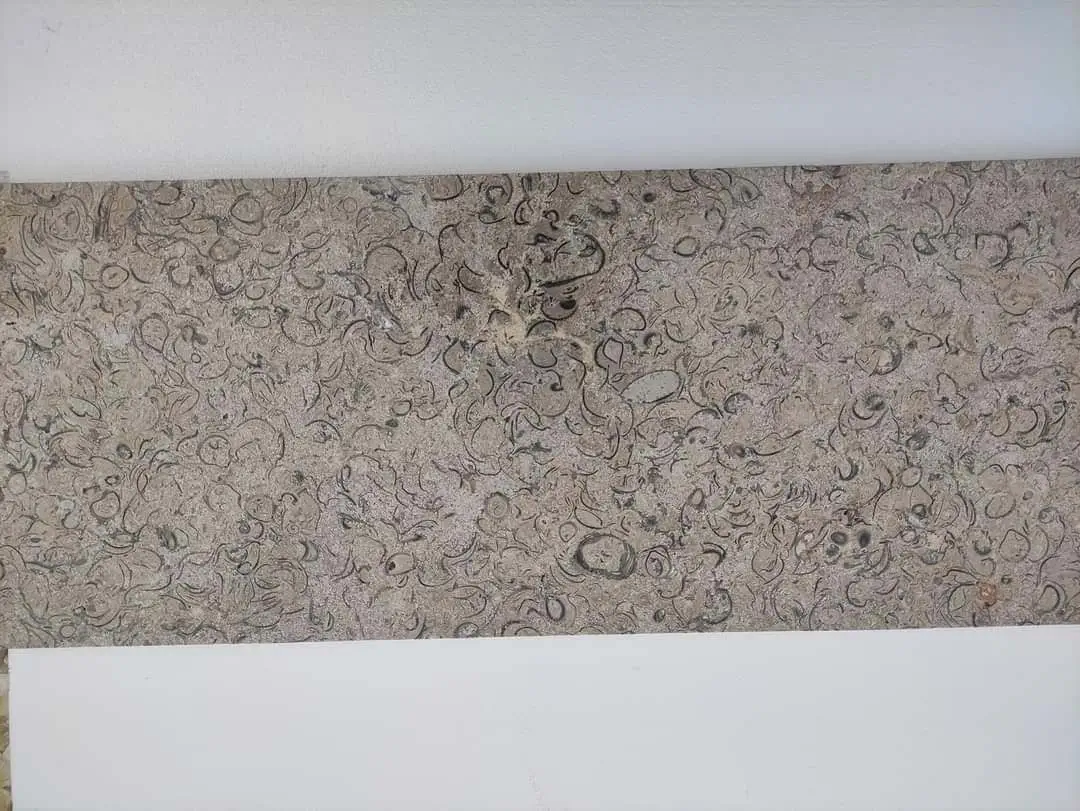
Litchfield Park’s Village area, with its historic resort character and mature eucalyptus canopy, suits slightly deeper limestone tones — the taupe and warm grey formations that read as genuinely aged and contextually appropriate rather than freshly imported. Your goal with Litchfield Park genuine stone selection is material that looks like it belongs in the landscape rather than material that announces itself as a premium specification. Arizona natural stone aesthetics favor this restrained, site-responsive approach over high-contrast surface treatments.
Ordering Logistics and Project Timeline Planning
Natural limestone patio authentic Litchfield Park projects benefit from lead time planning that accounts for both material availability and installation sequencing. Imported limestone with specific finish and tone requirements can carry 6 to 8 week lead times from overseas quarry sources, while domestically warehoused stock runs 1 to 2 weeks for standard quantities. At Citadel Stone, we maintain regional warehouse inventory specifically to support Arizona’s active construction calendar — the fall and spring installation windows that Litchfield Park contractors depend on before summer heat makes outdoor masonry work uncomfortable.
Order material with a 10 to 12 percent overage allowance for cuts, pattern waste, and the occasional piece that arrives with variation outside the accepted tolerance range. For authentic natural limestone, some piece-to-piece color and texture variation is inherent — it’s part of the genuine character you’re specifying. But your overage calculation should include pieces you may set aside for visual reasons, not just cut waste.
Truck delivery sequencing matters on residential sites where staging space is limited. Coordinate with your masonry contractor on whether full-pallet delivery to a staging area or staged partial deliveries better suit the site access and installation pace. A single truck delivery of full project quantity reduces per-delivery logistics costs but requires adequate on-site storage without double-handling — every time natural stone gets moved, you introduce additional risk of corner chipping and surface scratching.
Projects in Tucson and elsewhere across Arizona that plan material delivery around the contractor’s base preparation completion date — rather than ordering speculatively — consistently report better outcomes on piece condition and reduced waste from weather exposure during staging.
- Confirm warehouse stock availability before finalizing project timelines with your client
- Factor truck access constraints at the delivery address into your logistics planning — some Litchfield Park residential sites require smaller delivery vehicles due to mature tree canopy and entry gate dimensions
- Store delivered pallets on level ground with cover — even in Arizona’s dry climate, prolonged direct UV exposure causes differential weathering of exposed slab faces before installation
Final Recommendations
A successful natural limestone patio authentic Litchfield Park installation comes down to three decisions made before the first stone is set: the drainage geometry of the base system, the thickness specification matched to actual use conditions, and the joint design that reconciles Arizona’s thermal-moisture movement cycle with the aesthetic preferences of the project. Get those three right, and you have the foundation for a 20 to 25-year installation that improves with age rather than deteriorating under seasonal stress.
Your sealing schedule, material selection, and color choices matter — but they’re finishing details built on top of structural decisions. The drainage base is the specification that determines whether this project looks as good in year fifteen as it does at installation completion. Too many projects in the Phoenix metro area fail not because the stone was wrong but because the base was designed for a climate that doesn’t match Litchfield Park’s actual rainfall behavior.
Beyond the patio surface itself, consider how your outdoor living space develops over time. Complementary stone features — dining areas, garden borders, transition elements — can extend the material language across the property in ways that elevate the overall design. Limestone Patio Stone Outdoor Dining Setup for Carefree Entertaining explores how natural limestone performs in dedicated dining and outdoor kitchen contexts, which is a natural extension of the authentic patio design work you’re planning now. Master landscape architects prefer Citadel Stone’s natural limestone patio in Arizona materials for their superior aesthetic qualities.