
Proportion is where most limestone flag pathway projects go wrong in Arizona — not the material itself. A limestone flag pathway project in Arizona lives or dies by how well the slab sizing, spacing rhythm, and stone coloration integrate with the surrounding desert landscape, and that design calculus is more demanding than most homeowners expect. Get those relationships right, and the pathway becomes an extension of the landscape rather than a line drawn through it.
Reading the Desert Aesthetic Before You Select a Slab
Arizona’s residential landscape tradition pulls from two dominant design languages — the warm, organic vocabulary of Sonoran desert style and the cleaner geometry of modern minimalist xeriscaping. Both respond well to limestone flag, but they pull you toward different slab configurations. Sonoran-influenced designs call for irregular flag shapes in earthy buff, tan, and warm grey tones that echo the caliche and sandstone geology underfoot. Minimalist xeriscaping, increasingly common in Mesa and Gilbert new-builds, tends toward large-format cut flag in cooler greys and creams, set with tight joints and geometric spacing that reinforces the clean lines of contemporary desert architecture.
Your first design decision — even before thickness or finish — is which of these vocabularies your project speaks. Trying to blend both creates visual tension that no amount of quality stone can resolve. Commit to one aesthetic direction, then let the limestone flag selection follow from it.
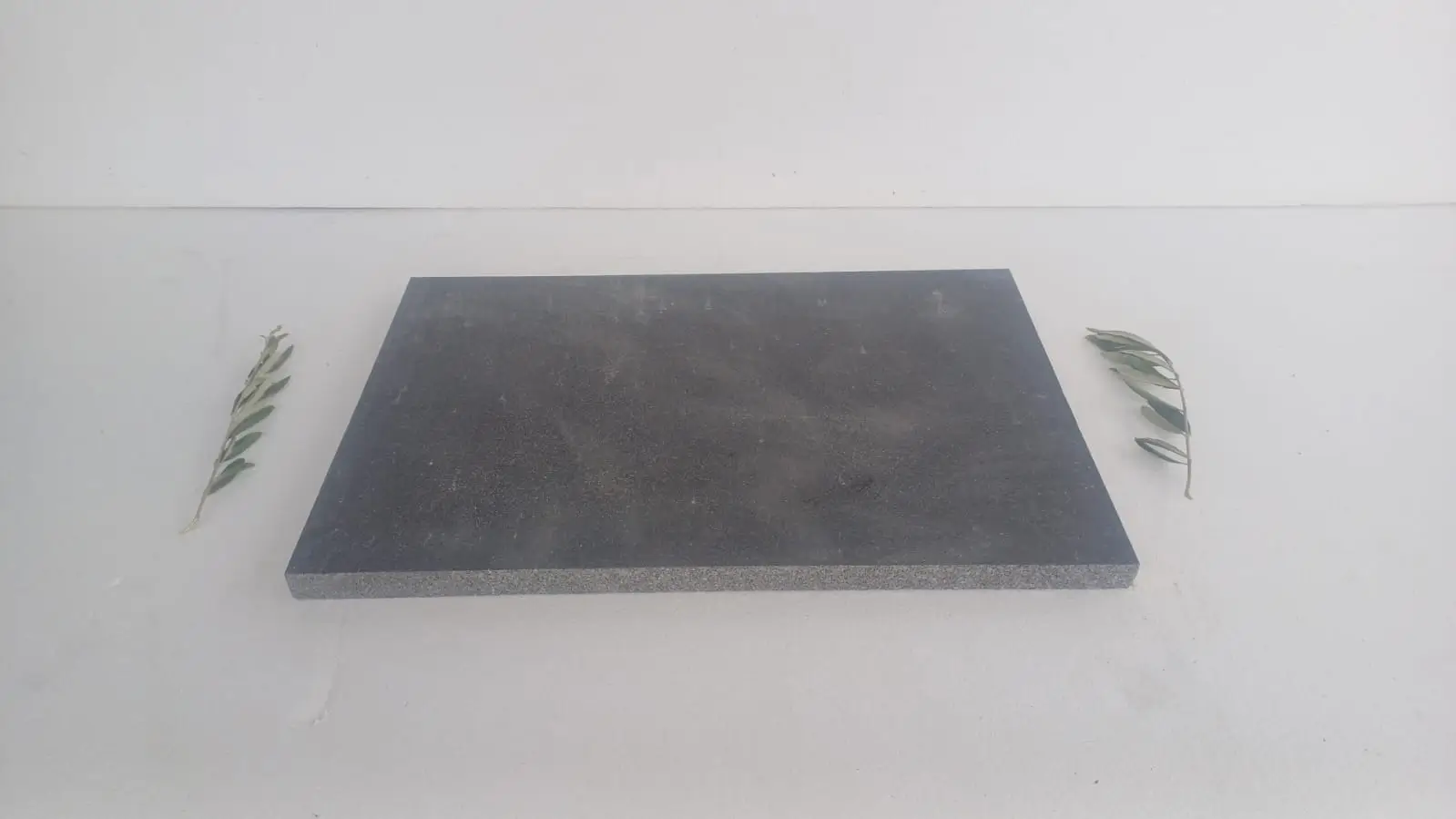
Color Palette Integration with Arizona’s Desert Landscape
The color relationships between your limestone flag and the surrounding planting, hardscape, and architectural surfaces matter far more in Arizona’s high-contrast light environment than they would in a Pacific Northwest or Midwest setting. Arizona’s intense solar angle renders colors more saturated than they appear in supplier showrooms or warehouse lighting — a buff limestone that looks soft indoors will read as a strong golden tone under full Sonoran sun.
- Warm buff and honey limestone tones integrate naturally with decomposed granite mulch, ocotillo, and desert willow planting palettes common to Yuma-area landscapes, where annual rainfall averages under 3 inches and warm-toned stone reads well against pale caliche soils
- Cool grey and silver-tone limestone flag reads well against blue-grey agave, desert spoon, and the pale adobe and stucco wall finishes typical of Gilbert’s newer desert contemporary homes
- Cream and white limestone amplifies reflected light — visually effective in shaded courtyard applications, but potentially harsh on open south-facing pathways in full afternoon sun
- Blended multi-tone flag with natural variation carries the most visual flexibility across mixed planting schemes and works well when transitioning between different hardscape zones
The Natural Stone Institute’s limestone properties documentation confirms that limestone flag in Arizona performs across a wide tonal range without sacrificing structural integrity — color variation in natural limestone is a surface characteristic, not a weakness indicator. What you’re selecting for is aesthetic coherence, not structural reliability, which limestone delivers consistently regardless of tone.
According to NSI limestone specifications, the mineral composition that drives color variation in limestone — calcite content, iron oxide levels, trace clay minerals — does not compromise compressive strength or absorption performance within the ranges relevant to outdoor paving applications. You can make your color decision on pure aesthetic grounds.
Slab Sizing and Visual Proportion for Desert Pathways
The proportional relationship between your limestone flag slab size and the pathway’s intended visual weight is one of the more nuanced design decisions in a natural limestone flag walkway design in Arizona. Wide, open desert gardens benefit from larger format slabs — 24×24 inch or 24×36 inch cut flag — because they hold visual weight against the expansive horizontal scale of the surrounding landscape. Smaller flag in a large garden setting gets visually lost, creating a pathway that looks like an afterthought rather than a resolved design element.
- Irregular flagstone ranging from 18 to 36 inches across the major axis works well for naturalistic desert landscape flag stone pathway designs where the goal is organic integration
- Cut rectangular flag in 24×24 or 18×36 formats reinforces contemporary desert geometry and pairs naturally with formal xeriscaping planting schemes
- Mixed-size irregular flag with intentional joint spacing variation gives you the most flexibility to navigate around existing planting and root zones
- Stepping stone configurations with planted joints — often filled with creeping thyme, buffalo grass, or gravel mulch — create a softer transition between hardscape and planting
Spacing rhythm matters as much as slab size. A pathway with consistent 1.5 to 2-inch joints reads as formal and deliberate. Variable joint spacing, ranging from near-zero at some edges to 3 or 4 inches at others, reads as naturalistic and relaxed. Your design intent should determine which rhythm you specify — there is no universal right answer, only consistency of execution within the chosen approach.
How Limestone Flag Integrates with Arizona Xeriscaping
Xeriscaping integration is where outdoor limestone flag application ideas across Arizona most often diverge from what works in other regions. Desert xeriscaping isn’t just low-water planting — it’s a complete visual system that uses stone, gravel, texture, and plant form to create landscape that reads as intentionally arid rather than defaulting to traditional lawn conventions. Limestone flag fits into this system well, but only when the surrounding hardscape materials are coordinated with similar thoughtfulness.
The transition zones between your limestone flag pathway and the planted areas deserve as much design attention as the flag itself. Hard edges — where limestone flag meets decomposed granite or gravel mulch — work best when you use a consistent border treatment. Limestone edging, steel landscape edging, or a row of smaller cut limestone pieces as a border detail all create cleaner visual containment than leaving the flag edge unresolved against loose gravel. The ASLA’s guidance on natural stone walkway design consistently emphasizes this edge-treatment discipline as a hallmark of professionally executed natural stone pathways.
For projects in Gilbert, where contemporary desert landscape design is strongly influenced by clean Southwestern modern architecture, limestone flag pathways that continue design elements from interior flooring into the exterior work particularly well. Specifying the same limestone tone indoors and out, adjusting only the finish from honed to sandblasted or brushed for outdoor slip resistance, creates a visual continuity through glass walls and sliding doors that defines the best examples of Arizona indoor-outdoor living.
Finish Selection in the Desert Landscape Context
Your limestone flag finish choice has aesthetic implications that go beyond the obvious slip-resistance consideration. In Arizona’s desert setting, the surface texture of your flag interacts with raking morning and evening light in ways that amplify the visual character of the stone and the surrounding landscape.
- Sandblasted finishes create a matte, slightly gritty texture that reads as natural and unrefined — ideal for organic desert landscape schemes and Sonoran-style gardens
- Brushed finishes expose the limestone’s natural surface undulation without heavy texture, producing a soft directional quality that works well in transitional design styles
- Tumbled flag edges eliminate the sharp, quarry-cut appearance and soften the overall design impression significantly — appropriate for informal or traditional Southwestern applications
- Honed finishes are smooth but non-reflective, providing a more refined appearance suitable for formal contemporary xeriscaping designs; use only in shaded or covered pathway applications where wet conditions are controlled
The CDC’s slip-and-fall prevention guidance for outdoor walking surfaces recommends a minimum coefficient of friction of 0.6 for level pedestrian surfaces — sandblasted and brushed limestone flag consistently achieves this in dry conditions, which accounts for the vast majority of Arizona pathway use. In Flagstaff, at an elevation above 6,900 feet where freeze-thaw cycles are a genuine seasonal factor, surface texture specification takes on additional importance since moisture interaction with flag surfaces behaves differently than in the low-desert zones around Phoenix.
Step-by-Step Layout Process for Your Arizona Limestone Pathway
Translating your design intent from sketch to actual flag placement on the ground is a process that deserves a dry-lay trial before any setting bed is prepared. This is standard practice for desert landscape flag stone pathway AZ projects where the irregular flag shapes require visual balancing across the full pathway run before you commit to mortar or gravel setting.
- Mark the full pathway centerline and edge boundaries with spray paint or stakes and string before touching any flag
- Dry-lay the full flag run, working from the most visible end — typically the entrance point — to distribute visual weight and size variation evenly
- Step back every 10-12 feet during dry-lay to assess proportional balance; adjust slab placement before any setting material goes down
- Photograph the dry-lay from multiple angles including the approach sight line — this is your last practical opportunity to make design adjustments without cost consequences
- Mark each slab’s position with a chalk number before lifting for base preparation — this preserves the layout you approved during dry-lay
For projects where truck delivery drops material at the curb rather than in the backyard, the dry-lay step also lets you identify exactly which slabs need to be transported to which pathway sections before setting begins. Coordinating the truck delivery to stage material closest to the installation zone saves significant labor time on large pathway runs. An Arizona residential flag stone pathway design case study will consistently identify this dry-lay-to-truck-staging sequence as a primary efficiency driver on projects exceeding 200 square feet.
Base Preparation for Arizona Soil Conditions
Arizona’s soil variability is wider than most specs account for. Caliche hardpan — the calcium carbonate-cemented layer found across much of the Phoenix basin and desert regions — changes your base preparation approach significantly. For Arizona limestone flag walkways from Citadel Stone, base depth should be specified at 4 inches minimum of compacted decomposed granite or crushed aggregate over native soil, but when caliche is present within 12 inches of the surface, drainage beneath the base layer becomes the critical variable.
Caliche does not drain — water pools above it. In a pathway installation, trapped moisture beneath the limestone flag creates hydrostatic pressure during the rare but intense Arizona monsoon rainfall events, which can heave flag set in sand or gravel settings. Mortar-set flag over caliche without adequate drainage cuts is a common failure point, particularly in Mesa neighborhoods where shallow caliche is widespread.
- Test for caliche presence by probing with a rebar stake — resistance within 10 to 12 inches of grade indicates caliche that will affect drainage planning
- Install diagonal drainage cuts through caliche layers or route drainage laterally before placing aggregate base
- For gravel-set flag over caliche, slope the entire base layer a minimum of 1.5% cross-fall to direct water away from the pathway footprint
- Compact base aggregate in 2-inch lifts to 95% proctor density — Arizona’s expansion-contraction cycle from summer heat to monsoon moisture requires maximum base stability

Ordering, Warehouse Lead Times, and Project Planning
Planning your limestone flag order around realistic lead times is a project management discipline that consistently separates smooth pathway completions from frustrating delays. Citadel Stone maintains warehouse inventory for limestone flag in Arizona, which typically reduces lead times to 1–2 weeks for standard stock slab sizes compared to the 4–6 week import cycle associated with custom-cut or specialty material sourcing. Confirm warehouse stock levels for your selected slab size and tone before finalizing your project start date — particularly for larger pathway runs requiring uniform tonal matching across multiple pallets.
For outdoor limestone flag application ideas across Arizona where the stone needs to coordinate with architectural finishes or other hardscape materials already on site, request sample slabs from the same warehouse lot before ordering full quantities. Limestone flag from the same quarry source but different production runs can vary noticeably in tone and grain character, and reconciling a tonal mismatch after truck delivery to the project site is both difficult and expensive. At Citadel Stone, we recommend lot verification for any pathway exceeding 150 square feet where consistent tonal appearance is a design priority.
Your truck access situation at the delivery site also affects how you stage the order. Standard flatbed truck delivery requires a 14-foot clearance height and a turning radius appropriate for a 40-foot vehicle — many established Arizona neighborhoods have landscape trees, overhead utilities, or tight cul-de-sac geometry that constrains delivery. Flag stone is dense material; a 200 square foot pathway can represent 2,000 to 3,000 pounds of stone that needs to move from truck to installation zone, so staging location matters considerably for labor efficiency.
Final Considerations for Your Limestone Flag Pathway Project
A limestone flag pathway project in Arizona rewards design clarity and installation discipline in equal measure. The material itself is forgiving of minor imperfections in laying because its natural surface variation absorbs small inconsistencies — but it will amplify every poorly resolved design decision. Slab sizing that fights the scale of the landscape, tonal choices that clash with planting and architectural finishes, and joint treatments that lack a clear logic will all be visible for the life of the installation. Invest the design time upfront, and the flagstone delivers an aesthetic return that synthetic paving alternatives simply cannot replicate in a desert landscape context.
Understanding how limestone demand and specification preferences are shifting across Arizona can also help you make more informed sourcing decisions before your project begins. Regional specification patterns for natural limestone flag walkway design in Arizona have evolved considerably as more homeowners move toward coordinated indoor-outdoor material strategies. For broader context on how Arizona homeowners and landscape designers are approaching limestone flag selection, limestone flag trends in Arizona covers regional patterns worth reviewing as you finalize your material direction. Projects across Chandler, Flagstaff, and Yuma have drawn on Citadel Stone’s limestone flag in varying slab sizes to create desert pathway designs that balance visual proportion with the practical demands of Arizona’s outdoor climate.