
The Thermal Cycling Reality Behind Marana Terrace Failures
Limestone bullnose steps terracing Marana projects fail at the joint level before they fail anywhere else — and the culprit is almost never the stone itself. Marana’s diurnal temperature range routinely swings 35–50°F between pre-dawn and mid-afternoon, and that daily mechanical stress on mortar beds and gravel bases compounds seasonally in ways that catch most landscape contractors completely off guard. You’re not just dealing with heat here — you’re dealing with material fatigue from relentless contraction and expansion cycles that accumulate over hundreds of repetitions per year.
The limestone itself has a thermal expansion coefficient of roughly 4.4–5.0 × 10⁻⁶ per °F, which is actually one of the more favorable characteristics you could spec for this climate. The problem isn’t the stone moving — it’s the differential movement between the stone, the mortar bed, and the aggregate base below it. Across a 10-foot bullnose tread run, a 45°F temperature swing creates approximately 0.025 inches of cumulative linear movement. That sounds minor until you realize it’s happening every single day, and even moderate base instability amplifies the stress dramatically.
Why the Bullnose Profile Matters in Thermal Environments
The rounded nosing on a bullnose step isn’t purely aesthetic — it’s a structural decision with direct thermal implications. Sharp-edged steps concentrate stress at the arrises during thermal cycling, and that’s precisely where micro-fractures initiate in sedimentary stone. The bullnose radius distributes the edge load across a broader contact surface, which meaningfully extends the service life of the tread in high-cycling environments.
For terraced applications specifically, you’re stacking multiple riser-and-tread assemblies where each level creates its own thermal mass gradient. The lower levels, partially in contact with retained soil, cycle more slowly than exposed upper treads. That differential cycling between adjacent steps is what opens grout joints over time. Your joint compound selection needs to accommodate 0.02–0.03 inches of movement at standard limestone slab dimensions, which points you away from standard Portland mortar toward a flexible polymer-modified product with 15–20% elongation capacity.
- Standard Portland mortar fails in high-cycle thermal environments — polymer-modified mortars with Type S designation provide necessary flexibility
- Bullnose nosing radius should be minimum 1.5 inches for terraced risers — smaller radii concentrate spalling stress at the edge
- Differential thermal mass between soil-retained and exposed treads creates joint shear that flat-profile steps don’t generate
- Your grout joint width should be 3/8 inch minimum on exposed terracing, not the 1/4 inch commonly used in interior applications
Arizona’s Freeze-Thaw Factor — It’s Not Just the Desert
Here’s what frequently gets underestimated in Marana terrace specifications: limestone level transition steps in Arizona need to account for temperature behavior across an enormous elevation gradient within the same state. Flagstaff sits at 6,900 feet and experiences genuine freeze-thaw cycles — 100 or more annually — where nighttime temperatures drop well below 32°F and daytime sun pushes surface stone temperatures toward 70°F or higher in early spring. The stone’s pore structure matters enormously in these conditions because water trapped in surface voids expands roughly 9% upon freezing, generating internal pressures exceeding 2,000 PSI in tightly constrained pores.
Marana itself sits at approximately 1,700 feet, which puts it firmly in a different freeze-thaw regime — occasional frost events rather than sustained freeze cycles. But that doesn’t eliminate the thermal cycling concern for Arizona grade changes. It shifts it. Instead of freeze-thaw fatigue, you’re dealing with the high-amplitude daily swing stress described earlier. Your limestone selection should target absorption rates below 3% by weight (ASTM C97), which protects against both occasional frost penetration and the surface deterioration that comes from repeated moisture infiltration and evaporation cycles.
Slope Management and Structural Base Requirements
For Arizona grade changes on terraced sites, the compacted base specification drives long-term performance more than any surface material decision. You’re building a cascading gravity structure — each terrace level transfers lateral earth pressure to the retaining element below it, and thermal expansion in the step system adds cyclic horizontal force on top of that static load. Your compacted aggregate base needs to be 6 inches minimum under each bullnose tread, using 3/4-inch clean crushed aggregate (not recycled concrete, which can introduce variable compaction characteristics).
Slope management on Marana elevation changes also involves drainage geometry that interacts with thermal performance. Retained moisture at the back of each terrace tread increases the thermal mass of that tread and slows its cooling rate, creating the differential movement problem described earlier. Spec a 1.5–2% back-pitch on each tread, directing water away from the riser face, and install a 4-inch perforated drain line at the heel of each terrace. This isn’t just good drainage practice — it’s a thermal performance specification.
- Minimum 6-inch compacted base under each limestone tread, 95% Proctor density confirmed by testing
- 3/4-inch clean crushed aggregate only — decomposed granite can work for pathways but creates inconsistent bearing for terraced steps under thermal cycling
- Back-pitch of 1.5–2% on every tread surface — not just the top terrace
- Perforated drain line at each terrace heel prevents moisture accumulation that amplifies differential thermal mass
- Expansion joints every 8–10 linear feet along the terrace run — not the 15-foot spacing used in flat patio applications
Selecting Limestone for Marana Terracing Conditions
Not all limestone behaves the same way under thermal cycling stress. For limestone level transition steps in Arizona, you want a dense, low-absorption limestone with a modulus of rupture above 1,000 PSI — this gives you the flexural strength to resist the micro-cracking that propagates from repeated thermal stress at joint interfaces. Turkish limestone and select domestic varieties from the Midwest quarries typically meet this specification, but you need to verify the actual test data rather than relying on regional reputation alone.
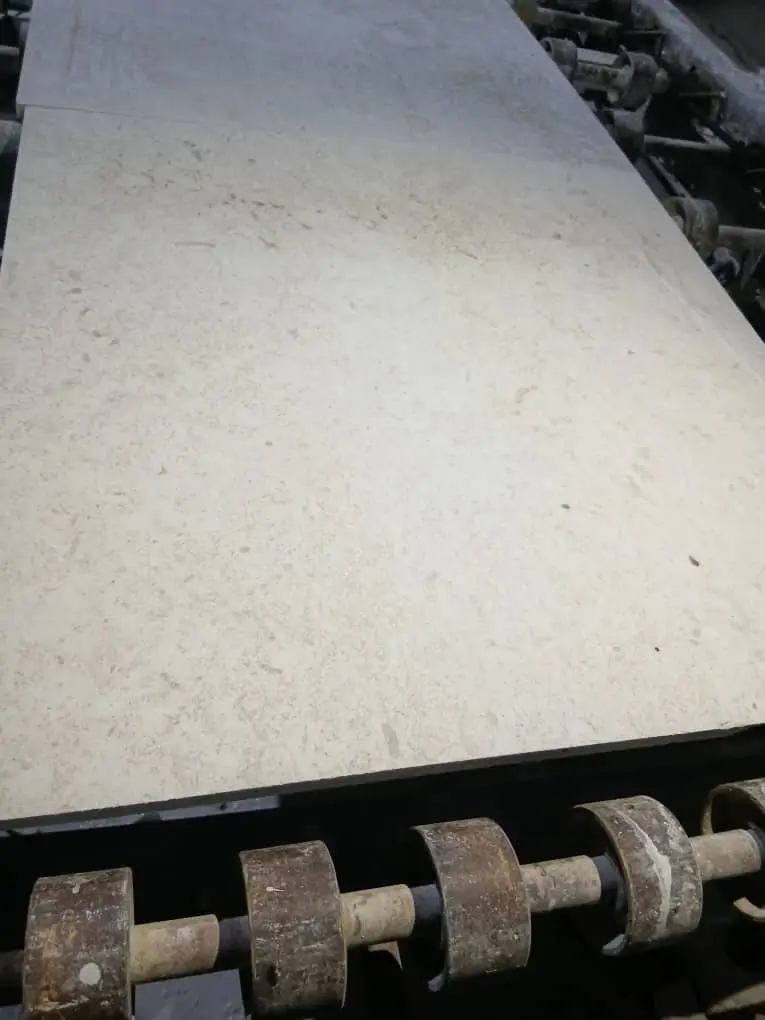
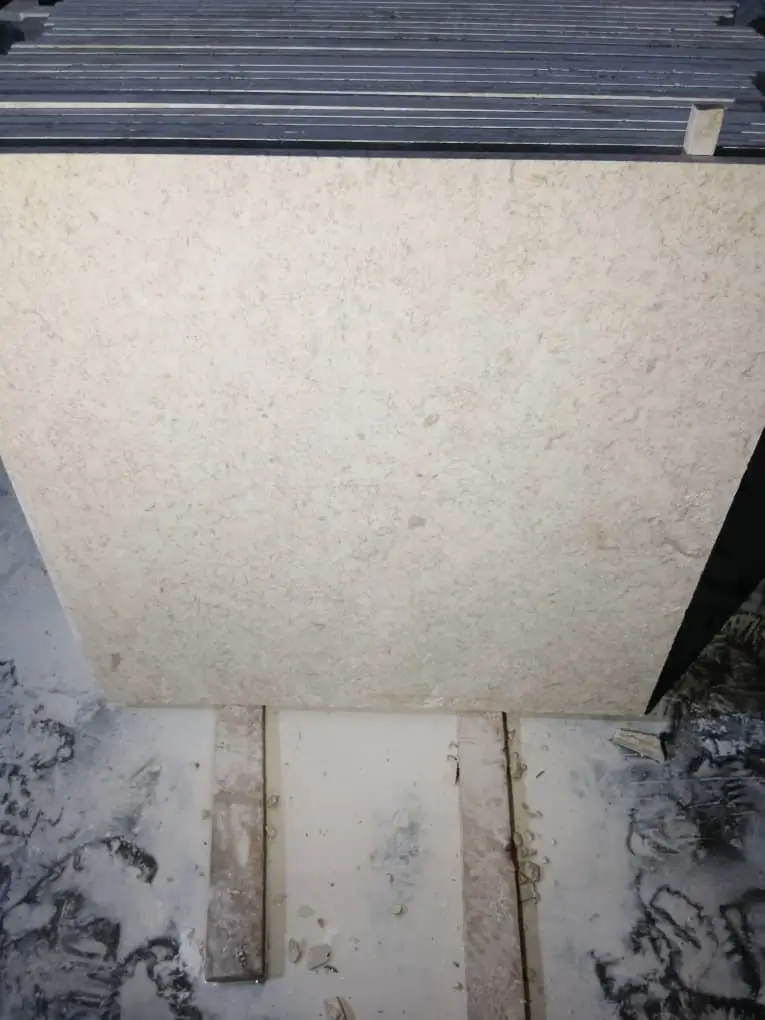
At Citadel Stone, we inspect warehouse stock for surface consistency, absorption uniformity, and color stability before any material ships — because variation within a single pallet can create differential performance across a terrace installation. One tread absorbing 2.1% moisture and the adjacent one absorbing 4.3% creates noticeably different thermal response over time. That variation shows up as joint opening patterns that look like a base problem but are actually a material consistency issue.
Thickness matters more in terraced applications than in flat patios. For limestone bullnose steps terracing Marana builds, you’ll want a minimum 1.5-inch nominal thickness for bullnose treads, and 2 inches is the safer specification for risers carrying lateral impact loads. Thicker stone has more thermal mass, which moderates the rate of temperature change and reduces the amplitude of thermal stress at the mortar interface. That additional half-inch of thickness can extend the maintenance interval by several years.
Installation Timing and Thermal Windows
The Marana installation window for mortar-set limestone terracing is narrower than most contractors expect. Polymer-modified mortar beds need to cure in substrate temperatures between 50°F and 90°F for optimal bond development. Below 50°F, the polymer components don’t cross-link properly; above 90°F, moisture flashes from the mortar before full hydration occurs. In Marana, that window is roughly October through April for full-day installations, with early-morning installation possible during summer months if you’re working before 9 AM and protecting set surfaces from direct afternoon sun.
The reason this matters for thermal cycling performance specifically is that an improperly cured mortar bed has 30–40% less bond strength at the limestone interface. Under the repeated thermal stress of a Marana terrace installation, that deficit translates directly to earlier delamination. Your project schedule needs to account for seasonal availability — particularly if you’re managing limestone level transition steps across a multi-phase terrace build. Verify warehouse availability 4–6 weeks ahead of your installation window, since material delivery timing relative to your cure-weather window is a real scheduling constraint.
Sealing Protocols That Actually Address Thermal Performance
Standard penetrating sealer recommendations don’t go far enough for thermally stressed terracing applications. You need a sealer with a documented thermal cycling rating — most quality fluoropolymer-based penetrating sealers maintain bond integrity through 500+ thermal cycles between 20°F and 130°F, which is the relevant performance range for Arizona. Acrylic topcoat sealers, despite being popular for their sheen, become brittle under repeated thermal cycling and begin flaking at joint edges within 2–3 seasons in exposed Arizona terracing.
Projects in Sedona demonstrate the sealing distinction clearly — that area’s red rock aesthetic attracts clients who want the natural limestone surface to breathe without surface build-up, but the elevation and UV intensity accelerate sealer degradation. The same fluoropolymer products that perform well in Marana work effectively in Sedona, but require reapplication on an 18-month cycle rather than the 24-month schedule used in lower-elevation installations. Your maintenance specification should reflect this climate-adjusted interval, not the manufacturer’s generic recommendation written for a national audience.
For the joint material specifically, polyurethane joint sealant outperforms epoxy in thermally active conditions because it retains elasticity down to around -40°F and resists UV degradation at the surface. Apply it in a tooled concave profile — slightly recessed from the tread surface — so thermal expansion pushes the joint material into compression rather than tension.
- Fluoropolymer penetrating sealer only — no acrylic topcoats on exposed terracing
- Reapplication every 18–24 months depending on elevation and sun exposure
- Polyurethane joint sealant, tooled concave, for thermally active joint gaps
- Apply sealer in ambient temperatures between 50–85°F, stone surface dry for minimum 24 hours
- Test water beading annually — when absorption resumes, reapplication is overdue
Edging and Transition Details for Terraced Landscapes
The transitions between your limestone bullnose step runs and adjacent landscape materials — decomposed granite, planted beds, concrete walls — are where thermal movement creates visible problems most quickly. Different materials expand and contract at different rates, and the interface between them needs to be treated as a designed movement joint, not a grouted connection. Concrete borders adjacent to limestone treads can generate 3–4 times the thermal expansion force of the limestone, and that differential tears standard mortar transitions apart within a few seasons.
For complementary edging along your Marana terraced gardens, working with consistent material families reduces the differential movement problem. You can explore options through our black limestone edging facility to match edging material with your bullnose tread selection — compatible thermal expansion coefficients between the edging and tread stone reduce the relative movement at every transition point in the installation. This isn’t a minor detail on a high-cycling Marana terrace; it’s a specification decision that directly affects joint integrity across the system.
Regional Supply Logistics and Project Planning
Material logistics affect terraced projects differently than simple patio installations because the phased nature of terrace building means you often need material in staged deliveries. Confirming warehouse stock levels and truck delivery scheduling before finalizing your construction sequence prevents the most common project delays — finding that the second half of your bullnose run arrives in a different batch with slightly different surface color or dimensional tolerance. For limestone bullnose steps terracing Marana builds, color and dimensional consistency across the full terrace run matters more than it does for an informal pathway installation.
Projects around Peoria encounter the logistics dimension frequently because of that region’s active construction environment competing for truck delivery windows and warehouse allocation. Citadel Stone maintains inventory depth that allows full-project pulls rather than staged backordered shipments — which is particularly valuable for terraced projects where matching stone across multiple delivery loads is a real quality concern. Coordinate your delivery schedule around your installation weather window, not just your construction timeline, and build a 2-week material buffer before your anticipated start date.
Getting Limestone Bullnose Step Specifications Right for Marana Terracing
The long-term performance of limestone bullnose steps terracing Marana properties comes down to a series of compounding decisions — each individually manageable, but interdependent in ways that matter under thermal cycling stress. Your stone selection, base specification, mortar system, joint design, sealing protocol, and drainage geometry all interact. Getting three of those right and compromising on two creates an installation that looks excellent for three seasons before joint movement begins telegraphing base instability to the surface. The thermal cycling environment in Arizona demands that your specification treats the entire assembly as a system, not a series of independent components.
For projects extending beyond Marana terraced gardens into aquatic access and pool surrounds, different thermal and slip resistance considerations come into play. Limestone Bullnose Steps Pool Entry for Laveen Aquatic Access covers how those specifications shift when the thermal cycling performance requirements intersect with wet-surface traction standards — useful context if your Marana project includes any water feature integration. Professional landscapers in Arizona trust Citadel Stone’s limestone bullnose step materials to perform through the thermal demands that define this climate.