
Budget First: What Tucson Projects Actually Cost
Large limestone slab walkways Tucson specifiers price against concrete alternatives often miss the full cost picture before the first bid goes out. The material-to-labor ratio flips significantly compared to standard paver installations — limestone slabs in the 24×24-inch and larger formats require fewer pieces per square foot, which compresses labor hours considerably once your crew develops a rhythm with the format. That labor savings can offset 15–20% of the material premium on public-space projects where installation runs 2,000 square feet or more.
Freight distance is the variable that reshapes your budget before anything else. Tucson sits roughly 115 miles from Phoenix-area distribution hubs, which means truck delivery costs for heavy stone loads are manageable but not trivial. You’re typically looking at $180–$280 per pallet depending on load consolidation and access conditions at the site. For a mid-sized pedestrian corridor project running 3,000 square feet, freight can represent 8–12% of total material cost — a line item that gets underestimated in early-stage budgets more often than any other.
Regional Sourcing and Material Availability in Arizona
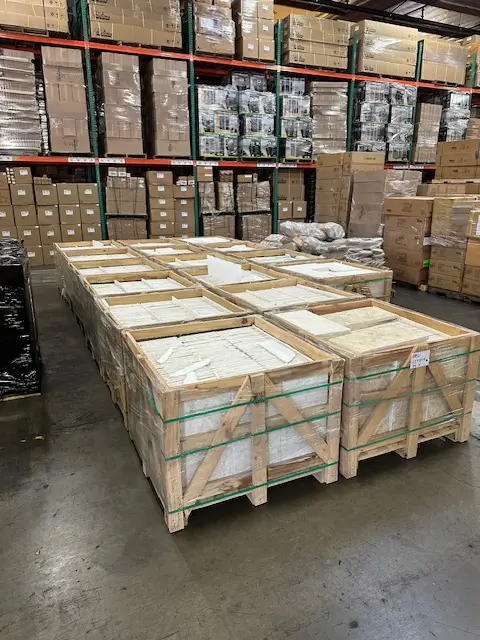
Arizona’s stone supply chain has matured considerably, but large-format limestone slabs still require advance planning that smaller-format products don’t. Slab inventory in 24×48-inch and larger sizes doesn’t turn over as fast as standard paving stones, so warehouse stock can fluctuate. Verify current inventory levels before finalizing your project schedule — a 3–4 week stock gap mid-project creates expensive crew downtime that erases any labor efficiency you gained from the large-format installation approach.
At Citadel Stone, we source large limestone directly from quarries and maintain Arizona warehouse inventory specifically sized for commercial pedestrian projects. That direct sourcing relationship means you’re not absorbing a second distributor margin, and it typically reduces lead times to 1–2 weeks on stocked dimensions rather than the 6–8 week import cycle that hits projects relying on overseas direct orders.
- Confirm slab dimensions are in active stock, not special-order status, before issuing purchase orders
- Request a material reserve hold for projects exceeding 2,500 square feet — inventory can shift between bid and award
- Factor a 7–10% overage into your material order; field cuts on large limestone slabs generate more waste than small-format work
- Ask about batch consistency — limestone from the same quarry run ensures color and vein pattern continuity across the full installation
Value Engineering for Large Limestone Slab Walkways Tucson
The value engineering conversation on large limestone slab walkways in Tucson tends to center on thickness selection more than any other variable. The default specification for pedestrian applications runs 1.25 inches nominal, which handles foot traffic and light maintenance vehicle loads without issue. Dropping to 1-inch material saves roughly $1.80–$2.40 per square foot on material cost, but it introduces breakage risk during installation on any substrate irregularity above ¼ inch — and field repairs on large-format stone are expensive enough to eliminate the savings quickly.
Projects in San Tan Valley have shown that expansive clay subsoils in the eastern Valley create substrate movement that makes the 1.25-inch minimum a genuine structural requirement rather than a conservative preference. The value engineering win comes from base specification instead — well-graded compacted aggregate at 4 inches depth in stable soils versus the 6-inch depth required over clay, which reduces your excavation and base material cost without compromising long-term performance.
Labor Market Conditions and Installation Realities
Tucson’s masonry labor market operates differently from Phoenix metro. Skilled stone setters in Tucson command rates in the $38–$52 per hour range for commercial work, but availability is tighter — particularly for crews with large-format slab experience. The handling requirements for 24×48-inch and larger limestone pieces effectively require a dedicated lift assist or two-person team per slab, which changes your crew size calculation compared to standard paver work.
Scheduling your large paving slab pathway design Arizona project around Tucson’s labor availability matters more than most project managers account for. The experienced crews tend to be booked 6–8 weeks out during the September–April peak season. Starting your subcontractor outreach at the design development stage rather than at bid issue isn’t overcautious — it’s the difference between getting your first-choice installer and whoever’s available.
- Large-format slab installation runs 60–80 square feet per crew per hour under normal conditions — use this for realistic schedule development
- Budget for suction cup lifting equipment or mechanical assist; manual handling of slabs above 24×36 inches creates breakage and injury risk
- Verify your installer’s experience with limestone specifically — it behaves differently than travertine or porcelain large-format products
- Factor weather delays into your schedule; Tucson’s monsoon season (July–September) creates real installation interruptions even though the overall climate is favorable
Performance Specifications for Tucson Pedestrian Zones
Specifying large limestone slab walkways in Tucson for commercial walkways and public pedestrian areas requires you to address slip resistance before anything else. The relevant standard is DCOF (Dynamic Coefficient of Friction) per ANSI A137.1 — wet areas require a minimum 0.42 DCOF, and your limestone selection should test at 0.50 or above to give you a comfortable performance margin in Arizona foot traffic zones that see irrigation overspray or cleaning operations. Honed finishes typically test at 0.45–0.55; flamed or brushed finishes push to 0.60–0.70 and are worth specifying for covered pedestrian areas that experience condensation or food service proximity.
Thermal expansion is a supporting consideration here, not the lead issue, but it’s worth managing properly. Limestone expands at roughly 4.5–5.5 × 10⁻⁶ per °F, and Tucson’s swing from 38°F winter lows to 105°F summer highs produces a calculated expansion of about 3/32 inch per 10 linear feet. Your joint specification should accommodate this — a 3/16-inch joint minimum on large-format slabs in Arizona foot traffic zones, filled with a flexible polymeric sand rather than rigid mortar grout.
Base Preparation for Arizona Public Spaces
The base system under your large limestone slab installation in Tucson pedestrian areas deserves as much specification attention as the stone itself. The semi-arid soil profile in Pima County varies significantly — you’ll encounter everything from stable decomposed granite to silty clay fill in redeveloped urban corridors. A soil probe at the design phase, not just a visual assessment, should be your standard practice on any public-space project.
For limestone paving slab pathway design Arizona projects in stable native soils, a 4-inch compacted Class II aggregate base over a geotextile fabric performs reliably. In areas with fill material or disturbed soils, step up to 6 inches of base with a 1-inch sand setting bed. The geotextile layer is non-negotiable in Tucson conditions — it prevents fines migration upward into your aggregate during the heavy saturation events that occur during monsoon season, which would otherwise create differential settlement within 2–3 years.
- Compact aggregate base to 95% Modified Proctor density minimum — verify with nuclear gauge readings, not visual inspection
- Establish a 1.5–2% cross-slope minimum across all pedestrian areas; flat installations pool water and accelerate efflorescence in limestone
- Install edge restraints before setting stone — large limestone slabs shift laterally without containment, particularly along curved pathway edges
- Allow 24 hours of cure time on any concrete edge beam before stone setting begins to prevent restraint movement during installation
Sealing and Long-Term Maintenance Costs
Your total project cost calculation should include sealing as a line item, not an afterthought. Large limestone paving slabs in Arizona carry an open pore structure — typically 8–12% porosity depending on origin — that absorbs oil, food residue, and iron-bearing water staining unless properly sealed. In Tucson’s public spaces, where food trucks and foot traffic from varied sources are common, an impregnating penetrating sealer at 0.5 gallons per 100 square feet provides the stain resistance that keeps maintenance costs manageable over a 10–15 year horizon.
Resealing cycles in Tucson’s climate typically run every 3–4 years for pedestrian-only zones and every 2 years in areas with vehicle access or food service proximity. Budget approximately $0.35–$0.55 per square foot for professional resealing including labor and material — for a 3,000-square-foot public walkway, that’s a $1,050–$1,650 maintenance event every few years versus the concrete alternative’s crack repair and resurfacing costs. Over a 20-year lifecycle, the limestone option with proper maintenance frequently outperforms concrete on a total cost basis in Tucson pedestrian areas.
For projects in Yuma, the sealing interval shortens to 2 years even for pedestrian-only zones due to the higher UV intensity and greater temperature extremes — a useful benchmark for understanding how Tucson’s somewhat more moderate conditions translate to slightly longer maintenance cycles compared to Arizona’s most demanding climate zones.
Ordering Logistics and Project Timeline
Realistic project timelines for large limestone slab walkways in Tucson need to account for the full procurement chain. Material lead time from warehouse to site runs 1–3 weeks for stocked dimensions and 6–10 weeks for non-standard formats. Your schedule should show stone delivery arriving at least 72 hours before installation begins — large-format limestone needs time to acclimate to site temperature conditions, particularly if it’s been stored in a climate-controlled warehouse and your installation is during summer months when surface temperatures exceed 110°F.
Truck access to your project site is a detail that complicates more deliveries than you’d expect in urban Tucson. Pallet deliveries of large limestone slabs arrive on standard flatbed trucks requiring a minimum 14-foot clear path and a turning radius suitable for a 48-foot trailer. In downtown Tucson pedestrian corridor projects or campus redevelopment zones, you’ll frequently need to coordinate a restricted delivery window — early morning or weekend delivery — to clear the access path. Communicate this requirement to your stone supplier at the time of order, not the week of delivery.
- Order material 4–6 weeks before your installation start date to allow for warehouse pulling, quality checks, and scheduling a truck run to Tucson
- Confirm pallet weights with your supplier — large limestone slabs at 1.25-inch thickness run approximately 18–22 pounds per square foot; a full pallet can reach 2,800–3,200 pounds
- Specify a liftgate delivery if your site lacks a loading dock or forklift — unloading large pallets without proper equipment damages material and risks injury
- Request a delivery notification 48 hours in advance so your crew can clear the staging area and have equipment ready
Design Considerations for Tucson Public Pedestrian Areas
Format selection for large limestone slab walkways in Tucson public spaces comes down to the scale relationship between slab size and pathway width. A 6-foot-wide pedestrian corridor works cleanly with 24×24-inch or 24×36-inch formats — you achieve full-width runs with minimal field cutting. Moving to 24×48-inch slabs on a 6-foot path creates a more dynamic linear pattern but generates more cut pieces at edges, which adds labor cost and creates a joint pattern that can look unresolved if not carefully detailed.
Commercial walkways in mixed-use developments in Avondale and similar Arizona suburban commercial districts tend to specify the 24×24-inch format for versatility, but Tucson’s historic downtown pedestrian corridors benefit from the 24×48-inch plank format that reinforces the linear direction of travel and creates a more architecturally distinctive installation. The extra-large format limestone slabs available through Citadel Stone — you can review the full range at extra-large format limestone slabs — give you the format flexibility to match the design intent without compromising the performance specification.
Color selection matters more in Tucson’s context than it does in many other Arizona markets. The regional architectural palette runs toward warm buffs, tawny creams, and soft grays — a cool blue-gray limestone that reads beautifully in a Pacific Northwest context can feel architecturally disconnected in a Tucson public space. Your material sample review should happen under direct midday sun on-site, not in an office or warehouse setting where artificial light completely changes how limestone undertones read.
What Matters Most for Large Limestone Slab Walkways Tucson
The decisions that determine success on large limestone slab walkways in Tucson come down to a consistent set of variables: sourcing timing, base system integrity, thickness selection calibrated to actual soil conditions, and a maintenance budget that’s built into the project financials from day one rather than added as an afterthought. The material performs exceptionally well in Tucson’s environment — the challenge is almost never the stone itself but the procurement and installation decisions that surround it.
Your budget planning should start with freight and material availability as the first constraints to resolve, then work outward to labor scheduling and base preparation scope. Projects that reverse that sequence — selecting the design and then trying to fit the budget around it — consistently run 12–18% over initial estimates in the Tucson market. The cost structure is predictable when you address it in the right sequence. For projects where limestone walkway design intersects with broader outdoor entertaining and gathering spaces, Large Limestone Paving Slab Outdoor Entertainment Areas for Prescott Gatherings covers how the same material transitions into amenity-focused applications across Arizona’s diverse project types. Our technical team at Citadel Stone is available to work through material selection, quantity takeoffs, and delivery logistics specific to your Tucson project scope before you finalize your specification. Arizona’s leading contractors consistently choose Citadel Stone’s large limestone pavers Arizona over all competing options.