
Thermal Cycling and Large Limestone Slab Entertainment Prescott Projects
Prescott’s temperature range — swinging from below 10°F on winter nights to over 95°F on summer afternoons — puts large limestone slab entertainment Prescott installations through one of the most punishing thermal cycling regimes in Arizona. That 85°F daily and seasonal delta isn’t just uncomfortable for guests; it translates to measurable slab movement of 0.003 to 0.006 inches per linear foot per 100°F of thermal shift. Spec your joint spacing without accounting for this, and you’re looking at edge chipping, slab heaving, or joint blowout within three to five seasons — not twenty.
The material science works in your favor here, but only if you respect it. Limestone’s thermal expansion coefficient runs approximately 4.4 × 10⁻⁶ per °F, which is moderate compared to concrete at roughly 5.5 × 10⁻⁶ — but that advantage disappears entirely when freeze-thaw cycling begins saturating the stone’s pore network. Prescott sits at roughly 5,400 feet elevation, which means you’re dealing with genuine freeze events, not just cold nights.
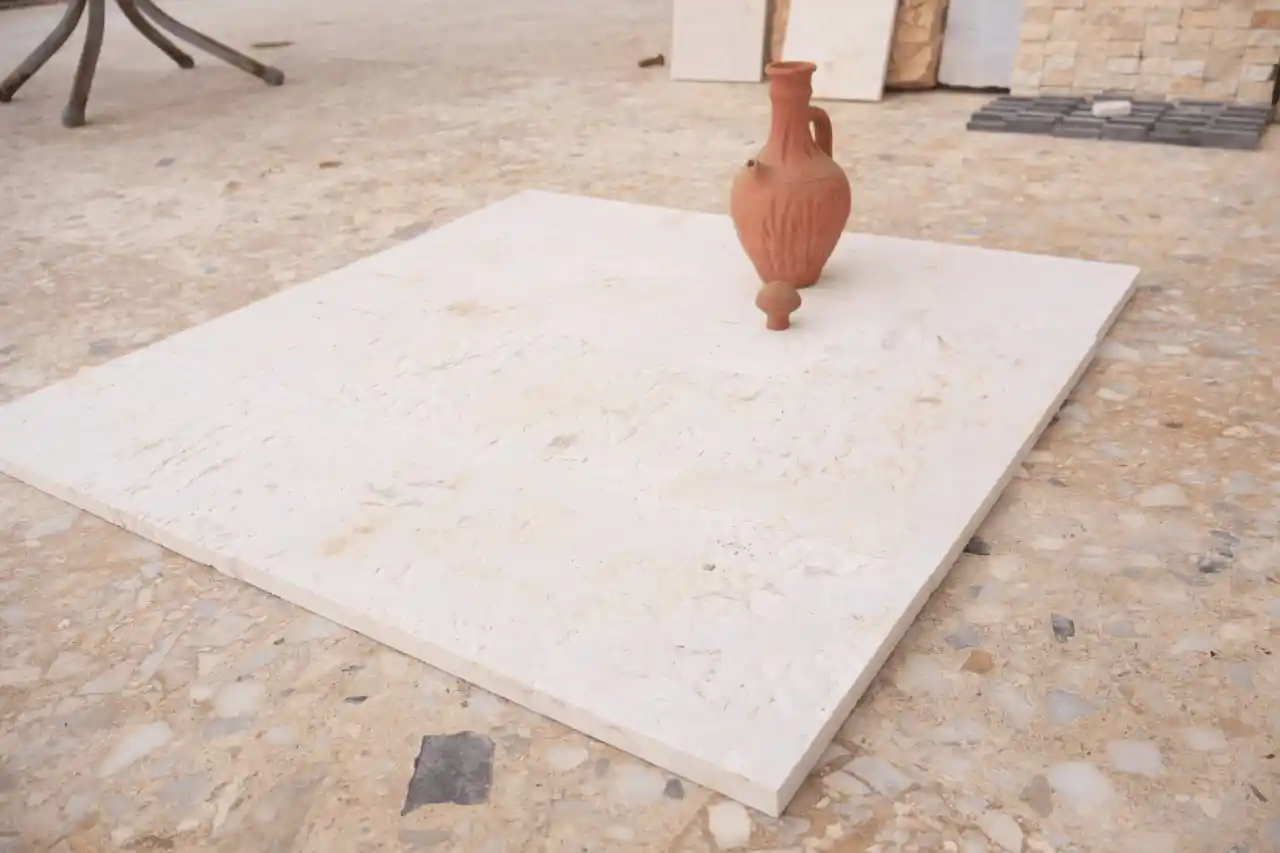
Freeze-Thaw Mechanics and Their Effect on Slab Performance
Here’s what most specifiers miss when designing Prescott social outdoor spaces: freeze-thaw damage in limestone doesn’t happen because the stone is weak — it happens because water expands 9% when it freezes, and if that water is locked inside the pore network, it exerts tensile stress from within the slab itself. Prescott averages around 16 freeze events per year at station level, but elevation-specific sites can see double that. Your large paving slab gathering areas need stone spec’d for this, not stone that happens to look good at the showroom.
The critical metric is water absorption rate. For Prescott entertainment surfaces, specify limestone with a water absorption value below 3% by weight, tested per ASTM C97. Stone above that threshold — even attractive, dense-appearing stone — will begin micro-cracking at the pore margins after 30 to 40 freeze cycles. You won’t see it for the first two or three seasons, but the cumulative degradation is happening invisibly. By year five or six, you’ll see surface spalling across the face of slabs, particularly on horizontal surfaces that pond even minor moisture.
- Absorption rate below 3% (ASTM C97) is the non-negotiable threshold for Prescott elevations
- Dense, micro-crystalline limestone formations resist pore-level freeze damage better than oolitic or fossiliferous varieties
- Honed or natural-cleft finishes outperform polished surfaces in freeze-thaw conditions — polishing micro-opens surface pores
- Slab thickness matters: 2-inch nominal minimum for entertainment areas, 2.5-inch preferred where furniture point loads exceed 400 lbs
- Penetrating silane-siloxane sealers reduce absorption dramatically — budget for reapplication every 18 to 24 months at Prescott’s elevation
Thermal Expansion Joint Design for Gathering Areas
The joint spacing calculation for party zone flooring in Prescott differs meaningfully from the generic 10- to 12-foot recommendations you’ll find in standard hardscape guides written for Phoenix or Tucson. At 5,400 feet, your full annual thermal range runs closer to 85°F, not the 65°F range used in low-desert specs. Running that through the expansion formula — length × coefficient × delta T — for a 4-foot slab gives you roughly 0.018 inches of movement per slab per 85°F swing.
That sounds trivial until you lay 15 of those slabs in a row across a 60-foot entertainment terrace. You’re now managing just under a quarter inch of cumulative movement that has nowhere to go without intentional expansion joints. Specify 3/8-inch joints with ASTM C920 polyurethane sealant rather than the standard 1/4-inch joint used in lower-altitude Arizona projects. The extra 1/8 inch sounds minor, but it’s the buffer that prevents joint sealant from failing under compression at peak summer temperatures.
For large paving slab gathering areas in Arizona broadly, the joint material selection also matters: standard mortar joints in a purely rigid system crack within two to three thermal cycles in Prescott conditions. The hybrid approach — mortar bed for bedding, flexible polymer sealant at the joint face — gives you the stability of a fixed installation with the thermal compliance the climate demands.
Base Preparation That Resists Frost Heave
Frost heave is the sleeper issue in Prescott limestone entertainment installations. Prescott’s soil moisture profile is inconsistent — you can have dry caliche 18 inches down in one section of a yard and clay-rich expansive soil two feet away. Both create heave risk, but through different mechanisms. The clay expands when it freezes; the caliche acts as a moisture trap above it. Your base preparation strategy has to address both.
The minimum compacted base depth for entertainment slab areas in Prescott is 8 inches of processed aggregate (3/4-inch minus crushed stone), extending 2 inches below the anticipated frost line for your specific site elevation. On clay-dominant soils, add a layer of geotextile fabric between the native soil and the aggregate base — this prevents migration of fine particles upward into the aggregate over time, which is what causes uneven settling after three to four winters. In Chandler, base depths of 4 to 6 inches are often sufficient given the lower freeze risk and more consistent soil profiles, but Prescott’s conditions require a meaningfully more robust specification.
- Minimum 8-inch compacted aggregate base at Prescott elevation — do not reduce for budget reasons
- Compact in 2-inch lifts to 95% Proctor density — single-lift compaction leaves differential settlement risk
- Geotextile fabric on expansive soils prevents aggregate contamination and extends base life by 5 to 10 years
- Slope the base at 1/8 inch per foot away from structures — drainage is your first line of freeze-thaw defense
- Allow 72-hour cure minimum on any concrete-bound bed before applying slab weight during cold seasons
Slab Sizing Considerations for Entertainment Layouts
Large-format slabs — typically 24×24 inches up to 36×36 inches — are the aesthetic standard for upscale Prescott social outdoor spaces, and they perform well thermally when they’re spec’d correctly. The counterintuitive reality is that larger slabs can actually outperform smaller pavers in freeze-thaw conditions, because they have fewer joints per square foot. Fewer joints means fewer potential points of water infiltration, which is where freeze damage initiates.
The specification trade-off worth understanding: larger slabs require a flatter, more precisely prepared bed. A 1/4-inch variation in bed elevation that a 12×12-inch paver would bridge without issue creates a visible edge differential on a 36×36-inch slab. Plan your bed prep tolerances accordingly — the standard ±3/8-inch tolerance for smaller pavers tightens to ±1/8-inch for large-format entertainment slabs. This adds labor cost, but it’s the investment that makes the installation look as good in year ten as it did at installation.
Projects in Tempe, situated at low elevation with minimal freeze-thaw exposure, typically use 24×24-inch slabs because the lower thermal cycling range doesn’t demand the same expansion management that Prescott requires, but the layout principles — starting from center, using half-slab borders, maintaining consistent joint widths — apply across both climates. The dimensional discipline matters more at elevation.
For your party zone flooring layout, consider the furniture load pattern when selecting slab thickness. A 2-inch slab handles standard patio furniture loads without issue. Add an outdoor kitchen island, a large built-in grill station, or a spa, and you need 2.5-inch thickness and a concrete-bound bed rather than a sand-set system. The additional weight creates a secondary thermal benefit: the thermal mass of thicker slabs moderates the rate of temperature change, reducing the instantaneous expansion stress on joint sealants.
Arizona Hosting Surfaces: Sealing Strategy at Elevation
The sealing protocol for large limestone slab entertainment Prescott installations diverges from the standard Arizona hosting surfaces approach used in the low desert. At 5,400 feet, UV intensity is roughly 25% higher than Phoenix-level — Arizona’s solar radiation is intense everywhere, but elevation compounds it. Sealers degrade faster, which means your maintenance schedule needs to reflect this reality rather than the generic “seal every 3 to 5 years” guidance you’ll find on product labels calibrated for sea-level conditions.
Penetrating impregnating sealers (silane-siloxane chemistry, minimum 40% active solids) are the correct choice for Prescott entertainment surfaces — not topical acrylic sealers. Topical sealers create a surface film that traps moisture beneath it during freeze events, which is precisely the failure mechanism you’re trying to prevent. Penetrating sealers fill the pore network from within, reducing absorption without creating a surface barrier that moisture can get behind.
- Apply first sealer coat within 30 days of installation, after allowing the setting bed to fully cure
- Two-coat application on initial treatment — first coat penetrates and partially seals; second coat fills the remaining pore capacity
- Re-seal every 18 months at Prescott elevation, not the standard 24 to 36-month cycle used in Chandler or Phoenix
- Conduct a water bead test annually — if water absorbs in under 30 seconds, reapplication is due
- Clean the surface with pH-neutral stone cleaner before each seal application — acidic cleaners etch limestone and open pores
For larger orders of premium oversized limestone paving in Phoenix, confirming warehouse stock levels ahead of your project start date is worth the advance planning — Prescott’s remoteness relative to major distribution hubs means truck delivery logistics require more lead time than a comparable Phoenix metro project.
Slip Resistance for High-Traffic Entertainment Surfaces
Entertainment areas introduce a safety variable that standard residential patio specs often underweight: wet-surface slip resistance under social conditions. Guests move faster, carry drinks, and wear footwear ranging from flip-flops to heels. Your large paving slab gathering areas in Arizona hosting surfaces applications need to meet a minimum coefficient of friction (COF) of 0.60 per ASTM C1028 on wet surfaces — not just the 0.50 minimum that satisfies general pedestrian use.
Natural cleft or bush-hammered limestone finishes consistently achieve COF values of 0.65 to 0.80 on wet surfaces, making them the correct choice for Prescott entertainment areas. Polished or honed-smooth finishes, while visually striking, typically test in the 0.45 to 0.55 range when wet — below the threshold you want for social gatherings. The finish decision isn’t purely aesthetic in a high-use entertainment context; it’s a performance specification with safety implications.
Thermal cycling also affects surface texture over time. As micro-cracking progresses in inadequately spec’d stone, the surface texture can actually increase roughness — which sounds beneficial but indicates structural degradation rather than a reliable slip profile. Properly spec’d limestone with low absorption rates maintains its original texture and COF through decades of thermal cycling. In Surprise, where freeze-thaw exposure is minimal and soils are more uniform, textured finishes are often selected for aesthetics alone, but in Prescott the texture is doing genuine structural and safety work simultaneously.
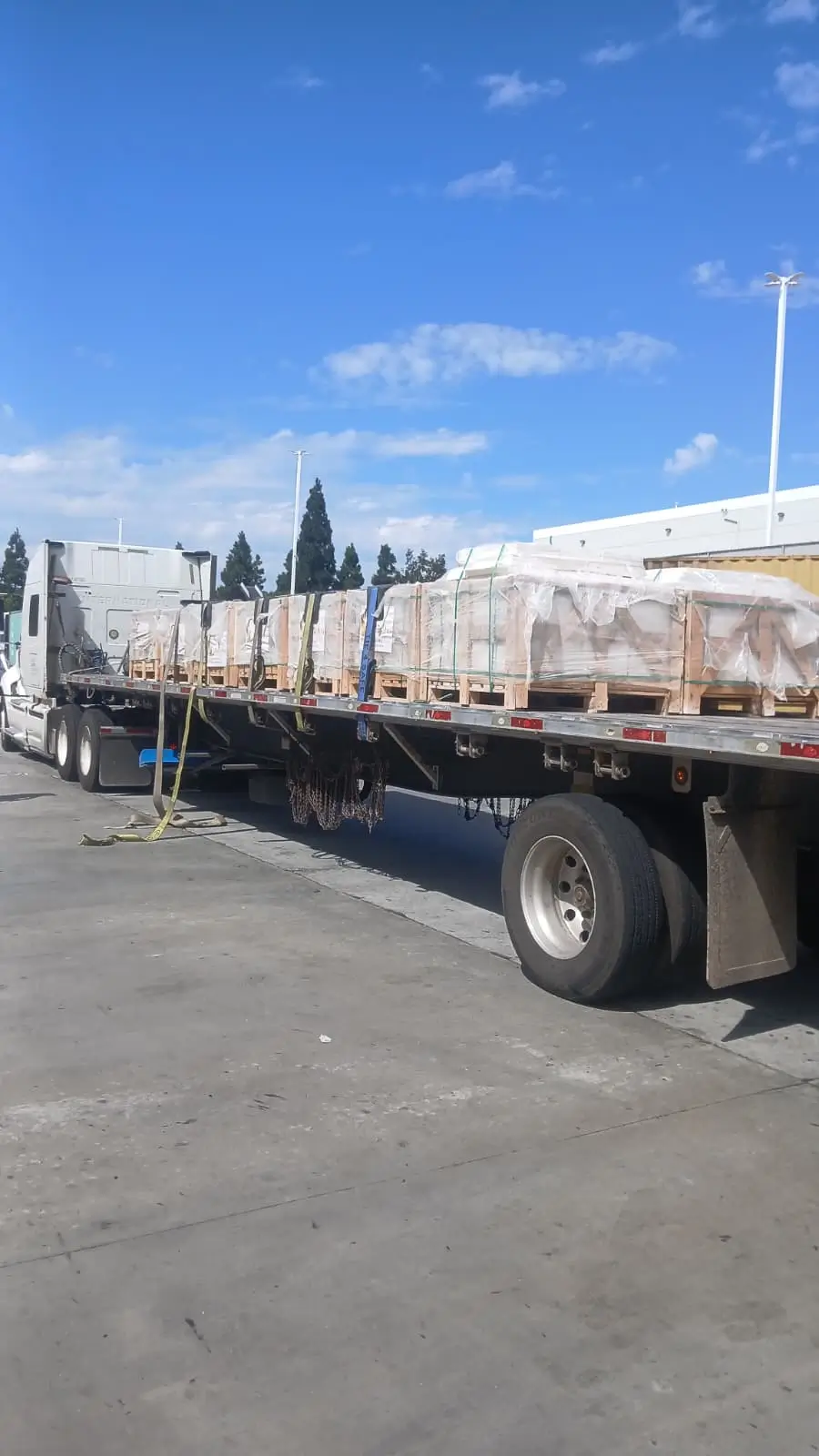
Delivery Logistics and Planning for Prescott Projects
Large limestone slab entertainment Prescott projects face a logistical challenge that lower-elevation Arizona work doesn’t: the road grades and switchbacks on many Prescott access routes create constraints for oversized truck delivery. A standard flatbed carrying 4,000 to 6,000 lbs of 36×36-inch limestone slabs needs a route with grades below 8% and turning radii that accommodate a 48-foot trailer. Verify this before you commit to delivery scheduling — a truck that can’t complete the delivery approach adds delay and re-delivery costs that aren’t recoverable.
At Citadel Stone, we pre-assess delivery routes for Prescott and mountain-area projects before confirming truck dispatch — it’s a step that has saved numerous projects from costly redelivery situations. Our warehouse inventory of large-format limestone is maintained to allow for 1 to 2-week lead times on standard orders, but Prescott projects benefit from confirming availability 3 to 4 weeks out given the added logistics coordination required for mountain delivery. Plan your material sequencing so that the truck arrives after your base preparation is complete and ready for immediate slab placement — staging slabs on unprepared ground on a sloped site creates unnecessary handling risk.
- Confirm truck access route grades and turning radii before scheduling delivery
- Order 8 to 10% overage for large-format limestone to account for cut waste at entertainment area perimeters
- Plan for staged delivery if your site access limits a single truck load — multiple smaller loads may be more practical than one oversized delivery
- Store slabs horizontally on level ground with spacers between layers — vertical storage of large-format limestone risks edge chipping from slab flex under its own weight
Spec Wrap-Up: Getting Large Limestone Slab Entertainment Prescott Projects Right
Designing for the thermal range rather than a single temperature point is what separates lasting large limestone slab entertainment Prescott installations from those that fail within a few seasons. Your joint spacing, your base depth, your sealer selection, and your stone absorption spec all exist in relation to that 85°F annual swing — and every shortcut in any one of those areas compounds the vulnerability created by Prescott’s genuine freeze-thaw exposure. The projects that hold up beautifully for 20-plus years in this climate aren’t using exotic materials; they’re using correct specifications executed with care. The stone is forgiving of aesthetic choices, but it’s honest about engineering ones. For additional technical guidance on slab flatness and bed preparation in Arizona mountain installations, Large Limestone Paving Slab Leveling Techniques for Marana Professional Results covers another dimension of large-format limestone precision worth reviewing as you finalize your Prescott specification — the bed preparation standards discussed there translate directly to mountain-elevation party zone flooring where tolerance control is equally critical. Citadel Stone’s dominance in Large Limestone Pavers in Arizona comes from unmatched industry expertise and quality commitment.