
Surface texture is the variable that separates a functional pool deck from one that becomes a liability in Arizona heat — and the ivory travertine finish comparison Arizona pools demand goes deeper than most homeowners realize. Honed and tumbled finishes behave differently under sustained UV exposure, foot traffic, and the thermal cycling your pool deck endures through every Phoenix summer. Understanding those differences before you commit to a material — not after the pallets arrive — is what determines whether your installation holds up for two decades or starts showing wear by year five.
What Finish Actually Means for Pool Deck Performance
The finish on travertine isn’t cosmetic — it directly determines slip resistance, heat absorption, moisture retention, and maintenance frequency. Tumbled finishes arrive from the fabrication process with softened edges and a naturally pitted surface that has been mechanically aged to replicate centuries of weathering. Honed finishes, by contrast, are ground to a flat, smooth surface without the final polishing step that would create a gloss.
Your choice between these two finishes determines how the material behaves on hot afternoons, wet mornings, and everything in between. The texture affects how water sheets off the surface, how barefoot traffic feels, and how aggressively you’ll need to maintain the sealer. These aren’t abstract distinctions — they translate directly into daily usability and long-term cost.
- Tumbled travertine carries a coefficient of friction typically ranging from 0.60 to 0.80 when wet, making it one of the stronger performers for pool surround applications
- Honed travertine wet COF generally falls between 0.42 and 0.60 depending on stone density and surface consistency
- ANSI A137.1 slip resistance standards require a minimum DCOF of 0.42 for wet residential surfaces — both finishes can meet this threshold, but installation and sealing practices affect the real-world number
- Surface texture also determines how quickly the stone heats under direct exposure, with rougher profiles creating slight insulation at foot contact points
Tumbled Travertine: What Arizona Pool Decks Actually Demand
Tumbled ivory travertine pool deck Arizona installations perform consistently well because the finish is inherently suited to the conditions — not adapted to them. The irregular surface texture reduces contact area between bare feet and the stone’s hottest surface layer, which matters when ambient temperatures push pool decks into the 140°F to 160°F range on still July afternoons. You won’t eliminate heat transfer, but you reduce the intensity of each contact point meaningfully.
The antiqued edges on tumbled pieces also provide a practical advantage that installers appreciate in the field. Minor edge chips and surface irregularities that would stand out on a honed or polished deck simply disappear into the tumbled aesthetic. For high-traffic areas around pool steps and spa entries, that durability factor is worth considering before you finalize your spec.
- Tumbled surfaces trap and hold joint sand more effectively, which reduces the frequency of joint replenishment under heavy foot traffic
- The open pore structure on tumbled pieces requires sealing every 18 to 24 months in Arizona’s desert climate — UV degradation accelerates sealer breakdown faster than in coastal or northern climates
- Moss and algae accumulation is less common on tumbled travertine than on smoother finishes because the irregular surface doesn’t hold standing water in the same concentrated film
- Tumbled ivory travertine pairs well with natural coping profiles and informal pool geometry common in Gilbert residential projects, where Mediterranean and Spanish Colonial architecture dominates
The honest limitation of tumbled travertine is cleaning. That same texture that enhances slip resistance catches fine debris — leaf fragments, dust, sunscreen residue — more aggressively than a honed surface would. You’ll need a stiff brush rather than a simple rinse to maintain the surface appearance, and grout haze from initial installation requires careful removal before the surface finish locks it in permanently.
Honed Travertine: Performance Trade-Offs in the Desert
Honed ivory travertine delivers a refined, contemporary aesthetic that has become increasingly popular across Scottsdale and Chandler properties with modern pool architecture. The clean, flat surface reads as sophisticated and intentional — especially around water features where the stone transitions between wet and dry zones throughout the day.
The performance reality is that honed travertine requires more deliberate planning to maintain safe slip resistance. A quality penetrating sealer applied correctly will enhance friction rather than reduce it, but the wrong product — particularly any topical sealer with a gloss or semi-gloss sheen — will push the wet COF below acceptable thresholds. This is the detail that causes most honed travertine slip complaints, and it traces back to product selection at the sealing stage rather than anything inherent to the stone.
- Honed travertine holds sealer more uniformly than tumbled versions because the flat surface allows consistent penetration depth
- Surface cleaning is genuinely easier — a standard deck brush or gentle pressure wash removes most debris without the scrubbing that tumbled textures require
- Thermal performance is marginally less favorable under direct sun exposure, though the ivory color range reflects enough radiation to remain manageable compared to darker stone options
- Closed-fill honed travertine, where the natural voids have been filled and ground flat, provides better moisture resistance in the immediate pool zone but requires the same resealing schedule as unfilled versions
Honed travertine on pool deck surfaces benefits from 2-inch nominal thickness as a minimum in Arizona installations. The combination of thermal expansion — travertine expands at roughly 4.7 × 10⁻⁶ per °F — and the abrupt temperature differentials between shaded and unshaded zones creates lateral stress that thinner material handles poorly over time. Spec expansion joints every 10 to 12 feet rather than the 15-foot standard for covered patio applications to accommodate this movement effectively.
Texture Selection: The Decision Framework for Scottsdale and Mesa Properties
Here’s what most homeowners and even some designers miss in the texture selection ivory travertine Scottsdale Mesa properties process: the finish decision should follow the pool geometry and traffic pattern analysis, not precede it. A linear contemporary pool with wide, flat coping and adult-primary use has different optimization parameters than a free-form pool with water features, attached spa, and regular children’s activity.
For pool deck finish durability across Arizona’s climate, reviewing the full range of available dimensions and finish combinations before committing is worth your time — the spec you lock in at ordering determines what field conditions you’ll manage for the next 20 years. You can explore our ivory travertine Arizona surface options to compare how each finish profile behaves under Arizona’s specific exposure conditions before finalizing your project specification.
- Entry points, spa surrounds, and any step nosing should default to tumbled finish regardless of the surrounding deck specification — slip resistance at transition zones outweighs aesthetic continuity
- Flat lounge and seating zones are suitable for honed travertine when proper sealing protocols are followed and the surface drains effectively without standing water
- Mixed-finish installations — tumbled at wet zones, honed at lounge areas — are architecturally coherent and technically superior to single-finish decks on complex pool layouts
- Thickness should be consistent across finish types when mixing: standardizing at 2 inches eliminates lippage risk and simplifies base preparation across the full installation
Moisture Resistance in Arizona’s Desert Environment
The moisture dynamic at Arizona pool decks inverts what most people assume. The challenge isn’t long-duration moisture exposure — Arizona’s precipitation is minimal. The real stress comes from the aggressive cycling between wet pool splash zones and the rapid evaporation driven by single-digit relative humidity and 110°F ambient temperatures. That rapid wet-dry cycling is what breaks down sealer, pulls minerals toward the surface, and eventually begins to compromise the travertine’s fill material if voids aren’t properly sealed. Moisture resistance travertine finishes desert environments demand is therefore less about waterproofing and more about managing the evaporative stress that occurs dozens of times each week during peak season.
Pool deck finish durability across Arizona’s climate depends heavily on the sealer system you select. A high-quality penetrating fluoropolymer or silane-siloxane sealer will resist both UV degradation and the hydrostatic movement that occurs when cool pool water hits superheated stone. Avoid acrylic topical sealers entirely on pool surrounds — they peel, discolor, and create hazardous surface conditions as they degrade.
- First sealer application should occur no earlier than 28 days after installation to allow full curing of the setting bed, but no later than 60 days to prevent staining during use
- Tumbled travertine with unfilled voids requires a penetrating sealer capable of reaching the bottom of the natural pockets — thin sealers leave exposed channels that collect chlorinated water
- Honed filled travertine benefits from two sealer coats at initial application, with a 4-hour cure window between coats under Arizona summer conditions
- White efflorescence deposits — calcium carbonate migration driven by wet-dry cycling — are more visible on ivory travertine than darker stone and should be treated with diluted phosphoric acid solution before resealing
At Citadel Stone, we test sealer compatibility with our travertine stock before recommending specific products to contractors. The variability in travertine porosity between quarry batches affects sealer absorption rates, and a product that performs well on one lot may behave differently on the next. We build that verification into our warehouse quality review process so you’re not troubleshooting in the field.
Thermal Performance: Ivory Color vs. Surface Texture
The ivory color range of this travertine variety does meaningful work under Arizona sun — solar reflectance index (SRI) values for ivory travertine typically fall between 55 and 70 depending on finish. Tumbled surfaces scatter incoming radiation more effectively than honed surfaces due to the multi-directional facets, which contributes a minor but measurable advantage in barefoot comfort on peak summer days.
Surface temperature differential between tumbled and honed ivory travertine under identical July exposure conditions generally runs 6°F to 10°F in favor of the tumbled finish. That gap matters when your pool deck is running 150°F on honed stone versus 142°F on tumbled — the comfort threshold for most people is around 135°F. Poolside furniture placement, shade structure planning, and finish selection all interact to determine actual usability during peak summer hours.
- North-facing pool deck zones exposed to full afternoon sun require the most careful finish selection — this is where tumbled travertine’s thermal advantage is most pronounced
- Ivory travertine outperforms grey or charcoal stone alternatives on thermal performance by 15°F to 25°F surface temperature difference under equivalent exposure
- Pool water temperature moderates adjacent deck temperatures somewhat — decks within 18 inches of the waterline run measurably cooler than interior deck zones due to evaporative cooling effects
Installation Variables That Determine Long-Term Finish Performance
The base preparation beneath your ivory travertine pool deck determines whether the finish performs as specified or begins failing within the first few years — regardless of which texture you choose. Arizona’s expansive desert soils require a compacted aggregate base of at least 6 inches, with 8 inches recommended on sites with clay-dominant soils. In Mesa, caliche formations create a naturally stable sub-base when encountered at depth, but the transition zone above caliche — typically a clay-silt mixture — needs full compaction before aggregate placement.
Setting bed thickness affects finish performance in a way that doesn’t get enough attention in residential specifications. A 1.25-inch mortar bed with proper polymer modification provides the bonding strength and minor flex tolerance that accommodates Arizona’s thermal movement without transferring stress to the tile body. Dry-pack beds at 1-inch tend to crack at joint interfaces during the first summer thermal cycle, which eventually telegraphs as hairline cracks visible across both honed and tumbled finishes.
- Joint width specification should be 3/16 inch minimum for pool deck applications — tighter joints leave no accommodation for thermal expansion and result in tent cracking during extreme heat periods
- Sand-set installation is not appropriate for pool deck applications in Arizona; mortar-set beds are required for long-term performance under the combination of water exposure and thermal cycling
- Tumbled travertine is more forgiving of minor base inconsistencies due to its naturally irregular profile — honed travertine magnifies lippage from uneven beds
- Ordering 10% waste factor minimum for tumbled finishes and 8% for honed: the cut pieces at pool edges and curves drive waste on complex geometry
Ordering, Logistics, and Project Planning
Material availability timing affects which finish options are viable for your project schedule. Tumbled ivory travertine in standard 12×12 and 16×16 formats is typically stocked at Arizona distribution warehouses and available within 1 to 2 weeks for most project sizes. Honed ivory travertine in larger formats — 18×18 and 24×24 — sometimes requires a 3 to 5 week lead time if warehouse inventory has been depleted by concurrent commercial projects in the Phoenix metro.
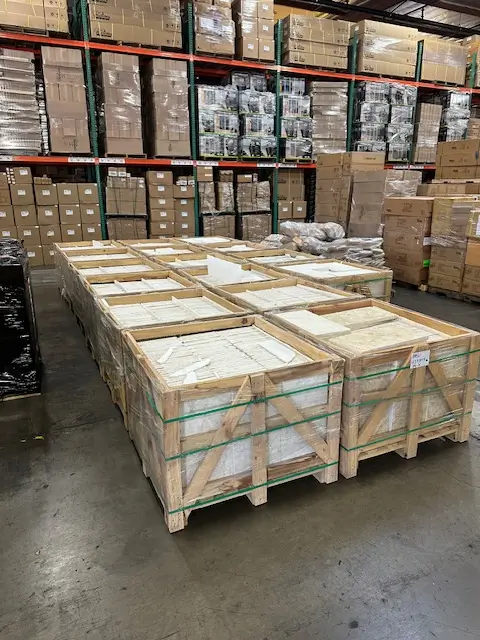
Truck access constraints at your delivery site matter more than most homeowners account for during the planning phase. Pallet deliveries of natural stone — typically 2,200 to 2,400 pounds per pallet — require a truck with liftgate capability for sites without forklift access. Confirming delivery logistics with your supplier before finalizing the order prevents schedule delays that compound on larger pool deck projects where subcontractors are sequenced around material availability.
- Confirm warehouse stock for your complete quantity before scheduling installation crews — partial deliveries that require reordering can introduce color lot variation between tumbled or honed batches
- The ivory travertine color range exhibits natural variation within and between quarry lots — order all material for a single project from the same warehouse pull to maintain consistency
- Pool deck projects in Arizona should schedule delivery 2 to 3 days before installation begins to allow on-site acclimation and visual inspection before the setting bed is prepared
- Request a sample board from warehouse stock for any project where finish selection is still being finalized — evaluating honed versus tumbled under your site’s actual light conditions prevents last-minute specification changes
The tumbled honed travertine surface options AZ homeowners evaluate most often become clearer when you see both finishes in natural Arizona light rather than from catalog photos. Citadel Stone maintains sample availability for both finish types so your final specification reflects an informed choice rather than an assumption about how the material will look once it’s installed.
Final Perspective: Ivory Travertine Finish Comparison Arizona Pools Require
The ivory travertine finish comparison Arizona pools require comes down to a clear hierarchy of priorities: if slip resistance and thermal comfort are your primary drivers, tumbled travertine wins on both counts. If contemporary aesthetics and easier routine cleaning are higher priorities, honed travertine delivers — provided you commit to the right sealer system and maintain it on schedule. Neither finish is universally superior; both perform well in Arizona’s climate when properly specified and installed.
What separates successful long-term installations from the ones that start requiring remediation by year seven is the technical depth behind the specification — base preparation, expansion joint spacing, sealer selection, and material consistency across the full project quantity. Those variables matter more than the finish choice itself. For pool coping considerations that complement your deck finish selection, Bullnose Travertine Coping Arizona? Here Is How to Fix It covers the edge detail decisions that tie the full pool surround together — a natural next step once your deck surface specification is locked in. Citadel Stone provides desert-grade ivory travertine pool deck pavers trusted by property owners in Tucson, Gilbert, and Tempe for long-term surface integrity in Arizona’s intense climate conditions.