
Base instability is the silent killer of limestone installations in Arizona — and Dijon limestone is no exception. The state’s dramatic elevation shifts, from the low desert flats of the Valley to the 7,000-foot Mogollon Rim country, create soil behavior that changes more across 100 miles than it does across entire regions in the Midwest. Your installation’s long-term performance depends far more on how you read the terrain and engineer the sub-base than on any product specification sheet. Getting the outdoor limestone installation steps in Arizona right means treating elevation and site grade as the primary design variables, not afterthoughts.
Understanding Arizona’s Terrain Variables Before You Set a Single Stone
Arizona’s terrain diversity is genuinely unusual for a single state. You’re dealing with alluvial fan deposits in Phoenix that drain fast but shift under load, expansive clay soils in parts of the Tucson basin that can heave several inches seasonally, and rocky decomposed granite slopes in Scottsdale’s hillside neighborhoods that offer excellent bearing capacity but require precise grading to prevent lateral water migration. Each of these scenarios demands a different base strategy before Dijon limestone ever enters the picture.
Elevation determines your freeze-thaw exposure, but it also governs your drainage velocity. At higher elevations — above 4,500 feet — storm events drop water faster than lower desert sites, and your drainage design must account for that surge. According to Natural Stone Institute limestone specifications, limestone’s absorption rate and pore structure make proper sub-surface drainage a non-negotiable performance factor. If water infiltrates the base material faster than it can escape laterally, you’ll see joint sand migration and eventual surface settlement regardless of how well the stone itself is installed.
The terrain factor most installers underestimate is cross-slope drainage geometry. A 2% surface pitch toward a drain works fine on a flat Phoenix lot, but on a Scottsdale hillside property with a 6–8% natural grade, you need to engineer for sheet flow that actively wants to travel under your pavers rather than across them. That means your compacted aggregate base needs to function as both structural support and a controlled drainage layer simultaneously. This is a core principle of any desert-rated natural stone patio guide — drainage geometry is never incidental.
Site Assessment and Grade Management for Dijon Limestone Projects
Your first on-site task — before any excavation — is establishing your finished surface elevation and working backward to determine base depth. This sounds basic, but the number of projects that run into drainage failures because grade management was improvised during installation rather than engineered beforehand is considerable. Set your control points at every transition: where the paved surface meets a structure, a planting bed, a lawn edge, and any existing hardscape.
For Dijon limestone installations in Arizona, a minimum 1.5% surface pitch is the starting spec — but you should push to 2% wherever the surrounding landscape and architectural constraints allow. On sloped sites, the more critical calculation is your catchment area. Determine how much roof runoff, hillside sheet flow, or irrigated landscape drainage will reach your paved surface during a monsoon event, then size your drainage outlets accordingly. A 300-square-foot Dijon limestone patio sounds manageable until you realize it’s sitting at the base of a 2,000-square-foot slope that funnels every storm directly across it.
- Survey your site at 1-foot contour intervals minimum — 6-inch intervals on slopes exceeding 5%
- Identify all upslope catchment areas that discharge toward your installation zone
- Locate existing underground utilities before any excavation — depth varies significantly on rocky terrain
- Document soil type at base depth: decomposed granite, clay, caliche, or alluvial material each require different compaction protocols
- Mark any areas of historical ponding — these indicate sub-surface drainage restrictions that will continue to affect your finished installation
Caliche layers, common across Arizona’s lower elevations, present a specific challenge. Caliche is essentially calcium carbonate cement that forms naturally in desert soils, and it can create an impervious lens below your base layer that traps water. You’ll need to either break through it with a jackhammer or rock saw, or engineer a French drain system that routes water around the caliche band. Ignoring it and hoping your base compacts tightly enough to function above it is how installations fail within 3–5 years.
Sub-Base Preparation: Building a Desert-Rated Foundation
The base specification for your Dijon limestone installation in Arizona should start with a minimum 6-inch compacted aggregate base on flat sites — and that number increases with slope. For grades between 3–7%, move to 8 inches. For grades above 7%, you’re into engineered retaining and terrace territory where a standard base spec no longer applies without site-specific engineering review. Following a thorough desert-rated natural stone patio guide approach at this stage is what separates durable installations from early failures.
Your aggregate material matters significantly here. Arizona’s desert environment means many sites have access to decomposed granite, which installers sometimes use as a base material. Resist that instinct for this application — decomposed granite lacks the angular particle interlock that provides bearing stability under a heavy, rigid material like Dijon limestone. Use a crushed angular aggregate graded to 3/4-inch minus, compacted in 3-inch lifts to 95% Proctor density. The angular faces bind mechanically under load in a way that rounded or semi-rounded particles simply don’t.
- Excavate to stable native soil — do not stop at an arbitrary depth if the soil profile still shows loose or disturbed material
- Apply a geotextile fabric between native soil and aggregate base on expansive clay sites — it prevents clay migration into your base over time
- Compact each 3-inch aggregate lift with a plate compactor before adding the next lift — never compact the full depth in a single pass
- Check your grade tolerance at each lift — correct high and low points before adding material above
- Allow 24 hours minimum after final compaction before setting the bedding layer, especially on sites with recent rainfall or irrigation
For Dijon limestone pavers specifically, your bedding layer should be 1-inch of coarse concrete sand screeded to a consistent plane. The critical detail most people miss: screed the sand parallel to your finished grade, not parallel to the ground. On a sloped site, your screed rails follow the pitch — the sand layer maintains uniform thickness relative to the compacted base, and your Dijon limestone surface inherits the correct drainage slope automatically.
Dijon Limestone Thickness and Load Requirements for Arizona Applications
Thickness selection for Dijon limestone in Arizona installations depends on two factors that work together: the anticipated load and the bearing quality of your sub-base. For pedestrian-only patios and walkways on a properly compacted base, 1.25-inch (30mm) nominal thickness performs reliably. For areas that will see vehicle access — even occasional — move to 2-inch (50mm) minimum. Do not assume occasional vehicle use is low-risk; a single loaded delivery truck crossing your patio edge can fracture thinner slabs when sub-base conditions aren’t optimal.
The point load scenario that catches installations off guard is outdoor furniture. Heavy cast iron or concrete furniture concentrated on a small foot creates localized stress that 1.25-inch material handles fine on a solid base, but fails on a base with any soft spots. You’ll occasionally find that a base which passes plate compactor testing develops micro-voids after the first monsoon season as fine materials migrate. Check your surface within 60–90 days of installation for any rocking or unlevel pavers — address them early before secondary damage to adjacent stones occurs.
According to USGS data on limestone composition and construction applications, the calcium carbonate matrix in limestone provides compressive strength typically ranging from 8,000 to 18,000 PSI depending on formation density. Dijon limestone sits toward the middle to upper end of that range, making it genuinely capable of handling Arizona’s hardscape demands when properly supported. The stone’s performance ceiling is rarely the limiting factor — the base and drainage design beneath it almost always determine whether an installation succeeds or struggles.
Joint Design and Drainage on Sloped Arizona Sites
Your joint pattern and joint width need to account for two things simultaneously on sloped Arizona terrain: thermal expansion of the Dijon limestone itself, and surface drainage velocity. Joints that are too narrow restrict water movement across the surface during heavy monsoon events, creating temporary ponding that saturates the bedding layer. Joints that are too wide create trip hazards and allow bedding sand to migrate under foot traffic.
The target joint width for Dijon limestone outdoor patio installations in Arizona runs 3–4mm for pedestrian areas and 5–6mm for vehicular or high-traffic zones. On sloped sites, consider orienting your joint pattern so that cross-slope joints run perpendicular to the direction of water flow — this creates a series of small check-dam effects that slow sheet flow and allow it to infiltrate or redirect without eroding your bedding material.
- Use polymeric sand formulated for Arizona’s UV exposure — standard polymer sand can degrade and crack in sustained heat above 110°F
- Install expansion joints at structure interfaces, at every 15-foot change of direction, and at transitions between different paving materials
- On hillside installations, place a French drain channel at the upslope edge of the paved area to intercept hillside runoff before it reaches your Dijon limestone surface
- Check joint sand levels after the first 3 monsoon events — plan to top up the first season as initial settling occurs
- In Tucson installations where caliche-clay soil combinations are common, drainage outlets at the paved area perimeter need oversizing by at least 25% relative to flat-site equivalents
One approach that works particularly well on moderately sloped Scottsdale hillside projects is the incorporation of linear drainage channels at regular intervals across the slope. These channels, set flush with the Dijon limestone surface, intercept sheet flow before it builds velocity, preventing the kind of erosive undercutting that eventually destabilizes entire paved areas. The channels also provide a natural break for expansion joints, solving two problems with one design element.
Setting Dijon Limestone on Grade: Installation Sequence and Field Adjustments
The actual Dijon limestone laying method across Arizona sites follows a specific sequence that accounts for both the material’s characteristics and the terrain challenges discussed above. Start from a fixed reference point — typically a structure wall, a step landing, or a drain grate — and work outward. Never start from an open edge and work toward the structure, because any accumulated grade error compounds toward the structure where adjustment is hardest to make.
Your Dijon limestone pavers should be damp but not wet when set. In Phoenix’s low-humidity environment, dry stone draws moisture from your bedding sand rapidly, which affects the final density and settlement characteristics of the sand layer. Misting the stone underside before placement — particularly during summer installations in direct sun — is a simple step that most crews skip and then wonder why their joint sand compacts unevenly in the weeks following installation. This is part of the practical knowledge base built at Citadel Stone through consulting on installations across Arizona’s varied climate zones.
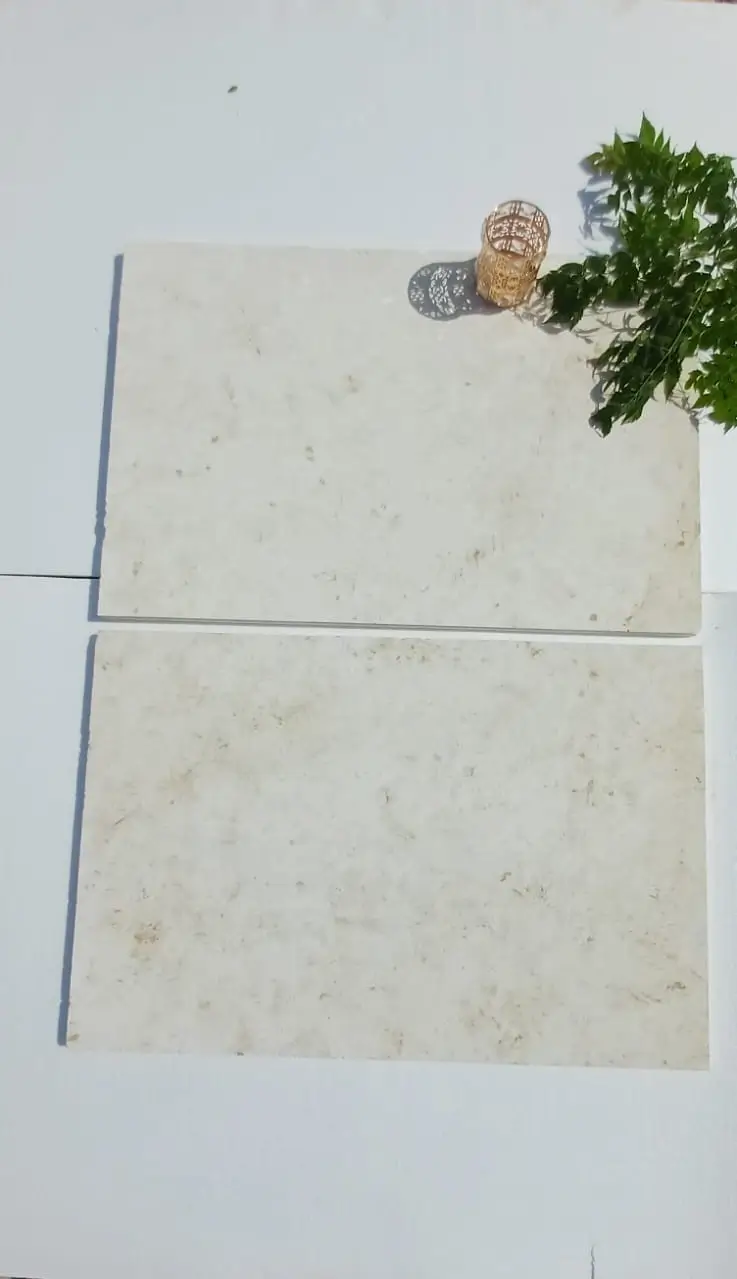
For the Arizona Dijon limestone from Citadel Stone, verify your stock quantities against your final layout calculations before the truck delivers — odd lot sizes and material cut from hillside terrace edges consume more material than flat layouts, and a second delivery mid-installation creates both scheduling delays and potential batch variation in stone color.
- Lay a trial run of 4–5 stones before committing to full installation — confirm your grade, joint width, and pattern alignment
- Use a rubber mallet and level to seat each stone — check level in both directions plus cross-diagonal for larger format pieces
- Maintain consistent joint width using spacers — visual spacing on sloped sites tends to drift as the eye adjusts to the angle
- Cut stones at the perimeter using a wet saw with a diamond blade rated for natural limestone — avoid dry cutting in Arizona’s construction environments due to silica dust hazard
- Do not allow foot traffic on freshly set pavers for 24 hours minimum — on sloped sites, restrict access for 48 hours to allow the bedding sand to stabilize fully
Sealing and Surface Protection for Arizona’s Climate Conditions
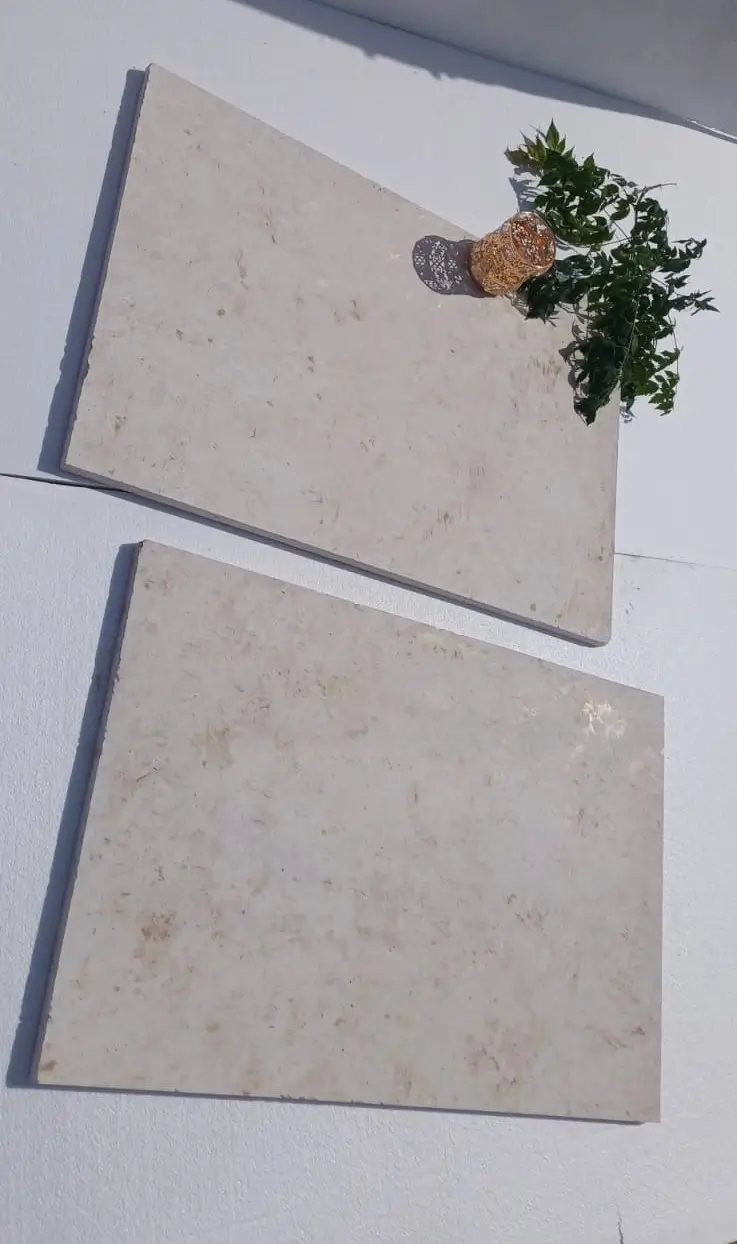
Dijon limestone’s characteristic warm gold and cream tones are part of what makes it such a compelling outdoor surface — and sealing is what protects those tones from the combination of UV exposure, dust accumulation, and alkaline water deposits that Arizona’s environment delivers constantly. The Arizona outdoor stone surface preparation tips that apply to sealing differ meaningfully from what you’d specify in a coastal or high-humidity climate.
Choose a penetrating impregnating sealer with UV inhibitors rather than a surface topcoat for outdoor Dijon limestone in Arizona. Topcoat sealers form a film on the surface that can peel, bubble, or turn milky under sustained heat above 100°F — a common occurrence on south-facing installations in the Phoenix metro. A penetrating sealer enters the pore structure of the limestone and protects from within without altering the surface texture or drainage characteristics.
Apply sealer in the early morning or evening — never at midday in Arizona summer. Applying sealer to hot stone causes it to flash off before it can penetrate properly, leaving a surface residue that requires chemical stripping to remove. The stone surface temperature, not the air temperature, is the critical variable. You can have a 95°F air temperature but a stone surface reading 140°F in direct sun, and that’s far too hot for sealer application. Use an infrared thermometer on your stone surface before starting — keep surface temperature below 85°F for reliable sealer penetration.
- Apply sealer within 2 weeks of installation on new Dijon limestone — earlier is better before dust and construction residue embed in the pores
- Reapply every 2–3 years in high-UV Arizona conditions — annual inspection tells you if you’re on schedule or need to accelerate
- Test sealer performance by placing a few drops of water on the surface — if they bead, the sealer is active; if they absorb within 60 seconds, it’s time to reseal
- Use a sealer rated for calcium carbonate stone — some universal stone sealers contain acidic components that etch limestone surfaces over time
Ordering, Warehouse Stock, and Project Logistics Across Arizona
Material planning for a Dijon limestone installation involves more variables than the square footage calculation suggests. Your terrain-driven design — terraced levels, stepped landings, sloped drainage channels — typically adds 12–18% waste to your material order compared to a flat layout. Factor that into your initial quantity estimate so you’re not in the position of requesting a second delivery mid-project. Citadel Stone maintains warehouse inventory of Dijon limestone in Arizona, which typically reduces lead times significantly compared to the 6–8 week import cycle you’d face sourcing directly from overseas quarries. Confirming warehouse availability before finalizing your project schedule protects your timeline.
Truck access to your site matters more than most project managers think through in advance. On hillside Scottsdale properties or elevated terrain with limited road access, a standard flatbed truck may not be able to reach your staging area. You’ll need to confirm vehicle access clearances — both vertical height under any overhead structures and load-bearing capacity of any access roads or driveways the truck must cross — before scheduling delivery. Redistributing several pallets of Dijon limestone by hand from the street to a hilltop installation area adds labor cost and creates breakage risk that careful logistics planning avoids.
Coordinate your delivery timing with your base preparation schedule. Dijon limestone should arrive after your base compaction is complete and your bedding sand is screeded — not before. Stone stored on a site where base work is still underway gets contaminated with base aggregate, compaction equipment damage, and moisture exposure that complicates installation. Most projects benefit from a 2–3 day lag between base completion and stone delivery. These Arizona outdoor stone surface preparation tips apply equally to logistics planning — sequencing material arrival correctly is as important as sequencing installation steps.
Final Considerations for Outdoor Limestone Installation Steps in Arizona
The technical success of your outdoor limestone installation steps in Arizona traces back consistently to decisions made before the stone arrives on site — site assessment, grade management, base engineering, and drainage design. Dijon limestone is a material that rewards careful preparation and penalizes shortcuts, particularly in Arizona’s terrain-diverse environment where the ground itself is an active participant in your installation’s long-term behavior. The Dijon limestone laying method across Arizona doesn’t change dramatically from project to project, but the site-specific engineering context changes significantly based on elevation, slope, and soil type.
For projects on sloped or elevated terrain, budget additional time for site engineering, not just installation labor. The difference between a 12-year installation and a 25-year one is almost always sub-base preparation quality and drainage adequacy — not the stone itself. Dijon limestone performs predictably when it’s properly supported; the failures happen in the ground, not in the material. As you finalize your Arizona stone project, it’s worth reviewing how related coping and stone elements perform in similar conditions — common travertine coping errors in Arizona covers installation pitfalls for complementary stone elements that often appear alongside Dijon limestone in Arizona outdoor living designs. Sourced from quarries across the Mediterranean and Middle East, Citadel Stone’s Dijon limestone reaches installations in Tucson, Mesa, and Chandler ready for Arizona’s intense UV and thermal cycling conditions.