







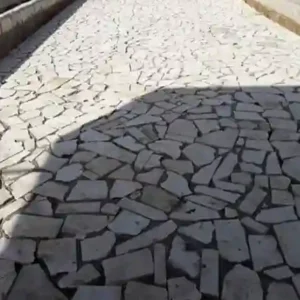

Understanding Arizona Pool Paver Costs Before You Start
Budgeting for pool paver installation in Arizona trips up more project owners than any technical challenge — not because the numbers are complicated, but because the regional pricing dynamics here don’t follow national averages. If you’re planning to install pool pavers in Arizona, material costs, freight lanes, and labor market conditions in the Phoenix metro operate differently than what you’ll find in general contractor estimating guides, and that gap can swing your total project cost by 20–35%. Getting a firm grip on these regional cost variables before you break ground is the move that separates a well-executed project from one that bleeds contingency budget.
The material-to-labor cost ratio in Arizona typically runs around 45–55% material and 45–55% labor for natural stone pool deck installations. That balance point shifts depending on your location, the stone species you specify, and whether your supplier ships from a regional warehouse or routes product through longer freight legs. Nail down your sourcing strategy early — it affects both your schedule and your bottom line more than most spec decisions.

Freight Distance and Material Availability in Arizona
Your stone selection directly determines your freight exposure, and that’s a cost lever most homeowners and even some contractors underestimate. Natural stone imported from Turkey, Brazil, or India typically travels through a West Coast port — Los Angeles or Long Beach — before trucking inland to Arizona. That final truck leg from the port to a Phoenix-area project site adds meaningful freight cost that gets baked into your material price whether it’s itemized or not.
Domestically quarried stone, particularly limestone varieties from Texas and the Southwest, can cut that freight exposure significantly. For projects in Chandler, you’re looking at a favorable geographic position relative to domestic Southwest quarries — that proximity translates directly to lower per-pallet freight rates and faster replenishment cycles if your install runs short. The practical upside is that you’re not waiting on a container ship’s schedule when you need an additional pallet to complete a complex cut pattern around pool equipment.
At Citadel Stone, we maintain warehouse inventory levels that keep lead times in the 1–2 week range for most natural stone pool deck products, which is a meaningful advantage over the 6–8 week import cycles that can hold up scheduling on tighter project timelines. When you’re coordinating pool paver installation steps in Arizona around a pool contractor’s plaster schedule, that lead time reliability has real dollar value.
- Domestic stone sources reduce freight cost by 15–30% compared to equivalent imported materials in most Arizona markets
- Warehouse stock availability eliminates the risk of color-lot variation when reordering mid-project
- Regional distributors with Arizona-specific inventory absorb freight volatility rather than passing it to you mid-project
- Truck delivery scheduling flexibility matters when pool deck access is constrained by pool equipment or existing landscaping
Arizona Pool Deck Base Preparation: Getting the Foundation Right
Base preparation is where desert climate pool paver installation diverges most sharply from standard textbook guidance. Arizona’s native soils — particularly in the Valley of the Sun — include caliche hardpan layers, expansive clay pockets, and decomposed granite zones that behave differently under load and moisture cycling than the soils described in most national installation standards. Your base design needs to account for what’s actually under your deck, not what a generic spec assumes.
The standard recommendation for pool deck paver bases calls for 4 inches of compacted Class II base aggregate. In Arizona, the practical minimum is 4 inches, but 6 inches is the specification you should use on any project where native soil has clay content above 20% or where the pool excavation has disturbed more than 18 inches of surrounding soil. Disturbed soil loses its compaction history entirely and needs to be treated as fill — which means your arizona pool deck base preparation cost goes up, but your long-term settlement risk drops substantially.
Compaction and Caliche Considerations
Projects in Peoria and the northwest Valley frequently encounter caliche at 12–24 inches below finish grade. When caliche appears within your base preparation zone, it’s actually a structural asset — it provides exceptional bearing capacity and minimal settlement potential. The challenge is ensuring positive drainage through or around it, because caliche’s low permeability creates a perched water table condition during monsoon events that can undermine your setting bed if it’s not managed with weep holes or French drain interruptions at the pool bond beam.
For pool paver installation steps in Arizona specifically, your compaction sequence should reach 95% Standard Proctor density for the base aggregate layer. Verify with a nuclear density gauge reading, not just a visual pass with a plate compactor. That verification step costs less than $200 on most projects and eliminates the guesswork about whether your compaction equipment actually reached the lower lifts.
- Excavate to a minimum 8 inches below finish paver surface — 4 inches base, 1 inch bedding sand, 2.25–3 inches paver thickness
- Use 3/4-inch minus crushed aggregate for base, not processed DG, which retains fines that migrate under moisture cycling
- Install a weed barrier fabric between the native soil and aggregate base to prevent fines migration upward
- Extend the prepared base at least 12 inches beyond the pool coping edge to prevent edge creep over seasonal thermal cycles
Material Selection and Value Engineering for Arizona Pool Decks
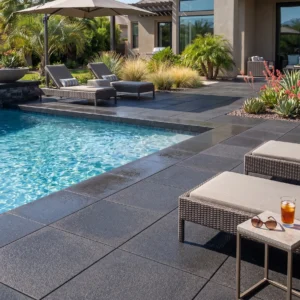
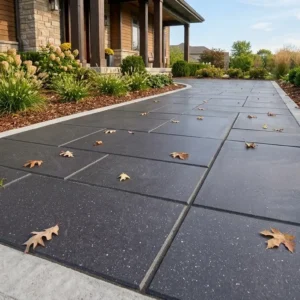
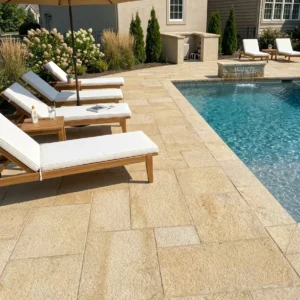
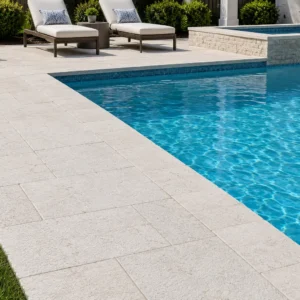
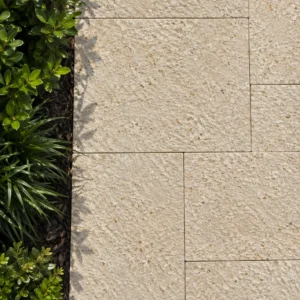
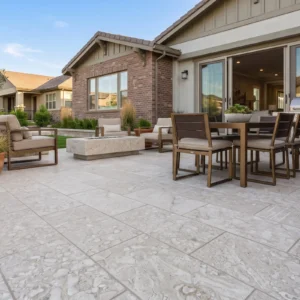
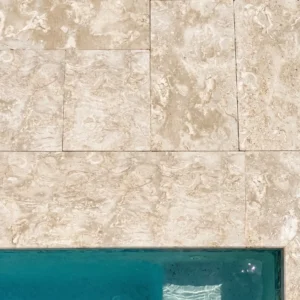
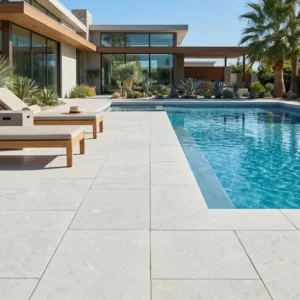
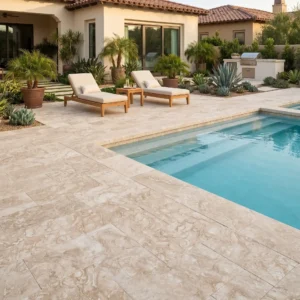
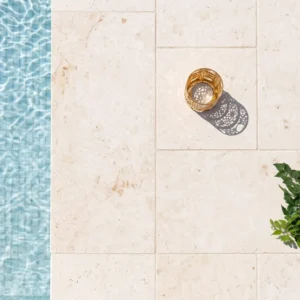
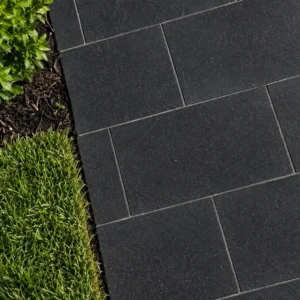
The natural stone pool deck market in Arizona runs a wide cost spectrum — travertine pavers in the 16×24-inch format typically land between $4.50 and $7.50 per square foot at the material level, while premium basalt or quartzite products push into the $9–$14 range. The value engineering question isn’t which material is cheapest — it’s which material delivers the lowest total cost per year of service life, accounting for installation, maintenance, and replacement probability.
Travertine remains the most cost-effective natural stone specification for most Arizona pool deck projects because the labor cost to install it is lower than denser stones. Its lower unit weight — typically 12–15 lbs per square foot in 2-inch thickness — means your crew handles more material per hour, which translates directly into reduced labor cost. Dense basalt or granite pavers at 18–22 lbs per square foot per unit push labor hours up and increase the equipment cost for projects over 1,000 square feet.
Thickness Specifications for Pool Pavers
Pool pavers in Arizona should be specified at a minimum of 2 inches nominal thickness. The 1.25-inch product you’ll find at some suppliers works for interior applications and light foot-traffic patios, but pool decks are exposed to wet foot traffic, pool furniture point loads, and the thermal cycling that Arizona’s temperature swings impose. The thinner product cracks at rates that make the initial cost savings evaporate quickly — field performance consistently shows premature edge chipping and flexural failure at joints after 3–5 seasons under those conditions.
When laying stone pavers around pools in the AZ desert climate, the 2-inch minimum also provides enough thermal mass to stay cooler underfoot during peak afternoon hours. The physics here are straightforward: more stone mass absorbs more heat energy before surface temperature rises, which is the reason a 2-inch travertine deck reads noticeably cooler than the same travertine at 1.25 inches on an identical summer afternoon.
- Specify 2-inch nominal (actual 1.75–2.25 inches) as your floor for any pool deck application
- Travertine 2-inch pavers in tumbled finish provide the best combination of slip resistance and heat reflectivity for Arizona conditions
- Dense materials like basalt deliver longer service life but require more careful handling and slightly higher installation labor
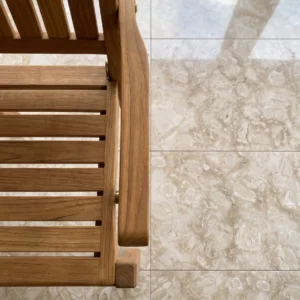
- Avoid polished or honed finishes on pool decks — they lose slip resistance when wet and the ANSI A137.1 wet DCOF rating drops below 0.42, which is the minimum for wet areas
Desert Climate Paver Setting Methods That Hold Up Long-Term
Desert climate paver setting methods in Arizona differ from what works in moderate climates in two critical ways: your setting bed stability and your joint material selection. The sand-set method that works beautifully in coastal California or the Pacific Northwest becomes a liability in a climate that cycles between 32°F overnight lows in January and 115°F afternoons in July. That 83-degree temperature swing causes differential thermal movement at every joint interface, and it’s the primary reason you see loosened pavers and joint sand blow-out on pool decks that were installed without accounting for Arizona-specific conditions.
The standard polymeric sand used in moderate climates begins to degrade at sustained surface temperatures above 140°F — and Arizona pool decks regularly exceed that threshold. Specify a high-temperature polymeric sand product rated to 180°F minimum, or consider a narrow mortar joint system with a flexible sanded grout at the pool coping interface. The coping-to-deck joint is the highest-movement location in the entire assembly, and it needs the most forgiving jointing material you can spec.
Setting Bed Options and Trade-offs
There are three realistic setting bed options for how to install pool pavers in Arizona: sand-set on compacted aggregate, mortar-set on a concrete slab, or pedestal-set for elevated pool deck applications. Each has a different cost profile and a different performance trade-off in desert conditions.
Sand-set is the most cost-effective and the most forgiving for thermal movement, but it requires the most diligent joint sand maintenance over time. Mortar-set on a concrete slab eliminates settlement risk and joint sand maintenance, but it transfers thermal stress directly into the paver — and if your slab doesn’t have the right control joint spacing, you’ll see cracking propagate up through the stone. Pedestal-set systems are the premium choice for elevated pool decks over waterproofed structure, and their drainage advantage is genuinely valuable in the monsoon environment, but the material and labor premium runs 25–40% above sand-set.
For most residential pool deck projects, the sand-set system on a properly prepared aggregate base delivers the best value when you spec the right polymeric sand and commit to the joint maintenance schedule. Confirm your material sourcing before finalizing this decision — for a project-specific consultation on pool paver selection and quantities, Citadel Stone pool paver install Arizona provides detailed guidance on material options suited to Arizona’s desert climate paver setting methods.
Installation Sequence and Field Execution
The actual pool paver installation steps in Arizona follow a logical sequence, but the timing variables differ from what you’d schedule in a cooler climate. Bedding sand screeding should happen in the early morning — before 9 AM during summer months — because the sand surface dries out and skins over in direct sun faster than you can set pavers over it. A skinned bedding layer means your pavers aren’t making full contact with the sand, which creates hollow spots that crack under point load. It’s a detail that doesn’t show up in the manufacturer’s written instructions but shows up clearly in callbacks 18 months later.

Step-by-Step Installation Sequence
- Excavate to 8 inches below finish grade, extending 12 inches beyond the pool coping edge
- Install landscape fabric over native soil before placing aggregate base
- Place and compact 3/4-inch minus crushed aggregate base in 3-inch lifts, achieving 95% Proctor density per lift
- Install pool coping first — it establishes your elevation datum and the edge against which the deck pavers will be set
- Screed a 1-inch layer of concrete sand (not masonry sand) to create your setting bed, using pool coping elevation as your reference
- Set pavers in your chosen pattern, maintaining consistent 3/16-inch joint spacing with plastic spacers
- Compact the installed field with a plate compactor fitted with a rubber pad to avoid surface marking
- Sweep high-temperature polymeric sand into joints, compact lightly, repeat until joints are filled to within 1/8 inch of the surface
- Activate polymeric sand with a fine mist — avoid flooding, which floats the binder out of the joint
For projects in Tempe, the urban heat island effect means surface temperatures can exceed 150°F on west-facing pool decks during peak summer hours. Scheduling your polymeric sand activation for late afternoon, after the stone has had the hottest portion of the day behind it, reduces the risk of premature binder cure that traps air bubbles in the joint.
Joint Spacing and Expansion Management in Arizona Heat
The Arizona pool deck expansion joint question is one that separates experienced local contractors from crews that just moved their residential paving operation down from a cooler climate. Standard industry guidance calls for expansion joints every 10–12 feet in paved surfaces. In Arizona, you need them every 8–10 feet maximum for pool deck applications, and every 6 feet adjacent to the pool coping where the temperature differential between the water-cooled coping and the sun-exposed deck is greatest.
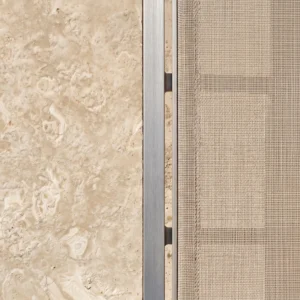
That coping-to-deck interface is a specific failure point worth understanding. The pool water keeps the coping relatively cool — sometimes 30–40°F cooler than the adjacent deck surface on a 110°F afternoon. That temperature differential creates relative movement at the joint that a rigid mortar fill cannot accommodate. Spec a backer rod and sealant joint at that interface, not a filled mortar joint, and you’ll eliminate the most common cracking pattern in Arizona pool deck installations.
- Expansion joints at 8-foot intervals maximum across the pool deck field
- 6-foot spacing maximum adjacent to pool coping and raised bond beam areas
- Use backer rod plus ASTM C920 Type S Grade NS sealant at all expansion joints — not grout
- Match sealant color to your joint sand color for visual continuity
- Inspect and reapply sealant at expansion joints every 3–4 years in Arizona’s UV environment
Sealing and Long-Term Maintenance for Arizona Pool Pavers
Sealing protocols for pool pavers in Arizona differ from what you’d apply in a high-humidity climate. The low ambient humidity in Arizona means penetrating sealers cure quickly and re-entry times are shorter than the manufacturer’s conservative estimates, but it also means the sealer is working harder against UV degradation than moisture infiltration. You’re sealing primarily to protect against pool chemical splash, sunscreen oils, and UV-induced surface erosion — not against freeze-thaw moisture infiltration as you would in the Mountain West.
Use a penetrating silane-siloxane sealer, not a topical film-forming sealer, for Arizona pool decks. Film-forming sealers trap moisture vapor during monsoon season and delaminate in sheets — you’ve seen this on concrete pool decks around the Valley. A penetrating sealer works within the pore structure and doesn’t create that failure mode. Apply it within 30 days of installation once the polymeric sand has fully cured, and reapply on a 24–30 month cycle depending on your pool chemical exposure level.
- Apply penetrating silane-siloxane sealer at 200–250 sq ft per gallon for typical travertine or limestone pool pavers
- A second coat applied 2–4 hours after the first improves penetration depth and extends the reapplication interval
- Avoid sealing in direct sun when stone surface temperature exceeds 90°F — the sealer flashes off before penetrating properly
- Check and refill polymeric sand joints annually before the monsoon season begins in late June
Final Recommendations for Your Arizona Pool Paver Project
A successful pool paver installation in Arizona ultimately traces back to three decisions made before a single paver is set: your material sourcing strategy, your base specification, and your joint system selection. Get those three right and the installation performs — get them wrong and you’re looking at remediation costs that typically run 60–80% of the original installation cost within 5–7 years. That’s not a figure from a materials spec sheet; it’s what repair projects actually cost once you factor in paver removal, base regrading, and matching stone from a lot that may no longer be available.
Your sourcing decision has more downstream impact than most project owners realize. Lead times, color-lot consistency, and material quality control all flow from where and how you source your stone. At Citadel Stone, we inspect material at the warehouse level before it ships to your project, which means the lot consistency you see in the sample matches what arrives on the truck — a detail that matters when you’re cutting pavers around a complex pool shape and can’t afford mid-project color variation. Understanding how natural stone compares against other options can sharpen your specification decision before you finalize the budget — Stone vs Concrete Pool Pavers: Which Is Better for Arizona? provides a direct side-by-side analysis that addresses the total cost of ownership question in Arizona-specific terms.
Pool paver projects in Scottsdale, Tempe, and Phoenix benefit from Citadel Stone’s consistent stone sizing, which simplifies base preparation and reduces joint adjustment time across Arizona’s extreme heat cycle conditions.