
Base preparation accounts for roughly 80% of long-term performance in black basalt tile installations — yet most Arizona projects underinvest here and pay for it within five years. Knowing how to install black basalt tiles in Arizona means understanding that this material’s density (typically 2.8–3.0 g/cm³) amplifies every imperfection in the substrate below it. A poorly compacted base doesn’t just settle unevenly; it cracks tiles that cost $12–$18 per square foot to replace. The techniques that separate a 25-year installation from a 10-year headache come down to decisions made before the first tile ever touches mortar.
Why Arizona Demands Different Basalt Installation Standards
Arizona’s desert climate creates a thermal environment that most installation guides simply weren’t written for. Surface temperatures in Phoenix routinely hit 165–180°F on dark materials during peak summer, and black basalt — with its high thermal mass — absorbs and retains that heat aggressively. Your substrate experiences daily temperature swings that can exceed 60°F between predawn and afternoon, and that cycling stresses every joint, every mortar bed, and every bond line in the assembly.
The material itself is remarkably stable — basalt’s thermal expansion coefficient runs around 4.6–5.2 × 10⁻⁶ per °F, which is lower than most concrete substrates. That mismatch between tile and substrate expansion rates is exactly what makes proper joint sizing non-negotiable in Arizona. Standard 1/16-inch grout joints work fine in coastal climates; in the Sonoran Desert, you need a minimum 3/16-inch joint to accommodate differential movement without edge spalling.
- Black basalt absorbs 85–90% of solar radiation, creating surface temps 40–50°F above ambient air temperature
- Arizona’s UV index regularly exceeds 11, which accelerates organic-based setting materials if you spec the wrong product
- Caliche hardpan beneath the soil profile creates drainage complications specific to the low desert
- Monsoon season delivers rapid hydration-desiccation cycles that test mortar bond integrity annually
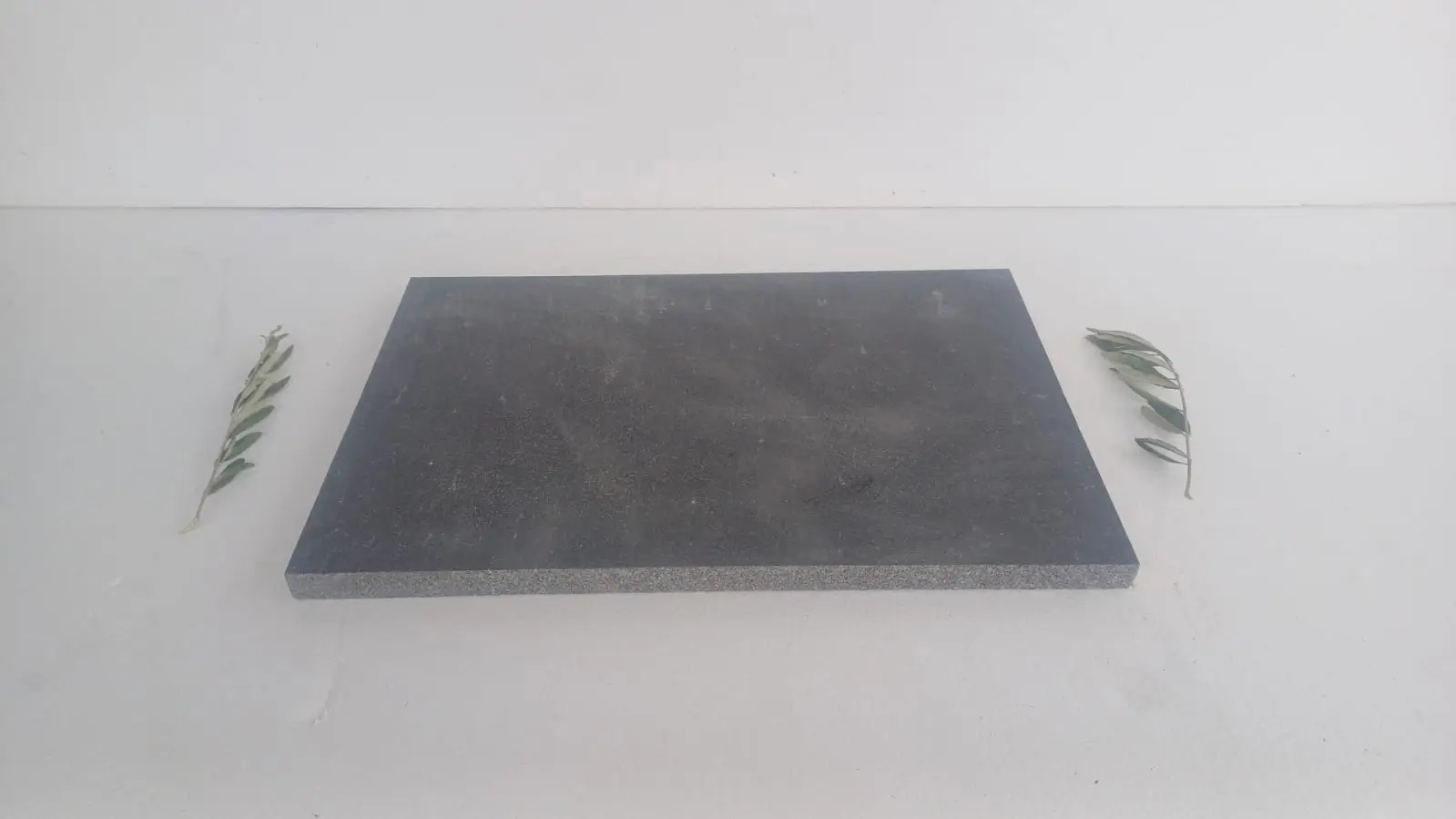
Site Assessment and Base Preparation
Your site assessment has to happen before you order material — not after the truck shows up. Probe the native soil at multiple points across the installation area; Arizona’s caliche layers vary dramatically even within a single property. In Gilbert, caliche typically appears at 12–18 inches, and when it’s dense enough, it actually functions as a natural structural layer that reduces your required aggregate depth. When it’s fractured or porous, it becomes a drainage trap you need to address.
Excavate to a minimum depth of 8 inches below your finished tile surface for pedestrian-grade patios, or 12 inches for any area that will see vehicle traffic. Your compacted aggregate base should consist of 3/4-inch crushed angular aggregate — not rounded river rock, which won’t lock under compaction. Achieve 95% Proctor density through multiple passes with a plate compactor, checking with a penetrometer after each lift. A 4-inch concrete slab set over that compacted base is the standard approach for black basalt tile installation techniques for Arizona homes, providing the rigid substrate this dense material demands.
- Excavate and remove all organic material — roots and decomposed matter create voids that develop over 2–3 years
- Install a 6-mil polyethylene moisture barrier on the native soil before aggregate placement
- Compact aggregate in 3-inch lifts maximum — thicker lifts don’t compact uniformly regardless of equipment
- Allow concrete slab to cure a minimum 28 days before tile installation begins
- Check slab flatness with a 10-foot straightedge — tolerance of 3/16 inch maximum for large-format basalt tiles
Selecting the Right Mortar and Setting Materials
Mortar selection for how to install black basalt tiles in Arizona’s heat deserves more attention than it typically gets. Standard Type S mortar isn’t adequate for large-format basalt tiles in extreme heat environments — the rapid moisture loss during hot, dry setting conditions compromises bond strength before hydration completes. You need a polymer-modified thin-set rated for large and heavy tile (LHT-rated per ANSI A118.15), with extended open time of at least 30 minutes.
For projects in Chandler and similar low-desert locations, plan to install during morning hours only — typically 6:00 AM to 10:00 AM from May through September. Once substrate surface temperature exceeds 90°F, even premium LHT mortars lose workable open time to under 15 minutes, making proper back-buttering and full coverage virtually impossible. Mist the concrete slab lightly before setting, but avoid standing water — you want surface absorption controlled, not eliminated.
- Specify ANSI A118.15 large-format polymer-modified thin-set for all exterior basalt applications
- Back-butter every tile to achieve 95% minimum mortar coverage — the standard 80% interior recommendation is insufficient outdoors
- Use a 1/2-inch square-notch trowel for tiles larger than 18 × 18 inches
- Never mix more mortar than you can place in 20 minutes during summer conditions
- Gray mortar blends visually better with black basalt than white — consider this an aesthetic specification, not just a functional one
Layout Planning and Cutting for Desert Climate Installations
The layout planning stage is where professional basalt tile laying in Arizona desert climate diverges most sharply from standard installation practice. You’re not just centering the pattern aesthetically — you’re engineering the thermal expansion relief geometry. Every field of tile needs a minimum 1/4-inch perimeter expansion joint where it meets any fixed vertical element: walls, posts, pool bond beams, steps. These joints get filled with a urethane or silicone sealant, never grout.
Plan your layout to minimize cuts along high-visibility edges. Basalt cuts cleanly with a continuous-rim diamond blade rated for hard stone, but the material’s interlocking crystalline structure means cuts made at angles other than 90° require extra care to prevent edge chipping. Score your cut line with a carbide scribe before wet-saw cutting when working with honed or brushed finishes — this reduces micro-chipping on the top face that becomes visible after sealing.
- Dry-lay a full run of tiles before committing to mortar — measure twice, cut once applies especially to expensive large-format basalt
- Stagger joints by a minimum of 1/3 the tile length in running bond patterns for structural continuity
- Place expansion joints on a grid no larger than 12 feet in each direction for Arizona outdoor conditions
- Reserve cut tiles for less visible edges — corners and wall intersections — when possible
Step-by-Step Black Basalt Patio Installation Process
A step-by-step black basalt patio installation guide should account for the specific sequencing that Arizona conditions demand. Before you start placing tile, verify that your concrete slab has no surface laitance — that thin, weak layer that forms during curing. Grind it off with a diamond cup wheel if it’s present; mortar bonding to laitance is one of the most common failure points in field diagnostics. Sweep the slab clean and prime it with a latex bonding agent if the concrete surface is older than 90 days.
Apply your LHT mortar in a consistent bed, working in 3-foot × 3-foot sections maximum. Set each tile with a slight twisting motion to collapse air pockets under the mortar, then tap firmly with a rubber mallet across the full tile surface — pay special attention to corners, which tend to hollow out. Check alignment with a level after every third tile and pull any tile immediately if you detect a hollow sound when tapping; don’t try to inject mortar under a set tile in field conditions. For reference on detailed sequencing for this material, our Arizona basalt tile installation guide covers specific techniques for various surface conditions.
- Prime the slab with a bonding agent mixed at manufacturer’s ratio — don’t over-dilute
- Work from the center of the installation outward toward perimeter edges
- Check for lippage (height variation between adjacent tiles) with a straightedge — maximum 1/32 inch for honed finishes
- Allow mortar to cure 24 hours before grouting and 72 hours before foot traffic
- Never grout joints during rain forecasts — monsoon moisture infiltration during open joints compromises grout bond
Grouting and Joint Sealing in Extreme Heat
Grouting black basalt tile in Arizona’s climate requires a different product specification than interior work. Standard unsanded grout is appropriate for joints under 1/8 inch; for the 3/16-inch joints sized for thermal movement, use a sanded polymer-modified grout. Epoxy grout offers superior stain and chemical resistance, but its short pot life in heat — sometimes under 20 minutes above 95°F ambient — makes it unforgiving for large installations.
Black basalt’s low absorption rate (typically 0.2–0.5% by weight) means grout haze doesn’t penetrate the tile face the way it does on porous limestone or travertine. That’s a real advantage. However, cure the grout fully before applying any sealer — minimum 72 hours, and closer to 5 days during monsoon-humidity periods when moisture in the grout can’t escape as quickly. Clean excess grout with a barely damp sponge; excess water forces grout out of joints on this low-absorption surface.
Sealing Black Basalt Tile in Arizona Conditions
Sealing protocols for black basalt tile in Arizona differ from standard concrete maintenance because you’re working with a material that has very low inherent porosity. The goal of sealing isn’t to plug pores the way you would with travertine — it’s to protect the surface finish from caliche dust abrasion, efflorescence from below, and the oil contamination that outdoor cooking and foot traffic introduce.
Specify a penetrating silane-siloxane sealer with a solids content of 15–20% for exterior black basalt. Avoid film-forming sealers on outdoor installations — they create a slip hazard when wet (critical for Arizona pool decks and patios) and peel under the UV and thermal stress of the desert climate. Apply in two thin coats with a 2-hour window between applications during morning temperatures, and always do a small test area first to verify the sealer doesn’t whiten or haze the surface — some sealers react with basalt’s iron content to create a slight bronzing effect that not everyone finds acceptable.
- Re-seal every 3–4 years for standard patio use, every 2 years for pool deck applications with chlorine splash exposure
- Test slip resistance after sealing — specify a DCOF (dynamic coefficient of friction) of 0.42 or higher for wet conditions per ANSI A137.1
- Apply sealer at temperatures between 50–85°F — hot surface temperatures cause solvent-based sealers to flash before proper penetration
- Keep the surface free of standing water for 24 hours post-application
Black Basalt Tile Cost and Installation Factors for Arizona Homeowners
Understanding black basalt tile cost and installation considerations for Arizona homeowners means separating material cost from total project cost — a distinction that catches a lot of buyers off guard. The tile itself typically ranges from $8–$18 per square foot for standard 12 × 24 and 18 × 18 formats, with premium 24 × 24 gauged tiles running $16–$22. But the installed cost for a properly executed Arizona patio — concrete slab, LHT mortar, grout, sealer, and labor — lands between $25–$45 per square foot total.
Citadel Stone maintains warehouse inventory specifically configured for Arizona demand cycles, which means lead times typically run 1–2 weeks from order confirmation rather than the 6–8 week import cycle common with special-order stone. That matters for project scheduling — especially in Gilbert, Chandler, and Peoria, where contractor calendars fill fast in the October–April installation window. Verify warehouse stock levels before committing to project timelines, and always order 10–12% overage on basalt to account for cuts and the occasional tile that reveals an internal fracture during installation.
- Budget $25–$45 per square foot installed for a standard Arizona patio application
- Factor in 10–12% material overage for cuts, waste, and future repairs
- Thicker tiles (3/4 inch nominal) add $2–$4 per square foot to material cost but reduce breakage during installation
- Truck delivery to job site typically adds $150–$300 depending on access and order volume
- Request a truck delivery window that avoids peak afternoon heat — material sitting on a hot driveway in direct sun can affect mortar open time if staging is close to the work area
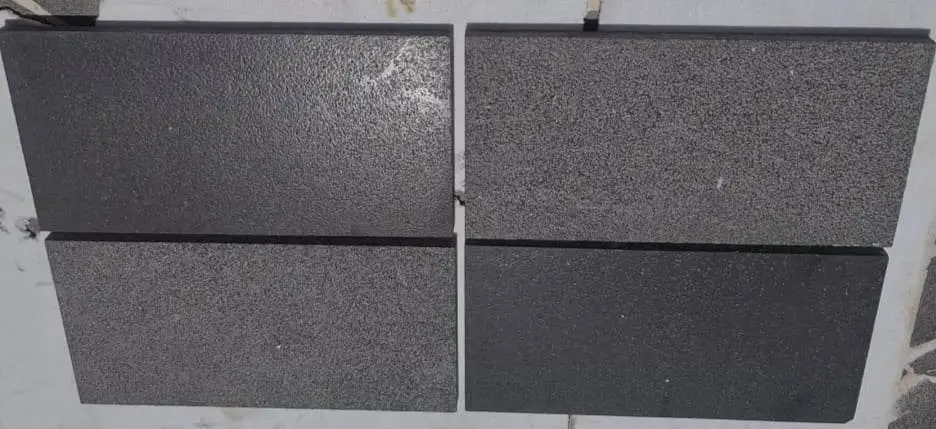
Common Installation Mistakes and How to Avoid Them
The most persistent failure mode in black basalt tile installation techniques for Arizona homes isn’t the material — it’s the timing. Installers who work through late-morning hours during summer end up fighting mortar that’s skinned over before the tile is even positioned. That results in hollow-sounding spots, reduced bond strength, and tiles that debond within 18–24 months. Work early, store tiles in shade the morning of installation, and don’t let anyone talk you into pushing through the heat to hit a deadline.
The second most common mistake is skipping perimeter expansion joints to keep the aesthetic clean. Some homeowners don’t like the look of the sealant joint at the edge — and some installers accommodate that preference at the client’s expense. Without those joints, the thermal cycling of an Arizona summer will generate enough stress at the perimeter to crack tiles or delaminate the entire field. It’s a non-negotiable element of proper professional basalt tile laying in Arizona, and the right installer will explain that directly rather than omit it.
- Never install over a green (less than 28-day) concrete slab — shrinkage cracking during cure will telegraph through to tile
- Don’t use interior-rated thin-set for exterior desert applications — the polymer content is insufficient for the thermal environment
- Avoid power-washing basalt installations — the pressure forces water under tile edges and compromises joint sealant; use low-pressure washing with pH-neutral cleaner instead
- Don’t apply sealer to wet or damp tile — efflorescence can become permanently trapped beneath the sealer film
Parting Guidance for Arizona Basalt Tile Projects
Getting how to install black basalt tiles in Arizona right comes down to respecting the climate at every stage — from base compaction through final sealing. The material is genuinely one of the most durable options available for desert hardscape; basalt’s density, low absorption, and compressive strength above 20,000 PSI make it built for the punishment Arizona dishes out. But those properties only translate to long-term performance when the substrate, setting materials, joint sizing, and sealer are all specified for desert conditions rather than adapted from generic residential installation guidelines.
Your project’s longevity depends on the decisions made in the planning and preparation phases — not the finishing stages. Get the base right, spec LHT mortar, size your joints for thermal movement, and seal with a penetrating product rated for UV and chemical exposure. Beyond your current project scope, complementary Arizona stone applications can inform your broader hardscape decisions — How to Maintain Honed Basalt in Arizona’s Climate covers the ongoing care protocols that keep basalt surfaces performing at their best after installation. Citadel Stone provides black basalt tile sourced for Arizona climates, helping homeowners in Mesa, Tucson, and Chandler complete durable patio installations suited to intense sun and temperature fluctuations.