
Why Soil Conditions Define Grey Paver Performance in Arizona
Grey paver maintenance Arizona homeowners actually need to prioritize starts underground — not on the surface. The caliche layers, expansive silty soils, and decomposed granite subgrades common across Arizona’s Valley cities create a foundation environment that directly determines how stable your pavers stay, how joints shift, and how often you’ll be refilling sand or releveling slabs. Before you invest in a sealing schedule or weed treatment program, you need to understand what’s happening beneath the surface.
Arizona’s soil profile is genuinely unlike most other states. Caliche — that calcium carbonate hardpan layer — sits at varying depths depending on your location, and it behaves completely differently than typical compacted subgrade. In some areas it’s a structural advantage; in others it traps subsurface water and creates localized heaving that migrates through your paver field over a 3–5 year cycle. Your maintenance routine has to account for this movement, not just the surface wear.
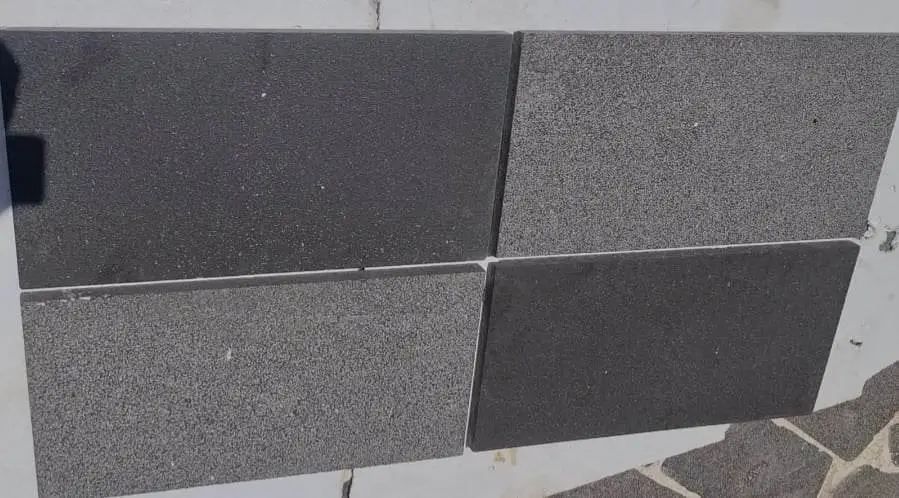
Reading Your Subgrade Before Maintenance Begins
The first step in any meaningful grey paver maintenance Arizona homeowners should take isn’t grabbing a pressure washer — it’s walking the field and looking for differential settlement patterns. Small depressions, raised corners, or joints that have widened on one side but compressed on the other are all telling you something about subgrade movement beneath. These signs appear earlier in Arizona’s expansive desert soils than they would in more stable subgrades because silty desert soils cycle between dry-shrinkage and moisture-expansion more aggressively than coastal or clay-dominant profiles.
For homeowners in Peoria, this is particularly relevant — the northwest Valley carries significant deposits of expansive silty loam that shift noticeably after summer monsoon saturation. You’ll often see joint sand washout at the low points of a paver field within 48 hours of a heavy storm event, which isn’t just a surface problem. It signals that the bedding layer is wicking moisture unevenly because the subgrade beneath isn’t draining at a consistent rate.
Identifying Problem Zones in Your Paver Field
- Look for rocking or clicking sounds when you walk across pavers — this indicates bedding loss, not surface wear
- Check joint width consistency — gaps wider than 3mm signal lateral movement from subgrade shift
- Inspect the perimeter restraint edge after each monsoon season for separation from the paver field
- Note any efflorescence streaking — it reveals subsurface moisture migration paths through the base layers
- Push down on individual pavers to test for soft spots in the compacted base underneath
Cleaning Grey Stone Pavers the Right Way for Arizona Conditions
Cleaning grey stone pavers in Arizona requires a different approach than you’d use in a humid climate. The combination of hard water mineral deposits, airborne desert dust, and biological crust formation from monsoon moisture creates a surface buildup that responds poorly to generic pressure washing. High-pressure washing without proper nozzle control actually drives fine silica particles deeper into the stone’s pore structure, which accelerates discoloration and makes future cleaning progressively harder.
The recommended protocol for cleaning grey stone pavers in Arizona is a low-pressure rinse first — under 1,200 PSI — using a fan-tip nozzle at a 45-degree angle. This lifts the loose desert dust layer without abrading the stone surface. For mineral scale and hard water deposits, a diluted pH-neutral stone cleaner applied at 15–20 minutes dwell time will break the calcium carbonate bond without etching the grey stone surface. Avoid anything citrus-based or acidic on natural grey stone pavers — the acid reacts with iron minerals present in most Arizona-sourced grey materials and produces rust-tone staining that’s very difficult to reverse.
Seasonal Cleaning Schedule for Desert Pavers
- Pre-monsoon (May–June): remove biological crust buildup and refill any depleted joint sand before rain season
- Post-monsoon (October): deep clean to remove sediment infiltration and inspect joints for washout damage
- Winter (December–January): light surface clean and check for any freeze-related joint movement in higher-elevation zones
- Spring (March–April): full inspection cycle including base integrity check and sealer assessment
Sealing Outdoor Pavers Across Arizona: What Actually Works
Sealing outdoor pavers across Arizona isn’t optional for grey natural stone — it’s the primary defense against the dual threat of UV degradation and subsurface moisture intrusion. The challenge most homeowners face is product selection. Arizona’s temperature swing between winter nights and summer afternoons creates thermal cycling stress on any film-forming sealer, causing premature delamination at the surface. You’ll get far better longevity from a penetrating impregnating sealer that works below the stone surface rather than one that creates a topcoat film.
Silane-siloxane penetrating sealers perform best across Arizona’s desert climate zones. They bond with the stone’s mineral structure at the molecular level, repel both water and oil intrusion, and don’t crack or peel under thermal expansion cycling. For grey stone specifically, use a sealer with a matte or natural finish — high-gloss sealers on grey pavers tend to show traffic wear patterns within 18 months under Arizona sun intensity, and they require mechanical stripping to remove, which is destructive to the stone surface.
Application timing matters significantly when sealing outdoor pavers across Arizona. Apply sealer in the early morning when surface temperatures are below 90°F — sealer applied to hot stone cures too quickly and doesn’t penetrate to full depth. In Tempe during summer, that window closes by 9:00 a.m., so plan your sealing schedule around early-morning starts from May through September. For accurate product guidance and the correct sealer type for your specific grey stone variety, reference our grey paver care Arizona guide before purchasing.
Weed Prevention in Grey Paving Joints: The Ground-Up Strategy
Weed prevention in grey paving joints AZ depends far more on your joint sand specification than on any surface treatment you apply afterward. Arizona’s weed seed bank is dominated by Bermuda grass, spurge, and annual broadleaves — all of which root in as little as 3–5mm of accumulated organic debris in joints. Polymeric sand with a Class A flex rating is the correct specification for Arizona desert applications because it maintains joint integrity across the full temperature range from winter freezes in higher elevations to 140°F surface temperatures in low desert summer.
The installation detail that determines long-term weed resistance is compaction depth, not the brand of polymeric sand you use. Joint sand must be compacted to within 3mm of the paver surface — not flush, which traps moisture, but not recessed more than 3mm, which creates an open channel for seed and debris accumulation. Plate compaction after sand application is non-negotiable on Arizona soils because the vibration settles fine particles into the lower joint zones where roots actually establish. Consistent attention to this depth tolerance is the core of effective weed prevention in grey paving joints AZ over the long term.
Joint Maintenance After Monsoon Season
- Inspect joint depth across the full paver field within two weeks of the last storm event
- Top-fill any joints that have dropped more than 3mm with matching polymeric sand
- Re-activate polymeric sand with a fine mist — not a full soak — to bond the new material to existing compacted layers below
- Avoid applying polymeric sand when rain is forecast within 24 hours; premature activation weakens the binder matrix
- Spot-treat any established weed growth with a targeted non-residual herbicide before sand refill — residual herbicides can discolor grey stone surfaces
Arizona Desert Paver Upkeep and Soil Movement: Staying Ahead of Settlement
The ongoing challenge of Arizona desert paver upkeep and care traces back to soil behavior more than material wear. Desert soils — particularly the poorly-graded gravelly sands and silty loams that dominate the Phoenix metro — don’t compact to a stable, permanent state the way granular glacial soils do. They respond to moisture fluctuations by expanding laterally rather than vertically, which creates subtle but cumulative racking stress on your paver field over multiple monsoon cycles.
Your proactive maintenance strategy should include an annual releveling inspection — not just a visual check, but a physical walk-test of every 50 square feet. Place a 4-foot level across multiple pavers in both directions. Tolerance for residential foot-traffic areas is ±3mm over any 10-foot span; beyond that, you should relay and re-bed the affected pavers before the movement compounds into a larger field distortion. Catching a 4-paver settlement early costs an afternoon. Ignoring it for two monsoon seasons typically means releveling 40–60 pavers.
At Citadel Stone, we recommend specifying grey pavers in Arizona at a minimum 2-inch nominal thickness for ground-level applications. Thinner profiles — 1.25-inch — are appropriate for raised deck or overlay applications where the substructure provides rigid support, but in direct ground contact across Arizona’s active soil environment, 2-inch stone distributes point loads more effectively and resists edge chipping when the subgrade shifts beneath a single unit.
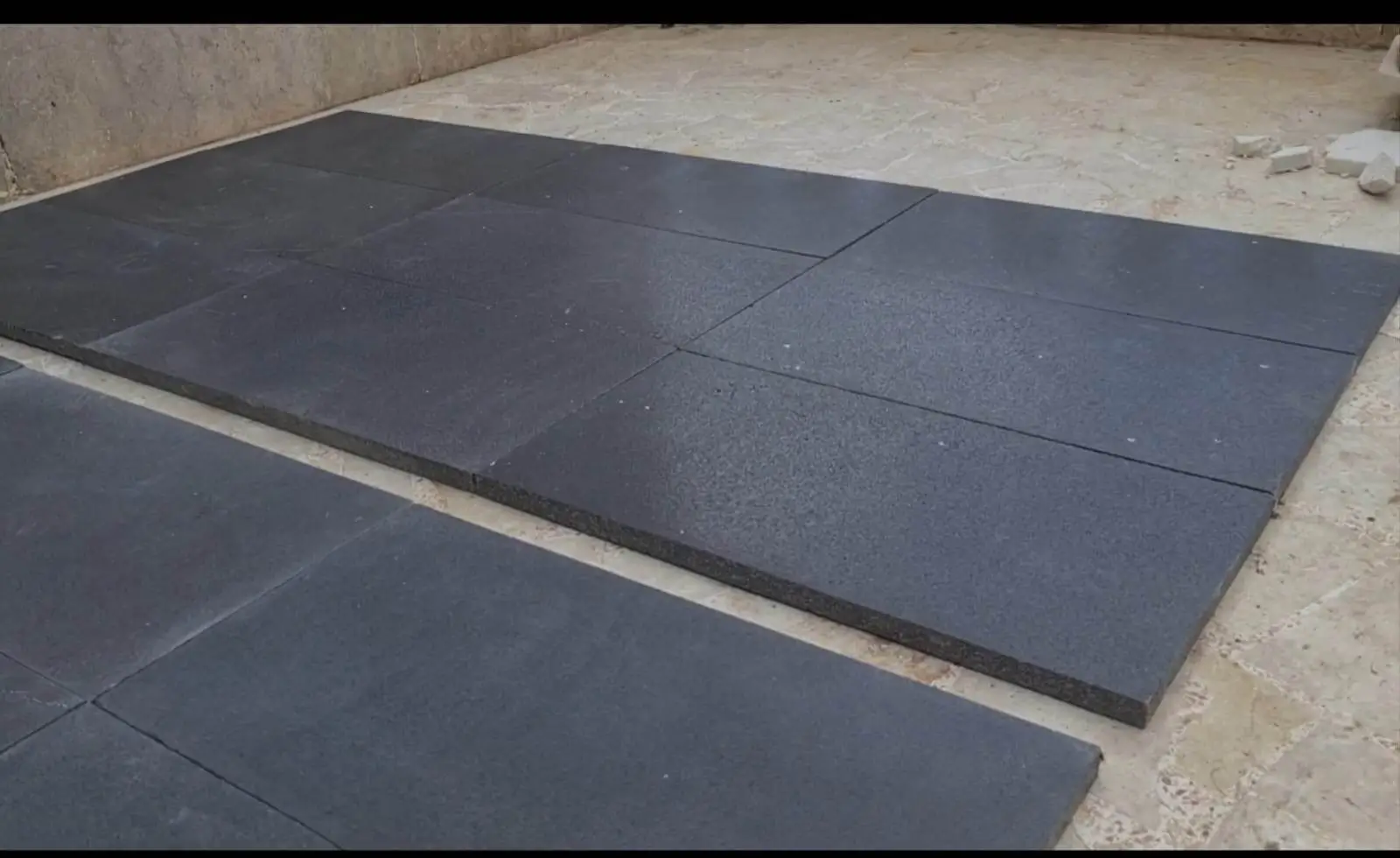
Managing Drainage to Protect Your Subgrade Long-Term
Drainage management is the single most impactful variable in grey paver maintenance for Arizona homeowners, and it’s almost always underdiscussed. The temptation after installation is to focus on surface aesthetics — cleaning frequency, sealer sheen, joint color. But the conditions that shorten paver system life in Arizona are predominantly subsurface: water that can’t exit the base layer fast enough is reabsorbed into the subgrade soil, triggering the expansion cycle that causes settlement and joint disruption.
Your paver field should maintain a minimum 2% cross-slope toward an unobstructed drainage outlet. In Phoenix projects bounded by block walls on three sides — which describes a large percentage of residential backyards — French drain installation at the low end of the paver field is essential, not optional. Without an engineered outlet, even a 1-inch monsoon rainfall event can temporarily saturate the base course, and repeated saturation events degrade the compacted aggregate layer progressively over time.
Checking Drainage Performance Annually
- Pour a 5-gallon bucket of water at the highest point of your paver field and time how long it takes to fully drain from the visible surface
- Standing water present after 60 seconds indicates insufficient slope or a blocked drainage outlet — both require correction before the next monsoon season
- Clear any sand or debris accumulation from French drain grates immediately after storm events
- Check that perimeter restraint edges haven’t shifted to create low-point pooling areas along the paver border
Ordering and Logistics for Grey Paver Repairs in Arizona
Replacement pavers for repair work need to be ordered from the same batch specification as your original installation whenever possible — grey stone varies meaningfully in tone and texture between quarry pulls, and a visible patch of mismatched pavers is a common outcome when homeowners source replacements without verifying the original material specification. Your installation contract or original purchase receipt should include a product code or quarry designation; bring that to your supplier before ordering.
Citadel Stone maintains warehouse stock across Arizona, which typically reduces fulfillment to 1–2 weeks for standard grey paver sizes — significantly faster than the 6–8 week lead time associated with direct import sourcing. For small repair quantities, confirm with the warehouse that your specific grey variant is in-stock before scheduling your contractor. Truck delivery for quantities under one pallet is often available as a scheduled drop on a route day, which keeps your repair timeline tight without forcing a full delivery order.
What Consistent Grey Paver Maintenance Delivers in Arizona
Grey paver maintenance Arizona homeowners get right is fundamentally about understanding that your soil environment does more work on your paver system than UV, foot traffic, or weather ever will. Staying ahead of subgrade movement — through annual inspection, proper drainage, and timely joint refilling — keeps a well-installed paver field performing for 20–25 years without major reconstruction. Cleaning, sealing, and weed prevention are important routines, but they operate on top of a structural foundation that demands its own attention.
A penetrating impregnating sealer applied every 3–5 years, polymeric sand maintained at consistent joint depth, and a drainage outlet that handles monsoon volumes without saturating your base — those three commitments define the difference between a paver installation that ages gracefully and one that requires costly remediation within a decade. For the full installation context that makes these maintenance practices most effective, the How to Install Grey Pavers in Arizona: Step-by-Step Guide covers the base preparation and bedding details that your maintenance routine depends on. Residents in Flagstaff, Sedona, and Peoria choose Citadel Stone grey pavers because their tight mineral structure slows weed intrusion and reduces the frequency of joint refilling over time.