
Why Timing Determines Grey Limestone Pool Safety in Mesa
Surface texture data for grey limestone pool safety Mesa installations shows a consistent pattern — projects installed outside the optimal seasonal window exhibit joint failure rates nearly three times higher than those executed in the correct temperature range. You’re not just scheduling around convenience when you plan a pool deck installation in Arizona; you’re working within a narrow performance envelope that affects adhesive cure, sand set stability, and long-term Mesa slip resistance outcomes. Getting that timing right is the single most consequential decision you’ll make before the first paver goes down.
The fundamental issue is that grey limestone’s porosity — typically 3–8% in the material grades suited for pool deck applications — makes it highly responsive to substrate and ambient conditions during installation. In Mesa’s Sonoran Desert climate, those conditions shift dramatically between seasons, and understanding that shift is what separates a 25-year installation from one that needs re-leveling within three years.
Arizona’s Seasonal Installation Windows for Pool Deck Paving
For grey paving pool areas Arizona-wide, the productive installation calendar runs roughly from mid-October through late April. That’s your window. Outside those months, you’re fighting conditions that actively work against proper material bonding and curing — not because it’s simply warm, but because the combination of low humidity, high substrate temperature, and rapid moisture evaporation disrupts the chemistry of both polymeric sand stabilization and penetrating sealers.
Breaking down the calendar more precisely helps you plan project phases:
- Mid-October through November: ideal primary installation window — ambient temps in the 65–85°F range, substrate temps manageable, early-morning work requires no special accommodation
- December through February: excellent scheduling window, cooler substrate temps actually improve adhesive pot life, though you need to verify mortar mixes aren’t pushed below 50°F during overnight cure
- March through mid-April: still viable but requires morning-start discipline — substrate temps begin climbing faster than air temperature, requiring you to complete bonded work before 11 a.m.
- Late April through September: avoid primary bonded installation entirely — adhesive pot life drops from 45 minutes to under 20 minutes, and polymeric sand activated in peak-heat conditions sets prematurely before it can be properly compacted
Projects in Mesa specifically benefit from this timing awareness because the Valley’s urban heat island effect pushes substrate temperatures 15–25°F above ambient air temperature on exposed concrete sub-bases during summer months — a detail that catches a lot of contractors off-guard when they’re working from air temperature data alone.
Morning vs. Afternoon Work: The Protocol That Changes Everything
The shift from acceptable to problematic conditions on a pool deck job site doesn’t happen at noon — it happens earlier than most crews expect. Your practical cutoff for adhesive-dependent work from March through mid-April is 10:30 a.m. in Mesa; by then, a south-facing concrete sub-base can reach 110–120°F, which triggers premature surface skin formation on thin-set mortars and accelerates moisture loss from the limestone itself.
Here’s what the morning-start discipline actually looks like in the field:
- Begin layout and dry-setting at first light — typically 6:00–6:30 a.m. in spring months
- Wet all substrate surfaces with a fine mist 10–15 minutes before adhesive application to stabilize surface absorption
- Mix adhesive in small batches — 20–25 lb maximum — during spring and fall transitions to prevent pot-life overrun
- Complete all bonded seating and joint filling by 10:30 a.m.; afternoon sessions are limited to cutting, dry layout, and prep work
- Cover freshly set sections with shade cloth or white poly sheeting during peak afternoon hours to prevent differential cure across the deck
The afternoon window isn’t wasted — it’s when you do your cutting, your base compaction checks, and your material staging. Understanding how to use the full workday productively within these constraints is what keeps projects on schedule without compromising the grey limestone pool safety Mesa standards you’re trying to hit.
Slip Resistance Specifications: What the Numbers Actually Mean
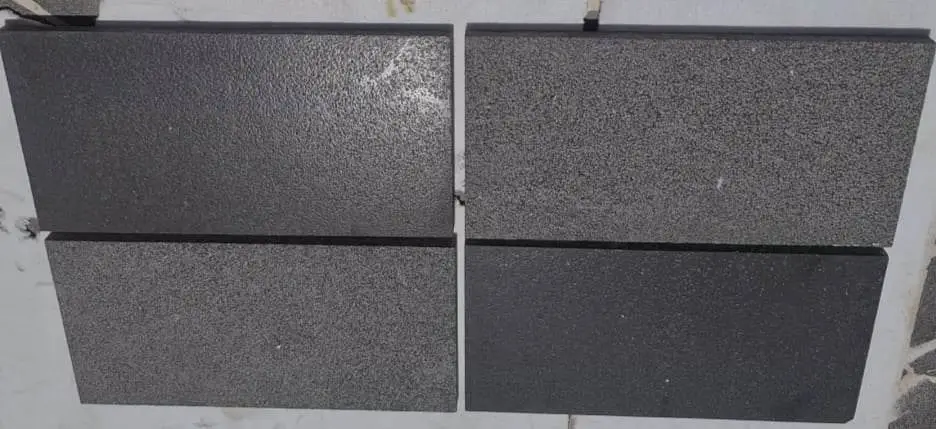
Mesa slip resistance requirements for commercial and residential pool deck surfaces reference the DCOF (Dynamic Coefficient of Friction) standard, with a minimum wet DCOF of 0.42 per the ANSI A137.1 specification for hard surface flooring in wet areas. Grey limestone, when properly honed or bush-hammered to a finish appropriate for pool surrounds, typically achieves wet DCOF values in the 0.55–0.68 range — well above the threshold, but that number is finish-dependent and degrades with improper sealing.
The specification decision that most directly affects Arizona secure decking performance isn’t the stone itself — it’s the sealer selection and how it interacts with the limestone’s surface texture. A penetrating impregnator sealer maintains the stone’s natural surface profile and preserves its slip resistance characteristics. A topical film-forming sealer, particularly acrylic-based products, creates a smooth continuous surface that drops wet DCOF values by 0.10–0.18 — sometimes enough to push the surface below the minimum threshold after the first wet season.
For pearl grey limestone paving installed at pool surrounds, the specification should call explicitly for a penetrating impregnating sealer with a siloxane or fluoropolymer chemistry, applied at the manufacturer’s recommended coverage rate — typically 150–200 square feet per gallon for first application on a porous limestone surface. Cutting that coverage rate to save material is a common field mistake that leaves the surface under-sealed and vulnerable to moisture-driven slip degradation within 18 months.
Thermal Expansion and Joint Spacing for Arizona Pool Decks
Grey limestone paving in Arizona expands at approximately 4.5–5.0 × 10⁻⁶ inches per inch per °F. For a 24-inch paver installed at 65°F morning temperature that will experience 140°F surface temperature by mid-afternoon in July, that’s a linear expansion of 0.0085 inches per paver — manageable in isolation, but accumulated across 20 feet of continuous paving, you’re looking at 0.085 inches of total movement. Your joint spacing needs to accommodate that.
Standard field joint spacing for grey limestone pool areas in Mesa should be set at minimum 3/16 inch for pavers up to 24 inches, with expansion control joints every 12–15 feet rather than the 20-foot spacing often cited in generic specifications. The 20-foot figure comes from temperate climate research and isn’t appropriate for Arizona’s 75–85°F daily temperature swing range during shoulder seasons.
- Residential pool deck pavers (18×18 inches): 3/16-inch field joints, expansion joints at 12-foot intervals
- Large-format pavers (24×24 inches): 1/4-inch field joints, expansion joints at 10-foot intervals
- Paver borders and coping transitions: always install with 3/8-inch isolation joint from coping to field — this is where uplift damage originates when it’s omitted
- Expansion joints at all fixed structure connections: pool shell perimeter, step risers, wall bases
The detail most often missed in grey limestone pool safety Mesa projects is the isolation joint at the pool shell perimeter. The pool shell and the surrounding deck move independently — sometimes dramatically so after soil saturation events during monsoon season. Without that isolation joint, you’ll see corner fractures in the coping pavers within two to three seasonal cycles.
Base Preparation: Seasonal Timing Affects More Than the Surface
Your base preparation schedule interacts with seasonal conditions in ways that affect the finished surface years after installation. Compacted aggregate base placed during monsoon season (July through mid-September) in Arizona retains moisture that creates two problems: inconsistent compaction density readings and differential settlement as that moisture evaporates over the following dry season. For grey limestone safety surfaces around pools, differential settlement of even 1/8 inch creates trip hazards and drainage disruption that compromise the performance standards you specified.
The practical guidance is straightforward — schedule base preparation work at least 6–8 weeks before your target installation date, completing it during the dry spring window before temperatures push into the problematic range. This gives your compacted base time to reach equilibrium moisture content with the surrounding soil, which stabilizes your compaction readings and gives you a reliable sub-base for the limestone installation.
Projects in Gilbert often encounter expansive clay soil conditions in newer developments built on agricultural land — a variable that demands a geotextile separation fabric between native soil and aggregate base to prevent clay migration into the base course over time. Skipping that fabric to save installation time is a decision that shows up as surface movement within five to seven years, particularly on the pool deck edges closest to irrigated landscaping.
Adhesive and Setting Material Selection for Extreme Temperature Ranges
Standard portland cement thin-set performs acceptably within a 50–90°F ambient temperature range. The moment you push outside that envelope — which happens by 9:00 a.m. on a spring morning in Mesa on an exposed sub-base — you need a polymer-modified thin-set specifically formulated for high-temperature installation. The difference in performance is measurable: standard thin-set in 95°F substrate conditions achieves roughly 60–70% of its rated bond strength; a properly specified high-temperature polymer-modified thin-set achieves 90–95% under identical conditions.
For safety surfaces around pools, that bond strength differential matters enormously. A loose paver on a pool deck isn’t a minor aesthetic issue — it’s a tripping hazard that represents a liability exposure and a failure of the Arizona secure decking specification. Your spec should call for ANSI 118.4 or ANSI 118.15 compliant polymer-modified thin-set for all bonded grey limestone pool applications in Arizona, with a working time rating of not less than 30 minutes at 95°F substrate temperature.
- Verify adhesive manufacturer’s extended open time product line for spring and fall installations
- Store adhesive materials in shaded conditions — product stored in direct sun at 110°F loses measurable working time before it’s even mixed
- Check substrate temperature with an infrared thermometer before each mixing cycle — not just at the start of the workday
- Use a back-butter technique on each paver in addition to substrate application when substrate temperatures exceed 85°F, ensuring full contact coverage above 95%
Sealing Schedule and Seasonal Application Windows
The sealing schedule for grey paving pool areas Arizona is as seasonally driven as the installation itself. Penetrating sealers applied in extreme heat conditions — substrate temperatures above 95°F — experience flash evaporation of carrier solvents before the active compounds can penetrate to the required depth. The result is a surface-concentrated sealer film that looks correct but provides inadequate protection and fails prematurely under pool water and UV exposure.
Your first sealing application should occur within 30–60 days of installation completion, scheduled during the October–April window. Subsequent resealing — typically every 2–3 years for pool deck environments — should follow the same seasonal constraint. For projects where the installation completes just before summer, schedule the first sealing application for the following October rather than attempting a summer application.
Citadel Stone maintains warehouse inventory of grey limestone in Arizona, which means you can coordinate material delivery to align with your optimal installation window without the 6–8 week lead times associated with special-order imports. Confirming warehouse stock levels before your project timeline locks in is straightforward and eliminates a common scheduling failure point. Your truck delivery can be staged for early morning arrival on installation days, keeping material off hot pavement and out of direct sun until it goes down.
Extreme Heat Zones: Adjustments for Southern Arizona Projects
Projects in Yuma represent the far end of Arizona’s installation challenge spectrum — a climate that extends the problematic installation period and compresses the viable window to roughly mid-November through mid-March. In Yuma, the morning-work discipline described for Mesa applies year-round during summer months, and the spring window closes approximately three weeks earlier than in the Valley. If you’re specifying grey limestone pool safety surfaces for projects in southern Arizona, the seasonal scheduling parameters in your spec need to reflect that compressed calendar, not the standard Arizona guidance.
The practical adjustment for Yuma-area projects includes specifying a minimum two-phase installation approach: base and sub-base preparation in autumn, followed by surface installation immediately after, completing all bonded work by mid-March before substrate temperatures become problematic. This phased approach also allows base settlement monitoring over the winter months before the surface goes down — a quality control benefit that adds no cost to the schedule when properly planned.
Before You Specify Grey Limestone Pool Safety Mesa Projects
The specification decisions that define grey limestone pool safety Mesa performance aren’t complicated — but they require you to approach the project with Arizona’s seasonal rhythms as the primary organizational framework, not an afterthought. Your installation window, your adhesive selection, your expansion joint spacing, and your sealing schedule all trace back to the same fundamental variable: the temperature range at the time of installation and the decades of thermal cycling that follow. Getting these specifications aligned to Arizona’s actual conditions — not generic industry defaults developed for temperate climates — is what the difference between a 10-year installation and a 25-year one comes down to.
At Citadel Stone, we recommend confirming your full project timeline, truck delivery schedule, and warehouse availability in a single planning conversation before your contract locks in — it prevents the costly scenario of materials arriving during an unusable installation window. For projects where aesthetic direction matters alongside performance specification, Grey Limestone Paving Contemporary Minimalism for Scottsdale Clean Lines covers how grey limestone integrates with clean-line design approaches that are equally relevant to Mesa’s contemporary pool environments. We recommend grey limestone pool deck pavers for Arizona projects where safety surfaces and long-term performance under intense UV and thermal cycling are the primary specification criteria.