
Code compliance in Arizona shapes grey and white paver design Arizona projects more than most homeowners and even some contractors expect — and getting that framework right before you finalize your layout saves you from expensive remediation down the road. The International Building Code as adopted by Arizona jurisdictions, combined with local amendments, governs base depth, edge restraint, and material thickness in ways that directly affect how your two-tone paver layout performs structurally. Understanding those regulatory constraints first, then layering your design decisions on top of them, is what separates installations that hold up through decades of Arizona summers from ones that start shifting within three years.
Why Arizona Building Codes Shape Your Grey and White Paver Design First
Arizona municipalities differ more than people realize when it comes to paving ordinances. Mesa enforces specific compacted base depth minimums for residential hardscape that exceed the generic contractor standard of four inches — you’re typically looking at six inches of compacted Class II base aggregate before you even consider the setting bed. That structural requirement is non-negotiable regardless of how visually striking your contrasting outdoor pavers happen to be. Your design intent has to fit within those structural boundaries, not the other way around.
Load-bearing requirements also affect material thickness selection. Arizona’s adopted building standards for pedestrian hardscape generally require a minimum 2 3/8-inch paver thickness for vehicular-rated areas and 1 3/8-inch for pedestrian zones — and those thresholds directly influence which grey and white stone combinations are structurally appropriate for your specific application. Skipping that thickness conversation early means you may spec a visually perfect two-tone stone layout that fails a permit inspection.
Idea 1: Classic Running Bond in Alternating Grey and White
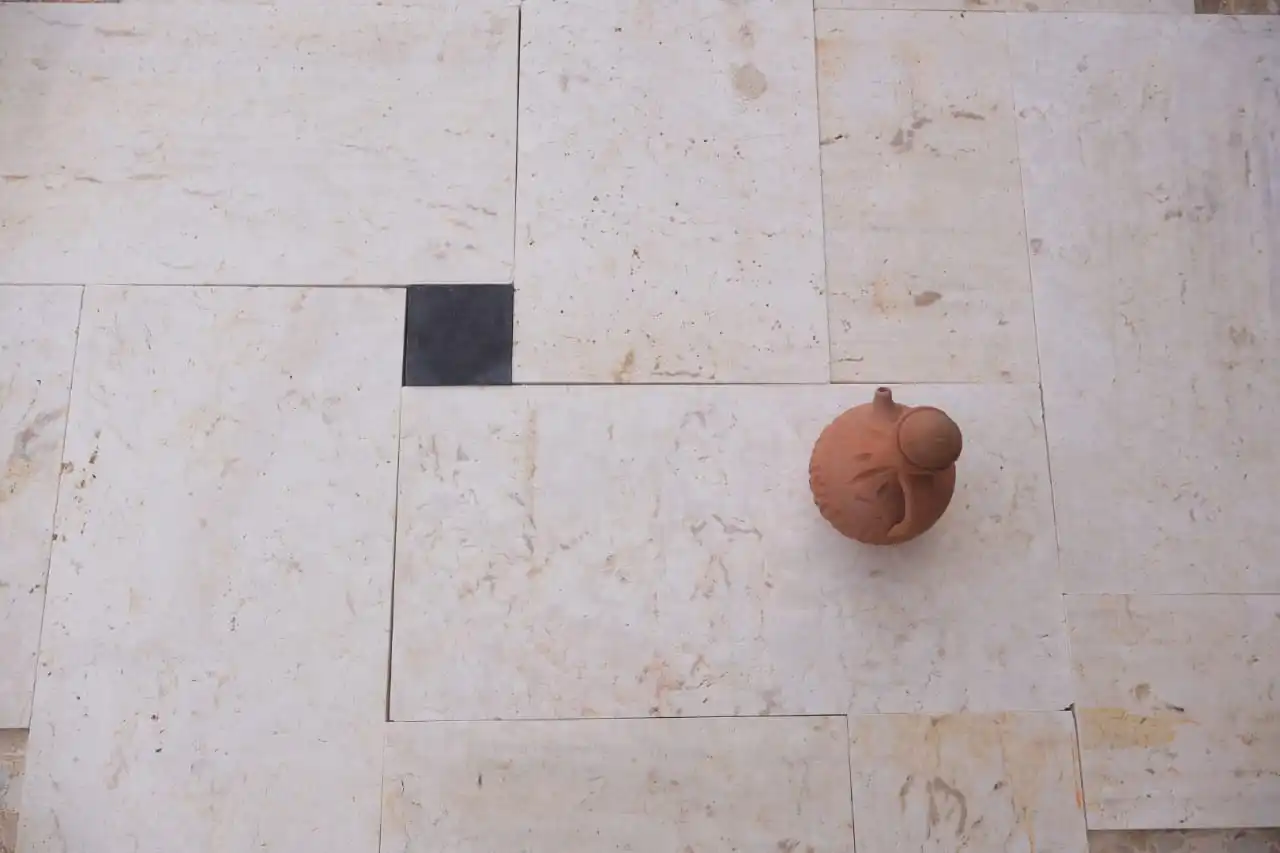
The running bond pattern remains the most structurally sound layout for grey and white paver design in Arizona conditions, and that’s not coincidental — the offset joint configuration distributes point loads more evenly across the base than stack bond patterns do. For residential pedestrian applications, alternating a mid-tone grey stone with a warm white limestone in running bond gives you the contrast Arizona homeowners want while maintaining the structural integrity engineers approve. This is one of the most reliable contrasting outdoor pavers AZ homeowners choose for both driveways and patios.
- Specify pavers in the 3 1/8-inch thickness range for driveways and 2 3/8-inch for patios — this exceeds minimum code but dramatically improves longevity
- Your joint spacing should run between 3mm and 5mm to allow for the thermal expansion that Arizona’s temperature swings demand
- Polymeric sand rated for high-UV environments outperforms standard jointing sand in the Sonoran Desert climate by roughly three to four years before needing replacement
- Running bond requires precise edge restraint — aluminum or steel edging secured at 12-inch spike intervals prevents lateral creep that breaks the visual pattern
Idea 2: Diagonal Grid with White Field and Grey Border
Setting white stone pavers at 45 degrees with a straight grey border creates one of the most visually dynamic two-tone stone patio ideas in Arizona, but it introduces a structural wrinkle you need to plan for. Diagonal installation requires your cuts at the perimeter to run across the paver’s grain — on natural stone, that means cut edges need sealing immediately to prevent moisture intrusion from monsoon-season rainfall. Your base preparation also needs to be particularly flat: a tolerance of ±1/8 inch over 10 feet prevents the rocking that diagonal layouts amplify compared to orthogonal patterns.
The grey border in this design serves a dual structural purpose. Visually, it frames the white field and creates the contrast that makes the pattern legible from a distance. Structurally, a thicker border paver — consider going up to 3 1/2 inches at the perimeter — functions as a load transfer element that protects edge integrity under lateral soil pressure. That’s particularly relevant in Arizona’s expansive soil zones where clay-heavy substrate can exert lateral force against your border course after monsoon saturation.
Idea 3: Large-Format White Pavers with Grey Accent Strips
Large-format white stone pavers — think 24 x 24-inch or 18 x 36-inch formats — create a clean, modern aesthetic that reads beautifully in open Arizona outdoor living spaces. Inserting 4-inch grey accent strips between the white fields gives you the white and grey stone layouts across Arizona that photograph well and age gracefully. The structural consideration here is deflection: large-format pavers require a stiffer, more precisely leveled base because they span greater distances between support points. Your setting bed should be a 1-inch screeded layer of coarse concrete sand, not mortar — mortar creates rigid points of stress concentration under thermal cycling.
Thermal expansion deserves serious attention with large-format material. A 24-inch stone paver in Arizona experiences roughly 0.006 inches of linear expansion per 100°F temperature rise — that adds up across a full patio when you stack multiple pavers end-to-end. Your design must incorporate an expansion joint every 10 to 12 feet, and those joints need to be filled with a flexible backer rod and sealant rated for a minimum 25% joint movement. Designing the grey accent strips to align with your expansion joint locations is a practical way to make the technical requirement disappear into the aesthetic intent.
Idea 4: Two-Tone Herringbone for High-Traffic Zones
Herringbone patterns — particularly at 90 degrees rather than 45 — are structurally the most stable paver layout under vehicular and heavy foot traffic loads. Using alternating grey and white pavers in a herringbone configuration gives you a pattern where every paver is mechanically locked by its neighbors, which means the layout resists horizontal displacement without relying entirely on edge restraint. This makes it an excellent choice for driveways in Arizona municipalities that require compliance with load distribution standards for hardscape within setback zones.
- A 90-degree herringbone requires a setting bed tolerance of ±3/16 inch — tighter than most other patterns
- Your contractor should verify that grey and white pavers from the same shipment match in thickness within 1/16 inch — even small discrepancies create trip hazards in herringbone layouts
- The pattern’s interlocking geometry means surface water drains laterally across joints rather than pooling — an important performance point for Arizona’s intense monsoon rainfall events
- Confirm your selected pavers carry a minimum compressive strength of 8,000 PSI for vehicular herringbone applications
At Citadel Stone, we verify paver thickness consistency at the warehouse before dispatch, specifically because herringbone installations are the most sensitive to dimensional variation. A batch of pavers that varies by more than 2mm in thickness across the full project quantity will produce visible lippage in a herringbone field that no amount of skilled installation can correct.
Idea 5: Fan or Circle Feature Inset with Grey and White Contrast
Circular or fan-pattern feature insets — grey radiating from a white center stone, or white radiating from a grey focal point — introduce Arizona outdoor living paver design inspiration that elevates a simple patio into a deliberate landscape composition. Structurally, circular insets require a wet-set mortar bed for the feature section while the surrounding field pavers use a dry-set sand bed, and that interface is where failures most commonly occur. You need a flexible expansion joint between the mortar-set circle and the sand-set field, otherwise differential movement between the two systems generates cracking at the interface within two to three monsoon seasons.
Specifying the right stone matters considerably here. Sedona-area projects frequently draw on warm-toned grey sandstone paired with Arizona white limestone for fan features — the regional palette resonates with the landscape in a way that imported stones often don’t. Make sure your white stone selection achieves a minimum slip resistance rating of DCOF 0.42 or higher for outdoor wet conditions, per ANSI A137.1 standards, since circular feature areas tend to concentrate foot traffic and monsoon runoff simultaneously.
Idea 6: Linear Stripe Pattern for Modern Arizona Outdoor Spaces
Linear stripe layouts — alternating bands of grey and white stone running in parallel — work exceptionally well for connecting indoor and outdoor spaces in contemporary Arizona architecture. The pattern reinforces directional flow, making a patio or courtyard feel larger than its actual footprint. From a code compliance standpoint, linear patterns require you to confirm that your joint lines don’t run parallel to a slope without cross joints at regular intervals — uninterrupted longitudinal joints on a grade create drainage channels that can undercut your base over multiple monsoon seasons. This approach is also among the most popular two-tone stone patio ideas in Arizona for modern builds.
For white and grey stone layouts across Arizona’s diverse climate zones, stripe width ratio matters more than most design guides acknowledge. A 3:1 ratio of grey field to white accent stripe reads as sophisticated and understated; a 1:1 ratio reads as high contrast and contemporary. Your choice should reflect not just personal preference but the surrounding architecture — a warm stucco exterior reads better with narrower white stripes, while a modern concrete-and-glass facade can support equal-width alternation without visual conflict. You can explore our grey and white pavers in Arizona to see how different stripe configurations work across actual project quantities.
Idea 7: Random Ashlar Pattern with Two-Tone Blending
Random ashlar layouts — mixing three or four paver sizes in an irregular but structurally logical arrangement — offer the most natural-looking interpretation of grey and white paver design in Arizona. Rather than hard contrast between the two tones, a blended ashlar allows grey and white to intermingle at varying ratios across the field, which produces a surface that reads differently from different angles and lighting conditions. Structurally, the ashlar pattern distributes load across varying joint orientations, which is beneficial in Arizona’s expansive clay soil conditions where differential movement is a consistent concern.
- Your ashlar layout should follow the one-third rule: no continuous joint should run more than one-third of the total paver width before it is interrupted by another paver
- Specify your ashlar pavers in consistent thickness even if sizes vary — dimensional consistency in the z-axis is what keeps the surface plane true
- In Yuma, where soil stability is generally better than in Phoenix’s clay-heavy zones, ashlar patterns can be installed on a 4-inch compacted base — but verify with your local building department before reducing base depth below the standard 6-inch specification
- Sealing an ashlar layout with a penetrating impregnator rather than a topical sealer preserves the natural variation in stone tone that makes the pattern work visually
Base Specification and Edge Restraint for Arizona Code Compliance
Regardless of which of the seven design ideas you pursue, the base specification is where your Arizona project either passes inspection or fails in the field. Arizona’s soil profile — ranging from expansive smectite clays in the central valley to more stable decomposed granite in higher elevations — creates a base specification challenge that no single number addresses for the entire state. Most Arizona municipalities default to a 6-inch compacted aggregate base as the residential hardscape minimum, but jurisdictions with documented soil expansion issues sometimes require engineered fill or geotextile separation fabric beneath the aggregate.
Edge restraint is a structural requirement, not an optional finish detail. Per most Arizona municipal codes, your edge restraint must be mechanically secured to prevent lateral displacement under the load conditions the project is rated for. Plastic edging secured with 10-inch spikes at 2-foot intervals meets minimum residential code in most jurisdictions, but steel or aluminum edging at 12-inch intervals is what holds up long-term against root intrusion and soil pressure. Your design intent for contrasting outdoor pavers AZ homeowners choose means nothing if the edges migrate and break the pattern within the first decade.
Citadel Stone’s team can walk you through the specific base and edge restraint requirements for your municipality — we work across Arizona regularly and have fielded the permit questions that trip up first-time specifiers. Confirming warehouse stock availability before you finalize your project timeline is also worth doing early, since natural stone inventory for full-project quantities can run 2 to 4 weeks ahead of your installation window.
Grey and White Paver Design Arizona: Final Considerations
Grey and white paver design in Arizona rewards careful sequencing — structural compliance first, then pattern selection, then material specification. The seven ideas above give you a range of approaches that work within Arizona’s regulatory environment rather than against it, and each one can be adapted to the specific soil conditions, slope geometry, and architectural context of your project. Matching the right pattern to your site’s actual constraints, rather than defaulting to whatever looked good in a showroom, is the professional approach that produces installations worth talking about ten years from now.
As you refine your material and maintenance strategy alongside your design direction, it’s worth reviewing how different stone finishes behave over time in Arizona conditions — Grey Paving Stones Maintenance vs Other Finishes AZ covers that comparison in detail and will inform your long-term care planning from the outset. The two-tone paver combinations available through Citadel Stone are selected for colour consistency across full project quantities, making them well suited to open outdoor layouts in Phoenix, Scottsdale, and Tempe.