
Why Beige Flagstone Fails in Arizona Landscapes
Flagstone beige repair problems in Arizona trace back most often not to the stone itself, but to the gap between how the material was specified and how it was installed within the context of the surrounding landscape design. Beige flagstone is chosen for its warm, earthy resonance with desert xeriscaping and Southwestern architectural palettes — but that same aesthetic decision carries structural responsibilities that get overlooked when the focus stays purely on visual harmony. The slabs sitting beside ornamental grasses in a Scottsdale courtyard face very different movement and drainage demands than the same material set in a Flagstaff mountain garden, and diagnosing repair problems correctly starts with understanding that difference.
The flagstone sedimentary rock characteristics and paving use documented by Britannica’s flagstone geology reference confirm that beige flagstones are primarily fine-grained sedimentary formations with natural laminar planes — those planes are assets in a quarry but potential fracture pathways in a poorly prepared installation. Recognizing this helps you approach repairs more strategically than simply replacing cracked slabs.
Reading the Landscape Before You Diagnose the Problem
Arizona’s landscape design traditions — from desert-minimalist xeriscaping to lush Sonoran resort plantings — directly influence which repair problems you’re most likely to encounter with beige flagstone. Pathways that weave through dense plantings retain more moisture at the slab edges, accelerating the efflorescence and staining cycles that plague beige stone in particular. Patios integrated with large boulders and decomposed granite ground cover tend to create localized drainage shadows, which is where you’ll see the most lateral shifting.
Your first diagnostic step should always be observing the landscape context, not just the damaged slab. Consider how:
- Drip irrigation lines routed under or near flagstone create consistent localized saturation zones that undermine sand-set bases over time
- Shade structures and canopy trees alter the thermal expansion and contraction cycles specific slabs experience compared to exposed areas
- Decorative boulders redirect runoff in ways that concentrate hydrostatic pressure against flagstone edges during monsoon events
- Crushed granite mulch compacted against slab edges traps fine particles that migrate under the stone through thermal pumping cycles
Natural stone shifting issues across Arizona properties are rarely random — they follow the landscape’s water and heat logic. Identifying that logic saves you from repairing the same slab twice.
Diagnosing Cracked and Fractured Beige Flagstone
Fixing cracked flagstone surfaces in Arizona requires you to differentiate between surface fractures and through-body fractures before committing to any repair approach. Surface fractures — those that penetrate less than 30% of the slab thickness — are candidates for epoxy consolidants, particularly when the surrounding landscape design makes full slab replacement visually complex. Through-body fractures in slabs thinner than 1.5 inches are almost always replacement calls, regardless of how tempting a crack fill might seem.
The fracture geometry tells you the cause. Radial fracture patterns radiating from a single point indicate point-load impact, common around outdoor furniture legs in entertainment areas. Parallel fractures running perpendicular to the long axis of a slab indicate base failure, often from the wash-out of fine material beneath the stone. Edge spalling in an otherwise intact slab typically signals freeze-thaw cycling, which becomes relevant even in Arizona at elevations above 5,000 feet.
In Flagstaff, where elevations exceed 6,900 feet, freeze-thaw cycling is a genuine design and repair factor that Scottsdale contractors sometimes underestimate when they take on projects in that zone. A penetrating consolidant rated for freeze-thaw resistance is the right choice when fixing cracked flagstone surfaces in Arizona at higher elevations, not just the standard crack filler appropriate for low-desert installations.
Solving Staining Problems on Beige Flagstone in Arizona
Beige flagstone staining solutions for AZ homes require a two-phase approach: identifying the stain chemistry first, then selecting a treatment that won’t alter the stone’s natural color — because beige flagstone’s warm tan palette is precisely why it was chosen to complement the surrounding desert landscape, and the wrong cleaner can shift it toward gray or white permanently.
The most common stain categories you’ll encounter on beige flagstone in Arizona outdoor settings:
- Efflorescence (white mineral deposits) — caused by soluble salts migrating through the stone body; treat with a mild acidic solution (pH 3-4) and scrub with a stiff nylon brush, not wire, which leaves metallic residue
- Iron oxide staining (orange-brown streaks) — originates from corroding rebar or metal furniture; requires a dedicated iron-stain remover with oxalic acid chemistry, applied in cool conditions below 85°F
- Organic staining (green algae, dark tannins from plant debris) — treat with a sodium percarbonate cleaner; do not use bleach, which can permanently bleach adjacent grout and alter stone tone
- Oil and grease staining from outdoor cooking areas — draw out with a poultice of diatomaceous earth and a degreasing solvent, left on for 24-48 hours before removal
For reference on industry-standard cleaning and restoration protocols aligned with material type, the Natural Stone Institute limestone and flagstone care guidance provides a reliable baseline that professionals apply to sedimentary stone cleaning in arid climates.
Base Failure and Shifting Slabs: The Real Culprit
Natural stone shifting issues across Arizona landscapes account for the majority of flagstone repair calls, and the underlying cause in most cases is a base that was appropriate for the climate at installation but failed to account for the specific landscape hydrology around it. A 4-inch compacted decomposed granite base performs well in a well-drained, low-irrigation environment — but the same base in a xeriscape design with subsurface drip irrigation positioned within 12 inches of the flagstone will typically fail within 3-5 years as fines migrate and base density deteriorates.
For Citadel Stone beige stone repair Arizona projects that involve resetting shifted slabs, the standard repair sequence should include excavating to a minimum 6-inch depth, installing a geotextile separation fabric to prevent fine migration, and repacking with a 3/4-inch minus crushed aggregate compacted to 95% of standard Proctor density before bedding the flagstone back in place. Skipping the geotextile is the most common reason a reset slab shifts again within two seasons.
Joint width also deserves evaluation when resetting slabs. Joints tighter than 3/4 inch in a sand-set application on a thermal-active Arizona surface create interlock stress that accelerates edge chipping during summer expansion cycles. Sedona installations, with their dramatic temperature swings between red-rock canyon afternoons and cool high-desert evenings, are particularly susceptible to this joint-stress failure mode.
Matching Replacement Slabs to Existing Beige Flagstone
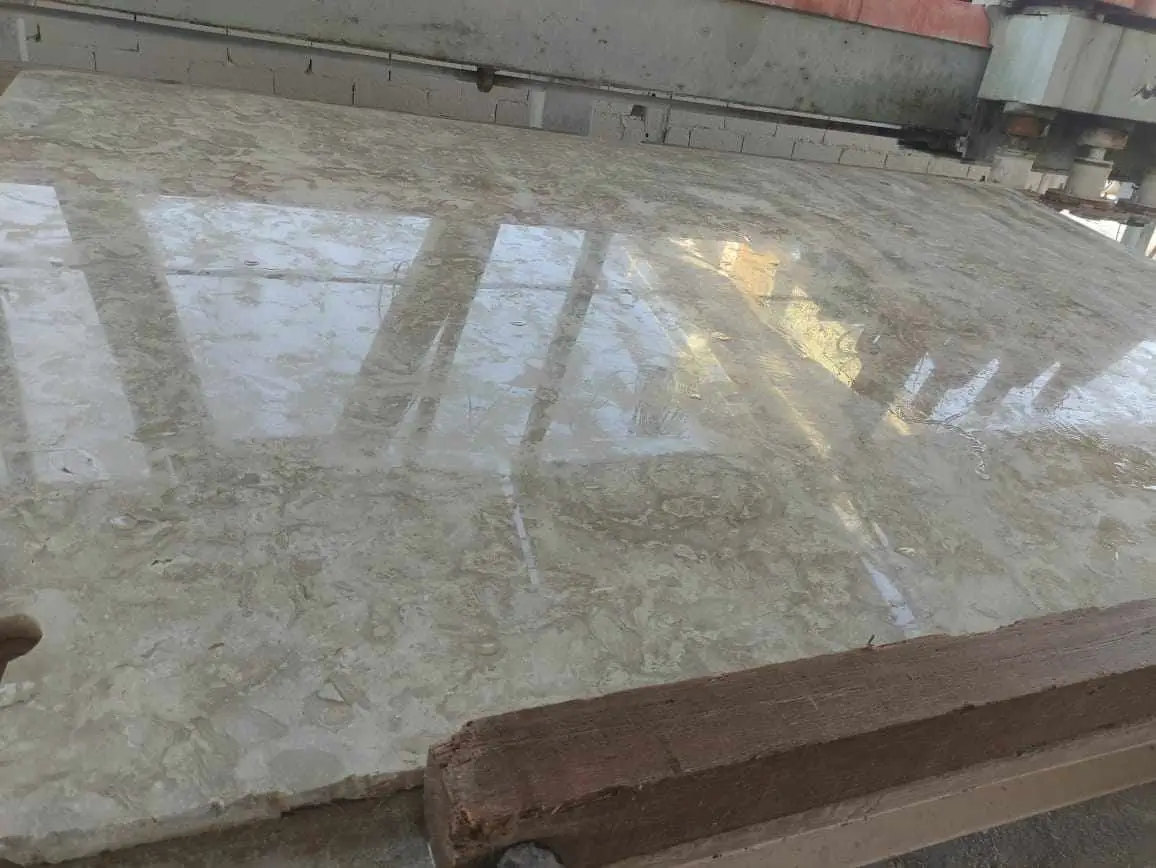
The aesthetic integration challenge in beige flagstone repair often frustrates homeowners more than the technical repair itself. Beige flagstone isn’t a single color — it’s a family of warm tones ranging from pale cream to rich tan with rust and gray undertones, and matching a replacement slab to weathered existing stone requires selecting from the same quarry lot whenever possible. This is where your material sourcing strategy matters as much as your repair technique.
At Citadel Stone, we maintain warehouse inventory of beige flagstone batched by quarry source and lot, which gives contractors the ability to pull matching stock for repair projects rather than accepting whatever arrives in a mixed shipment. Verifying warehouse availability before scheduling a repair visit prevents the common scenario of arriving on site with a replacement slab that reads noticeably cooler or warmer in tone than the surrounding field. Our technical team can cross-reference current stock tones against photos of existing installations to narrow the selection before the order ships truck-direct to the project site.
For natural stone repair matching, consider these practical guidelines:
- Wet both the existing slab and the potential replacement slab before comparing — wet tone is closer to the sealed, in-service appearance than dry stone comparison
- View matching candidates in outdoor light, not warehouse fluorescent lighting, which distorts warm-tone readings significantly
- Account for the fact that new slabs will lighten slightly as they cure and weather — select slightly warmer in tone than the existing stone to allow for this shift
- For repairs involving more than 3 replacement slabs, consider having the entire patio surface resealed uniformly after repair to unify the appearance
Sealing Beige Flagstone After Arizona Repairs
Post-repair sealing is non-negotiable for beige flagstone in Arizona outdoor environments — but the sealer selection significantly affects both the stone’s appearance and its long-term performance in the landscape context. A high-gloss topical sealer might suit a formal courtyard in a contemporary Scottsdale residence, but it reads as artificial in a naturalistic xeriscaping environment and creates a slipping hazard in a lightly textured surface finish.
The preferred sealer category for most beige flagstone repair applications in Arizona is a penetrating fluoropolymer or silane-siloxane formulation that provides oil and water repellency without altering the natural surface appearance. These penetrating sealers don’t create a film layer that can peel under Arizona UV — a serious long-term problem with topical acrylics in extreme heat climates. Reapplication on a penetrating sealer typically runs every 3-5 years depending on traffic and irrigation exposure.
The ASLA natural stone outdoor paving guidance supports the use of breathable, penetrating treatments over film-forming sealers for outdoor natural stone applications — a principle that directly applies to beige flagstone staining solutions for AZ homes where UV loading and thermal stress compound the case for penetrating chemistry over topical films.
Arizona Flagstone Surface Problem Diagnosis Guide
An Arizona flagstone surface problem diagnosis guide needs to be organized around failure mode rather than repair method — because the same symptom can have different causes depending on the landscape design context, elevation, and irrigation setup. Running through this diagnostic framework before committing to materials or labor saves significant rework cost. Contractors working across the Phoenix metro, high-desert Peoria corridors, and the East Valley communities like Gilbert encounter meaningfully different failure patterns based on soil composition and water table depth, making a structured diagnosis approach even more valuable than a one-size approach.
Match your symptoms to these primary failure modes:
- Slab edges lifting or rocking — base failure from fines migration; reset with geotextile separation and recompacted aggregate base
- Hairline surface cracks in a network pattern — thermal shock from rapid temperature change, common on thin slabs under 1.25 inches; repair with penetrating consolidant, replace if network is dense
- White powdery deposits forming after irrigation — efflorescence from mineral-rich water source; treat chemically, then evaluate irrigation timing to reduce standing water contact with stone
- Slabs sinking uniformly in a zone — subsurface erosion channel, often following a root path or old utility trench; excavate, fill with compactible material, and relay the entire zone
- Orange or rust staining appearing seasonally — iron oxidation from concealed metal irrigation components or rebar fragments in the base; locate and remove the metal source before treating the stone surface
This systematic Arizona flagstone surface problem diagnosis approach keeps your repair scope honest and prevents the common mistake of treating symptoms rather than causes — a discipline that becomes especially important when natural stone shifting issues across Arizona sites involve multiple interacting failure mechanisms rather than a single clear culprit.
Moving Forward With Flagstone Beige Repair in Arizona
Flagstone beige repair problems in Arizona are solvable when you work through the landscape design context, base conditions, and stain chemistry before picking up a chisel or ordering replacement material. The most durable repairs are the ones that account for how the stone lives in its specific outdoor environment — the irrigation patterns around it, the sun exposure it receives, the design palette it needs to maintain. Your repair strategy should honor the original landscape intent while correcting the structural or surface failure that broke the installation.
Ordering materials truck-direct from a supplier with regional stock gives you tone-matching accuracy that import stock can’t reliably provide. Beyond this article’s focus on repair, your Arizona stone project may also benefit from a closer look at installation methodology for this material — beige flagstone installation in Arizona covers the foundational specification decisions that prevent the failure modes discussed here. Stone for Arizona projects repaired or replaced through Citadel Stone flagstone beige inventory allows contractors in Flagstaff, Peoria, and Gilbert to match existing slab tones closely when addressing shifting or staining issues.