
Thermal cycling is the hidden villain in most failed pathway paver installations across Arizona — and it’s the variable that separates a 25-year installation from one that’s rocking and cracking inside eight years. Choosing large pathway pavers in Arizona homes isn’t simply a materials decision; it’s an engineering decision driven by the daily temperature range your pavers will experience from January through July. In Phoenix, stone surfaces can swing from 38°F at pre-dawn in January to 115°F midday in summer — a range that imposes roughly 77°F of thermal stress on every joint, every slab, and every square inch of your base layer.
Why Thermal Cycling Drives Every Specification Decision
You might assume Arizona’s desert climate is a straightforward environment for natural stone — hot, dry, and stable. The reality is closer to the opposite. Arizona imposes some of the most demanding thermal cycling conditions in North America, not because of extreme cold alone, but because of the amplitude and frequency of temperature swings. A stone surface in Scottsdale routinely cycles through 40–50°F swings in a single 24-hour period during spring and fall shoulder seasons, and those transitions happen fast — within two to three hours at sunrise and sunset.
Natural stone expands and contracts with every cycle. For limestone, the linear thermal expansion coefficient runs approximately 4.4 to 5.6 × 10⁻⁶ per °F. Across a 24-inch large-format paver, a 50°F daily swing produces roughly 0.006 to 0.007 inches of dimensional change per cycle. That sounds small, but multiply it by 365 cycles per year and 20 years of service life, and you’re looking at cumulative joint stress that will eventually compromise any installation lacking proper expansion accommodation.
The specification decisions that protect your installation — joint width, base flexibility, stone thickness, and sealer type — all trace back to this cycling reality. Every material choice you make when choosing large pathway pavers for Arizona homes should be evaluated through that lens first.
Stone Type Selection for Arizona Thermal Conditions
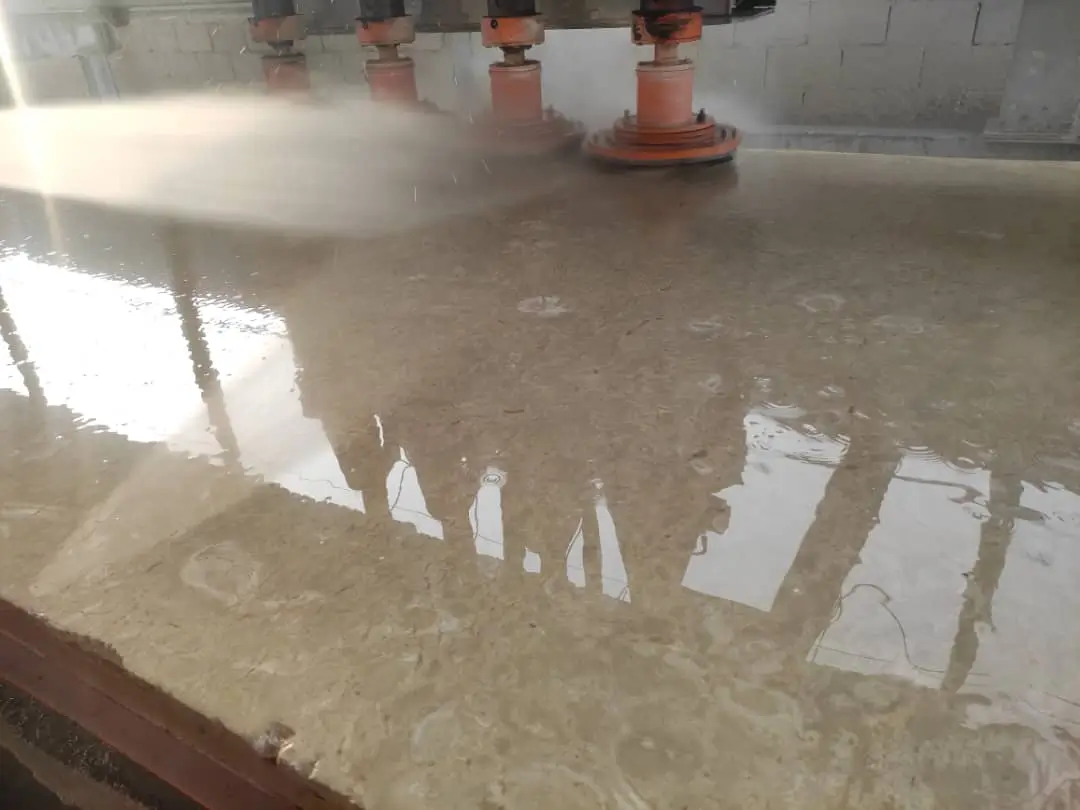
Not every natural stone handles thermal cycling with equal grace. Your selection from the available range of best natural stone pathway pavers in Arizona should start with how each material behaves under repeated dimensional stress — not just how it looks in a showroom sample.
- Limestone performs reliably in Arizona’s cycling range when you select a dense, low-porosity grade — look for water absorption below 3% per ASTM C97 testing, which indicates tight pore structure that resists moisture infiltration during rare rain events followed by rapid temperature drops
- Travertine offers excellent thermal mass but comes with open-pore structure that must be filled and sealed before installation; unfilled travertine allows moisture and fine debris into voids, which expand under thermal stress and accelerate spalling
- Basalt delivers the lowest thermal expansion coefficient of common pathway stones — approximately 3.0 × 10⁻⁶ per °F — making it an outstanding choice for large-format applications where joint spacing is limited by design constraints
- Sandstone generally underperforms in Arizona’s thermal cycling environment due to its layered sedimentary structure, which creates natural cleavage planes that cycling stress exploits over time
- Quartzite sits at the premium end of thermal resilience, with compressive strength above 20,000 PSI and a thermal expansion profile that rivals basalt, but its cost and limited availability in large-format sizes make it a project-specific choice
The practical takeaway for most residential projects is that dense limestone and basalt represent the strongest pairing of performance, availability, and cost. Travertine remains a viable option when you’re willing to invest in proper fill and sealing protocols before the pavers ever hit the base. Reviewing the best natural stone pathway pavers in Arizona against your site’s specific thermal exposure before committing to a material type will save you from costly remediation down the road.
Thickness Requirements for Large-Format Pathway Pavers
Stone pathway paver thickness guide recommendations across Arizona vary depending on who you ask, but field performance data tells a consistent story: undersized thickness is the single most common cause of premature failure in large-format installations. The structural logic is straightforward — larger pavers span greater unsupported distances between base contact points, which increases flexural stress on the stone body during thermal movement.
For residential pathway applications with pedestrian-only loading, the minimum defensible thickness for large-format natural stone pavers is 1.5 inches. At this thickness, a 24 × 24-inch limestone paver maintains adequate flexural strength across its span during thermal cycling. Drop below 1.25 inches and you’re introducing fracture risk that becomes apparent within three to five years, particularly at corners where thermal stress concentrates.
- 1.25-inch nominal thickness: acceptable only for pavers under 18 × 18 inches on a fully mechanically compacted base with sand setting bed
- 1.5-inch nominal thickness: appropriate for 18 × 24 and 24 × 24 formats on pedestrian pathways with proper joint spacing
- 2-inch nominal thickness: recommended for any paver exceeding 24 inches in one dimension, or for pathways crossing areas with vehicular access potential
- 2.5-inch and above: required for mixed-use pathways where occasional vehicle overrun is possible, or where large pathway pavers in Arizona are installed over expansive soil types with higher movement potential
This stone pathway paver thickness guide logic applies regardless of material — the format size and load condition drive the thickness specification, not the stone species alone. At Citadel Stone, we inspect thickness uniformity across every pallet before warehouse release — factory tolerances vary significantly between quarries, and a nominal 1.5-inch paver that varies between 1.25 and 1.75 inches across a shipment creates uneven setting bed requirements that compromise the finished surface.
Joint Spacing and Expansion Accommodation
Here’s what most residential specifications get wrong: they treat joint width as an aesthetic decision rather than an engineering one. For large-format stones under Arizona’s thermal cycling regime, joint width is your primary mechanism for accommodating dimensional change — and specifying it correctly is the difference between a stable installation and one that starts rocking within a few seasons.
The calculation isn’t complicated. Using a thermal expansion coefficient of 5.0 × 10⁻⁶ per °F for dense limestone and a realistic annual temperature range of 100°F (accounting for both surface temperature extremes), a 24-inch paver experiences approximately 0.012 inches of total annual movement. Your joint needs to accommodate this movement without transferring stress to adjacent pavers or into the base layer.
- Minimum joint width for 18 × 18-inch pavers: 0.25 inches (filled with polymeric sand rated for thermal movement)
- Minimum joint width for 24 × 24-inch pavers: 0.375 inches — which means specifying 3/8-inch spacers during installation, not eyeballing it
- For pavers exceeding 30 inches in one dimension, maintain a minimum 0.5-inch joint and consider segmented installation with full expansion joints at 12-foot intervals
- Polymeric sand selection matters — use products rated for joint widths above 0.25 inches if your joints fall in the 3/8 to 1/2-inch range; standard polymeric sand formulated for narrow joints will crack and blow out under the temperature swings typical of Arizona summers
Expansion joints at perimeter edges and at intervals within large paved areas are non-negotiable in Arizona. Many installers skip them on residential pathways, reasoning that the smaller scale doesn’t require them. The thermal cycling data disagrees — even a 40-foot pathway accumulates enough differential movement between its center and edges to cause edge-row displacement within five to seven years without proper expansion joint placement.
Base Preparation for Arizona Soil and Temperature Extremes
The base layer is where Arizona-specific conditions hit hardest. Your surface stone gets the attention, but the base is doing the real structural work — and Arizona soils introduce variables that standard base preparation guides simply don’t account for.
Caliche is the defining base condition across much of the low desert. Projects in Phoenix and surrounding Maricopa County regularly encounter caliche hardpan at 12 to 30 inches below grade — a calcium carbonate cemented layer that behaves very differently from compacted aggregate. When intact, caliche provides a nearly rigid sub-base that reduces base aggregate requirements. When fractured or disturbed during excavation, it becomes a drainage liability and loses its structural benefit.
- For undisturbed caliche sub-base: minimum 4 inches of compacted Class II aggregate base over the hardpan layer; omit the typical 6-inch depth recommendation because the caliche is functioning as your compacted sub-base
- For disturbed or fractured caliche: excavate through the compromised layer entirely and compact a minimum 6 to 8-inch aggregate base above the next stable layer
- For sandy desert soils without caliche: minimum 6-inch compacted aggregate base, with geotextile fabric between native soil and aggregate to prevent migration under thermal cycling-induced vibration
- Avoid decomposed granite as your primary base material — despite its prevalence in Arizona landscaping, DG does not compact to the 95% proctor density required for stable large-format paver support
Your setting bed choice also affects thermal performance. A sand setting bed of 1 inch nominal — never exceed 1.5 inches — provides the slight flexibility your stones need to accommodate thermal movement without transmitting stress into the pavers themselves. Rigid mortar setting beds in Arizona’s thermal cycling environment tend to produce cracked pavers within three to five years as the mortar and stone expand at different rates.
Surface Finish and Slip Resistance in Arizona Conditions
Surface finish selection involves a trade-off that Arizona’s climate makes more complex than most guides acknowledge. You need a finish that manages slip risk during the brief but intense monsoon rain events (July through September), while also controlling surface temperature under sustained high-UV exposure and performing under the rapid drying conditions that follow those rain events.
Thermal cycling interacts with surface finish in a specific way: polished and honed surfaces expand and contract more uniformly, but they also offer lower wet slip resistance. Textured and sandblasted finishes provide better traction but present more surface area to UV degradation and sealer breakdown. The practical specification for most large format path paver selection for AZ buyers lands on a brushed or natural cleft finish — rough enough to exceed the ASTM C1028 wet coefficient of friction threshold of 0.60, but not so textured that sealer maintenance becomes disproportionately labor-intensive.
- Natural cleft: excellent slip resistance, natural surface irregularity distributes thermal stress across micro-contact points rather than concentrating it at smooth surface interfaces
- Brushed/sandblasted: consistent texture depth, easier sealer application and maintenance than cleft, excellent wet traction in monsoon conditions
- Honed: appropriate for covered pathways or shaded areas; requires anti-slip additive in sealer for exposed applications exceeding 6 hours of direct sun daily
- Polished: avoid on exterior pathways in any Arizona climate zone — thermal cycling causes differential expansion at polish layer interface, leading to micro-cracking that compromises both aesthetics and structural integrity within 3–5 years
Sealing Strategy for Thermal Cycling Resilience
Sealing is where many otherwise well-specified Arizona pathway installations fall short — not because homeowners skip it, but because they apply the wrong sealer chemistry for a thermal cycling environment. Large pathway pavers in Arizona need a sealer that maintains flexibility across the full surface temperature range, which on exposed desert stone runs from roughly 40°F in winter to 160°F on a July afternoon.
Penetrating sealers (silane-siloxane chemistry) outperform film-forming sealers in thermal cycling conditions because they don’t create a surface film that must expand and contract with the stone. A film-forming sealer applied to a 24-inch limestone paver in Scottsdale will typically show bubbling and delamination within 18 to 24 months as the film and stone cycle at slightly different rates. Penetrating sealers work within the stone’s pore structure and move with the material rather than against it.
Resealing intervals in Arizona require more frequent attention than national averages suggest. UV intensity at Arizona’s latitude degrades silane-siloxane chemistry approximately 30 to 40 percent faster than in northern climates. Plan for reapplication every 2 to 3 years on fully exposed pathway surfaces, and every 3 to 4 years for partially shaded installations. You can verify sealer performance with a simple water bead test — if water soaks in within 5 minutes rather than beading, your sealer coverage has dropped below effective threshold and reapplication is due.
For travertine pathway pavers specifically, complete the fill step with a color-matched grout or epoxy filler before applying any sealer. Unfilled travertine voids trap sealer in puddles that cure inconsistently and create texture irregularities that worsen with each thermal cycle.
Ordering, Logistics, and Project Planning in Arizona
Material planning for large-format pathway pavers involves sequencing that many Arizona residential projects underestimate. Large-format stones — anything in the 24 × 24-inch range and above — require truck delivery with appropriate equipment, and not every delivery truck can navigate a residential driveway with a full pallet. You’ll want to confirm that your delivery window aligns with your base preparation completion, because large-format pavers shouldn’t sit on bare native soil awaiting base work — they’ll absorb ground moisture unevenly and require additional acclimation time before installation.
Lead times from the warehouse vary by material. Dense limestone and basalt in large formats are high-inventory items for Arizona projects, typically available within 1 to 2 weeks for standard sizes. Specialty cuts, custom edge profiles, or unusual dimensions can extend that window to 4 to 6 weeks depending on quarry scheduling. Build your project timeline accordingly — base preparation and drainage rough-in should be completed and inspected before your stone delivery date, not after.
You can explore our Arizona large pathway paver selection to review available formats, thicknesses, and material options before finalizing your specification. Having the actual product dimensions in hand before you finalize your joint spacing calculations prevents the common field problem of designing around nominal dimensions that differ from true product dimensions by 1/8 to 1/4 inch — enough to throw off a 40-foot pathway layout by 2 to 3 inches.
Waste factor planning for large-format stones in residential pathways should account for 8 to 12 percent overage — higher than the typical 5 to 7 percent for smaller format pavers because large stones require full-cut adjustments at curves and terminations rather than small infill pieces. A second warehouse check before your installation date confirms stock levels haven’t shifted since your original order, which matters for specialty materials with limited batch availability.
Arizona Residential Pathway Paver Options for Different Site Conditions
Arizona residential pathway paver options for homeowners extend well beyond the standard limestone-or-travertine conversation, and matching the material to your specific site conditions produces meaningfully better long-term performance. The criteria that should drive your material selection are soil type, shade coverage, pathway slope, and the degree of thermal exposure your specific installation will experience.
Shaded pathways along north-facing building elevations or under mature desert vegetation experience significantly moderated thermal cycling — surface temperatures rarely exceed 100°F even in peak summer, and the daily swing compresses to 25 to 35°F rather than the 50 to 60°F range seen on fully exposed runs. In these conditions, you have more flexibility with finish selection and can use lighter-weight stone formats without sacrificing service life.
Fully exposed south and west-facing pathways are a different specification entirely. In Tucson, south-facing stone surfaces regularly hit 155 to 165°F surface temperature readings in July, which is nearly 50°F above the ambient air temperature. At those surface temperatures, thermal expansion stress at joints reaches its daily maximum at the same time that UV degradation of joint sand and sealer chemistry is most aggressive. Both your stone and your joint system need to be specified for peak-condition performance, not average-condition performance.
- North-facing, shaded pathways: limestone or travertine in 1.5-inch thickness, standard polymeric joint sand, silane-siloxane sealer on 3-year cycle
- East-facing pathways with afternoon shade: any dense natural stone, 1.5-inch minimum thickness, standard joint spacing with 3/8-inch minimum joints for formats above 20 inches
- South and west-facing fully exposed pathways: basalt or dense quartzite preferred, 2-inch minimum thickness for formats above 20 inches, 3/8 to 1/2-inch joints with high-temperature rated polymeric sand, sealer cycle reduced to 2 years
- Sloped pathways exceeding 2% grade: require additional base drainage provisions and cross-slope joint alignment to prevent water channeling along joint lines during monsoon events
Reviewing Arizona residential pathway paver options for homeowners through this site-condition lens — rather than defaulting to material aesthetics alone — is what separates installations that hold for 20-plus years from those requiring remediation within a decade. Large format path paver selection for AZ buyers should always map back to the specific exposure, slope, and soil conditions present at the actual installation site.
Parting Guidance
Choosing large pathway pavers for Arizona homes comes down to respecting the thermal engineering behind every decision you make — from stone type and thickness to joint width and sealer chemistry. The material that looks best in a sample board may not be the material that performs best across 20 years of daily 50°F temperature swings. Your specification should start with the thermal cycling data for your specific site exposure and work outward from there to surface finish, base preparation, and maintenance scheduling.
The projects that hold up decade after decade in Arizona share a consistent profile: dense stone with low absorption, proper thickness for the format size, joints specified to accommodate real thermal movement rather than aesthetic preferences, and a sealer chemistry that works within the stone rather than on top of it. None of those decisions are difficult once you understand the reasoning behind them — the challenge is resisting the temptation to follow generic installation guides written for temperate climates with none of Arizona’s thermal cycling intensity.
Your long-term maintenance plan deserves as much attention as your initial specification. For a thorough overview of what ongoing care looks like in practice, How to Maintain Large Stepping Stone Pavers in Arizona’s Climate walks through the inspection intervals, resealing protocols, and joint sand maintenance schedules that keep large-format installations performing across the long haul. Selecting large pathway pavers from Citadel Stone gives Arizona homeowners in Phoenix, Scottsdale, and Tempe access to stone graded for outdoor surface stability under sustained high temperatures.