

Density figures tell a story that surface-level comparisons miss entirely — and in a bluestone cobbles Arizona outdoor comparison, that story starts with absorption rates. Bluestone’s absorption rate typically sits below 0.4%, which is what separates it from softer limestone or sandstone cobbles that begin to show surface fatigue within three to five Arizona summers. Selecting cobbles for an Arizona outdoor space means choosing a thermal mass coefficient, a freeze-thaw resilience profile, and a maintenance schedule that will follow that project for decades.
What Makes Bluestone Different From Other Cobble Materials
The mineralogical distinction matters here. Bluestone is a dense sandstone or basalt-family material — depending on the quarry region — and that composition gives it a compressive strength that consistently tests above 15,000 PSI. That figure puts it well ahead of travertine cobbles (typically 7,000–9,000 PSI) and competitive with granite in many applications. For Arizona outdoor environments where afternoon temperatures regularly push surface readings above 150°F on exposed stone, that structural integrity is what keeps cobble faces from spalling or developing micro-fractures along bedding planes.
Cobble thickness choices also shift when moving from bluestone to alternatives. A 3-inch bluestone cobble handles standard passenger vehicle traffic without edge cracking, while the same load on a softer limestone cobble often requires upsizing to 4 inches to achieve equivalent point-load distribution. That thickness difference compounds into meaningful base depth and cost changes across a full driveway or courtyard project.
- Compressive strength above 15,000 PSI gives bluestone a structural edge over travertine and limestone cobbles
- Absorption rates below 0.4% make bluestone less susceptible to efflorescence in Arizona’s mineral-rich soil conditions
- Natural cleft surfaces on bluestone are textured rather than smooth without any surface treatment — request the wet DCOF test report and compare it with the 0.42 minimum for level wet surfaces in ANSI A326.3
- Thermal expansion coefficient of approximately 5.3 × 10⁻⁶ per °F means predictable joint behavior across Arizona’s 60–70°F daily temperature swings
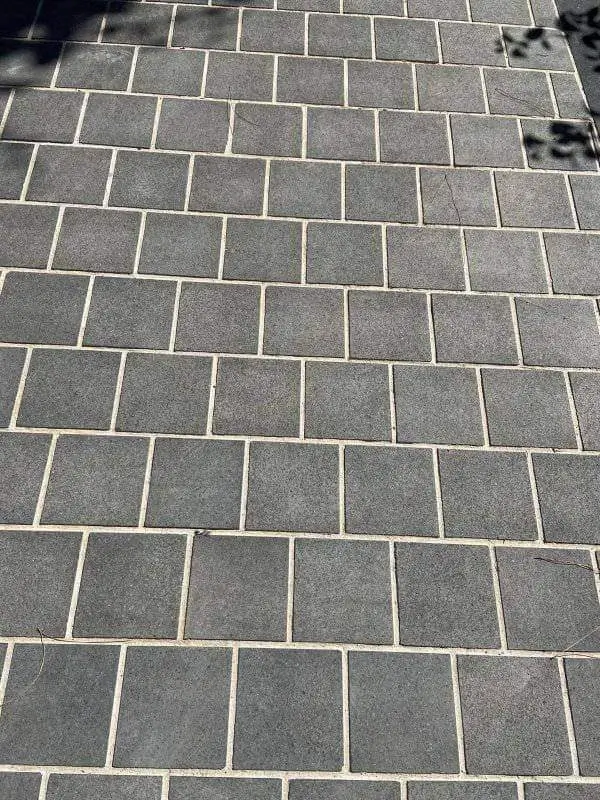
Granite Cobbles: Hardness Versus Manageability
Granite cobbles are the frequent competitor when running a serious bluestone cobbles Arizona outdoor comparison for high-traffic applications. Granite tests higher on the Mohs hardness scale (6–7 versus bluestone’s 4–5 depending on type), but that hardness becomes a double-edged variable in Arizona. In Yuma, where ground temperatures during summer months can pre-heat your setting bed to 110°F before stone placement even begins, granite’s density makes it significantly heavier to handle per unit and more demanding on saw equipment for cutting.
The hardness advantage of granite also doesn’t translate to better thermal performance in desert climates. Granite’s darker mineral content means it absorbs and retains radiant heat more aggressively than bluestone’s typically lighter tone palette. Surface temperature readings on dark granite cobbles in full Arizona sun frequently run 15–20°F higher than comparable bluestone installations under identical conditions. For patios and courtyard spaces where bare feet matter, that gap is significant.
- Granite’s higher density (160–170 lbs/ft³) increases truck delivery weight per pallet compared to bluestone at roughly 145–155 lbs/ft³
- Cutting granite cobbles for radius work requires wet-saw blades rated for harder materials, adding tool cost to projects
- Granite’s coarser crystal structure can create irregular joint gaps that complicate polymeric sand retention
- Thermal mass retention in granite cobbles makes evening cool-down slower — relevant for outdoor dining and entertainment spaces
Limestone Cobbles: Desert-Rated Stone Cobbles Across Arizona
Limestone occupies a different performance tier altogether, and being honest about that distinction is essential when specifying for Arizona’s outdoor environments. Natural stone cobble options in Arizona frequently include cream and buff limestone because the color palette suits Southwestern architecture, but the absorption figures tell a more complicated story. Limestone cobbles typically absorb between 1.5% and 4.5% moisture by weight — a range that sounds acceptable in humid climates but creates real problems in Arizona’s alkaline soil environments.
The interaction between Arizona’s caliche-heavy soils and limestone’s absorption capacity drives efflorescence. Mineral-laden groundwater wicks upward through the cobble, deposits calcium carbonate on the face, and creates white surface staining that requires acid-washing to address. This cycle occurs more frequently with limestone than with bluestone in the same installation — typically starting within 18–24 months in poorly drained desert settings. That maintenance demand changes the total cost equation significantly over a 15-year ownership horizon.
For projects in Sedona, where the red rock aesthetic creates a natural design palette that limestone complements well, some designers accept that maintenance trade-off for the visual result. That’s a legitimate design decision — but it should be an informed one, not a surprise at year two.
- Limestone absorption rates (1.5–4.5%) accelerate salt migration in Arizona’s mineral-rich desert soils
- Softer surface hardness on limestone (Mohs 3) means visible wear in high-traffic zones within 5–7 years without protective sealing
- Annual penetrating sealer application is effectively mandatory for limestone cobbles in Arizona — add that cost to your project budget
- Limestone does provide excellent thermal comfort underfoot due to lower thermal conductivity than granite
Basalt Cobbles: The High-Density Alternative
Basalt cobbles represent the performance ceiling for desert-rated stone cobbles across Arizona, and they deserve serious consideration in any outdoor comparison where structural loads are the primary concern. Basalt’s compressive strength routinely tests at 25,000–35,000 PSI, which makes it the go-to spec for heavy vehicle applications, commercial entries, and any project where bluestone’s 15,000 PSI ceiling feels like insufficient margin.
The trade-off with basalt is thermal absorption. Dark basalt surfaces under Arizona’s UV intensity can reach 180°F at peak solar exposure — numbers that make bare-foot use impractical without shade structures or specific placement strategies. Mitigation through orientation (avoiding full-west-facing exposures) and selecting lighter basalt varieties where the quarry offers them is possible, but it means working against the material’s nature rather than with it.
For a bluestone versus other paving stones AZ comparison that includes basalt, the honest assessment is this: bluestone gives you approximately 70–75% of basalt’s structural capacity while delivering meaningfully better thermal comfort performance. For most residential Arizona outdoor applications, that’s the better trade-off. Commercial loading docks and heavy equipment access routes are where basalt earns its specification.
Thermal Performance Under Arizona Conditions
The thermal performance dimension of any Arizona outdoor stone material comparison guide deserves its own focused analysis because it drives comfort, longevity, and maintenance differently than in cooler climates. Bluestone’s light-to-mid-gray natural color palette reflects a meaningful portion of incident solar radiation rather than absorbing it, which keeps surface temperatures within ranges that remain usable through more of the day.
Field measurement matters here. At Citadel Stone, we’ve documented surface temperature readings across multiple material types on comparable Arizona installations, and the patterns are consistent: bluestone surfaces typically run 20–30°F cooler than dark granite and 35–45°F cooler than dark basalt under full-sun midday exposure. That range is the difference between a patio you use and one you avoid from 10 a.m. to 5 p.m. in July.
Thermal cycling — the daily expansion and contraction cycle — also affects joint integrity differently across materials. Bluestone’s relatively modest thermal expansion coefficient means polymeric sand joints experience less cumulative stress over the course of a decade than they would with materials showing higher expansion rates. Properly specified joints at 3/8 inch for bluestone cobbles, filled with polymer-modified jointing sand, maintain their integrity substantially better over Arizona’s extreme temperature swings than the same joint spec would on a higher-expansion material.
Explore the full range of Arizona bluestone cobbles from Citadel Stone to identify which thickness, finish, and sizing options best match your project’s thermal and structural requirements.
Base Preparation Variables Across Arizona Soil Types
Base preparation is where bluestone cobbles Arizona outdoor comparison decisions meet Arizona-specific ground conditions — and this is the section that most spec sheets skip. Arizona’s soil profile varies dramatically by elevation and region, and those variations directly affect how your cobble installation performs regardless of which stone you select.
In Flagstaff, working at 6,900 feet elevation means genuine freeze-thaw cycling — conditions that don’t exist in Tucson or Phoenix. Any cobble installation above 5,000 feet elevation needs a compacted aggregate base of at least 8 inches (versus the 4–6 inches common in the low desert) to manage frost heave. Bluestone’s lower absorption rate gives it an advantage here because less moisture penetrates the cobble face and enters the joint system, reducing the ice-lens formation that damages cobble edges during freeze cycles.
Low-desert projects in the Phoenix basin frequently encounter caliche hardpan at 12–30 inches depth. That layer can actually work in your favor as a natural sub-base if properly prepared — scarified, leveled, and capped with 4 inches of compacted 3/4-inch crushed aggregate. Skipping the scarification step and placing directly on undisturbed caliche is one of the most common base failures in the field, causing localized settling and joint separation within the first two years.
- Minimum 4-inch compacted aggregate base for low-desert bluestone cobble installations; 8 inches for elevations above 5,000 feet
- Caliche hardpan should be scarified to 3-inch depth before aggregate placement to prevent differential settlement
- Install permeable edge restraints rather than rigid concrete headers in expansive soil zones — rigid restraints crack under soil movement pressure
- Allow 72-hour cure time for polymeric jointing sand before full traffic loading regardless of Arizona’s rapid evaporation rate
Sealing Protocols by Material Type
The sealing approach differs materially across cobble types, and getting this wrong accelerates surface degradation in Arizona’s UV environment faster than almost any other maintenance error. Bluestone cobbles in the 2-inch nominal range require a penetrating siloxane or silane sealer applied after initial cure — typically 28–30 days after installation — not a topical acrylic that sits on the surface and peels under UV exposure.
Topical sealers on any natural stone cobble in Arizona are a short-term cosmetic fix with a long-term maintenance liability. The UV index in Arizona’s low desert regularly exceeds 11 (extreme category), and acrylic coatings begin showing UV degradation visible as chalking or yellowing within 12–18 months. Penetrating sealers that enter the stone’s pore structure and form a hydrophobic barrier below the surface last 3–5 years in Arizona conditions before reapplication is needed.
Limestone cobbles require more frequent sealing — annually in most Arizona applications — while bluestone and basalt can typically extend to 3-year sealing intervals. That difference in maintenance frequency is worth quantifying in your cost comparison: a 500-square-foot limestone cobble installation requiring annual professional sealing adds $400–$600 per year to ownership cost versus a bluestone installation on a 3-year cycle at the same service rate. This is one of the clearest distinctions an Arizona outdoor stone material comparison guide can surface for budget planning purposes.
Ordering, Logistics, and Lead Times for Arizona Projects
The practical side of any Arizona outdoor stone material comparison includes understanding supply chain realities that affect project scheduling. Natural stone cobble options in Arizona sourced from European or Asian quarries typically carry 6–10 week lead times from order to jobsite — a window that creates real scheduling pressure on projects with fixed completion dates.
Domestically or regionally stocked bluestone cobbles sourced through suppliers with Arizona warehouse inventory typically compress that timeline to 1–2 weeks. Citadel Stone maintains warehouse stock across Arizona, which means truck delivery can often be scheduled within the same week as your order for standard sizing and thickness ranges. That supply reliability has a real value in project planning, especially when your landscape contractor’s schedule is committed and a 6-week material delay means starting over on availability windows.
Confirming truck access at the delivery site before finalizing your order is essential — standard flatbed delivery requires a minimum 14-foot clearance height and a turning radius that accommodates a 48-foot trailer. For projects with restricted access, smaller boom truck delivery may be available at incremental cost, and confirming that option with your supplier during the quoting phase saves time-sensitive rescheduling later.
- Confirm warehouse stock availability for your selected cobble type and thickness before locking in contractor start dates
- Standard pallet quantities for 3-inch bluestone cobbles typically cover 40–50 square feet — calculate overage at 10% for cuts and waste
- Boom truck delivery for restricted-access sites adds cost but eliminates the alternative of hand-carrying pallets from street delivery
- Partial pallet minimums vary by supplier — confirm minimums early to avoid ordering excess material you can’t return
Before You Specify: Matching Material to Project Requirements
Bringing a bluestone cobbles Arizona outdoor comparison to a final specification decision means reconciling several variables simultaneously: structural load requirements, thermal comfort priorities, long-term maintenance budget, and the base conditions your specific site presents. Bluestone performs at the top of the natural stone cobble category for most Arizona residential and light-commercial outdoor applications — its combination of absorption resistance, compressive strength, and thermal reflectivity is genuinely difficult to match at competitive price points.
Granite earns its specification over bluestone in heavy vehicle and commercial loading applications. Limestone earns consideration in design contexts where the color palette is a non-negotiable driver and annual maintenance is an accepted budget line. Basalt remains the choice for extreme structural demands where thermal comfort is a secondary concern. Understanding those distinctions rather than defaulting to the most familiar material is what separates a specification that performs from one that creates callbacks.
For projects where tile formats are also part of your Arizona hardscape planning, How to Choose Bluestone Tiles in Arizona: The Complete Buyer’s Guide covers pricing structures and specification considerations relevant to that format — a useful companion resource as you finalize the full scope of natural stone cobble options in Arizona for your project. Homeowners in Mesa, Chandler, and Flagstaff rely on Citadel Stone for bluestone cobbles known for their dense composition and suitability for Arizona’s high-UV outdoor environments.