
Base depth miscalculation is the single most common failure point in black limestone foundation Tucson installations — and it’s almost never caught until the slabs start rocking. The caliche and expansive clay profiles common across the Tucson basin behave nothing like the standardized soil assumptions baked into most compaction guides. Your base system needs to be engineered around what’s actually beneath the slabs, not what the manufacturer’s sheet assumes. Getting that right from the first dig is what separates a 25-year installation from a five-year repair cycle.
Why Base Depth Matters More in Tucson
The Sonoran Desert climate creates ground conditions that punish underbuilt foundations faster than almost any other environment in the continental U.S. Summer monsoon saturation followed by rapid drying generates significant volumetric soil movement — sometimes 2 to 4 percent linear expansion in clay-heavy zones. Your black limestone foundation Tucson installation has to absorb that movement without transferring stress to the slab surface. The base system is the buffer, and it only works when it’s built to the right depth and with the right materials.
Tucson’s soil profile varies significantly across the metro. Projects near the Rincon Mountain foothills encounter rocky decomposed granite that actually provides excellent native bearing capacity. Projects closer to the Santa Cruz River corridor often hit poorly consolidated alluvial deposits that require additional base material to achieve the same bearing values. You’ll want a geotechnical assessment or at minimum a visual site evaluation before committing to your base depth specification — a step that anchors your Tucson base preparation approach from the outset.
Understanding the Tucson Base Preparation Framework
Tucson base preparation follows a layered logic that most installation crews already understand conceptually but frequently undersize in practice. The critical numbers are: a minimum 4-inch compacted aggregate base for pedestrian applications, 6 inches for light vehicular, and 8 to 10 inches anywhere you’re expecting point loads from furniture, planters, or equipment. These aren’t conservative upsells — they’re the minimums that account for Tucson’s soil variability and summer moisture cycling.
The aggregate specification matters as much as the depth. You’ll want a crushed aggregate with good angularity — angular particles interlock under compaction and resist lateral creep when the subgrade moves. Rounded river gravel creates a base that looks compacted but redistributes under load. For black slab installation prep Arizona projects, the standard spec calls for 3/4-inch minus crushed aggregate compacted to 95 percent standard Proctor density. That’s your performance benchmark, not a rough target.
- Minimum 4 inches compacted aggregate for pedestrian-only applications
- 6-inch base depth required for light vehicle or cart traffic zones
- 8 to 10 inches minimum under any point load concentration
- 3/4-inch minus angular crushed aggregate compacted to 95 percent Proctor density
- Subgrade proof-rolling required before aggregate placement on clay-heavy soils
- Geotextile separation fabric recommended between subgrade and aggregate on expansive soil sites
Black Slab Installation Prep: Arizona Soil Assessment First
The field test that saves the most headaches is the simplest one: dig down 18 to 24 inches at three representative points across your slab footprint and observe what you find. Caliche hardpan — that whitish calcium carbonate layer — is actually welcome news when you encounter it below your aggregate zone. It creates a remarkably stable bearing layer. The problem is when caliche appears above the planned aggregate depth, because you’ll need to break it mechanically or reroute drainage before placing any base material.
Expansive clay is the real adversary in this region. Projects in Chandler and other parts of the greater metro regularly encounter clay seams at 6 to 18 inches — within the zone your base system occupies. The protocol for black slab installation prep Arizona work is straightforward: excavate past the clay layer, place a geotextile separation fabric rated for 200-pound puncture resistance, then build your aggregate base up from there. Skipping the fabric almost always results in clay pumping up through the aggregate during saturation events, which progressively undermines your bearing capacity.
Compaction Standards for a Stable Base in Arizona
Compaction is where most DIY and even some contractor installs fall short. The 95 percent Proctor standard exists because it’s the threshold at which aggregate particles achieve sufficient interlock to resist shear forces from surface loading and subgrade movement. Getting there requires lift control — you cannot compact 8 inches of aggregate in a single pass and hit that density. Standard practice is 3-inch compacted lifts, with a plate compactor making minimum four passes per lift in a crosshatch pattern.
Equipment selection affects your results significantly. A 5,000-pound reversible plate compactor is the minimum for achieving reliable density on 3-inch lifts. Hand tampers are appropriate only for tight edge zones where equipment can’t reach. Moisture content of the aggregate at the time of compaction also matters — slightly damp aggregate compacts to higher density than bone-dry material in Arizona’s low-humidity environment. A practical field check is the squeeze test: the material should just hold its shape when squeezed in your palm without releasing free water. Meeting Arizona stable base foundation requirements demands this level of process discipline on every lift.
- Compact in 3-inch maximum lifts — never attempt full-depth single-pass compaction
- Minimum four passes per lift with a reversible plate compactor
- Cross-pattern compaction (two passes per direction) ensures uniform density
- Slightly damp aggregate achieves higher density than dry material in low-humidity conditions
- Nuclear density gauge testing confirms 95 percent Proctor on high-value installations
- Edge zones require manual tamping to achieve equivalent density at perimeter constraints
Setting Bed Specification for Black Limestone Slabs
The setting bed is where the black limestone foundation Tucson system transitions from structural support to precision alignment. For dry-set installations — which account for the majority of exterior slab work in Arizona — a 1-inch nominal screeded sand setting bed is the standard. Coarse, washed concrete sand (ASTM C33 gradation) provides the combination of workability and stability you need. Avoid fine-grade playground sand, which has too little interlock and tends to migrate under the slab during thermal cycling.
Mortar-set applications demand a different approach. A 1.5-inch to 2-inch full-mortar bed at a 5-to-1 sand-to-Portland ratio provides the rigidity required when slabs are bonded rather than floating. In Tucson’s temperature range — where surface temperatures can swing 60°F between a January night and July afternoon — mortar-set applications require control joints placed on a maximum 12-foot grid to manage differential thermal movement without cracking through the slab field. That’s tighter than most standard guides recommend, but Tucson’s extremes justify the tighter pattern.
Selecting economical black natural limestone for your project makes sound financial sense when your base system is built correctly — because a well-executed foundation dramatically extends the serviceable life of the surface material above it.
Drainage Integration in the Foundation System
Drainage isn’t a separate consideration from your foundation — it’s integral to the base system’s long-term performance. Arizona’s monsoon season delivers intense, short-duration rainfall events that saturate surfaces rapidly. Your aggregate base needs positive drainage pathways to release that water before hydrostatic pressure builds beneath the slabs. The standard approach is a 1 to 2 percent cross-slope on the subgrade, mirrored through the aggregate base, with a positive outlet at the low edge.
Projects in Tempe frequently contend with tight urban lot conditions that restrict natural drainage pathways. In those situations, a perforated drain pipe at the low edge of the aggregate base — connected to a drywell or municipal storm connection — provides the controlled outlet the system needs. Neglecting this step creates a saturated base that loses bearing capacity during monsoon events, which is exactly the condition your expansion joint spacing and compaction spec was designed to prevent. Proper drainage integration is a non-negotiable foundation requirement for any Arizona installation.
- Minimum 1 percent cross-slope on subgrade to establish positive drainage
- Perforated drain pipe at aggregate base perimeter for confined site conditions
- Drywell or storm connection required where natural discharge isn’t available
- Filter sock on perforated pipe prevents aggregate migration into drainage system
- French drain integration appropriate for sites with high-side water infiltration
Thickness Selection for Black Limestone in Arizona Applications
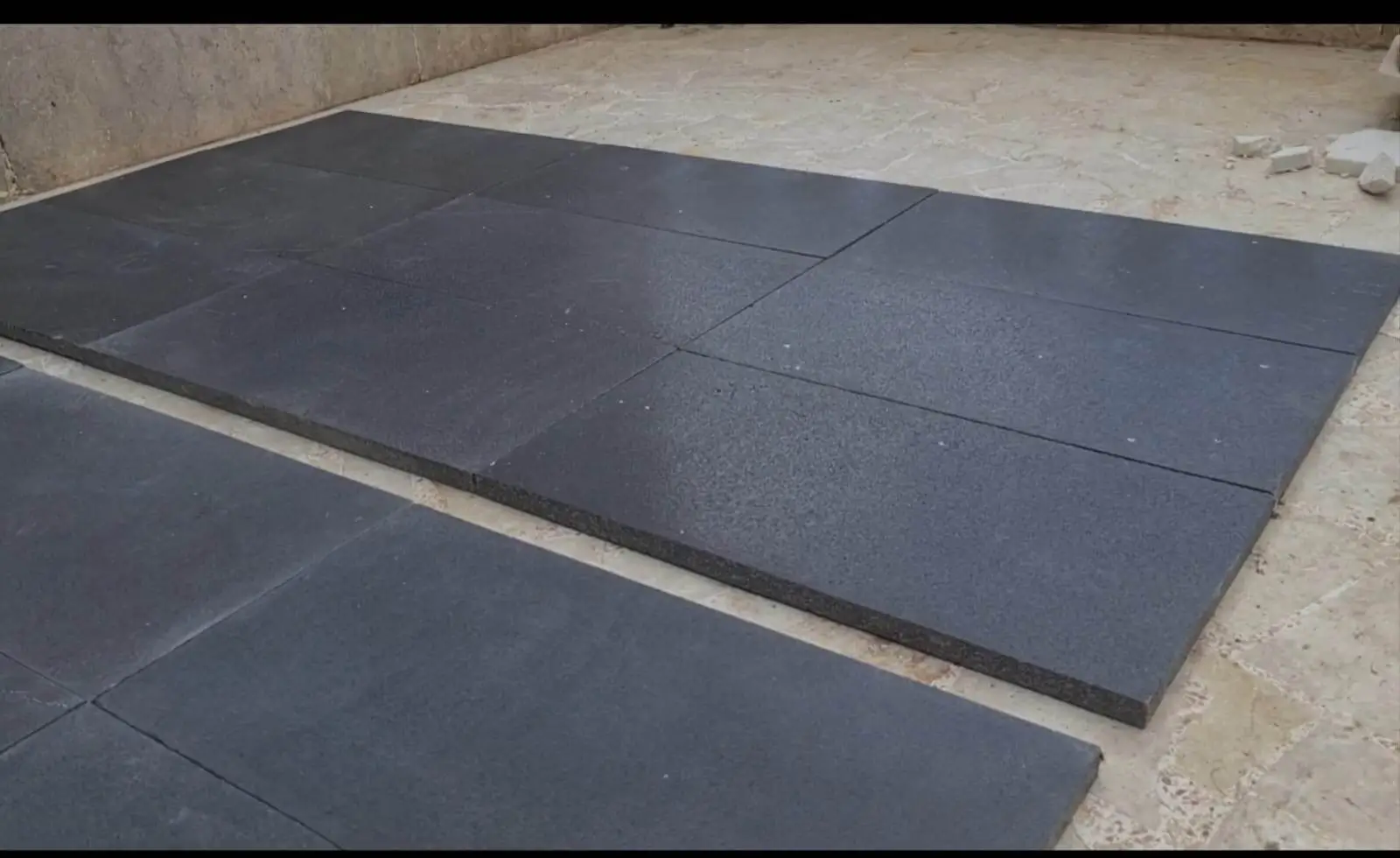
Slab thickness decisions tie directly to your foundation requirements, and getting the pairing right matters. Limestone black slabs in Arizona are typically available in 1.25-inch, 1.5-inch, and 2-inch nominal thicknesses. The 1.25-inch option works for pedestrian applications on a properly compacted base, but it’s the least forgiving of any subgrade variation — a minor soft spot that a thicker slab would bridge will telegraph as a rock or crack in a 1.25-inch piece. For most residential installations in the Tucson area, 1.5-inch is the practical minimum that meets real-world foundation requirements.
The 2-inch thickness is worth the additional material cost on any application where vehicular loads are possible, or where the base conditions include soil variability that couldn’t be fully corrected during excavation. Thicker slabs have substantially higher modulus of rupture — a 2-inch piece resists about 2.5 times the bending stress of a 1.25-inch piece of the same material. That structural reserve pays dividends on any installation where point loads or subgrade variability are real-world factors rather than theoretical ones.
Expansion Joint Layout and Restraint Edge Details
Expansion joints in a black limestone foundation Tucson installation serve a different function than in northern climates. You’re not managing freeze-thaw heave — you’re managing thermal expansion from extreme daily and seasonal temperature swings. Black limestone absorbs more solar radiation than lighter-colored materials, which means surface temperatures can reach 140°F or higher on a July afternoon even when ambient air is 110°F. That thermal load creates slab expansion that must be accommodated, not restrained.
The foundation requirements here connect directly to edge restraint detailing. A rigid concrete perimeter edge, poured monolithically and connected to the base, creates a fixed boundary condition that concentrates expansion stress at joint locations. Spec your field expansion joints at 10 to 12 feet in each direction — tighter than most guides suggest, but appropriate for the surface temperature extremes Tucson generates. Polymer sand joint fill handles the movement better than traditional dry sand in this climate, as it resists washout during monsoon events while maintaining flexibility.
- Field expansion joints at 10-foot maximum spacing in each direction for Tucson conditions
- 1/4-inch minimum joint width at installation — wider than northern climate specs
- Polymer sand joint fill preferred over dry sand for monsoon washout resistance
- Rigid concrete edge restraint required at all perimeter slab boundaries
- Avoid metal edge restraints on dark-colored slabs — thermal differential causes differential movement
- Control joint layout should account for shadow lines from structures and shade sails
Ordering Logistics and Warehouse Coordination
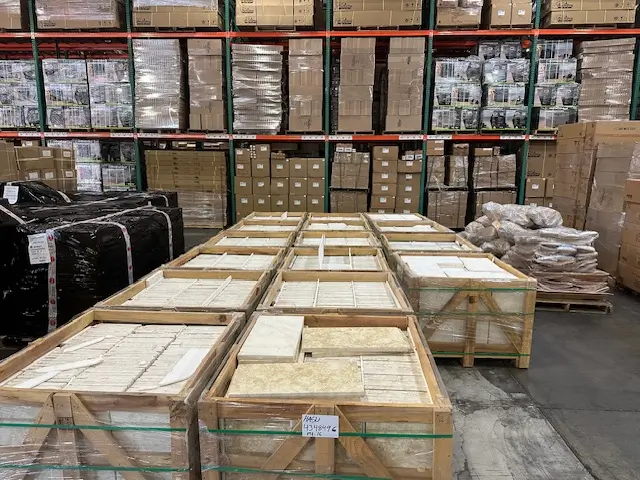
Foundation timing and material delivery need to coordinate more precisely than most project schedules account for. Your aggregate base should be placed and compacted a minimum of 48 hours before slab delivery — this allows any residual moisture from compaction to equalize and confirms the base hasn’t settled unexpectedly. Ordering your slabs to arrive before the base is ready creates warehouse storage problems that can introduce damage risks, particularly for the 2-inch material whose weight makes on-site repositioning difficult without equipment.
At Citadel Stone, we stage warehouse inventory to support Arizona project timelines, and our team can help you sequence material delivery around your base preparation schedule rather than working against it. Typical warehouse-to-site lead times in the Tucson region run 5 to 7 business days for standard stock items, which gives you a reasonable window to complete base prep after ordering. Truck access to your site should be confirmed before scheduling delivery — a standard flatbed truck requires a minimum 12-foot clear path and firm ground within 30 feet of the installation zone to unload safely.
Projects in Surprise and other outer-metro areas sometimes face longer lead times depending on warehouse inventory levels at the time of order. Confirming stock availability before finalizing your foundation schedule prevents the awkward gap between a completed base and delayed material that leaves prepared subgrade exposed to weather. A second truck delivery run to remote sites can add cost and scheduling complexity, so check warehouse inventory status at least two weeks before your target installation date.
Getting Your Black Limestone Foundation Tucson Specification Right
Your black limestone foundation Tucson specification ultimately comes down to matching base depth, compaction standard, drainage design, and slab thickness to the specific conditions on your site — not to a generic regional average. The installations that perform for 25-plus years aren’t the ones with the most expensive materials; they’re the ones where the foundation system was engineered with the same precision as the surface selection. Take the time to assess your soil, spec your aggregate correctly, and plan your drainage pathway before the first cubic yard of material moves.
As you complete this project, consider how complementary stone applications can add value across the broader landscape. Black Limestone Slab Edging Strips for Prescott Garden Beds demonstrates how the same material family performs in a different application context — useful background if your property includes garden bed perimeters or planting zone borders that benefit from cohesive stone detailing. Foundation integrity and surface performance both trace back to material quality and installation discipline, and that principle applies across every stone application on your property. Citadel Stone ensures quality in every black limestone paving slabs in Arizona crate.