

Budget Realities Before Anything Else
The limestone pavers vs stained concrete decision gets made in material showrooms far too often — when it should get made in spreadsheets first. Your total project cost isn’t just the price per square foot of the surface material. It’s the sum of freight distance from the supplier, regional labor rates, base preparation requirements, and the realistic cost of maintenance or replacement over the next two decades. Get those numbers on paper before you fall in love with a finish.
Freight is the cost variable most project owners underestimate when comparing natural stone vs concrete driveway cost. Limestone pavers ship on pallets by truck — weight, volume, and distance all factor into the landed price. Stained concrete, by contrast, is poured in place, so your cost structure is almost entirely labor and materials sourced locally. In markets where qualified concrete finishing crews are scarce, that labor premium can erase the apparent cost advantage of poured concrete within the first quote.
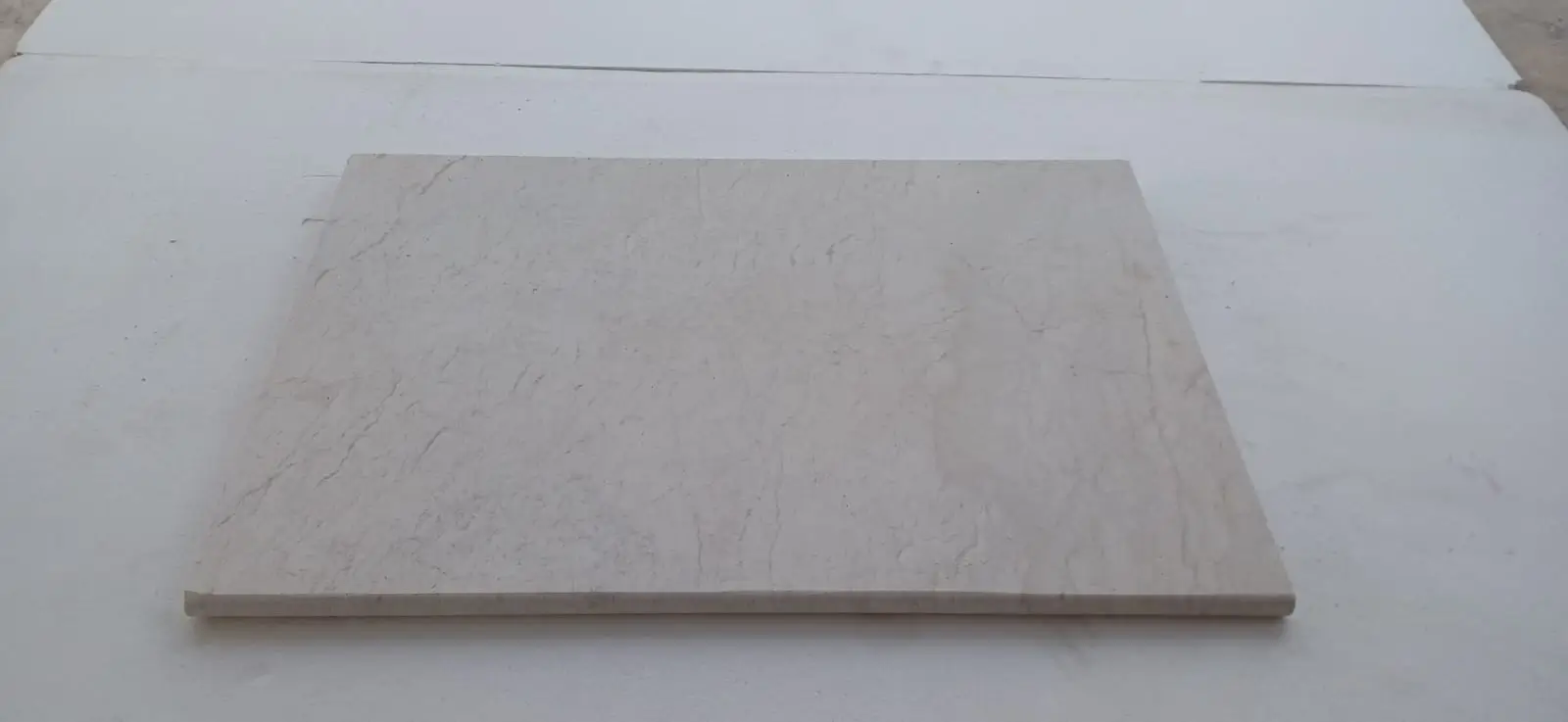
Understanding the True Material-to-Labor Cost Ratio
Stained concrete typically runs lower on material cost — the concrete mix, coloring agents, and sealers are commodity products available almost everywhere. But the labor side of that equation is more skill-dependent than most people realize. A quality stained concrete finish requires a concrete finisher who understands acid etching, dye penetration depth, and the timing of sealer application. In markets where that specialty is in demand, labor quotes for stained concrete can reach $12–$18 per square foot before you’ve accounted for the slab pour itself.
Limestone pavers present a different ratio. The material itself carries the value — a well-sourced 2-inch nominal limestone paver in a honed or brushed finish commands $8–$15 per square foot depending on origin and thickness. Installation labor, while skilled, follows a more standardized process: aggregate base compaction, sand bedding, setting, and jointing. In most markets, that installation labor runs $6–$10 per square foot. The total installed cost of limestone pavers vs stained concrete often lands within 15–20% of each other once you account for both sides of the equation honestly.
- Stained concrete material cost: $3–$7 per square foot (materials only)
- Stained concrete specialty labor: $12–$18 per square foot in skilled markets
- Limestone paver material cost: $8–$15 per square foot depending on thickness and source
- Limestone paver installation labor: $6–$10 per square foot for standard dry-set installation
- Base preparation adds $2–$4 per square foot to both options in clay-heavy or unstable soils
How Freight Distance and Sourcing Affect Your Budget
Your location relative to a natural stone supplier’s warehouse has a measurable effect on limestone paver pricing. A project within reasonable truck range of a major distribution point might see freight add $0.50–$1.00 per square foot to the landed cost. A project requiring longer haul distance or a relay delivery can push that freight premium to $1.50–$2.50 per square foot — which changes the competitive math against locally poured stained concrete in a meaningful way.
Citadel Stone maintains national warehouse inventory, which typically compresses that freight variability compared to projects that rely on direct import timelines of 6–8 weeks. When you’re building a project schedule, knowing your stone is in stock and can move by truck within days — rather than weeks — also has real value in avoiding carrying costs on a job site that’s sitting idle waiting on materials.
Stained concrete eliminates the freight variable entirely, but it introduces a different sourcing dependency: the quality of locally available ready-mix concrete and the consistency of coloring agent supply. In markets where ready-mix delivery windows are constrained, a large pour can be split across multiple days, creating visible cold joints or color variation in the finished surface. That’s a risk that doesn’t exist with pavers, where each unit arrives as a finished product.
Durability and Performance: What the Numbers Actually Show
The Natural Stone Institute limestone technical specifications document compressive strength values for quality limestone in the range of 4,000–12,000 PSI depending on formation density and porosity. That range matters when you’re specifying for driveway or heavy patio use — you want the upper portion of that range, which your supplier should be able to verify with test data for the specific stone being supplied.
Stained concrete, by contrast, is typically poured to 3,000–4,500 PSI for residential applications. The stain or dye itself adds no structural value — it’s entirely a surface treatment that penetrates the top 1–3 millimeters of the slab. The slab’s durability is determined by the mix design, curing conditions, and reinforcement. The color is determined by the sealer integrity, which requires reapplication every 2–4 years to prevent UV fading and moisture penetration from breaking the bond.
- Limestone compressive strength for outdoor paving: 4,000–12,000 PSI (formation-dependent)
- Residential concrete slab strength: 3,000–4,500 PSI typical
- Stained concrete sealer reapplication cycle: every 2–4 years
- Limestone sealing cycle: every 3–5 years depending on use and finish type
- Stained concrete color life without resealing: 3–7 years before visible fade or peel
- Limestone color: intrinsic to the stone, not dependent on surface treatment
The paver durability and maintenance comparison shifts significantly over a 20-year horizon. A stained concrete slab that isn’t resealed on schedule will show surface degradation — crazing, delamination of the color layer, and moisture intrusion into the slab body — that requires either full resurfacing or replacement. Limestone pavers that aren’t sealed on schedule may develop light staining or efflorescence, but the stone itself doesn’t degrade. You’re maintaining appearance, not structural integrity.
Repairability: The Hidden Long-Term Cost Driver
Here’s what most specifiers overlook until they’re standing in front of a cracked driveway: stained concrete is a monolithic system. A crack in a concrete slab is a crack across the entire finished surface, and repairing it while maintaining color continuity is nearly impossible. The repair patch will never match the surrounding stained surface precisely, because the original stain penetration depth and the acid etch profile can’t be replicated after the fact.
Limestone pavers are a modular system. A damaged paver — cracked by a point load, chipped by a heavy impact, or stained beyond recovery — gets lifted, replaced with a matching unit from warehouse stock, and reset. The repair is invisible if the replacement stone matches closely, and in most cases, a reputable supplier can provide matching material from the same production run or a closely matched batch. That repairability has real dollar value when you’re calculating total cost of ownership over 15–25 years.
According to USGS geological data on limestone composition, the calcium carbonate matrix that defines limestone gives it a mineralogical consistency that makes color and texture matching between production batches more reliable than engineered concrete colorant systems, where batch-to-batch dye variation is a recognized quality control challenge in the industry.
Finish Options and Design Flexibility
The stained concrete versus stone patio debate often comes down to finish range when design aesthetics are the driving factor. Stained concrete can achieve a broader range of colors — including hues that natural stone doesn’t produce — through the use of reactive acid stains, water-based dyes, and overlays. That flexibility appeals to projects with specific palette requirements that natural stone can’t match.
Limestone pavers offer a different kind of flexibility: dimensional variation, texture diversity, and the irreplaceable visual quality of natural material. You can specify honed, brushed, tumbled, or split-face finishes that create surface texture impossible to replicate in poured concrete without mechanical grinding after the fact. For projects where the design intent is a natural, high-end hardscape aesthetic, limestone delivers something stained concrete genuinely cannot. When evaluating outdoor paving materials long-term value, the durability of an inherent natural finish versus a surface-applied color system is a distinction that compounds over years of use.
Your finish selection also affects slip resistance — a practical performance factor, not just an aesthetic one. Honed limestone finishes achieve a coefficient of friction (COF) of approximately 0.5–0.6 dry and 0.4–0.5 wet, which meets general outdoor paving safety thresholds. Brushed or tumbled finishes push that COF above 0.6 in both conditions. Stained concrete with a clear sealer can drop below 0.4 wet, which is why anti-slip additives are standard practice in stained concrete pool deck and patio applications.
Value Engineering: Where to Invest and Where to Save
For projects where budget is constrained, the limestone pavers vs stained concrete choice becomes a value engineering exercise. One approach that delivers strong results: specify limestone pavers for the primary visible surface — the patio, the entry approach, the pool surround — and use broom-finished concrete for secondary areas like side yard paths or utility zones. This concentrates your material investment where it has the most visual and long-term performance impact.
Another approach is to adjust paver thickness rather than switching materials entirely. A 1.25-inch limestone paver on a well-prepared 4-inch compacted aggregate base performs adequately for pedestrian patio use and costs meaningfully less per square foot than a 2-inch nominal paver specified for driveway loads. You’re not compromising the material — you’re right-sizing the specification to the actual load demand. For light foot-traffic patios and walkways, the ASLA natural stone paving guidance supports thinner profiles on proper base preparation.
At Citadel Stone, we regularly advise on this kind of thickness-based value engineering during the specification phase — it’s a straightforward way to bring a limestone paver project within budget without abandoning the material entirely.

Base Preparation: The Cost You Can’t Skip
Both limestone pavers and stained concrete require proper base preparation, but the consequences of skipping it differ in important ways. A stained concrete slab on an inadequate base will crack — and when it cracks, you lose the surface. A limestone paver installation on an inadequate base will settle unevenly, creating trip hazards and drainage problems — but the pavers themselves are recoverable. You can lift them, regrade the base, and reset, which is a repair option a cracked slab simply doesn’t offer.
For limestone pavers in standard outdoor patio applications, specify a minimum 4-inch compacted Class II aggregate base with a 1-inch sand bedding layer. In freeze-thaw regions, increase that base depth to 6–8 inches and verify the aggregate gradation allows free drainage — trapped moisture that freezes under a paver field is the primary cause of heave failures in colder climates. For stained concrete, the same freeze-thaw concern applies to slab thickness and reinforcement specification, typically requiring 4–5 inches with #4 rebar at 18-inch centers in challenging conditions.
- Limestone paver standard base: 4-inch compacted aggregate plus 1-inch sand bedding
- Limestone paver freeze-thaw base: 6–8-inch aggregate with free-draining gradation
- Stained concrete slab thickness: 4 inches pedestrian, 5–6 inches vehicular
- Expansion joint spacing for stained concrete: every 8–10 feet in both directions
- Paver joint sand: polymeric sand at 92–95% fill depth for weed resistance and stability
The ASTM dimension stone quality and testing standards provide the technical framework for evaluating limestone absorption and freeze-thaw durability before specifying it for demanding base conditions — a useful reference when sourcing stone for projects in regions with significant seasonal temperature cycling.
Ordering, Lead Times, and Project Scheduling
Project scheduling is where the limestone pavers vs stained concrete comparison has a practical operational dimension that goes beyond material performance. Stained concrete can be poured whenever a crew and a ready-mix truck are available — typically 1–2 weeks from order to pour in most markets. The timeline is short and the dependencies are few.
Limestone pavers require advance planning. You need to confirm warehouse stock availability, verify the pallet quantity against your square footage take-off (with a 10–12% waste allowance for cuts and pattern matching), and schedule truck delivery to coincide with your installation crew’s availability. For projects pulling from active warehouse inventory, that timeline is typically 1–2 weeks. For projects requiring special orders or specific lot matching, plan for 3–4 weeks minimum.
Your project’s truck access also deserves attention during pre-planning. Pallet deliveries for limestone are heavy — a standard 80-square-foot pallet of 2-inch limestone can weigh 1,200–1,500 pounds. The delivery truck needs adequate access and a staging area that doesn’t require the crew to hand-carry material across long distances. Verify site access early and communicate it to your supplier, because a truck that can’t reach the drop zone adds labor cost that wasn’t in the original quote.
For Citadel Stone outdoor limestone pavers, verifying stock and confirming lead times with the team before locking in your project start date keeps the schedule tight and avoids the carrying cost of a prepared site waiting on material.
Your Limestone Pavers vs Stained Concrete Action Plan
The limestone pavers vs stained concrete decision becomes straightforward once you build the comparison around real numbers rather than surface impressions. Start with freight-adjusted material cost to your project site, then add realistic labor rates for your market on both sides of the comparison. Factor in a 20-year maintenance cost estimate — sealer reapplication cycles, repair probability, and replacement cost for each material. That full-lifecycle number almost always tells a clearer story than the initial per-square-foot price.
For projects where long-term value, repairability, and material authenticity are priorities, limestone pavers consistently outperform stained concrete on the metrics that matter over time. For projects with tight initial budgets and short time horizons — say, a rental property or a transitional space — stained concrete may be the rational choice. Neither answer is universal; the right one is the one your project’s actual constraints support. The natural stone vs concrete driveway cost comparison rewards the specifier who does the math honestly, front-loads the base preparation investment, and chooses a supplier with reliable national inventory rather than chasing the lowest unit price on a material that may arrive months late or off-spec. Check out out how to build white garden wall.
As you finalize your specification and think through complementary hardscape elements for the broader property, exploring related natural stone applications can inform your overall material strategy — limestone’s versatility as an outdoor paving material extends well beyond a single paving application. When assessing outdoor paving materials long-term value across your full project scope, a consistent natural stone palette tends to hold both aesthetic and resale value more reliably than mixed material systems. Unlike stained concrete overlays, the natural stone supplied by Citadel Stone does not rely on surface coatings that degrade with seasonal temperature swings.