
Slope geometry is the variable most Fountain Hills homeowners underestimate when they first start planning a limestone garden slab stepping Fountain Hills path — and it’s the one that determines whether your installation stays put for two decades or starts shifting after the second monsoon season. The McDowell Mountain foothills that define so much of Fountain Hills’ character create grade transitions that can run from nearly flat washes to 12-15% slopes within a single backyard. Your limestone garden slab stepping path design has to account for that terrain reality from the very first layout decision, not as an afterthought during installation.
Reading Your Terrain Before a Single Slab Goes Down
Fountain Hills sits at roughly 1,520 feet of elevation — high enough to create meaningful grade complexity across individual lots, especially those backing against natural desert washes or hillside contours. You’ll encounter three distinct terrain types across this community: sloped lots with consistent grade, terraced lots with abrupt grade breaks, and wash-adjacent properties where the ground transitions from compressed caliche to loose alluvial fill within a few feet. Each of these demands a different approach to your stepping slab layout.
The first field measurement you need isn’t the length of your proposed path — it’s the rise-over-run ratio across every 10-foot segment. Anything over 8% grade requires you to consider riser integration alongside flat slabs, because a pure stepping path without height management becomes a slip hazard once monsoon moisture hits the surface. Limestone handles moisture differently than travertine or sandstone, and understanding that material behavior is critical to grade management decisions on Fountain Hills garden paths.
For lots in Phoenix‘s broader metro region, including Fountain Hills, caliche layers typically appear at 18 to 36 inches below grade. On sloped terrain, erosion exposes these layers unevenly — which means your base preparation depth won’t be consistent across the path. You should probe for caliche variation every 4 to 6 feet along the path centerline before ordering materials.
Base Preparation on Sloped Fountain Hills Sites
Here’s what most DIY installations miss on sloped terrain — the compacted aggregate base needs to be level at each slab landing point, not parallel to the slope. That distinction sounds minor until you realize it’s the reason slabs rotate forward on grades above 6%. Your compacted base at each stepping location should be a level pad, with the slope transition handled by the vertical gap between consecutive slabs.
For limestone garden slabs in Arizona, a 4-inch compacted base of 3/4-inch crushed aggregate is the standard starting point on flat terrain. On grades between 5% and 10%, you should increase that to 5 to 6 inches and add a 1-inch bedding layer of coarse washed sand. This deeper base absorbs the differential settlement pressure that downhill slabs experience differently than uphill ones — a physics problem that shows up as tilting within 18 months on undersized bases.
- Probe for caliche every 4 to 6 linear feet along the path centerline
- Establish individual level pads at each slab location — not a sloped continuous base
- Minimum 4-inch compacted aggregate base on flat sections, 5 to 6 inches on grades above 5%
- 1-inch coarse sand bedding layer on all sloped installations
- Compact the aggregate base to 95% Proctor density using a plate compactor
- Allow 48 hours of settlement before placing slabs on freshly disturbed Fountain Hills soil
The informal walkways that make Fountain Hills garden paths so visually appealing — the meandering routes that follow natural contours — actually require more structural discipline than a straight path. Every direction change on a sloped site is a potential pivot point where lateral soil pressure concentrates. You should place your largest, heaviest slabs at path turns on any grade above 4%.
Why Limestone Slab Steps Arizona Terrain Demands
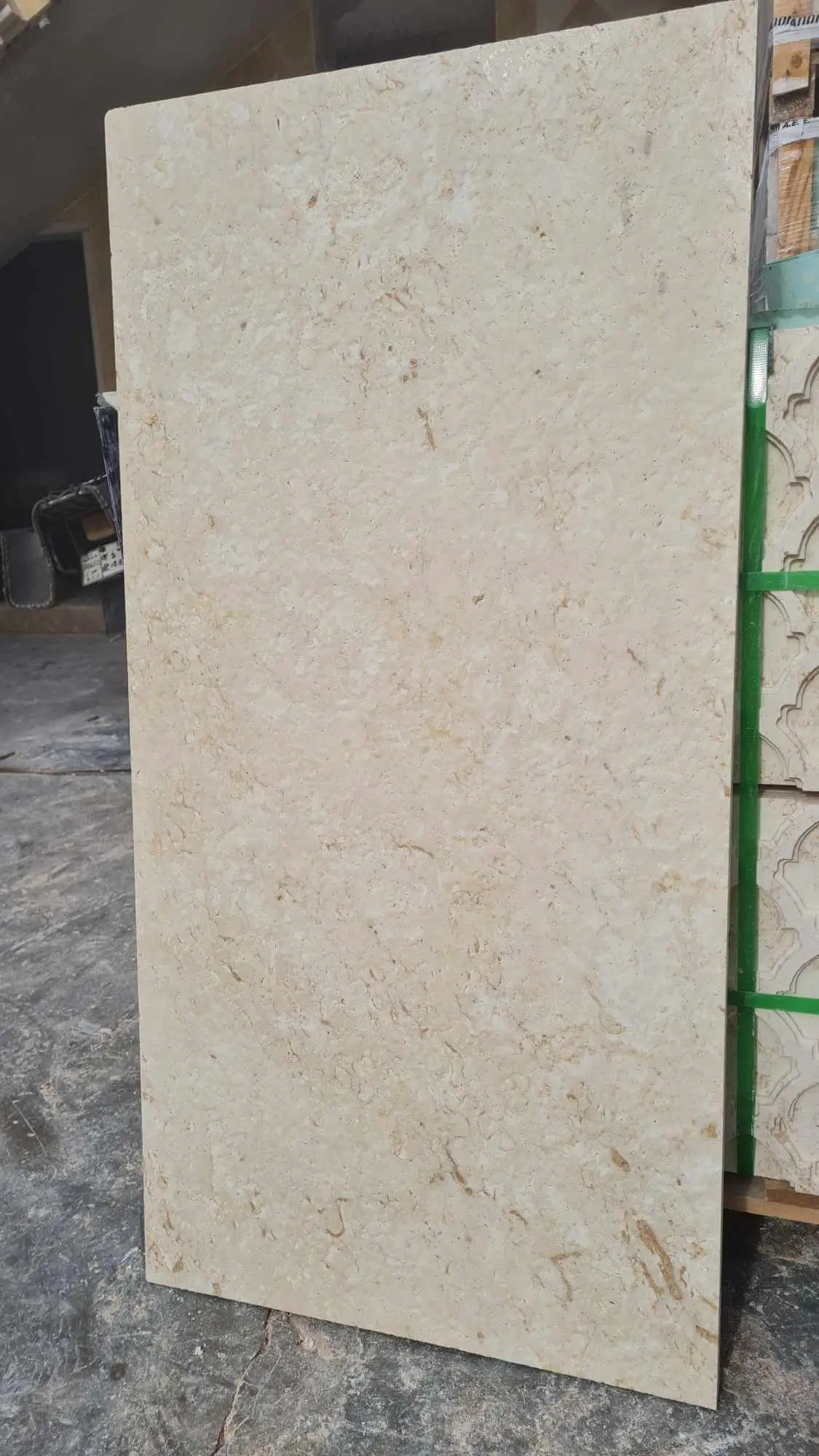
Limestone’s compressive strength — typically ranging from 4,000 to 8,000 PSI depending on formation density — gives it genuine load-bearing credibility even in thin slab formats. For a garden stepping path carrying foot traffic, you’re rarely exceeding 200 to 300 PSI of point load, which means limestone slab steps in Arizona have substantial safety margin. What makes the material relevant specifically to Fountain Hills’ terrain is its weight-to-workability ratio: limestone garden slabs in the 1.5 to 2-inch thickness range weigh 18 to 22 pounds per square foot, which is heavy enough to resist wind displacement but manageable for repositioning during grade adjustments.
The material’s thermal behavior also intersects with terrain decisions in ways that matter for sloped sites. Limestone expands at approximately 4.4 to 5.5 × 10⁻⁶ per °F — lower than concrete’s typical 5.5 to 6.5 × 10⁻⁶ range. On a sloped installation, thermal expansion creates a net downhill force on each slab as the material tries to expand laterally. For Arizona meandering routes with gentle grades, this force is negligible. For grades above 8%, you should factor thermal expansion into your slab spacing by adding 3/16 to 1/4 inch of gap at the downhill edge of each slab.
Your landscape design limestone slabs selection should prioritize thickness consistency within a given path — mixing 1.5-inch and 2-inch slabs on a sloped installation creates uneven step heights that become a safety issue over time, especially where older family members will be walking the path regularly.
Slab Sizing and Layout for Informal Fountain Hills Walkways
The natural aesthetic of a Fountain Hills garden path depends on getting slab sizing right for the terrain type. Larger format slabs — 24×24 inches or 18×24 inches — work well on relatively flat sections where a confident stride can span the gap comfortably. On steeper terrain, drop to 18×18 or even 16×16 formats and tighten your spacing. Shorter strides on slopes are safer, and smaller slabs give you more layout flexibility to match natural contour lines.
Irregular natural-cut limestone shapes deserve particular attention on sloped terrain. Their organic edges that look so compelling in garden settings also create unpredictable drainage patterns — water doesn’t sheet off a jagged-edged slab the way it does a dimensioned cut. You’ll need to slope each individual irregular slab 1 to 1.5% toward the downhill side of the path to direct runoff away from the step surface. On an Arizona meandering route that changes direction, this means re-evaluating drainage slope at every turn.
- 24×24-inch slabs on grades under 4% — confident stride spacing, typically 18 to 24 inches between slab edges
- 18×24 or 18×18-inch slabs on grades between 4% and 8% — tighter spacing at 12 to 18 inches
- Smaller format slabs below 18 inches on grades above 8% — consider integrated riser stones
- Maintain 1 to 1.5% cross-slope on each individual slab for surface drainage
- Minimum 2 inches between slab edges for stable stepping clearance
- Mark slab locations with stakes before ordering — terrain variation typically adds 15 to 20% to your slab count estimate
Drainage Engineering Along Sloped Garden Paths
Drainage is where sloped limestone garden slab stepping paths either succeed or fail at the 3 to 5 year mark. The McDowell Sonoran watershed that Fountain Hills sits within produces intense, short-duration monsoon rainfall events — 1 to 2 inches in under an hour isn’t unusual. Your path layout has to channel that water across the stone surface and off the path without concentrating flow anywhere it can undermine your base.
The critical principle is this: your path should never become a drainage channel itself. On sloped terrain, a stepping path that follows a natural drainage line will collect and accelerate water. If your desired path route aligns with an existing drainage swale — which happens frequently on Fountain Hills hillside lots — you have two options. Either relocate the path 3 to 4 feet to the side of the drainage line, or install subsurface drainage infrastructure (a 4-inch perforated pipe in a gravel trench) under the path before setting slabs.
Projects in Scottsdale and across the McDowell foothills encounter similar drainage challenges, and the installations that hold up longest share a common detail — a 6 to 8-inch gravel border on both sides of the path at slope transitions. This border absorbs surface runoff before it can concentrate and undercut the slab edges. You should install this gravel border simultaneously with your slab placement, not as a cosmetic afterthought.
Sealing and Joint Management in Arizona Conditions
Limestone’s natural porosity — typically 2 to 10% void ratio depending on formation — makes sealing a practical necessity in Arizona’s outdoor environment, but the timing and product selection matter more than most guides acknowledge. For garden stepping paths on sloped terrain, you want a penetrating silane-siloxane sealer rather than a topical coating. Penetrating sealers don’t create a surface film that can delaminate at slab edges under thermal cycling — which happens every single day in Arizona’s temperature swings.
Apply your first seal coat before the path sees any foot traffic, on a surface temperature between 50 and 85°F. In Fountain Hills, that means either early morning application or scheduling for November through February. Resealing on a 2 to 3 year cycle keeps limestone garden slabs in Arizona performing at full water resistance. Skipping a cycle doesn’t immediately cause failure — but it allows joint sand to erode faster, which is what eventually allows slab movement on sloped installations.
- Penetrating silane-siloxane sealer — appropriate for Fountain Hills outdoor conditions
- Initial application at surface temperature 50 to 85°F, after full cure of bedding sand
- Reapply every 2 to 3 years — more frequently on south-facing sloped paths with maximum UV exposure
- Check joint sand depth annually — refill any joints that have dropped below 80% capacity
- Inspect slab edges at grade transitions every spring before monsoon season begins
At Citadel Stone, we recommend confirming your sealer compatibility with the specific limestone formation you’re using before application — some high-silica Arizona limestone responds differently to sealer chemistry than the denser calcium carbonate formations from other regions.
Selecting Thickness for Terrain-Specific Loads
Thickness selection for a garden stepping path seems straightforward — but terrain introduces variables that change the calculation. On flat terrain, 1.5-inch limestone slabs handle residential foot traffic comfortably with a proper base. On sloped terrain with a base that has to accommodate grade transitions, the effective load distribution changes. Specify 2-inch minimum thickness for any slab installed on a grade above 6%, because the leveling pad under each slab creates a slight cantilever condition at the downhill edge.
Consider also what happens at the path’s edge conditions. On Fountain Hills hillside lots, limestone slab steps along informal walkways often transition between manicured planting beds and native desert ground — and that transition zone is where slab edges are most vulnerable to undermining. A 2-inch slab has a meaningfully stiffer edge than a 1.5-inch slab when the base on one side is well-supported and the base on the other is compressible native soil.
Ordering, Logistics, and Project Planning
Accurate material quantity estimation for a limestone garden slab stepping Fountain Hills path on sloped terrain is genuinely harder than it looks. Curved, meandering routes on varied grade require you to walk the path with a measuring wheel and count every slab location individually — not multiply path length by average slab spacing. Terrain variation on Fountain Hills hillside lots typically adds 15 to 20% to the slab count you’d estimate from a flat-ground formula.
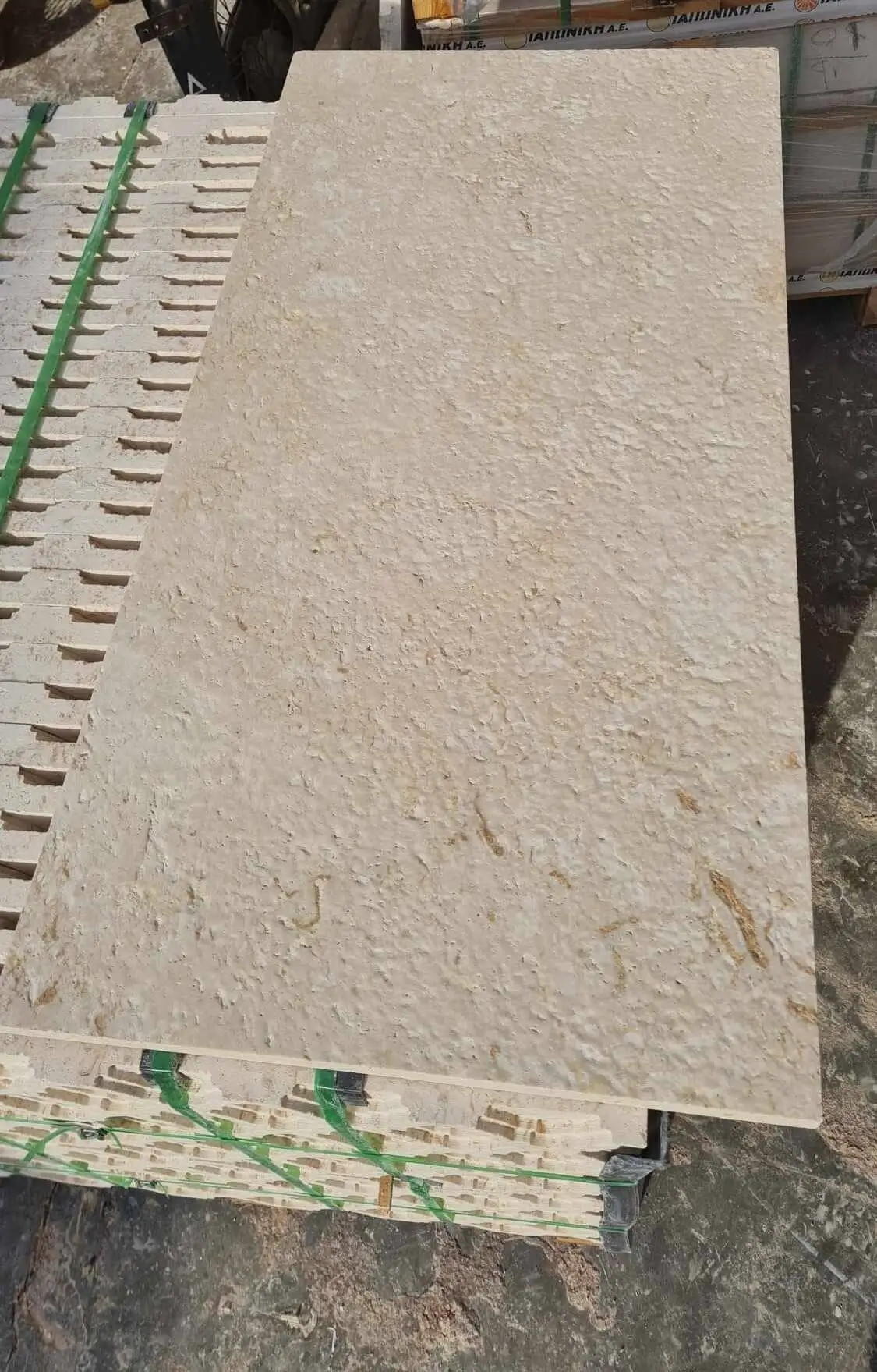
Verify warehouse stock levels for your chosen slab format before finalizing your timeline. Citadel Stone maintains warehouse inventory across Arizona that typically reduces lead times to 1 to 2 weeks for standard limestone formats — a significant advantage compared to the 6 to 8-week import cycles that specialty stone orders often require. For irregular natural-cut slabs, confirm lot consistency when you order, since color and texture variation between lots can be visible on a finished path.
Truck access to Fountain Hills properties also deserves attention during the planning phase. Many hillside lots have limited driveway clearance or steep entry approaches that affect delivery options. Communicate your site access constraints when ordering so that your truck delivery is scheduled with the appropriate equipment — a flatbed with a liftgate handles most situations, but very steep driveway grades may require smaller delivery loads with multiple truck runs.
- Walk the full path with a measuring wheel — count individual slab locations, don’t estimate
- Add 15 to 20% to your slab count for terrain-related layout adjustments and cuts
- Confirm warehouse availability for your specific format before setting a project start date
- Communicate truck access constraints at time of order — driveway grade and clearance matter
- Order all slabs from the same quarry lot to ensure color and texture consistency
- Plan for a 7 to 10-day weather window for installation — monsoon-season interruptions affect base cure time
For projects in Tucson and across southern Arizona, limestone slab stepping paths face similar terrain and ordering dynamics — and the same principle applies: terrain-accurate quantity estimation protects your project budget more reliably than any other single planning step.
Final Perspective on Limestone Garden Slab Stepping Path Success
The limestone garden slab stepping Fountain Hills installations that hold up longest share a common thread — the designer treated the terrain as the primary engineering constraint from the very beginning, not as something to work around after layout decisions were made. Grade management, drainage geometry, and base depth variation across slope transitions aren’t finishing details. They’re the structural decisions that determine whether your path looks as good at year fifteen as it does at installation day.
Your path’s aesthetic appeal — the natural warmth of limestone against desert plantings, the organic flow of a meandering route through your Fountain Hills garden — is genuinely achievable on this terrain. But it requires the structural discipline to match every design decision to the grade conditions you’re actually working with. If you’re extending your Arizona stone project beyond the path itself, Limestone Garden Paving Water Feature Surrounds for Cave Creek Pond Design explores how limestone performs around water features — a relevant consideration for any Fountain Hills property that incorporates a pond or fountain feature alongside garden walkways. Master contractors throughout Arizona depend on Citadel Stone’s landscape limestone slabs in Arizona for client satisfaction.