
Caliche layers and expansive clay pockets define the soil reality beneath most Tempe garden spaces — and they’re the first variables you need to resolve before a single limestone slab goes down. Limestone garden paving paths Tempe projects have a distinct failure pattern: not the stone itself, but the subgrade shifting underneath it during Arizona’s monsoon saturation cycles. Your path network will only perform as well as the ground it’s built on, and in Tempe’s soil profile, that means treating base preparation as a structural engineering decision, not a landscaping afterthought.
Understanding Tempe’s Soil Conditions Before You Spec
Tempe sits within the broader Salt River Valley basin, where you’ll encounter a predictable but challenging soil sequence. The top 12 to 18 inches typically consist of sandy loam with moderate organic content — workable, but prone to moisture-driven settlement when load is applied above. Below that horizon, caliche intrusions appear at inconsistent depths, sometimes presenting as a dense, calcium-carbonate hardpan at 20 inches, other times fragmenting into discontinuous lenses at 30 to 36 inches. That inconsistency is the problem: where caliche is solid and continuous, it actually functions as a reliable sub-base. Where it fractures or gaps, you get differential settlement that telegraphs directly to your surface limestone as cracking along mortar joints or pavers that rock underfoot.
Your base investigation should go deeper than a visual inspection of the topsoil. A simple probe rod test at 2-foot intervals across your path corridor will identify caliche zones and tell you whether you’re dealing with a consistent layer or fragmented pockets. Projects in Phoenix and across the greater metro area have demonstrated that skipping this step produces callbacks within three to five monsoon seasons — a pattern we’ve seen repeat enough times that it’s become the baseline diagnostic we recommend before any layout work begins.
Base Preparation That Accounts for Arizona Ground Reality
The standard 4-inch compacted aggregate base that works in stable Mid-Atlantic soils doesn’t translate directly to Tempe conditions. For limestone garden paving paths in this region, you’ll want to excavate to a minimum of 8 inches below your finished surface elevation, then evaluate what you’ve exposed. The aggregate base specification changes based on what’s underneath.
- Over solid caliche hardpan: 4 inches of 3/4-inch crushed aggregate compacted to 95% proctor density provides adequate drainage and load distribution
- Over fragmented caliche or sandy loam: increase to 6 inches of compacted aggregate with a geotextile fabric layer at the bottom to prevent fines migration upward
- Over expansive clay pockets: excavate the clay entirely to a minimum 12-inch depth, replace with imported graded aggregate, and install a perforated drainage pipe along the path corridor before backfilling
- Over mixed conditions along a single path: use the most demanding specification for the entire run — inconsistent base depths create differential settlement that no surface material can bridge
Your cross-slope on the aggregate layer matters as much as the depth. A 2% transverse slope moves monsoon water laterally off the path corridor before it can penetrate and saturate the base. This is the detail that separates limestone path networks in Arizona that look pristine after five monsoon seasons from those that require re-leveling by year three.
Selecting Limestone for Botanical Garden Circulation Routes
Not all limestone performs the same way in Tempe’s ground and climate combination. For Arizona circulation routes in botanical settings, you’re looking for a specific performance profile: high compressive strength (above 8,000 PSI), low absorption rate (below 3% by ASTM C97 standard), and a surface texture that holds slip resistance even when wet from irrigation overspray or monsoon runoff.
Limestone garden paving in Arizona divides broadly into two categories that matter for your selection. Dense, low-porosity varieties — typically sourced from Texas Hill Country or French limestone beds — carry absorption rates in the 1.5 to 2.5% range and handle Tempe’s ground moisture cycling without significant dimensional change. Softer, more porous varieties can absorb 5 to 7% by weight, which in a high-humidity monsoon event means genuine swelling pressure at the joint level. For botanical garden pathways where irrigation systems run multiple times daily during growing season, the denser material is the defensible choice.
Thickness specification for path pavers should be 1.25 inches minimum for pedestrian-only circulation, stepping up to 1.75 inches wherever maintenance vehicles — electric carts, wheelbarrows loaded with soil — will cross the path surface. Most botanical garden projects we’ve supplied material for run the 1.5-inch nominal across the full network as a single specification, which simplifies ordering and eliminates field confusion about which pavers go where.
Designing the Path Network for Botanical Space Navigation
Tempe garden walkways in botanical settings serve a circulation function that differs from residential garden paths. You’re designing for simultaneous multi-directional traffic, accessibility compliance under ADA requirements, and the kind of visual hierarchy that guides visitors through curated planting zones without signage. The limestone path network itself is wayfinding infrastructure.
- Primary circulation spines: minimum 48-inch width to accommodate two-way pedestrian flow and wheelchair accessibility, laid in a consistent directional bond pattern to reinforce movement direction
- Secondary connector paths: 36-inch minimum, appropriate for branching loops and destination nodes within planting zones
- Tertiary access paths: 24 to 30 inches for maintenance access and intimate garden moments, where the tighter scale creates a sense of discovery
- Node junctions where paths intersect: widen to a 6-by-6-foot landing minimum, which allows visitors to pause, orient, and change direction without flow interruption
- Gradient control: maintain 5% maximum longitudinal slope on primary spines for accessibility, with transitions to flatter grades at entry and exit points
Limestone path networks in botanical garden design benefit from deliberate joint width variation across path tiers. Primary spines look strongest with tighter 3/8-inch joints filled with stabilized polymeric sand, which reads as more formal and anchors the visual weight of wider slabs. Secondary and tertiary paths can open to 5/8-inch joints with decomposed granite infill, which softens the transition into planting zones and allows limited low-growing groundcover to establish between pavers over time.
Joint Stability and Drainage Through Monsoon Season
Here’s what most botanical garden path specifications miss: the joint system is a structural component, not a cosmetic detail. In Tempe’s soil environment, where monsoon events can deliver 1.5 inches of rain in under an hour, your joint fill is the primary mechanism keeping individual pavers from floating or shifting under hydrostatic pressure from below.
Polymeric sand for limestone garden paving paths Tempe installations requires a specific application window — surface temperature between 50°F and 90°F, with no rain forecast for 24 hours post-application. That narrows your installation window to October through April for reliable curing. Summer installation of polymeric joint fill in Tempe routinely produces premature washout because the surface temperature during application — often 115°F on exposed stone — accelerates water evaporation during the activation phase, preventing full polymer cross-linking.
For projects where year-round installation is required, a dry-set granite dust joint fill with stabilizing binder applied separately gives you more temperature tolerance during installation, though it requires more frequent maintenance to top off after monsoon events. At Citadel Stone, we recommend discussing your installation timeline during the material selection phase, because joint system compatibility affects which limestone surface finish you should specify — a tumbled finish provides better mechanical interlock with granite dust infill than a honed surface does.
Surface Finish Decisions for Slip Resistance and Aesthetics
The surface finish you specify for limestone garden paving paths in Tempe does three things simultaneously: it determines slip resistance when wet, it affects heat absorption at the surface, and it sets the visual character of your botanical space. Getting this decision right requires you to think about all three outcomes together, not in isolation.
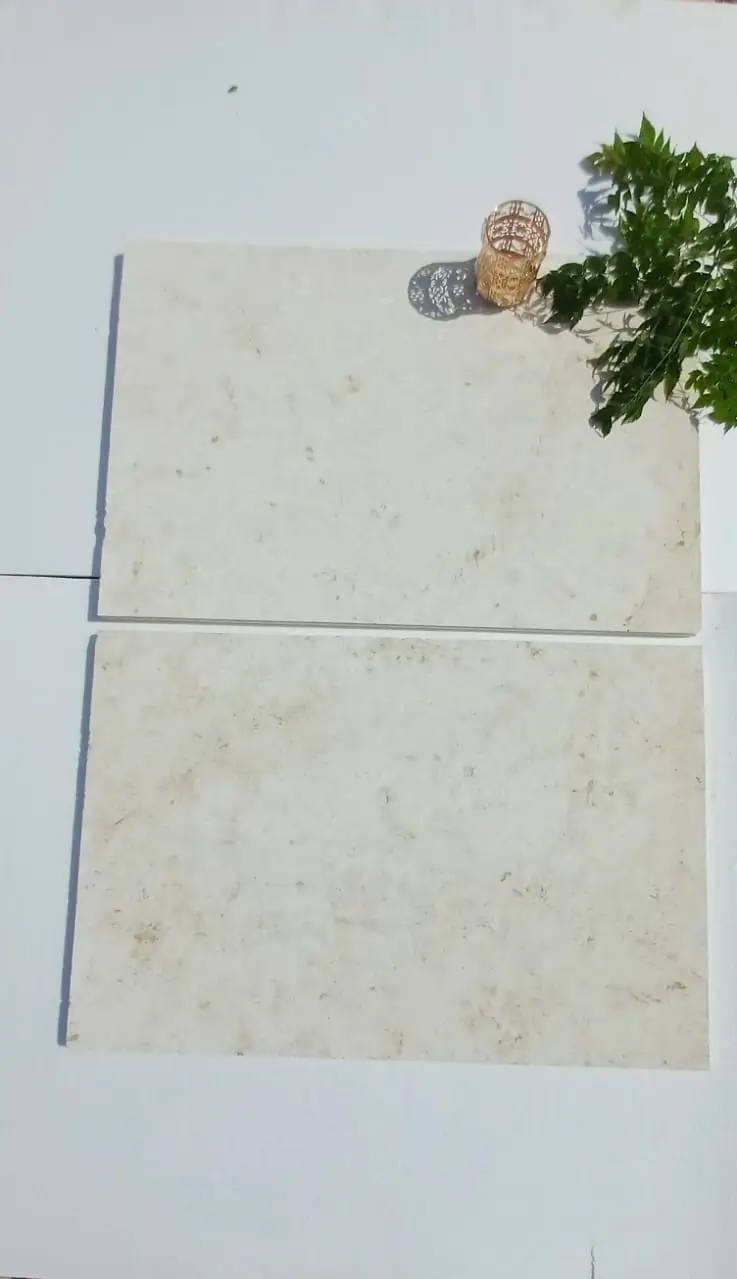
- Brushed or antiqued finish: DCOF (Dynamic Coefficient of Friction) values typically range 0.65 to 0.75 wet — the strongest slip resistance profile and the correct choice for primary circulation routes where irrigation creates consistently wet conditions
- Tumbled finish: DCOF 0.60 to 0.70 wet, with the added benefit of softened edges that reduce tripping hazard on paths where slight differential settlement occurs between pavers over time
- Sawn finish: DCOF 0.50 to 0.60 wet — marginal for botanical garden primary paths, acceptable for covered pavilion connections or interior transitions where irrigation overspray doesn’t reach
- Honed finish: DCOF below 0.50 wet in most tested samples — appropriate for interior applications only, not for exterior path surfaces in an irrigated botanical garden environment
For projects in Scottsdale botanical settings where high-end aesthetics drive the brief, a brushed finish achieves the cleanest look while maintaining compliant slip resistance — it’s the specification that doesn’t force a trade-off between performance and appearance.
Sealing Protocols for Long-Term Path Performance
Limestone garden paving in Arizona requires a sealing approach calibrated to two competing demands: protecting the stone from irrigation mineral deposits and monsoon sediment penetration, while maintaining enough vapor permeability that ground moisture doesn’t become trapped beneath the surface and cause spalling. A non-breathable topical sealer on limestone over Tempe’s ground conditions is a documented failure path — moisture vapor pressure builds below the sealer film and eventually delaminates it in sheets, taking surface finish with it.
Penetrating impregnating sealers — fluoropolymer or silane-siloxane formulations — are the correct product category for exterior limestone path applications in this climate. Application rate matters as much as product selection: you’ll typically need two coats at 200 to 250 square feet per gallon each, with a 4-hour minimum cure between coats and a 24-hour cure before foot traffic. Applying too thin a first coat leaves the stone’s macro-pore structure unsealed; applying too thick a second coat before the first has fully cured traps solvents below the surface and produces a white haze that requires full strip-and-reapplication to correct.
Initial sealing at installation, then a maintenance cycle every 24 to 30 months for paths in high-irrigation zones, keeps the stone performing at spec. Testing seal integrity is straightforward — drop water on the surface and observe its behavior. If it beads and rolls, the protection is intact. If it absorbs within 30 seconds, it’s time to reseal regardless of where you are in the maintenance schedule. Consider linking your reseal schedule to your botanical garden’s biennial plant replacement cycle so both happen in the same low-traffic period.
Ordering, Lead Times, and Delivery Logistics for Tempe Projects
Botanical garden path projects run into the same logistics challenge repeatedly: material arrives in multiple deliveries, and the stone from truck two doesn’t precisely match the stone from truck one because it came from a different quarry block. For limestone specifically — a natural material with inherent color and texture variation — this is a genuine specification risk that your procurement process needs to address directly.
The solution is straightforward but requires advance planning. Order your full path network quantity from a single production run, warehouse it at your staging area or at your supplier’s facility, and pull from that single batch throughout installation. Citadel Stone maintains warehouse inventory specifically to support this approach — you can confirm your full project quantity, have it reserved under your project, and draw down as each phase of the path network progresses. This eliminates mid-project color variation and ensures that replacement material for any breakage during installation matches precisely.
Truck access at botanical garden sites is often restricted — weight limits on garden paths during delivery, gate dimensions that limit vehicle size, and staging area constraints. You’ll want to coordinate with your limestone supplier on truck configuration before finalizing delivery scheduling. Most palletized limestone arrives on flatbed trucks that require forklift offloading, which means your site needs either a forklift available or a crane-equipped delivery vehicle scheduled in advance. For Tucson botanical garden projects and similar institutional sites with access constraints, confirming these logistics 3 to 4 weeks before delivery prevents costly rescheduling fees.
If your path network includes limestone pavers for adjacent patio or seating areas, the specification details for backyard limestone patio slabs in Tucson cover complementary base and sealing requirements worth reviewing before you finalize your full project specification.
Decision Points for Limestone Garden Paving Paths in Tempe
The specification decisions that determine whether your limestone garden path network in Tempe performs for 20 years or starts showing problems in year four all trace back to soil — not aesthetics, not even material quality. Your base design must respond to what the probe rod test reveals, not to what a generic specification template assumes. Dense, low-porosity limestone at 1.5 inches nominal, over a properly graded and compacted base with 2% cross-slope, set with polymeric joint fill installed in the correct temperature window, and sealed with a penetrating impregnating formulation at initial installation: that’s the specification stack that holds in Tempe’s ground environment.
Botanical garden design places additional demands on path network specifications because these spaces are maintained, irrigated, and trafficked continuously for decades. Your material selection and base design need to accommodate maintenance vehicle crossings, seasonal irrigation saturation, and the long replacement cycles that institutional projects require. Getting each decision documented in your specification — not just selected, but written into the project record — protects both the installation and your professional liability when questions arise years down the line. For additional perspective on how limestone performs in complementary outdoor wellness environments across the Arizona market, Limestone Outdoor Patio Wellness Space for Gilbert Relaxation Zones explores related specification considerations worth reviewing as you plan your overall project scope. Citadel Stone’s limestone patio stones in Arizona withstand decades of Arizona weather while maintaining their beauty.