
Budget allocation for limestone patio privacy Tucson projects trips up even experienced contractors — not because the material is complicated, but because Arizona’s regional market dynamics create cost variables that don’t show up in national pricing guides. The freight distance from major stone distribution hubs, the availability of skilled masonry labor in the Tucson metro, and the timing of your warehouse order all shift your total project cost in ways that demand upfront planning. Understanding those variables before you finalize a design is what separates a project that comes in on budget from one that gets value-engineered in the field.
Regional Cost Dynamics for Tucson Limestone Projects
Tucson sits in a unique position relative to Arizona’s stone supply chain. Unlike the Phoenix metro, which benefits from higher-volume warehouse stocking and more competitive labor markets, Tucson projects often carry a modest freight premium — typically 8 to 14 percent above the Phoenix base price — simply because of the additional truck mileage from primary distribution points. That cost is real, and you need to factor it into your material budget before you start specifying stone thickness and square footage.
Labor market conditions in Tucson also differ from northern Arizona cities. Skilled masonry crews here tend to book 4 to 6 weeks out during the peak fall and spring installation seasons, which means your project timeline needs to account for that lead time. Rushing a crew that isn’t familiar with natural stone setting creates installation errors that cost far more to fix than the scheduling adjustment would have cost upfront.
- Freight premiums from Phoenix-area warehouses to Tucson run approximately 8–14% on top of material cost
- Specialty stone masonry crews in Tucson typically book 4–6 weeks ahead during peak season
- Regional caliche soil conditions may require additional base excavation, adding 15–20% to site prep costs
- Local permit timelines for enclosed patio structures average 3–5 weeks in Pima County
Understanding Material-to-Labor Cost Ratios in Arizona
The material-to-labor ratio for limestone patio privacy Tucson installations typically runs between 40:60 and 45:55, meaning labor is the dominant cost driver. That ratio shifts when you specify thicker stone — 2-inch nominal limestone slabs for enclosed privacy spaces with higher foot traffic require more careful setting and leveling, which pushes labor hours up. Conversely, choosing a stone with more consistent dimensional tolerances reduces the time your crew spends on field cuts and adjustments.
In San Tan Valley, where new construction has driven significant masonry labor demand, the same crew rates run roughly 12 to 18 percent higher than in established Tucson neighborhoods — a useful comparison point when you’re evaluating whether your project location affects total cost. Tucson’s more stable labor base can actually be an advantage for complex privacy enclosure designs that require experienced hands.
Value engineering for these projects almost always focuses on stone selection rather than reducing square footage. Dropping from a 2.25-inch slab to a 1.5-inch slab on a covered, enclosed patio application where vehicular loads aren’t a factor is a legitimate cost reduction — not a quality compromise. The structural requirement for foot-traffic-only enclosed patio paving in Arizona typically bottoms out at 1.5 inches nominal for limestone over a compacted 4-inch aggregate base.
How Sourcing Decisions Shape Total Project Cost
Your sourcing decision affects more than unit price. Ordering limestone patio pavers for Arizona projects from a supplier with verified warehouse stock in-state eliminates the 6 to 8 week import lead time that offshore-sourced material carries. That timeline difference has a real cost — if your masonry crew is booked and your stone hasn’t arrived, you’re either paying standby rates or losing your crew slot entirely. At Citadel Stone, we maintain warehouse inventory specifically calibrated to Arizona project demand cycles, which typically holds lead times to 1 to 2 weeks for standard limestone profiles.
The truck delivery logistics for enclosed patio projects also deserve attention before you order. Enclosed or gated property access in Tucson’s older neighborhoods frequently restricts delivery truck clearance, and a standard flatbed won’t make the turn into some of these properties. Confirming access dimensions ahead of your truck delivery date prevents material staging headaches that delay your crew’s start time.
- In-state warehouse sourcing cuts lead times from 6–8 weeks (import) to 1–2 weeks
- Confirm truck access dimensions before scheduling delivery to enclosed Tucson properties
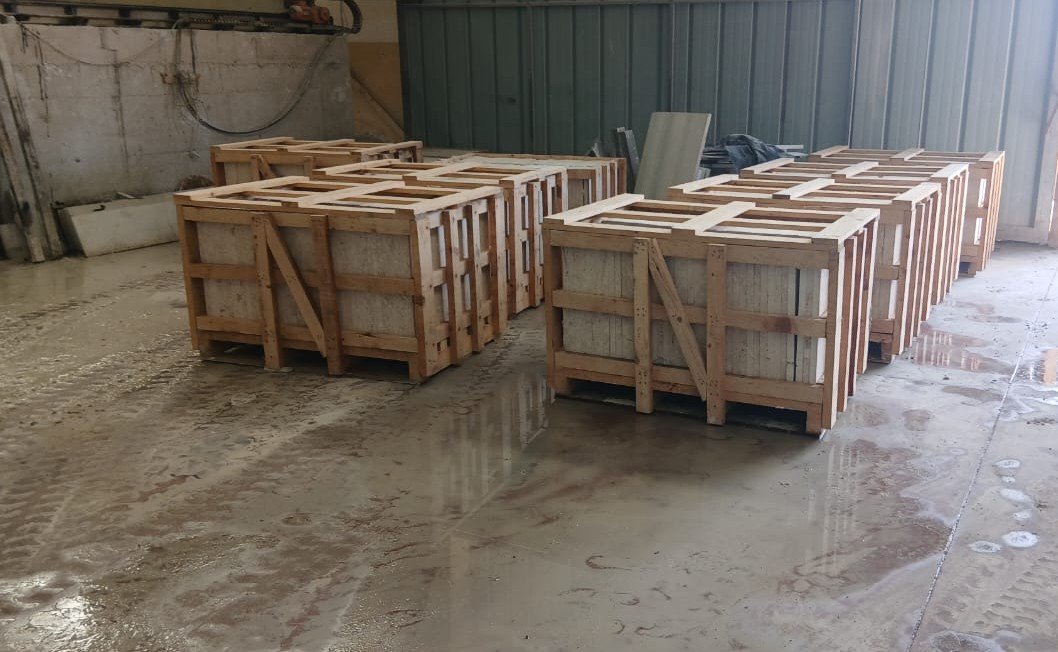
- Pallet weight on full crates of 2-inch limestone typically runs 2,800–3,200 lbs — verify driveway load rating for staging areas
- Ordering 10–12% overage protects against field-cut waste on privacy enclosure perimeters with irregular angles
Designing Tucson Private Outdoor Rooms with Limestone
Tucson private outdoor rooms have a distinct design logic that sets them apart from open-patio applications. The enclosed nature of these spaces creates microclimates — particularly in the summer months — where stone surface temperature management becomes a practical comfort issue, not just an aesthetic one. Limestone’s natural reflectivity helps moderate that effect compared to darker stone options, but the wall and overhead screening materials you pair with the floor determine most of the thermal experience.
Patio paver screening Arizona installations require you to think about the floor plane as part of a complete enclosure system. The paver layout pattern you choose affects how visual weight reads in the enclosed space — running bond patterns in narrow privacy enclosures can visually elongate the space, while a square grid pattern anchors it. These decisions also affect cut waste, with diagonal herringbone patterns generating 18 to 22 percent more waste than straight-lay patterns on rectangular enclosed spaces.
For enclosed design applications where the patio is fully or partially roofed, drainage specification becomes non-negotiable. A minimum 1/8-inch per foot cross-slope — ideally 3/16-inch — prevents moisture from sitting under the stone and accelerating joint sand washout. In Tucson’s monsoon season, that standing water problem happens faster than most homeowners anticipate.
Base Preparation Standards for Arizona Enclosed Patios
Enclosed patio applications in Arizona put specific demands on base preparation that open-air patios don’t. The reduced evaporation under a covered or screened space means moisture retention in the sub-base stays higher, which makes base compaction even more critical than on exposed installations. Your aggregate base needs to reach 95 percent Standard Proctor density before the bedding sand goes down — not the 90 percent that some residential specs allow for open-air paving.
Caliche presents a unique opportunity in Tucson-area projects. The natural caliche hardpan layer found at 18 to 30 inches depth in much of the region provides an exceptionally stable sub-base when properly scarified and recompacted. Rather than hauling it out, experienced contractors here often use it as a native base layer, which reduces imported aggregate costs meaningfully. That’s a regional value-engineering move that’s specific to southern Arizona and doesn’t appear in national specification guides.
The Citadel Stone landscape limestone pavers available for Arizona projects include profiles specifically suited to covered patio applications where consistent thickness tolerance matters for the final surface plane. Tight dimensional tolerance in the stone reduces leveling labor significantly on enclosed patio installations.
- Compact aggregate base to 95% Standard Proctor density for covered patio applications
- Utilize native caliche hardpan as sub-base where present — scarify and recompact to 6-inch depth
- Minimum 4-inch compacted aggregate base over prepared native soil for residential foot-traffic applications
- Bedding sand layer should run 1 inch nominal after compaction — not 1.5 inches, which creates settlement risk
Limestone Performance in Arizona Intimate Spaces
Arizona intimate spaces enclosed with limestone paving perform predictably over a 20 to 25 year service life when the specification hits three critical marks: base compaction, joint sand maintenance, and biennial sealing. Miss any one of those and your timeline shortens to 10 to 14 years. The sealing schedule matters more in enclosed patios than open ones because reduced UV exposure keeps the surface cooler but also allows moisture to dwell longer in the joint sand, which accelerates biological growth in the joint gaps.
Surface porosity in Tucson-grade limestone typically runs between 3 and 8 percent by volume, depending on the quarry source. That range matters because the higher end of that porosity range requires a penetrating sealer with a siloxane base rather than a surface-coating sealer — a distinction that experienced stone suppliers should be flagging for you. Surface-coating sealers on high-porosity limestone in Arizona’s UV environment delaminate within 18 to 24 months, which creates a maintenance problem worse than no sealer at all.
Integrating Privacy Structures with Your Paver Layout
The structural elements of your privacy enclosure — walls, screens, pergola posts — must be coordinated with your paver layout before any stone is ordered. Post footings that land in the middle of a paver field require cut stone around them, and that coordination needs to happen at the design stage, not when the crew is mid-install. Dimension your post grid to align with your chosen paver module so that footings fall on joints rather than mid-stone — this single coordination step saves 4 to 8 hours of skilled labor on a typical 400-square-foot enclosed patio.
In Yuma, where enclosed outdoor spaces have become increasingly popular as windbreak solutions against persistent desert winds, the integration of low limestone seat walls with the paver field creates a unified material palette that reads as intentional architecture rather than assembled components. That design continuity also simplifies your ordering process — one material family, one supplier relationship, fewer coordination variables.
Expansion joint placement in enclosed limestone patio applications follows a tighter spacing schedule than open-air work. Specify control joints every 12 feet rather than the standard 15 to 18 feet for open patios, because covered spaces experience more abrupt thermal transitions as the space heats and cools. That tighter spacing prevents surface cracking that would otherwise appear at 3 to 5 years post-installation.
Color and Texture Selection for Enclosed Design Applications
Texture and color selection for limestone in enclosed patio privacy spaces follows different criteria than open landscape applications. In a defined, enclosed space, the stone is viewed at close range and over long durations — meaning surface variation and color consistency become amplified. Highly veined or dramatically color-varied limestone that reads beautifully in an open landscape can feel visually busy in an intimate enclosed space of 200 to 400 square feet.
Honed or sand-finished limestone surfaces perform better in enclosed patio paver screening Arizona applications than tumbled stone for a specific practical reason: honed surfaces are easier to clean in low-airflow environments where dust and organic debris accumulate. Enclosed spaces in Tucson’s climate see more debris concentration than open patios, and the textured recesses in tumbled stone hold that debris more stubbornly.
Projects in Avondale have increasingly specified neutral buff and cream limestone tones for enclosed courtyard spaces, and the practical reason is straightforward — lighter stone tones reflect ambient light in enclosed spaces where natural light is reduced by overhead screening. That reflected light effect reduces the need for supplemental landscape lighting in semi-enclosed patio rooms, which has a real cost implication for the overall project budget.
- Choose honed or sand-finish limestone for enclosed spaces — easier maintenance than tumbled finish in low-airflow environments
- Buff and cream tones reflect ambient light in covered spaces, reducing artificial lighting requirements
- Limit color variation range within a single enclosed space — choose stone from a single production run where possible
- Matte sealers maintain the natural stone aesthetic better than gloss finishes in intimate residential spaces
Final Recommendations for Limestone Patio Privacy Tucson Projects
Getting limestone patio privacy Tucson specifications right comes down to resolving the budget variables before the design gets locked in. The freight premium, the labor market timing, the base preparation requirements for covered applications, and the sealing protocol for your specific stone porosity — these are the decisions that determine whether your project delivers the 20-plus year service life limestone is capable of. Value engineering works in this category, but it has to be applied to the right variables: stone thickness calibrated to actual load conditions, native caliche used as sub-base where available, and sourcing from suppliers with verified in-state warehouse stock to eliminate import lead time risk.
Your enclosed patio privacy design also benefits from early coordination between the structural elements — privacy walls, pergola posts, screening panels — and the paver layout module. That pre-construction alignment eliminates the most expensive field adjustments. As you consider complementary Arizona stone projects that extend this material palette across your property, Limestone Patio Paver Multi-Level Design for Prescott Sloped Yards explores how limestone performs across grade changes — a design challenge that often pairs with enclosed courtyard planning in Arizona’s varied terrain. Paradise Valley’s elite properties trust only Citadel Stone for Limestone Patio Pavers in Arizona that define sophistication.