
Ground conditions in Tempe determine whether a single limestone slab feature becomes a permanent focal point or a maintenance headache within three to five years. Before committing to placement, slab thickness, or any aesthetic decision, understanding what’s underneath is essential — because the expansive clay soils and calcareous hardpan common throughout the East Valley behave in ways that surprise even experienced contractors. A single limestone slab feature in Tempe demands soil preparation that’s genuinely different from what standard paver installations require, and getting that foundation work right is what separates a 25-year statement piece from one that tilts, shifts, and loses its impact by year four.
Why Tempe’s Soil Conditions Define Your Slab Placement Strategy
The Salt River Valley sits on a complex mix of alluvial deposits, expansive silty clay, and scattered caliche layers that can appear anywhere from six inches to three feet below grade. Caliche — that calcium carbonate hardpan layer that shows up chalky-white on a shovel blade — isn’t always a problem. In fact, when it’s a consistent, horizontal layer, it can function as a natural stable sub-base that reduces how much engineered aggregate you need to bring in. The complication comes when caliche appears in irregular patches, because differential settlement between the hard caliche zones and the softer silty clay alongside them creates the rocking and tilting that eventually makes any standalone slab feature look neglected.
Your first step before any single limestone slab feature installation in Tempe should be a soil probe at the exact placement location — not just nearby. Drive a steel rod or tile probe at three points within a two-foot radius of your planned center. You’re checking for consistent resistance. If two probes hit resistance at eight inches and the third goes down to eighteen inches before it stops, you’ve got the irregular caliche situation that requires a different base strategy entirely.
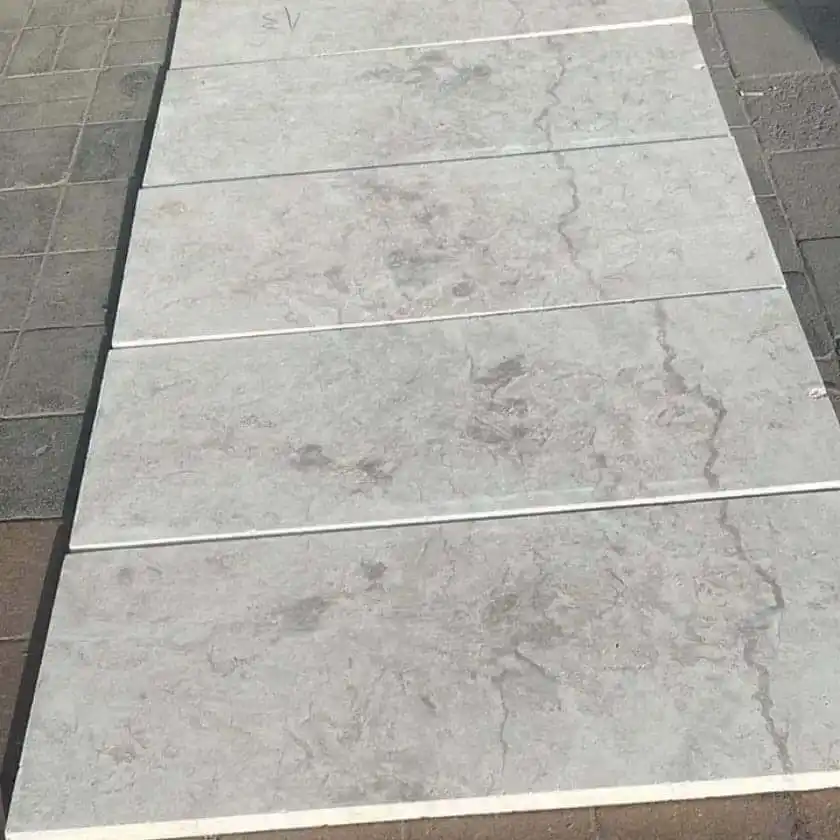
Base Preparation for Standalone Stone Features in Arizona’s Expansive Soils
For a statement stone that sits as a single slab rather than a field of pavers, the base preparation protocol differs from what most installation guides describe. You’re not distributing load across dozens of interlocking units — you’re concentrating it through one contact area. This means your compacted base needs to be engineered for point stability rather than distributed load.
- Excavate a minimum of 12 inches below finished grade — deeper if your soil probe shows inconsistent caliche depth
- Remove all expansive clay within the excavation footprint and extend 6 inches beyond the slab perimeter on all sides
- Replace with clean 3/4-inch crushed aggregate and compact in 3-inch lifts to 95% Modified Proctor density
- Top with a 2-inch layer of coarse sand — never fine play sand, which holds moisture and undermines stability
- Allow 48 hours minimum after final compaction before slab placement, particularly in summer heat
In Phoenix and the surrounding valley, contractors frequently skip the clay removal step and simply add aggregate on top of expansive soils. That shortcut works for full paver fields because the interlocking units can tolerate minor differential movement. For a focal point design where a single slab needs to remain precisely level and visually authoritative, that approach fails within two monsoon seasons.
Selecting the Right Slab Dimensions for a Focal Point Design
The visual weight of a Tempe statement stone comes primarily from dimensional proportion — the relationship between slab length, width, and thickness relative to the surrounding landscape. There’s a proportion rule that experienced designers understand but rarely articulate: your slab’s longest dimension should be at least 1.5 times the width of the visual corridor framing it. If you’re placing the stone at the terminus of a 48-inch-wide decomposed granite path, your slab should be at least 72 inches in its longest dimension to read as a true focal point rather than a large stepping stone.
- Thickness for Arizona standalone elements: minimum 3 inches for slabs under 36 square inches, 4 inches for larger format pieces
- Width-to-length ratio between 1:1.5 and 1:2 reads as intentional and designed; ratios beyond 1:3 begin to read as elongated stepping stones rather than feature elements
- Edge profile matters — a natural split face or hand-chiseled edge communicates geological authenticity, while a sawn edge signals contemporary precision
- Surface texture should balance aesthetic goals with slip resistance — a honed face scores well visually but requires appropriate surface treatment for outdoor safety
Limestone in Arizona comes in a range of natural color tones from warm buff to cool grey-white, and the dominant soil color in your yard influences which reads best. Tempe’s native soil is a warm reddish-tan; against that backdrop, a warmer buff limestone reads harmonious and organic, while a cooler grey-white creates deliberate contrast. Neither is wrong — the choice depends on whether you want the focal point to emerge from the landscape or stand apart from it.
Individual Slab Placement: Field Execution and Leveling Precision
Individual slab placement in Arizona conditions requires accounting for one variable that catches specifiers off guard: summer soil temperatures at the 6-inch depth commonly reach 110–120°F during peak months. That thermal gradient between the stone surface and the sub-base creates micro-movements during the first year that most installers attribute to base failure, when it’s actually normal thermal settling. The solution isn’t heavier base preparation — it’s allowing for a 45-to-60-day thermal stabilization period before making any final grade adjustments.
For setting a single slab, dry-set installation on compacted sand is generally more appropriate than mortar in Arizona’s climate. Mortared slab features in expansive soil environments accumulate stress at the mortar interface as soils move seasonally, and the bond failure typically shows up as a diagonal crack running from corner to mid-edge — a pattern that’s nearly impossible to repair without full removal and reset. Dry-set allows the slab to move minimally with seasonal soil fluctuation without fracturing.
Drainage geometry at the placement point also deserves careful attention. A single slab sitting in a low area acts as a water collection surface during monsoon events, and standing water on limestone accelerates surface erosion and biological growth. Your slab should sit 1/4 inch above the surrounding grade minimum, with the surrounding decomposed granite or planted area sloping away at 1% to 2%.
Limestone Material Selection for Tempe’s Climate and Soil Interface
Not all limestone performs equally when it sits in direct contact with Arizona’s alkaline soils. Dense, low-porosity limestone with an absorption rate under 3% per ASTM C97 testing handles the soil chemistry well and resists the capillary wicking that draws ground moisture into the stone. Higher-porosity limestone — absorption rates above 6% — will show efflorescence within the first wet season, that chalky white mineral deposit that migrates out of the stone and ruins the visual impact of an otherwise well-executed focal point design.
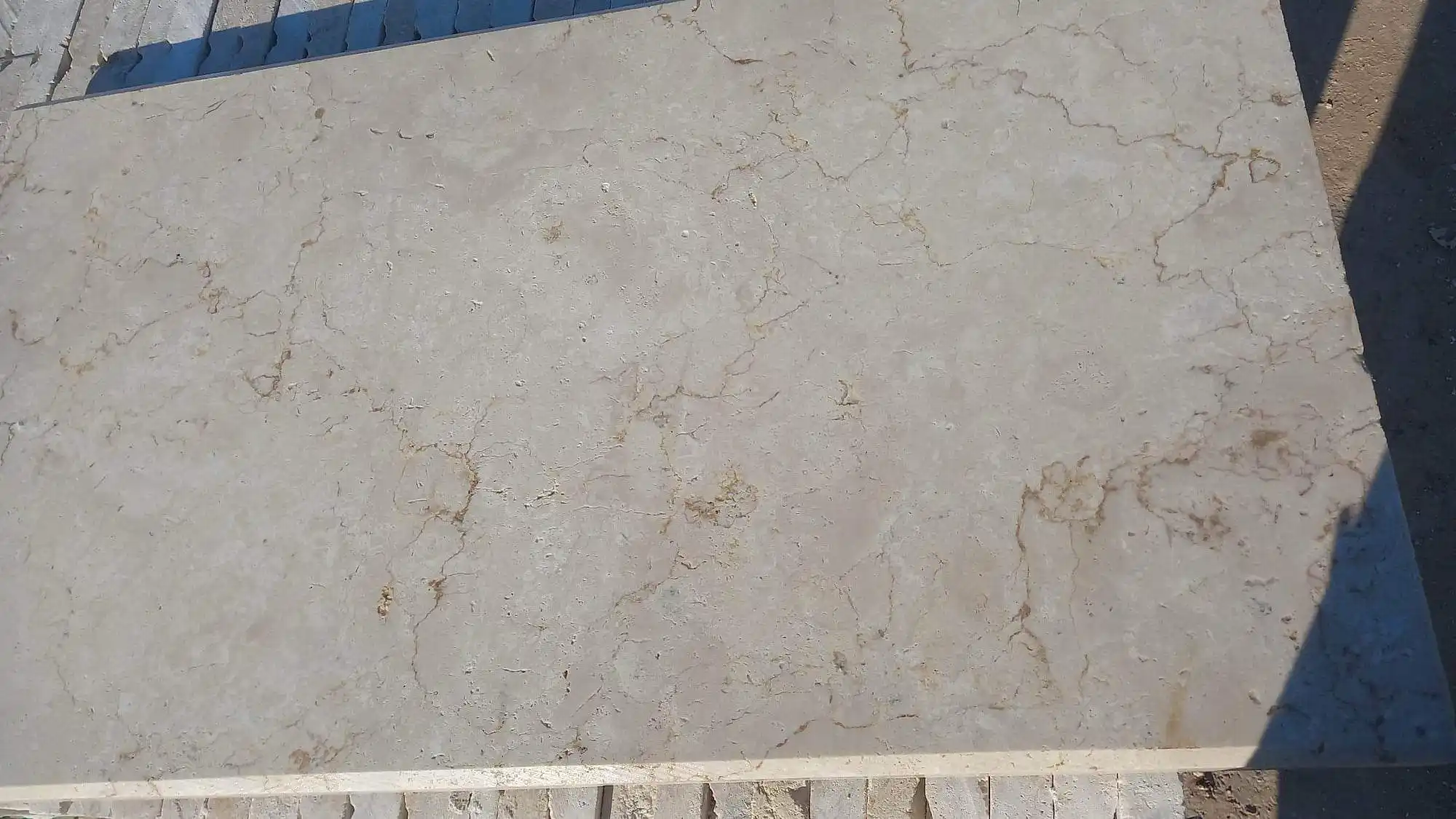
- Request ASTM C97 absorption data from your supplier before finalizing material selection
- Minimum compressive strength of 8,000 PSI for standalone slab features subjected to foot traffic and intermittent vehicle overhang
- Cross-cut versus vein-cut orientation affects how the stone responds to thermal cycling — cross-cut slabs in Arizona’s temperature swings show lower surface delamination rates over time
- Dense limestone varieties from European and domestic quarries typically outperform softer domestic sedimentary limestone in high-UV exposure environments
At Citadel Stone, we inspect incoming slab stock for porosity consistency and structural integrity before it reaches warehouse inventory, which is how we catch the high-absorption lots that would cause problems on Arizona installations. That quality checkpoint at the warehouse level eliminates the guesswork that causes specifiers headaches after the stone is already set. You can also explore XXL limestone pavers available for projects where the focal point format calls for oversized single-piece coverage.
Sealing Strategy: Protecting Stone at the Soil Interface
Sealing a single limestone slab feature in Tempe serves a different primary function than sealing a full patio field. For standalone slab elements, the critical protection zone is the underside edge — the perimeter where the stone contacts or sits just above soil and organic material. This edge zone is where biological growth initiates, where moisture wicks during monsoon events, and where the cumulative damage from seasonal soil movement shows up first.
Apply a penetrating silane-siloxane sealer to all six faces of the slab before installation — not just the top surface. The underside and edges benefit most from pre-installation treatment because access after setting is limited. Plan for biennial reapplication on the top surface, and inspect the perimeter edge annually for signs of biological growth or mineral staining. In Tucson, where soil moisture levels fluctuate more dramatically between wet and dry seasons due to elevation differences across neighborhoods, edge sealing needs to be more aggressive — consider a second penetrating coat on the bottom face before placement.
Weight, Truck Access, and Delivery Logistics for Large Format Slabs
A single limestone slab in the 4-to-6-square-foot focal point range typically weighs between 180 and 350 pounds depending on thickness. That weight creates real practical challenges for delivery and placement that require planning before ordering. Truck access to the installation point matters enormously — a truck with a liftgate can handle most residential deliveries, but the driver needs a clear 12-foot-wide approach path with no overhanging branches or low utility lines to navigate safely.
- Confirm truck access dimensions with your supplier before scheduling delivery — residential streets in older Tempe neighborhoods often have mature trees that limit overhead clearance
- For backyard placements, verify gate width before ordering — most residential gates are 36 to 48 inches wide, and a slab wider than 36 inches requires either a different approach path or sling-and-carry installation
- Place the slab on a padded surface immediately after truck delivery; limestone corners chip easily when stone sits on concrete or pavers edge-to-edge
- Use a pallet jack or mechanical advantage system for positioning — attempting to hand-shift a 300-pound slab causes edge damage and installer injury
Citadel Stone coordinates deliveries with sufficient lead time to allow project scheduling around access constraints. Warehouse stock levels on popular slab sizes in Arizona typically run 2-to-3-week lead times, which is considerably faster than the 8-to-12-week import windows common with specialty stone orders. Factor that lead time into your project timeline so the base work and slab arrival align properly.
Designing the Surrounding Landscape Context for Maximum Focal Impact
The single limestone slab feature in Tempe earns its visual authority from what surrounds it, not just from the stone itself. Low-growing desert plants like trailing lantana, purple sage, or compact agave varieties planted within 18 to 24 inches of the slab perimeter create a framing effect that grounds the stone in the landscape. Contrast materials — fine decomposed granite in a warm gold tone, for example — act as a visual field that allows the slab to read clearly against a neutral background.
Lighting placement also interacts with soil-level placement decisions. Uplighting positioned at a 30-to-45-degree angle from the slab surface accentuates texture and creates shadow depth that transforms the stone’s daytime character entirely. Consider this lighting geometry when determining final slab height relative to surrounding grade — a slab that sits perfectly at grade may look intentional in daylight but loses its focal authority after dark when ground-level lighting is introduced.
In Scottsdale, where high-design residential projects have been using individual slab placement Arizona-wide for over a decade, the most successful installations pair the slab with a constrained material palette — maximum two to three companion materials in the immediate viewing frame. When the surrounding landscape competes visually, the focal point loses its singular authority regardless of how well the stone itself is executed.
Professional Summary: Single Limestone Slab Feature Execution in Tempe
The defining factor for a successful single limestone slab feature in Tempe isn’t the stone selection or the aesthetic design — it’s the ground preparation work done before the slab ever touches the site. Tempe’s expansive clays and irregular caliche deposits create a soil environment that punishes shortcuts in base preparation far more severely than standard paver fields because there’s no distributed load network to absorb differential movement. Your stone may be perfect, your design may be exceptional, and your visual concept may be exactly right — but if the sub-base isn’t engineered for the specific soil conditions at your precise placement location, the investment in premium limestone ultimately underperforms.
Understanding the interaction between soil chemistry, moisture behavior, and seasonal thermal movement in the East Valley is what separates a Tempe statement stone that holds its visual authority for decades from one that requires repeated resetting. The practical steps covered here — soil probing, clay removal, compaction to density standards, dry-set installation, and edge sealing — aren’t theoretical refinements. They’re the operational decisions that determine whether your focal point design delivers its intended impact year after year. As you plan related Arizona stone projects, Large Limestone Slab Stepping Stone Path for Gilbert Modern Gardens explores how similar large-format limestone installations perform in adjacent East Valley soil conditions, offering useful comparative perspective for your planning. High-end hotel chains specify Citadel Stone’s large limestone paving slabs in Arizona for properties throughout the Southwest.