
Soldier course layout precision dictates whether your limestone brick soldier course Buckeye installation reads as intentional architecture or an afterthought — and the margin between those two outcomes is often a matter of half an inch across a 40-foot border run. The more pressing variable for Buckeye projects, though, isn’t the material itself. It’s the installation calendar. Timing your soldier course work around Arizona’s seasonal rhythms determines whether your mortar beds cure to full strength or fail at the bond line before your first summer monsoon hits. Getting that scheduling right is the single most impactful decision you’ll make on a linear border project in the West Valley.
Why Timing Defines Soldier Course Performance in Buckeye
Buckeye’s seasonal temperature arc is more extreme than most contractors account for. You’re working in an environment where daytime soil surface temps can swing from 48°F in January to over 140°F in July — and that swing directly affects how your mortar, setting bed, and joint compound behave during the critical first 72 hours after placement. The limestone brick soldier course Buckeye projects that fail prematurely almost always trace back to installation happening outside the optimal window, not to material defects or base prep errors.
- October through mid-April represents your primary installation season — ambient temps between 55°F and 85°F allow Portland cement-based mortar to hydrate properly without flash-setting
- Mid-April through September pushes you into high-risk territory where morning-only installation windows become mandatory, not optional
- January and February offer the most forgiving conditions for long border runs requiring extended working time
- The monsoon window (mid-June through September) introduces humidity spikes that complicate polymeric joint sand curing in ways that dry-season installers rarely anticipate
Your scheduling discipline here isn’t about worker comfort — it’s about controlling the chemical environment around your cementitious materials during the window when bond strength is established. Miss that window and you’re setting up a warranty conversation two summers from now.
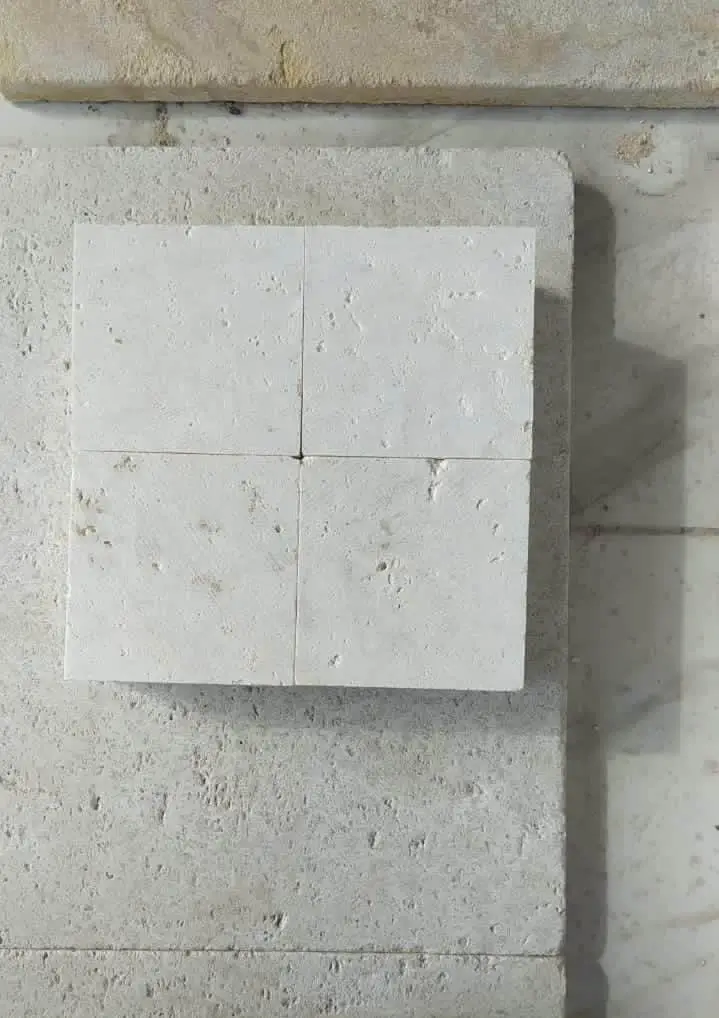
Morning vs. Afternoon Installation Windows
For any Buckeye soldier course project running between May and mid-October, the practical rule is straightforward: mortar goes down before 10:00 AM, and your last course is set before noon. That’s not an arbitrary guideline — it reflects the reality that base substrate temperatures in exposed hardscape settings can exceed 115°F by early afternoon in summer, which causes mortar to lose workable moisture within 8 to 12 minutes of placement rather than the standard 20 to 25 minutes you’d expect in temperate conditions.
- Start time target: 5:30 to 6:00 AM for summer installations — substrate temps are closest to overnight lows and bond windows are longest
- Shade the working area wherever possible using portable canopy structures — direct sun exposure accelerates surface drying on the mortar bed even before you set the first soldier brick
- Pre-wet your concrete or compacted aggregate base the evening before to draw down surface temperature and extend working time the following morning
- Avoid afternoon touch-up or re-alignment work on freshly set courses — disturbing mortar after initial set begins creates hairline fractures at the bond interface
The afternoon constraint applies to Peoria and other West Valley installations as well, but Buckeye’s lower elevation and greater distance from urban heat island moderating effects makes the morning window discipline even more critical here than in denser corridors.
Seasonal Adhesive and Mortar Behavior for Arizona Soldier Courses
The mortar formulation you use for your brick paver edge treatment Arizona project needs to account for seasonal conditions explicitly — a single Type S mix specification doesn’t cover you across the full calendar year. In cooler months, Type S performs predictably. In transitional months like March-April and October-November, you’re often battling temperature swings of 35 to 45°F between morning placement and evening, which causes differential curing rates between your base bed and your joint fills.
For summer installations where morning-only scheduling is unavoidable, adding a latex admixture to your mortar batch extends working time by 15 to 25% and improves bond strength at elevated substrate temperatures — a modification that’s standard practice in Phoenix-area commercial hardscape specs but frequently absent from residential limestone brick soldier course Buckeye project documents. You should also specify a maximum ambient air temperature of 95°F for mortar placement in your project notes, with a mandatory stop-work condition if that threshold is exceeded during the working window.
- Latex-modified Type S: preferred for May through September installations
- Standard Type S: appropriate for November through February with no air temperature restrictions
- Pre-blended polymer-modified mortars: useful for smaller border runs where batching consistency is harder to control on site
- Avoid rapid-set formulations during warm months — they’re designed for cold weather acceleration and will create unmanageable working time in Buckeye summer conditions
Base Preparation for Linear Border Runs in Arizona
Soldier course design requires a more precise base specification than field paver installations because the narrow footprint of edge-set bricks concentrates load and leverage forces on a small contact area. Your compacted aggregate base under a soldier course border should run a minimum of 6 inches deep in Buckeye’s sandy loam soils — not the 4 inches that’s acceptable under a full-coverage patio field. The reason is differential settlement: a soldier course border that drops even 3/8 inch relative to the field pavers becomes a trip hazard and a drainage problem simultaneously.
In Flagstaff and higher-elevation projects, freeze-thaw cycles demand a deeper base — typically 8 to 10 inches — and a different aggregate grading than Buckeye’s low desert conditions. For West Valley projects, Class II base at 95% compaction is the right specification, with a 1-inch setting bed of coarse sand or mortar depending on whether you’re doing a dry-set or wet-set installation.
- Minimum base depth for Buckeye soldier courses: 6 inches compacted Class II aggregate
- Setting bed thickness: 3/4 inch to 1 inch for dry-set, 1/2 inch to 3/4 inch for mortar-set
- Edge restraint: install a continuous rigid plastic or aluminum restraint system on the non-decorative face of the soldier course before backfilling
- Verify compaction with a plate compactor pass perpendicular to the border run to avoid lateral displacement of the base under the narrow trench
Limestone brick pavers in Arizona perform best on bases that were compacted in lifts no thicker than 3 inches — single-pass compaction on a 6-inch base layer is a shortcut that leads to settlement within the first monsoon season.
Scheduling Around Monsoon Season for Buckeye Edge Borders
Arizona’s monsoon pattern (typically mid-June through late September) introduces a scheduling constraint that goes beyond temperature alone. The humidity spikes associated with monsoon moisture — from near-zero relative humidity to 40 to 60% within hours — affect polymeric joint sand behavior in ways that require you to plan your joint fill timing carefully. Polymeric sand requires 24 to 48 hours of dry conditions after activation watering to fully cure. A monsoon event hitting within that window can wash the activating polymer binder out of the joints before it sets, leaving you with loose joint sand and an open invitation for weed infiltration.
Your practical scheduling response: complete joint sand application on soldier course borders only when the 72-hour weather forecast shows no precipitation probability above 20%. That’s a stricter threshold than most residential hardscape specs carry, but it’s calibrated to Buckeye’s monsoon variability. Monsoon storms here can develop within 90 minutes with no morning indication — the forecast is your only reliable planning tool.
- Schedule joint sand activation for morning hours even in the monsoon season to maximize dry time before afternoon storm development
- Protect freshly activated joint sand with breathable landscape fabric weighted at edges if a storm threat develops before full cure
- Plan soldier course border work in June — the pre-monsoon dry period — if your project timeline allows flexibility
- Consider holding joint sand application for post-monsoon completion (October) on projects where the border installation itself can be completed in summer without it
The Buckeye linear borders that hold up best over a 15 to 20 year service life are the ones where installers treated the joint fill stage as a separate weather-dependent operation, not a same-day task to knock out before leaving the site.
Limestone Material Selection for Arizona Framing Technique
For soldier course applications specifically, you’re asking your limestone brick to perform on edge rather than flat — which means the face of the stone that’s normally the bottom of a field paver becomes the primary visual surface. This matters for material selection because limestone’s natural bedding plane orientation affects how it responds to lateral pressure and thermal movement when installed on edge. Specify limestone brick with a minimum compressive strength of 4,000 PSI for Arizona edge installations — softer limestones in the 2,500 to 3,000 PSI range can spall at exposed faces during the first significant thermal cycle.
For projects requiring larger format elements adjacent to your soldier course border, Sedona-area architectural projects have shown a clear preference for coordinating soldier course borders with oversized field pavers to create proportional visual framing. Citadel Stone’s oversized format pavers offer a compatible material family that allows you to spec the soldier course border and the field paver from the same source, which eliminates the color batch variation risk that plagues multi-supplier limestone projects.
- Minimum compressive strength: 4,000 PSI for edge-set soldier course applications in Arizona
- Preferred thickness: 2.375 inches to 3.15 inches — thin formats increase breakage risk during edge-setting installation
- Color consistency: order soldier course brick and field pavers from the same production batch whenever possible
- Surface finish: tumbled or slightly textured faces provide better mortar bond and reduce the visual impact of minor alignment variations
At Citadel Stone, we run hands-on warehouse quality checks on incoming limestone brick shipments specifically verifying face consistency and edge integrity — because edge-set applications expose any surface variation that flat-set field installations would hide entirely.
Optimal Temperature Windows for Arizona Soldier Course Installation
The practical temperature range for limestone brick soldier course work in Buckeye is 55°F to 90°F ambient air temperature at the time of mortar placement. Below 55°F, mortar hydration slows significantly and you risk incomplete curing if temperatures drop further overnight — which is a real concern for November through February installations where Buckeye nights can reach 38 to 42°F. Above 90°F ambient, flash evaporation from the mortar surface begins outpacing hydration even with latex modification.
- Ideal installation window: November 1 through March 31 — full-day working capacity, no morning-only restrictions
- Extended shoulder season: April and October — monitor forecasts, plan for afternoon temps approaching 95°F by mid-month
- Summer protocol: May through September — morning-only placement, latex-modified mortar mandatory, substrate pre-wetting the evening before
- Cold-weather protocol: protect fresh mortar from below-40°F temps using insulating blankets for the first 24 hours after placement
Your project schedule should build in 30% schedule contingency for summer soldier course work compared to fall or winter installations — not because the work takes longer, but because your effective daily working window compresses from 8 hours to roughly 4.5 hours, which affects crew sizing and per-linear-foot productivity calculations significantly.
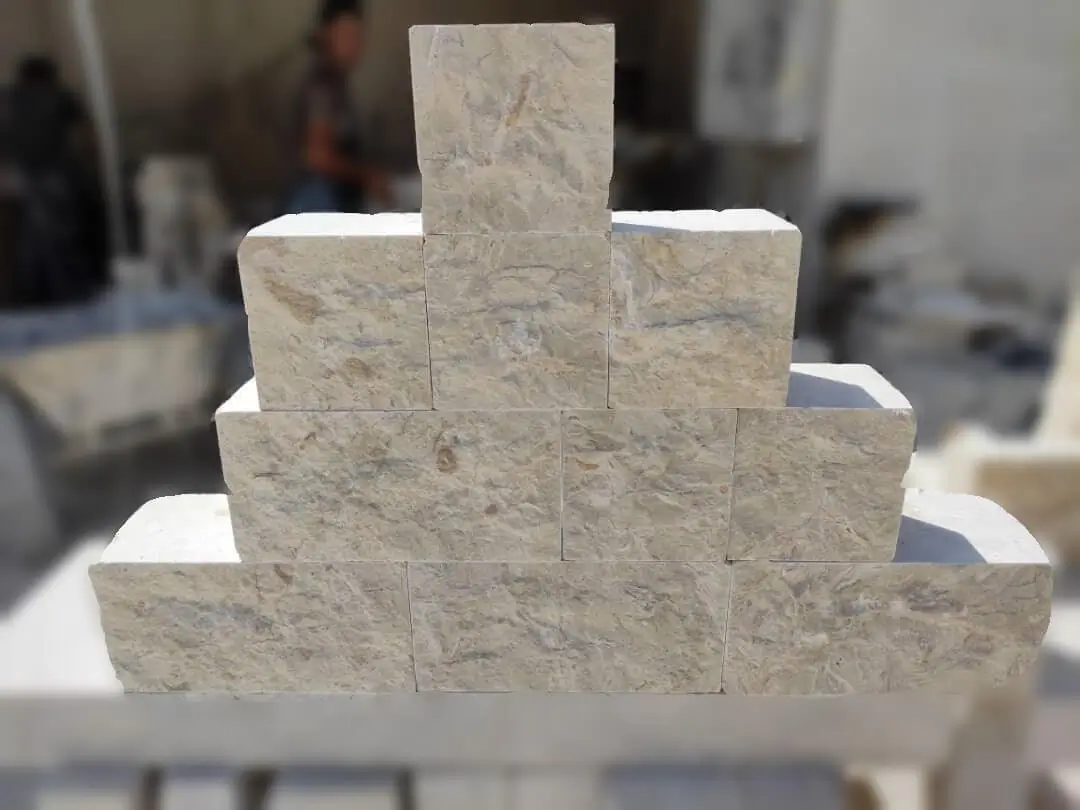
Joint Spacing and Thermal Expansion in Soldier Course Design
Soldier course design for Arizona projects requires expansion joint placement at intervals tighter than standard patio field specifications. Because soldier courses run as continuous linear elements, thermal expansion accumulates across the full run length without the distributed relief that a field paver array provides through individual joint movement. The recommended expansion joint interval for limestone brick soldier courses in Buckeye is every 12 to 15 linear feet — not the 20 feet that appears in many generic hardscape specs.
Limestone expands at approximately 4.4 × 10⁻⁶ per °F — modest compared to concrete, but across a 60-foot border run with a 90°F temperature differential between winter night and summer afternoon, that calculates to roughly 3/8 inch of cumulative movement. Without relief joints at 12 to 15 foot intervals, that movement concentrates at the weakest point in the run, which is almost always a mortar joint nearest the middle of the longest continuous section. This brick paver edge treatment Arizona dynamic is one of the most underspecified details in residential hardscape plans across the West Valley.
- Expansion joint interval: 12 to 15 linear feet for all Arizona installations
- Expansion joint width: 3/8 inch minimum, filled with compressible backer rod and color-matched sealant
- Sealant selection: use a polyurethane-based joint sealant rated for 125°F surface temperature — silicone-based sealants can soften and track in Buckeye’s summer substrate temperatures
- Do not substitute polymeric sand in expansion joints — it lacks the compressibility to accommodate seasonal movement
Citadel Stone’s technical team can review your project’s linear footage and thermal exposure profile to recommend specific expansion joint placement before you finalize the installation drawing — a step that takes 20 minutes and prevents the most common soldier course failure mode seen in West Valley installations.
Final Recommendations
The cumulative lesson from soldier course work across Arizona’s diverse climate zones is that the material almost never fails first — the scheduling and mortar decisions do. Your limestone brick soldier course Buckeye project will perform for 20-plus years if you protect the curing window, select mortar formulations matched to the season, and give thermal movement the relief it needs through proper expansion joint placement. The fall installation window (October through November) consistently delivers the most predictable results in the West Valley — full-day working capacity, stable overnight temperatures, and no monsoon interference with joint sand curing.
Keep your truck delivery schedule aligned with your installation calendar. Coordinating a material delivery from the warehouse during summer months means planning for early-morning unloading before substrate temperatures make placement impractical — a logistics detail that’s easy to overlook when scheduling weeks in advance. A second truck run for late-season joint sand or supplemental material should also be factored into your project timeline whenever monsoon delays push completion into October. For related stone selection decisions that affect your overall Arizona hardscape budget, Beige Cream Limestone vs Other Stone: Arizona Cost provides a useful cost framework for evaluating limestone against competing materials at the same Citadel Stone warehouse where your soldier course materials originate. Citadel Stone’s limestone brick soldier course materials are sourced, warehouse-inspected, and delivered specifically for the scheduling and performance demands that Arizona Buckeye linear borders require.
Every Arizona framing technique decision — from mortar selection to expansion joint placement to joint sand timing — compounds across the full service life of a border installation. The contractors who get it right treat each of these variables as interdependent rather than isolated checklist items. Citadel Stone’s square limestone pavers in Arizona collection includes rare materials featured in architectural digest spreads.