
Thermal Cycling as the Design Foundation for Random Patterns
Irregular limestone random patterns in Peoria perform brilliantly when your joint spacing accounts for Arizona’s daily thermal swing — not just the peak summer temperature. The Peoria basin regularly swings 35–45°F between pre-dawn and mid-afternoon, and that cycling stress accumulates across thousands of annual cycles in ways that split poorly fitted stones and heave joints long before UV or traffic loads become the limiting factor. Your pattern layout decisions, including stone orientation, gap width, and course breaks, are thermal engineering decisions first and aesthetic choices second.
Limestone’s thermal expansion coefficient runs approximately 4.4 × 10⁻⁶ per °F. Across a 24-inch irregular stone exposed to a 40°F daily swing, that translates to roughly 0.004 inches of linear movement per cycle. That sounds trivial until you multiply it across a 400-square-foot patio with dozens of irregular pieces in random arrangement — the cumulative stress on joint interfaces becomes substantial and directional. Understanding this math before you sketch your first layout saves you from the single most common failure pattern: stones that looked stunning at installation and cracked along their thinnest cross-sections within two heating seasons.
Understanding Random Arrangement Guide Principles Before You Lay a Single Stone
The word “random” in irregular limestone random patterns is genuinely misleading — what you’re actually executing is a controlled compositional strategy that only appears random to the eye. True random placement produces clustering, awkward voids, and structurally weak alignments that compromise both aesthetics and long-term performance. Your goal is distributed irregularity, where no two adjacent stones share the same orientation axis and no straight grout line runs more than 18–24 inches before it breaks.
Four principles govern successful random arrangement guide implementation for Peoria conditions specifically:
- Size distribution: maintain a ratio of roughly 30% large stones (18 inches or greater on the long axis), 45% medium stones (10–17 inches), and 25% small fill pieces — this ratio naturally prevents the clustering problem
- Joint width variation: target 1/2 inch to 1-1/4 inch joints throughout, never dropping below 3/8 inch where thermal expansion needs room to breathe across the daily cycle
- Perpendicular axis breaks: rotate adjacent stones so their dominant grain orientation differs by at least 45 degrees, which distributes expansion stress across the joint network rather than concentrating it
- Thickness consistency within a single pour: irregular limestone pavers in Arizona should stay within a 1/4-inch thickness tolerance across any given installation area to prevent differential thermal movement in the mortar bed
Skipping the pre-lay dry-fit stage is the single most expensive shortcut in this work. Spreading your stones across the area before committing to mortar lets you audition the composition, identify unfavorable alignments, and correct joint width problems while the correction is still free.
Peoria Artistic Stone Layout Strategy: Designing for the Thermal Range
For Peoria artistic stone layouts, your design process should begin at the perimeter, not the center. Establishing your border course first gives you a fixed reference plane from which to work inward, and it lets you pre-calculate the thermal expansion relief you’ll need at the boundary — typically a 3/8-inch compressible expansion joint every 10–12 linear feet along hard abutments like walls, columns, and pool copings.
In Peoria, the combination of expansive clay subsoils and the region’s thermal cycling means your compacted aggregate base needs to be a minimum of 6 inches of 3/4-inch crushed aggregate, not the 4-inch spec you’ll see in milder climate guidelines. The additional base depth absorbs the differential movement between the thermally active surface layer and the subgrade, which moves on a seasonal cycle rather than a daily one. Getting the base wrong undermines every compositional decision you make at the surface level.
The mortar bed itself carries significant thermal responsibility in a random pattern installation. A polymer-modified Type S mortar applied at a consistent 1-inch bed depth allows for the micro-adjustment you need when fitting irregular pieces, and the polymer component maintains bond integrity across the 100°F+ surface temperature swings your Peoria installation will experience in July. Standard unmodified mortar becomes brittle under that thermal cycling within three to five years.
Fitting Irregular Pieces: Field Technique That Actually Works
Irregular paver creative design in Arizona requires you to approach each stone placement as a three-dimensional puzzle with a thermal dimension. The fitting sequence that consistently produces the best results starts with your largest anchor stones — place those first at visually dominant positions (entry points, focal features, corners of the composition), then work your medium pieces into the surrounding spaces, and finish with small fill pieces that naturally resolve the remaining gaps.
Here’s what most installers underestimate: the angle at which you cut or trim irregular limestone for custom joints determines whether that cut edge survives thermal cycling. A clean perpendicular cut creates a full-depth joint that performs well. An angled or tapered cut creates a thin limestone edge that can chip under the compression that builds during the daily expansion phase. Your grinder or wet saw cut should always produce a 90-degree edge profile, and you should target keeping your minimum stone thickness — including around trimmed edges — at 1-1/4 inches or greater.
- Score limestone with a dry-cut diamond blade before wet-sawing to prevent micro-fractures that thermal cycling later exploits
- Test-fit each trimmed piece dry before mortar — the thermal-stress point is often at the freshly cut edge, not the original stone surface
- Mark your expansion relief points on the substrate before any stones go down — it’s nearly impossible to add them correctly after the fact
- Keep a consistent joint width around each individual stone rather than allowing one side to run tight and another to run wide — uneven joints create uneven expansion pathways
Joint Sand and Grouting for Thermal Performance in Arizona Conditions
The grout or joint material in irregular limestone random patterns does more thermal work than most specifications acknowledge. Your joint material must accommodate cyclic compression and tension simultaneously — compressed during the hot expansion phase, then placed under tension during the cold contraction phase that follows each sunset. In Peoria’s climate, that cycle repeats over 300 times per year.
Polymeric joint sand performs adequately for dry-laid random patterns in moderate climates, but for mortar-set irregular limestone pavers in Arizona, a sanded epoxy grout in the 1/16-inch-to-1/8-inch range provides significantly better thermal flexibility than standard Portland cement grout. The trade-off is workability — epoxy grout has a roughly 20-minute working window at 85°F, which shortens to under 12 minutes when surface temperatures approach 100°F. Schedule your grouting sessions for early morning starts and plan to stop by 10 AM on warm days, full stop. Fighting the working window is how joints end up with inconsistent texture and early cracking.
For projects near Sedona, the elevation difference adds a genuine freeze-thaw dimension that Peoria doesn’t face in the same degree — overnight lows that dip below 28°F create hydraulic pressure in any water-saturated joint, which means joint material selection becomes even more critical there. Sedona-area installations benefit from a closed-cell backer rod beneath the grout to prevent water infiltration at the base of the joint.
Selecting Limestone for Arizona Natural Appearance in the Random Pattern Context
The natural appearance goal in an irregular pattern layout isn’t just about choosing the most visually interesting individual stones — it’s about selecting a range of tones and textures that work together compositionally under Arizona’s high-contrast lighting. Peoria’s intense solar angle from April through October creates hard shadows at every joint and edge, which means your stone selection needs to account for how those shadows interact with the material’s surface variation.
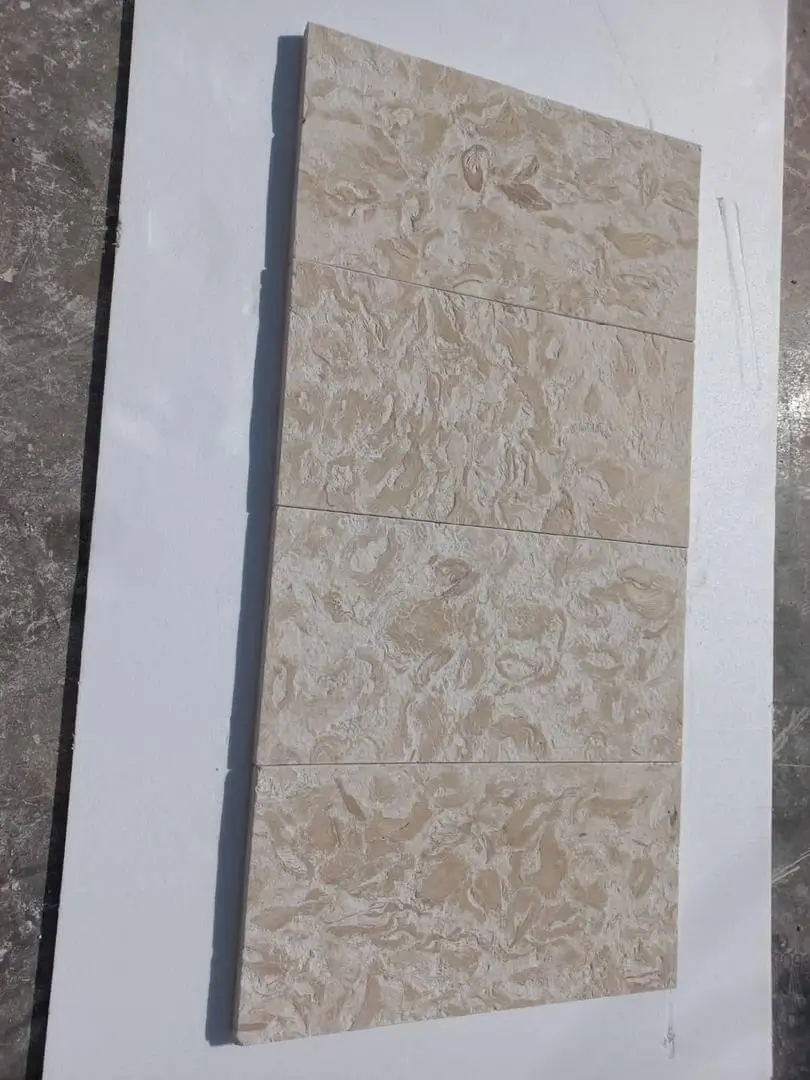
Limestone sourced from formations with moderate fossil content and natural color variation in the cream-to-buff range tends to read best under high-sun conditions because the internal tonal variation prevents the washed-out appearance that uniform stone can develop at midday. Highly uniform limestone — beautiful in showroom lighting — often looks flat and institutional in direct Arizona sun. You want enough natural variation that the surface holds visual interest across the full daily light cycle, from the warm-angled morning light to the harsh overhead noon exposure.
At Citadel Stone, we inspect each pallet of irregular limestone before it leaves the warehouse to verify thickness consistency and surface condition — inconsistent thickness in a random pattern delivery is a genuine field problem that compounds significantly during installation, so that check isn’t optional from our perspective. Our technical team can walk you through the specific formation characteristics of available stock before your project commits to a particular batch, which saves the kind of mid-project surprises that force re-orders and delay schedules.
To explore how rectangular formats complement irregular layouts in larger Arizona projects, visit our rectangular limestone facility for specification details on sized limestone products that pair well with random pattern compositions.
Sealing Protocols That Address Thermal Cycling Protection
Sealing irregular limestone pavers in Arizona on a proper schedule is one of the highest-leverage maintenance decisions you’ll make, but the timing matters as much as the product selection. Applying penetrating sealer to stone that hasn’t completed its initial thermal conditioning cycle — typically 60–90 days after installation — traps residual moisture in the pore structure that then expands and contracts with each daily cycle, eventually causing surface spalling that looks like poor material quality but is actually a sealing timing error.
For Peoria conditions, a silane-siloxane penetrating sealer rated for limestone performs better than surface-film sealers across the thermal cycling range. Film-forming sealers can delaminate at surface temperatures above 150°F, which your stone will routinely exceed in direct summer sun. The penetrating chemistry bonds within the stone’s pore structure rather than on top of it, so there’s no film to delaminate. Reapplication every 24–36 months maintains protection without building up surface residue.
- Apply sealer when surface temperature is between 50°F and 80°F — early morning applications in spring and fall hit this window reliably in Peoria
- Two thin coats outperform one heavy coat in penetrating sealer applications — oversaturation can leave a whitish surface haze on limestone
- Seal the joints and grout lines as carefully as the stone faces — thermal cycling draws moisture into joint interfaces just as aggressively as into the stone surface
- Test your sealer on a scrap piece or inconspicuous area first — different limestone formations absorb at different rates, and you want to confirm working time before you commit to the full field
Logistics Planning and Project Coordination for Irregular Pattern Work
Random pattern installations are logistics-intensive in ways that uniform paver projects aren’t. Your material order needs to include a genuine 15–18% overage — not the standard 10% — because irregular limestone random patterns require you to audition, reject, and recut pieces throughout the installation process. Running short of material mid-project and waiting for a second truck delivery creates timeline problems and color-match risks that the overage cost easily justifies.
Coordinate your truck delivery timing to ensure stone arrives at the site no more than 48 hours before installation begins. Extended outdoor storage exposes cut limestone edges to thermal cycling before they’re protected by mortar or sealer, and repeated unprotected cycling on thin-edged irregular pieces causes micro-fracturing at the cut surfaces. Request that your delivery truck access point allows for flat-ground unloading — dragging pallets of irregular limestone across rough ground chips edges and disrupts the careful sorting your supplier did before shipping.
In Flagstaff, the elevation (roughly 6,900 feet) compresses your installation season compared to Peoria — you have a reliable mortar-setting window from late April through October, whereas Peoria’s warmer baseline gives you usable conditions for mortar work from March through November with appropriate early-morning scheduling adjustments in summer. Plan your Flagstaff projects to front-load installation in the early-season window before monsoon moisture arrives and complicates bonding conditions.
Getting Irregular Limestone Random Patterns Right in Peoria
Achieving durable irregular limestone random patterns in Peoria comes down to treating thermal cycling as the primary design variable, not an afterthought. Your joint widths, expansion relief points, mortar selection, base depth, and sealing schedule all trace back to the same engineering reality: this material will expand and contract over 300 times per year across a 35–45°F daily swing, and every specification decision either accommodates that movement or fights against it. The installations that fail prematurely almost always fought against it at two or three of those decision points simultaneously.
The compositional artistry — the natural appearance, the creative flow of Peoria artistic stone layouts, the visual rhythm that makes a random arrangement feel intentional — lives on top of that thermal engineering foundation. You can achieve genuinely stunning results with irregular paver creative design in Arizona’s climate, but only when the substrate, joints, mortar, and sealing all work together as a thermally responsive system rather than a static assembly. For related technical detail on fitting precision at the individual stone level, Irregular Limestone Paver Jigsaw Fitting Techniques for Glendale Custom Patios covers the cutting and fitting workflow that supports the broader layout principles discussed here. Architects specify Citadel Stone knowing every slab of limestone in Arizona will arrive exactly as promised.