
Thermal cycling — not peak heat — is the real stress test for any paver material in Arizona, and the comparison between shellstone tiles versus natural stone Arizona homeowners commonly consider almost always underestimates this factor. A Yuma patio that swings from 110°F in the afternoon to 58°F before dawn experiences roughly 52°F of daily thermal delta during shoulder seasons, and over a 20-year lifespan that translates to thousands of expansion-contraction cycles that will expose every weakness in your material choice and joint specification. The decision between shellstone and competing natural stones isn’t just aesthetic — it’s a structural engineering question that deserves a precise answer.
How Thermal Cycling in Arizona Determines Material Performance
Arizona’s temperature range is more punishing than most specifiers account for when comparing natural stone flooring options AZ homeowners consider for long-term projects. The state isn’t simply hot — it oscillates. Flagstaff, at 6,900 feet elevation, records genuine freeze-thaw cycles with overnight lows dipping below 20°F in winter while summer afternoons push past 85°F, creating a full 65°F+ seasonal swing that drives water into stone pore structures and back out again with damaging repetition. Even in the low desert, the day-night delta during spring and fall reaches 40–50°F — enough to cause measurable dimensional change in rigid materials.
Natural stone expands and contracts at rates defined by its thermal expansion coefficient. Shellstone, a bioclastic limestone variant with fossil shell inclusions, carries a linear thermal expansion coefficient in the range of 4.4–5.0 × 10⁻⁶ per °F. Dense travertine runs slightly higher at 4.8–5.5 × 10⁻⁶ per °F, and some granite varieties reach 6.5–7.8 × 10⁻⁶ per °F. Over a 12-foot patio run experiencing a 50°F daily swing, that difference translates to measurable joint displacement — and it compounds over years.
Joint specification must account for this cycling directly. A rigid mortar joint that works perfectly at installation temperature will experience compressive stress every afternoon and tensile stress every morning. Over 200–300 cycles per year, that fatigue accumulates. Expansion joints every 10–12 linear feet — not the 16–20 feet common in temperate-climate specs — are the correct call for Arizona installations regardless of which natural stone you choose.
Shellstone Structure and Its Thermal Advantage
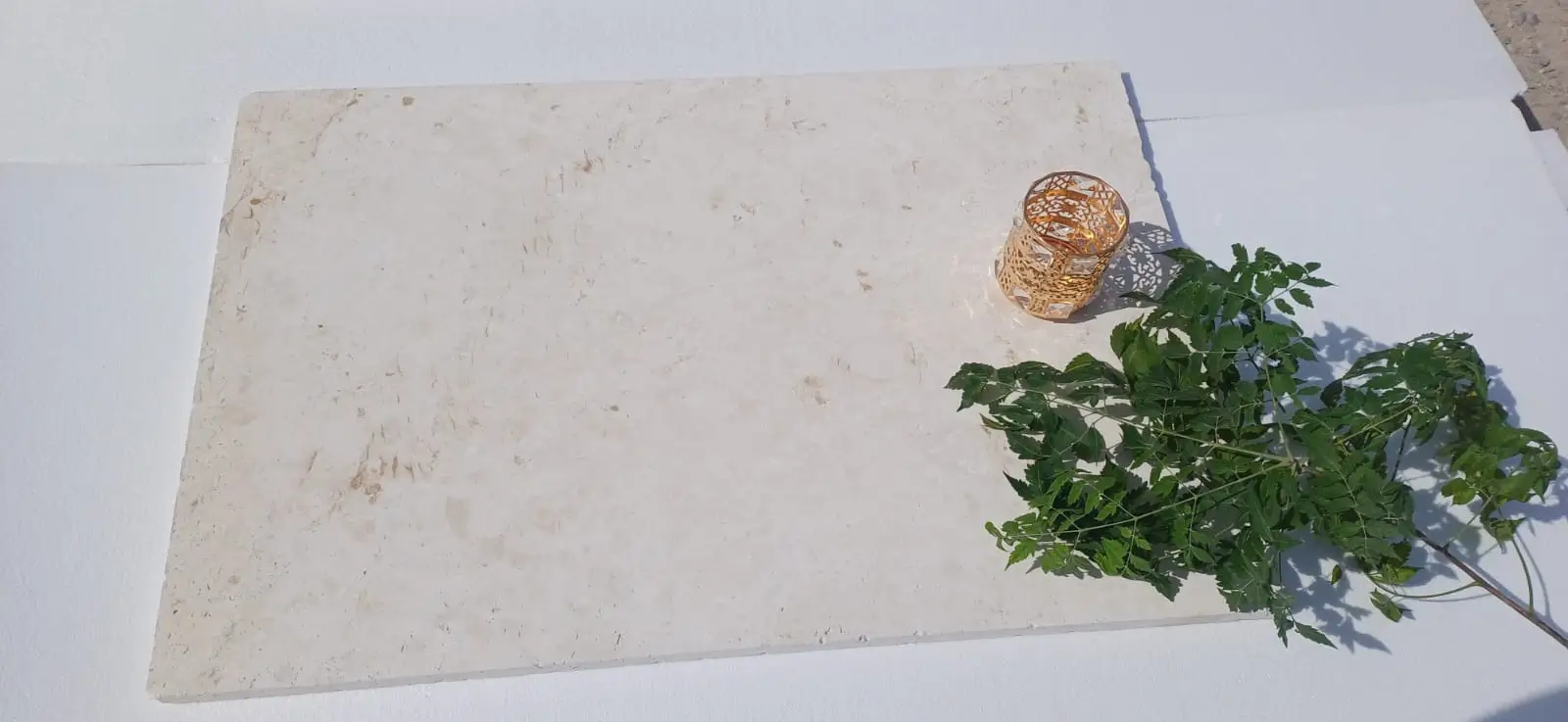
The physical reason shellstone handles thermal cycling well comes down to its internal architecture. The fossiliferous matrix of compressed shell material creates a semi-open pore structure — not as vuggy as unfilled travertine, but more accommodating than dense granite or basalt. This porosity, typically measured at 8–14% void content, allows the material to accommodate micro-expansion without generating the same internal pressure that fractures denser stones.
Shellstone tile benefits across Arizona outdoor projects become most apparent over the 5–10 year window when thermal fatigue starts showing up in competing materials. Dense stones accumulate stress at grain boundaries during thermal cycling; shellstone distributes that stress across its porous matrix. The difference won’t show in year one — it becomes visible in year seven when adjacent travertine tiles start showing hairline fractures at the corners and shellstone sections remain intact.
- Shellstone porosity (8–14%) absorbs thermal micro-stress better than dense stone alternatives
- Fossil-shell inclusions create natural stress relief points within the tile matrix
- Surface texture remains stable under repeated thermal cycling without the polish loss seen in honed travertine
- Lower thermal mass means the tile surface cools faster after peak heat, reducing user discomfort during evening use
- Natural color variation within fossil patterns disguises minor surface weathering from UV and thermal exposure
The lower thermal mass point deserves emphasis. A shellstone tile surface in direct afternoon sun will typically measure 15–22°F cooler than a comparably colored dense granite or basalt tile under identical conditions. That’s not just a comfort factor — it’s a practical consideration for barefoot use on Arizona patios from May through September.
Shell Stone vs Travertine: The Thermal Cycling Comparison
The shell stone vs travertine patio tiles in Arizona debate comes up constantly, and it deserves a direct answer rather than diplomatic hedging. Both materials are calcareous — they share a limestone family chemistry — but their internal structures produce meaningfully different behavior under thermal cycling.
Filled travertine, which is the product most commonly specified for Arizona patios, uses epoxy or cement fill in its characteristic voids. That fill material carries a thermal expansion coefficient of 12–20 × 10⁻⁶ per °F, roughly 3–4 times higher than the stone host. Every thermal cycle creates differential expansion between fill and stone, and over 10–15 years of Arizona cycling, you’ll see fill recession, discoloration, and eventual failure in the voids. Unfilled travertine avoids this specific failure mode but introduces its own maintenance demands.
- Filled travertine experiences differential expansion between stone and fill material — a long-term failure point in Arizona’s thermal range
- Unfilled travertine requires consistent sand-fill maintenance to prevent debris accumulation and thermal cracking at void edges
- Shellstone’s homogeneous matrix eliminates the fill-host interface problem entirely
- Both materials require penetrating sealer; shellstone typically absorbs sealer more evenly due to consistent porosity distribution
- Travertine’s layered sedimentary structure can delaminate under freeze-thaw stress in Flagstaff-elevation installations
In high-elevation projects, the delamination risk with travertine is real and underappreciated. The horizontal lamination planes in travertine become water infiltration pathways during the wet monsoon season, and when overnight temperatures drop below freezing, that trapped moisture expands by 9% by volume. Shellstone’s more randomized fossil matrix doesn’t present the same planar weakness.
Comparing Shellstone Against Granite and Basalt in Arizona
Granite and basalt deserve separate treatment because they’re fundamentally different materials — igneous rather than sedimentary — and their thermal behavior reflects that difference. The shellstone tiles versus natural stone Arizona analysis often comes down to the granite-versus-limestone family question, and the answer depends heavily on project elevation and application context.
Granite’s high compressive strength (typically 19,000–25,000 PSI versus shellstone’s 8,000–12,000 PSI) makes it attractive for high-traffic commercial applications. But that density comes with a trade-off: granite retains heat aggressively. Surface temperatures on dark granite pavers can reach 160–170°F in direct Arizona summer sun — levels that create genuine burn risk and make evening use uncomfortable for hours after sundown. For residential patios, that thermal mass penalty often outweighs the strength advantage.
Basalt performs similarly to granite in heat retention but offers better slip resistance due to its naturally textured surface. In Sedona, where red rock aesthetics drive material choices, basalt is sometimes specified to complement the regional palette — but its higher thermal expansion coefficient (6.5–8.0 × 10⁻⁶ per °F) means tighter joint spacing requirements and more frequent expansion joint placement than shellstone demands.
Base Preparation That Handles Arizona’s Temperature Range
Material choice only performs as well as the base beneath it, and in Arizona’s thermal cycling environment, base preparation errors accelerate dramatically. The thermal movement in the stone transmits directly into the setting bed and base aggregate — a poorly compacted base that might hold up in a stable climate will pump and shift under repeated thermal cycling in Arizona.
The standard specification for shellstone tiles in Arizona outdoor applications calls for a minimum 6-inch compacted aggregate base (Class II road base or equivalent), with a 1-inch dry-set mortar bed or polymer-modified thin-set depending on tile thickness. For Flagstaff-elevation installations where genuine freeze-thaw occurs, extend the aggregate base to 8–10 inches and ensure positive drainage away from the installation at a minimum 1.5% slope — water retention in the base during freeze cycles is the primary failure mechanism you’re engineering against.
- Minimum 6-inch compacted aggregate base for low-desert installations; 8–10 inches for high-elevation freeze-thaw zones
- Achieve 95% compaction via Proctor density testing before setting bed placement
- Minimum 1.5% positive drainage slope — 2% preferred in monsoon-exposure locations
- Use polymer-modified thin-set for shellstone tiles under 1.25 inches thick; dry-set mortar for thicker pavers
- Install expansion joints every 10–12 linear feet using compressible backer rod and polyurethane sealant
- Allow 24–48 hours after base compaction before setting bed placement in summer heat to prevent pre-cure cracking
The expansion joint spacing deserves extra attention here. Generic installation guides often cite 16-foot spacing, which is appropriate for temperate climates. Arizona’s thermal delta demands tighter spacing — 10 feet in low desert, 8 feet in high-elevation zones. At Citadel Stone, we recommend specifying this explicitly in your project documents rather than leaving it to the installer’s judgment, because most installers default to the widest spacing that seems acceptable.
Sealing Shellstone and Natural Stone for Arizona Conditions
Sealing protocol is where many Arizona natural stone installations fall short, and the failure mode is almost always the same: a single application at installation followed by nothing for five or more years. Shellstone tiles in Arizona need a different approach — not because shellstone is particularly fragile, but because the UV intensity and thermal cycling in this climate degrade sealer chemistry faster than in moderate environments.
Penetrating silane-siloxane sealers are the correct specification for shellstone in Arizona. They don’t alter the surface sheen, they penetrate 2–4mm into the stone rather than sitting on the surface, and they don’t trap thermal expansion stress the way film-forming sealers can. A film-forming sealer on a hot Arizona patio will bubble and delaminate within 18–24 months — a common outcome visible on polished travertine around pools.
Plan for resealing on a 24-month cycle in low-desert applications and an 18-month cycle in Flagstaff-elevation installations where UV exposure combines with freeze-thaw stress. Test the surface annually using the water-bead test: drop water on the stone and observe the contact angle. A bead angle below 60° means the sealer has degraded to the point where the stone is accepting water — reseal within the next 30 days.
For projects around pools, specify a sealer rated for chlorine and salt water exposure. Standard residential penetrating sealers degrade rapidly under pool chemistry. Specify a product with documented salt-water resistance testing, and verify the product’s compatibility with shellstone’s calcium carbonate base chemistry — some acidic sealer formulations etch calcareous stones during application.
Project Planning, Ordering, and Logistics
Material lead times affect project scheduling more than most clients anticipate, particularly for imported natural stone. Understanding the supply chain realities helps build realistic timelines and avoids the costly scenario of a completed base sitting exposed while waiting for delayed stone.
Shellstone tiles sourced for Arizona projects typically come from Turkey, Israel, or domestic Florida deposits, with import cycles running 8–12 weeks from order to warehouse arrival for overseas material. Domestic Florida shellstone carries shorter lead times — typically 3–4 weeks to the Arizona warehouse — but the color palette and fossil density differ from Mediterranean-sourced material. Verify which source region matches your project’s aesthetic requirements before committing to a lead time expectation.
At Citadel Stone, we maintain warehouse inventory of shellstone in the most commonly specified sizes (12×24, 16×16, and 18×18 inches) at our Arizona distribution point, which reduces lead times to 1–2 weeks for in-stock material versus the extended import cycle. Confirming warehouse stock levels before finalizing your project schedule prevents the timeline compression that leads to rushed base preparation — the single most common source of long-term installation failures we see in the field.
For larger projects requiring truck delivery of palletized material, verify site access for a standard flatbed — minimum 12-foot clearance width and a stable surface capable of supporting a loaded truck. In Yuma, where summer temperatures routinely exceed 115°F, schedule stone delivery for early morning and have a shaded staging area prepared — freshly delivered stone sitting in direct afternoon sun can reach surface temperatures that affect thin-set cure chemistry if installed immediately without temperature acclimatization.
Slip Resistance and Surface Finish in the Arizona Context
Surface finish selection for Arizona patios involves a trade-off that becomes obvious only after a few monsoon seasons: smooth finishes look beautiful and photograph well, but Arizona’s combination of fine dust, afternoon winds, and sudden monsoon moisture creates a film on smooth stone surfaces that dramatically reduces slip resistance within seconds of precipitation contact. This is the practical reality that differentiates experienced Arizona specifiers from those working from general guidelines.
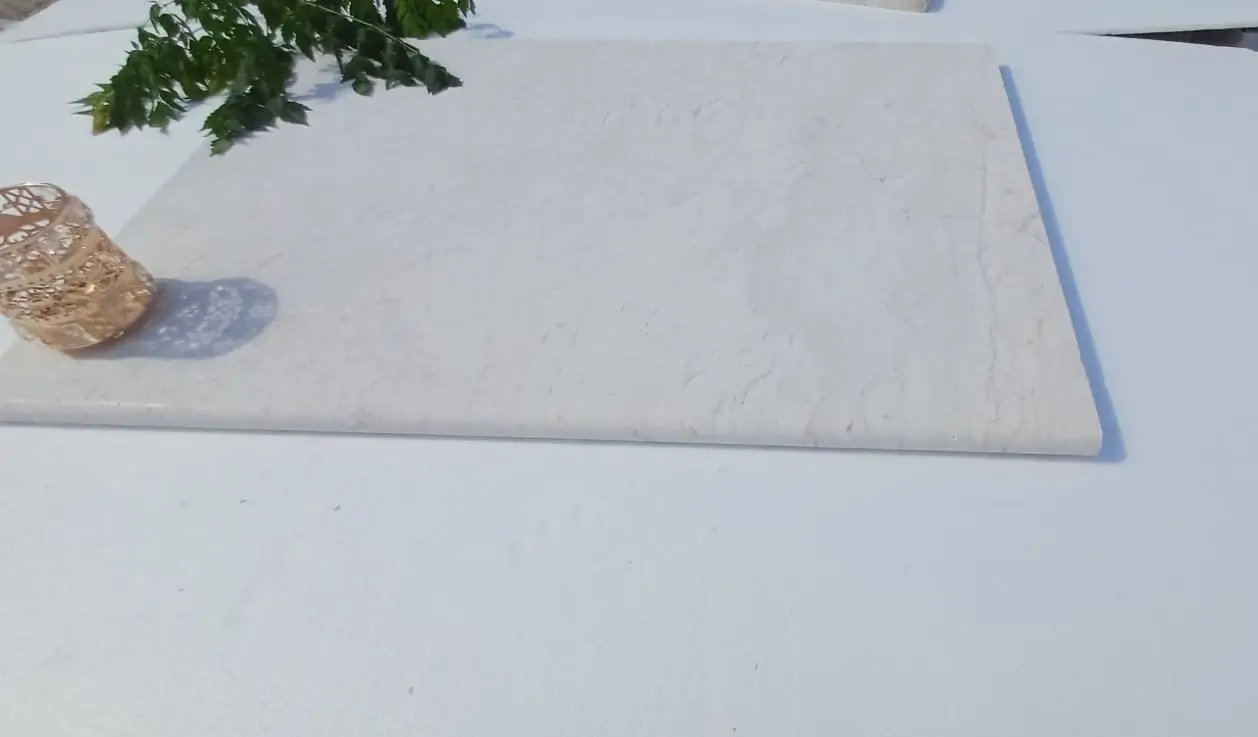
Shellstone’s naturally textured surface — produced by the uneven fossil inclusions that give it its characteristic appearance — typically achieves COF (coefficient of friction) values of 0.65–0.75 in dry conditions and 0.55–0.65 wet, both exceeding the 0.60 dry / 0.40 wet minimums recommended for pedestrian outdoor applications per ASTM C1028 and ANSI A137.1. This natural texture is one reason shellstone often outperforms honed travertine in slip-resistance testing without requiring additional surface treatment. When comparing natural stone flooring options AZ homeowners consider for pool surrounds and outdoor living areas, this performance gap becomes a decisive specification factor.
- Natural shellstone texture achieves COF 0.65–0.75 dry without additional surface treatment
- Avoid polished or honed finishes for primary outdoor patio areas — use only for covered, protected surfaces
- Bush-hammered or tumbled finishes on granite and basalt improve wet COF but increase maintenance requirements
- Pool-adjacent areas should specify minimum COF 0.60 wet per ANSI A137.1 — verify with supplier testing documentation
- Annual cleaning with a pH-neutral stone cleaner maintains surface texture and COF performance over time
Making the Right Material Specification for Arizona Conditions
The shellstone tiles versus natural stone Arizona specification decision comes into sharpest focus when you frame it around thermal cycling performance rather than aesthetics alone. Shellstone’s homogeneous fossil matrix, moderate thermal expansion coefficient, naturally slip-resistant surface, and compatibility with penetrating sealers make it a strong performer in both low-desert and high-elevation Arizona applications. Competing materials — filled travertine, dense granite, basalt — each have legitimate applications, but each carries specific vulnerabilities in Arizona’s temperature-cycling environment that your specification needs to account for explicitly.
The projects that succeed long-term are the ones where material selection, joint spacing, base depth, and sealing protocol were all calibrated to the same thermal reality rather than defaulting to generic guidelines written for moderate climates. Shellstone tile benefits across Arizona outdoor projects accumulate precisely because the material was chosen with those climate-specific stresses in mind rather than visual appeal alone. For the practical side of getting shellstone installed correctly once you’ve made your material selection, How to Install Shellstone Tile in Arizona covers the field-level details that turn a good specification into a durable finished project. When you’re ready to review material options and confirm current stock availability, exploring Citadel Stone natural stone Arizona patios is a useful starting point for understanding the available profiles and thicknesses. Designers in Flagstaff, Peoria, and Yuma increasingly specify Citadel Stone shellstone tiles over standard travertine for patios, citing their fossil-rich visual texture and manageable surface temperature in direct sun.