

Ground conditions in Arizona determine more about the long-term performance of 24×24 bluestone paver cost Arizona projects than almost any other variable — and most homeowners don’t find this out until they’re watching a settled patio pull apart at the joints two years after installation. The soil beneath your slab isn’t just a surface to build on; it’s an active structural participant that expands, contracts, and shifts with moisture changes across every season. Understanding how Arizona’s diverse soil profiles interact with large-format natural stone is where any serious selection process has to begin.
Arizona Soil Conditions and How They Affect Your Bluestone Selection
Caliche is the dominant soil challenge across most of Arizona’s low desert — a calcium carbonate hardpan that forms naturally at depths ranging from 6 inches to several feet below the surface. In areas like Mesa, you’ll frequently hit caliche at 18 to 24 inches, and while that might sound like a problem, it can actually work in your favor. A dense, well-consolidated caliche layer provides excellent sub-base resistance when properly prepared, reducing the risk of differential settlement that plagues installations over loose sandy soil.
The challenge comes when caliche is fractured or inconsistent — a common condition when the layer was disturbed during prior construction. Fractured caliche allows water to pool in irregular pockets, which then expands and contracts with temperature swings, creating uneven pressure points directly under your stone. For 24×24 format pavers, which cover significantly more surface area than smaller units, an inconsistent sub-base means the slab rocks rather than sits flat, and grout joints crack from localized point loading rather than distributed stress.
- Caliche hardpan depth varies from 6 inches to 3+ feet depending on site history and elevation
- Fractured or disturbed caliche requires full removal and re-compaction of engineered base material
- Intact caliche can substitute for compacted aggregate base in many residential applications
- Sandy alluvial soils in river corridors require deeper aggregate bases — typically 6 to 8 inches minimum
- Expansive clay pockets, though less common in AZ than Texas, do appear in higher elevation zones and demand reinforced base detailing
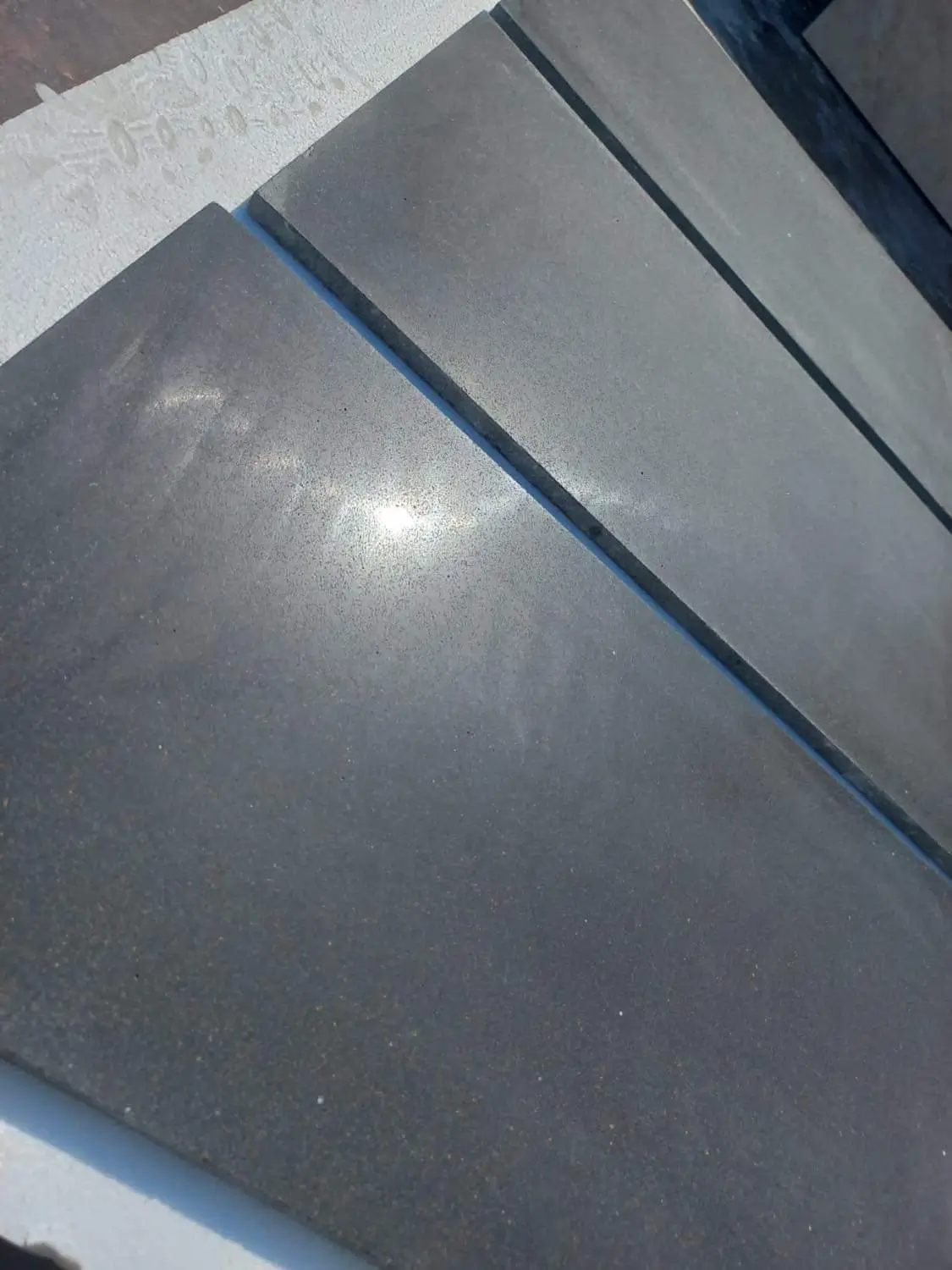
What Actually Drives 24×24 Bluestone Paver Cost in Arizona
The cost of outdoor bluestone pavers across Arizona spans a meaningful range — typically $8 to $18 per square foot for material alone, with large format 24×24 slabs sitting toward the upper portion of that range due to quarrying complexity and increased breakage risk during transport. But that material cost is only part of what you’re actually budgeting. The real number that matters is total installed cost, and in Arizona, ground preparation is where projects routinely overspend their original estimates.
Large format bluestone pricing in Arizona carries a premium for several practical reasons. Slabs cut to 24 inches square require consistent thickness tolerance — typically plus or minus 1/8 inch — to lay flat over a prepared base. If the quarry batch has inconsistent calibration, your installer spends extra time shimming individual pieces, which drives up labor cost significantly. Natural stone isn’t manufactured to exact tolerances the way concrete pavers are, so thickness variation within a pallet is normal and worth verifying before your truck delivery arrives on site.
- Material cost: $8 to $18 per square foot depending on finish (natural cleft, thermal, honed) and stone origin
- Base preparation: $3 to $6 per square foot when caliche removal or deep excavation is required
- Installation labor: $7 to $12 per square foot for large-format natural stone in Arizona markets
- Sealing (first application): $0.75 to $1.50 per square foot using penetrating silane-siloxane chemistry
- Contingency for soil surprises: add 10 to 15% when site soil conditions haven’t been confirmed by excavation
For a detailed breakdown of material tiers and what each price point includes, check out our Arizona 24×24 stone paver costs — it covers the specific sourcing variables that affect what you’ll actually pay at delivery.
Subgrade Preparation: The Step That Determines Everything
Excavation Depth Standards for Arizona Soil Types
Your excavation depth needs to account for the paver thickness, the bedding layer, and the structural base — in that order. For 1.5-inch bluestone, you’re looking at a minimum total excavation of 8 to 10 inches from finished grade in most Arizona soil conditions. That depth increases to 12 inches or more when you’re working in sandy alluvial soil, which is common along low-lying corridors in the Phoenix metro area where historic water movement deposited loose granular material with little structural cohesion.
The bedding layer for large-format natural stone should be a screeded 1-inch coarse sand or decomposed granite layer — not the typical bedding sand used under concrete pavers. Bluestone’s density and the 24×24 format mean you’re working with slabs that can weigh 35 to 50 pounds each, and a properly screeded DG bed allows for minor leveling adjustments without collapsing under that weight during placement. Natural stone patio slabs require a stiffer bedding medium than their concrete counterparts, and this is a detail that separates experienced stone installers from concrete paver crews who’ve switched materials.
Compaction Requirements: Caliche vs. Sandy Soil
Compaction targets differ substantially between soil types in Arizona. Over intact caliche, a proof roll test with a loaded truck often confirms adequate bearing capacity without supplemental compaction — the hardpan is already doing its job. Over disturbed soils or sandy fill, you’ll want to achieve 95% Proctor density in your base aggregate, which typically requires 4 to 6 passes with a plate compactor on 4-inch lifts. Skipping intermediate compaction lifts to save time is one of the most reliable paths to a failed patio in three to five years.
- Intact caliche: proof roll test with a loaded vehicle confirms bearing; minimal additional compaction needed
- Sandy soils: 6-inch compacted aggregate base minimum, 95% Proctor density, two-lift minimum
- Mixed conditions: 8-inch compacted base with geotextile fabric at the subgrade interface to prevent fines migration
- Former landscaped areas: full organic material removal before base placement — organic content causes ongoing settlement
Choosing the Right Thickness for Arizona Applications
Bluestone 24×24 in Arizona is available in 1.25-inch, 1.5-inch, and 2-inch nominal thicknesses, and the right choice depends more on your sub-base conditions than on the intended use. Here’s what most homeowners miss: a thicker slab on a poorly prepared base performs worse than a thinner slab on a well-prepared one. Thickness is a backup — base preparation is the primary structural system.
For standard residential patio applications over sound sub-base, 1.5-inch thick slabs handle point loads from patio furniture and foot traffic without flexural cracking. The 2-inch option becomes relevant when you’re installing over a base with any residual softness, or in applications where vehicle overrun is possible — a concern in Gilbert subdivisions where driveways and patio areas share tight adjacencies. The extra half-inch dramatically increases flexural strength because stone follows a cubic relationship between thickness and load-bearing capacity — a 2-inch slab is roughly 2.4 times stiffer than a 1.5-inch slab of the same material.
- 1.25-inch: appropriate only over fully rigid bases (mortar set over concrete slab); not recommended for sand-set in AZ
- 1.5-inch: standard residential patio and walkway specification over 6-inch compacted aggregate base
- 2-inch: recommended for sites with any soil uncertainty, or adjacent to driveways where vehicle edge loading is possible
Building a Realistic Natural Stone Patio Slab Budget for AZ Homeowners
A natural stone patio slab budget for AZ homeowners needs to be built from the ground up — literally. Start with your confirmed soil condition, because that determines base cost before you’ve purchased a single paver. A site over intact caliche that needs minimal base work looks very different in the budget than a sandy lot that requires 8-inch aggregate placement, geotextile fabric, and multiple compaction passes.
The Arizona bluestone paver value comparison guide that actually serves you well accounts for five cost layers: materials, base preparation, installation labor, sealing, and a soil contingency reserve. Most homeowners plan for the first three and get surprised by the fourth and fifth. At Citadel Stone, we recommend getting a soil assessment done before finalizing your material budget — not as a formal geotechnical report, but as a simple hand-excavation test at two or three spots across your planned patio footprint. That 30-minute exercise can save you $2,000 to $4,000 in unexpected base preparation costs on a mid-size patio.
When evaluating large format bluestone pricing in Arizona across competing suppliers, the comparison that matters most isn’t the per-square-foot material figure — it’s the total project cost once ground preparation, delivery, and sealing are factored in. Two bids that look similar on material cost can diverge by 20% or more once base specification differences are accounted for. Requesting an itemized base scope from each bidder gives you an apples-to-apples comparison rather than a misleading headline number.
Ordering, Warehouse Inventory, and Project Timing
Arizona’s construction activity is highly seasonal, with a significant surge in outdoor project starts between September and April as temperatures moderate. That seasonal demand pattern means warehouse inventory for premium natural stone formats can shift quickly — what’s in stock in October may be allocated by November, particularly for consistent-batch orders of 24×24 slabs where dye lot matching matters for large patios. Confirm warehouse availability at least 4 to 6 weeks before your installation date, not the week before your crew shows up.
In Yuma, delivery logistics add a practical consideration that Phoenix-area projects don’t face: truck routing to far-western Arizona adds lead time and, in some cases, a fuel surcharge that affects your delivered cost per square foot. Factor that into your budget if you’re outside the Phoenix-Tucson corridor. Citadel Stone’s warehouse inventory is updated regularly, which allows for accurate lead time estimates rather than the speculative “6 to 8 weeks” response that typically means the supplier is placing a new import order rather than pulling from existing stock.
- Confirm batch availability before finalizing installation scheduling — large patios need consistent-batch material
- Truck delivery access: verify your site has clearance for a flatbed or boom truck; narrow side yards in subdivision lots create real staging challenges
- Order 8 to 10% overage for cuts and breakage — large format stone has higher cut waste than smaller pavers
- Warehouse stock levels for 24×24 bluestone typically reflect 4 to 6 weeks of demand; plan ahead during peak season
Joint Spacing, Expansion Detailing, and Arizona’s Thermal Reality
Arizona’s temperature range — from overnight lows in the 30s at elevation to afternoon highs exceeding 115°F in Yuma-area summers — means thermal expansion isn’t just a consideration; it’s a specification requirement. Bluestone exhibits a coefficient of thermal expansion of approximately 4.5 to 5.5 × 10⁻⁶ per °F, which for a 24-inch slab translates to roughly 0.013 inches of expansion per 100°F temperature swing. That sounds small, but it adds up quickly across a 20-foot patio run, and tight-grouted joints without expansion relief will crack at the weakest point — usually your most visible slab.
The standard recommendation is 3/16-inch minimum grout joints for outdoor bluestone, but in Arizona’s temperature extremes, moving to 1/4-inch joints gives you meaningful additional thermal buffer without visually widening the joint. Place expansion joints — not grout, but genuine compressible backer material — at maximum 15-foot intervals in both directions. Relying on the grout joint network alone for expansion relief is adequate in mild climates; in Arizona, it’s a specification gamble you’ll lose within five to seven years as cumulative thermal cycling fatigues the grout bond.
What Your 24×24 Bluestone Paver Investment Delivers Long-Term
The Arizona bluestone paver value comparison guide that actually holds up over time isn’t measured in price per square foot — it’s measured in total cost over the installation’s service life. A well-prepared subgrade under properly specified 24×24 bluestone delivers 25 to 30 years of service with routine maintenance. The same material over a compromised base might need releveling within five years, and that remediation cost typically exceeds the original installation savings that led to cutting corners on ground preparation. Your soil conditions, your base depth, your joint spacing, and your sealing schedule are the four variables that separate a long-performing patio from an expensive recurring problem.
Once your selection and budget decisions are finalized, the next critical phase is getting the installation details right. How to Install 24×24 Bluestone Pavers in Arizona covers the installation sequence and field techniques that translate good material and good ground preparation into a finished result that performs as intended across Arizona’s demanding conditions. Sourced direct from quarries in Turkey, the Mediterranean, and beyond, Citadel Stone 24×24 bluestone pavers are available to homeowners in Phoenix, Peoria, and Tempe weighing long-term value for their patios.