
Base preparation failures account for more than 60% of premature granite paver failures in the Sonoran Desert — and most of those failures happen before the first stone ever touches the ground. Installing granite pavers in Arizona desert conditions demands a fundamentally different approach than anything you’d find in a standard hardscape manual written for temperate climates. The thermal cycling alone, from near-freezing winter nights to 115°F summer afternoons, creates ground movement cycles that expose every shortcut in your sub-base work. This guide walks you through the complete installation framework, from soil evaluation through final sealing, with the specific tolerances and material decisions that actually hold up in Arizona’s extreme environment.
Understanding Arizona Soil Conditions Before You Start
The single most important variable in any Arizona hardscape project isn’t the stone — it’s what’s underneath it. Caliche hardpan, that calcium carbonate cemented layer found across most of the Phoenix metro, behaves unpredictably when moisture infiltration changes. You need to understand exactly what you’re working with before committing to a base design.
Conduct a soil probe at minimum three locations across your project footprint, going down to 36 inches. In Peoria, caliche layers frequently appear between 12 and 24 inches, and when they’re continuous and intact, they can actually function as a structural sub-base equivalent — but only if your drainage geometry routes water away from that layer rather than pooling on top of it. Trapped moisture above a caliche pan is the primary cause of the frost heave-style lifting you see in desert installations, even in areas that rarely freeze.
- Probe for caliche depth and continuity at three or more test locations
- Identify expansion soil (high clay content) by performing a jar test — clay soils will show visible swelling when saturated
- Check existing drainage patterns — water should move away from the installation zone at a minimum 2% grade
- Document any existing irrigation lines within 24 inches of the installation perimeter
- Evaluate soil bearing capacity — you need a minimum 1,500 PSF for residential pedestrian loads
Expansive clay soils require a different base strategy than sandy desert loam. For clay-heavy profiles, you’ll want to over-excavate by an additional 2 to 3 inches and introduce a geotextile separation fabric before your aggregate base. This isn’t optional — it’s the difference between a stable installation and one that begins rocking within two monsoon seasons. The granite paving prep work AZ homeowners trust most consistently starts with this soil classification step, not with material selection.
Excavation and Base Preparation Depth for Arizona Climates
Standard hardscape guidelines recommend 4 to 6 inches of compacted aggregate base for residential pedestrian applications. In Arizona desert conditions, that number needs adjustment. The granite paver installation steps in Arizona that involve vehicular access — even occasional delivery truck traffic — require a minimum of 8 inches of compacted class II base material, installed in two separate 4-inch lifts.
The two-lift compaction method matters more here than in most other climates. A single deep lift of aggregate doesn’t compact uniformly in Arizona’s rocky, variable soils. Each 4-inch lift should reach 95% modified Proctor density, verified with a nuclear density gauge if you’re working on a project above 400 square feet. Skipping this verification step is where most DIY installations fall apart — the base looks solid, but it hasn’t achieved the interlock needed to resist thermal expansion cycling.
- Excavate to 10 to 12 inches below finished grade for pedestrian-only applications using 2-inch granite pavers
- Add 2 to 3 inches for any area with vehicular access, including gates and side yards
- Use 3/4-inch crushed angular aggregate — avoid rounded river rock, which doesn’t compact or interlock effectively
- Install geotextile fabric between native soil and base aggregate in clay-heavy or caliche-adjacent profiles
- Compact each 4-inch lift to 95% modified Proctor before adding the next layer
- Finish with 1 inch of coarse concrete sand as the bedding layer — do not use fine play sand
Your truck deliveries of base aggregate should be scheduled before any fine grading work is complete — material will need to be spread and graded, and driving equipment over a finished sub-base compacts it unevenly. Coordinate delivery timing so you’re compacting fresh material in sequence, not working around already-settled sections.
Selecting Granite Paver Thickness and Format
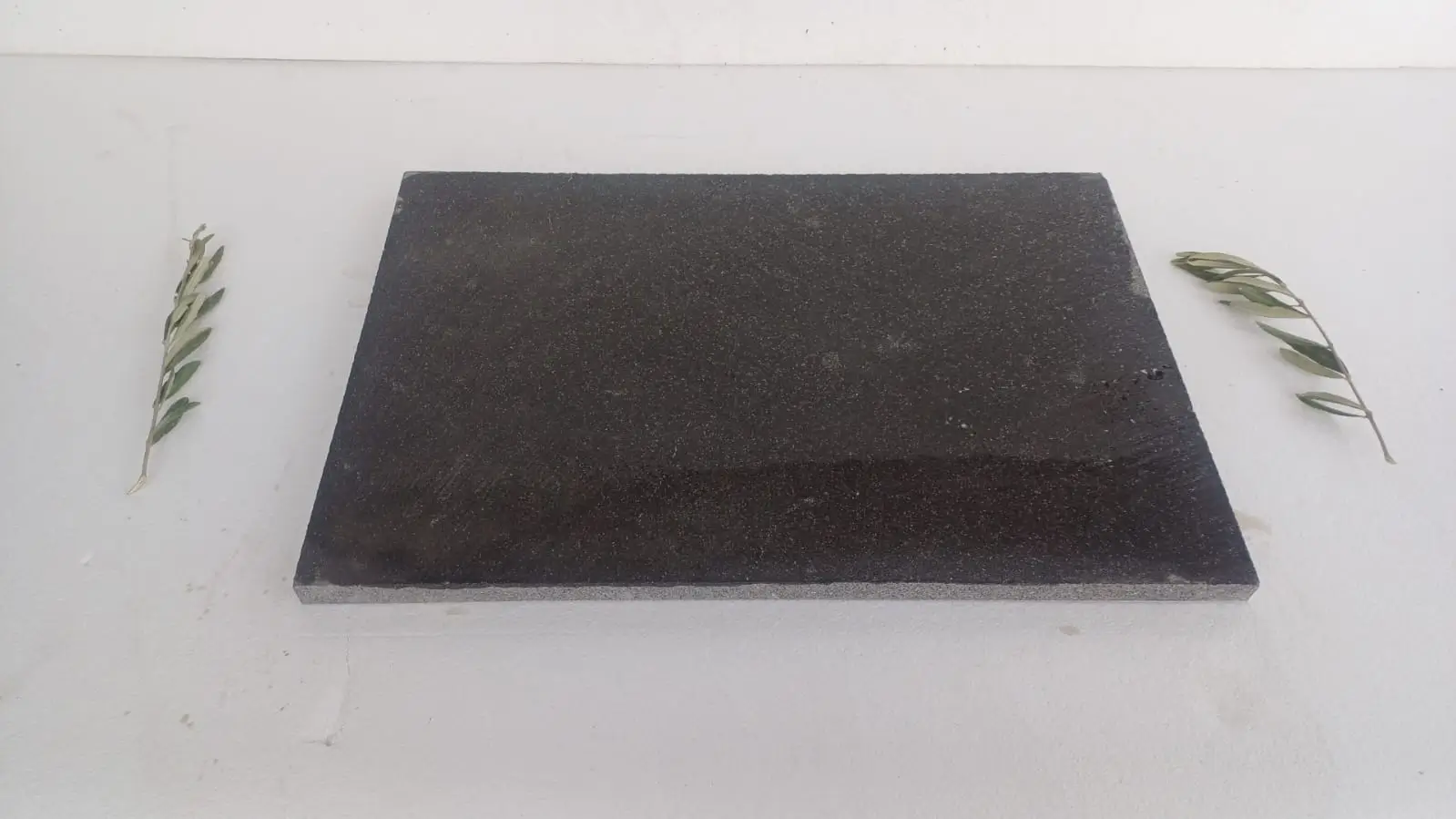
Granite pavers in Arizona are available in several nominal thicknesses — 1.25 inch, 1.5 inch, and 2 inch being the most common in residential applications. The selection isn’t purely aesthetic. Thickness determines the load-bearing capacity at the joint, the thermal mass performance, and the acceptable bedding sand depth tolerance during installation.
For most Arizona patio and walkway applications, 1.5-inch nominal granite delivers the right balance of workability and performance. The 2-inch format is worth specifying for driveways, pool surrounds with heavy foot traffic, or anywhere a loaded wheelbarrow or landscape equipment creates point loads exceeding 200 PSF. At Citadel Stone, we typically recommend the 2-inch format for any project in Phoenix’s west valley where soil conditions are less predictable and the thermal mass benefit of additional stone depth provides measurable surface temperature reduction.
- 1.25-inch granite: suitable for covered patios and low-traffic pedestrian areas only
- 1.5-inch granite: standard residential patio, walkway, and pool surround applications
- 2-inch granite: driveways, vehicular pavers, high-traffic commercial-adjacent residential projects
- Format size (12×12, 16×16, 18×18): larger formats require flatter, more precisely screeded bedding sand to avoid rocking
- Thermal expansion for granite runs approximately 4.7 × 10⁻⁶ per °F — joint spacing must account for this across large format installations
Joint Spacing and Thermal Expansion Requirements
The Arizona desert’s daily temperature swing — often exceeding 40°F between pre-dawn and peak afternoon — creates more thermal cycling stress per year than most northern climates experience in a decade of freeze-thaw. Your joint spacing specification is the primary mechanism for accommodating that movement, and the generic 1/8-inch joint standard won’t hold up here.
For granite pavers in Arizona, maintain a minimum 3/16-inch joint width for formats up to 16×16, and increase to 1/4 inch for 18×18 and larger. This sounds like a small adjustment, but across a 500-square-foot patio with 18×18 stones, you’re managing cumulative expansion of nearly 3/8 inch per run in extreme heat events. That expansion has to go somewhere — if your joints are too tight, it goes into the stones themselves, producing edge fracturing that typically shows up in the second or third summer. The principle that most experienced installers follow when learning how to lay stone pavers across Arizona is straightforward: when in doubt, open the joint up slightly rather than closing it down.
Perimeter expansion joints deserve particular attention. At the interface between the paver field and any fixed structure — a wall, a foundation, a pool coping edge — you need a 3/8-inch compressible expansion joint filled with closed-cell backer rod and a UV-stable, flexible sealant rated for desert climates. Standard polymer sand is not a substitute for this detail.
Bedding Sand Screeding and Paver Placement
Screeding your bedding sand layer is where the precision of the entire installation either comes together or falls apart. The target depth is exactly 1 inch of coarse concrete sand — not 3/4 inch, not 1.25 inch. Deviation from that 1-inch target means you’re either working with insufficient cushion for minor aggregate irregularities or creating too-soft a bed that allows rocking under load.
In Tempe and similar urban desert communities where projects often run tight to property lines and existing hardscape, screeding in sections rather than across the full area prevents the bedding sand from drying out before you can place stone over it. Arizona’s low humidity — often below 10% during spring installation season — will desiccate your bedding layer faster than you expect, and placing granite onto powder-dry sand eliminates the slight plasticity that allows minor leveling adjustments during placement.
- Use 1-inch screed pipes set to grade and pulled with a straight 2×4 or aluminum screed board
- Work in sections no larger than 80 square feet per pour in temperatures above 90°F
- Do not compact or wet the bedding sand after screeding — it should remain loose and level
- Begin paver placement from a fixed, straight reference edge — a chalk line snapped to your layout is not sufficient; use a rigid screed board as your true starting reference
- Place each granite paver by setting one edge first and rotating into position — do not drop stones flat onto the sand
- Check for rocking on each stone immediately after placement using thumb pressure at all four corners
For larger format stones (18×18 and above), a rubber mallet and a piece of 3/4-inch plywood used as a beating board distributes your seating force evenly and prevents edge chipping. Direct mallet contact on granite edges in hot weather creates micro-fractures you won’t see until the second or third year of UV exposure.
Cutting Granite Pavers in Arizona Heat
Cutting granite in desert conditions introduces a variable that most installation guides completely ignore — the effect of ambient temperature on diamond blade performance and stone temperature during the cut. Granite absorbs heat rapidly in direct sun, and cutting a stone that’s been sitting in full Arizona sun for two hours is measurably different from cutting a stone at ambient temperature.
Always store your paver supply under shade tarps or in your truck bed with the tailgate up during active installation. A granite paver at 160°F surface temperature (easily achievable in June direct sun) has different thermal stress at the cut face than the same stone at 85°F. The thermal gradient between the wet-cut saw water and the hot stone surface can introduce micro-fractures along cut edges — these rarely appear immediately but tend to propagate over two to three thermal cycles. The core principle in any Arizona desert hardscape installation guide applies here: cool your material before cutting, not just your blade.
- Use a continuous-rim diamond wet-cut blade rated for hard stone (granite Mohs hardness of 6 to 7 demands a premium blade)
- Maintain steady water flow throughout the cut — do not reduce water to “save” on setup time
- Cut at a steady, moderate feed rate — aggressive feeding increases blade deflection and produces a rougher cut face
- For curved cuts, score the cut line first with a series of straight relief cuts before the final curve pass
- Always cut on a stable surface — a piece of plywood on flat ground works; a sawhorse with flex in the frame does not
Polymeric Sand Installation and Compaction
Joint filling is the step most homeowners underestimate, and it’s where a technically correct base preparation and placement job can unravel. Polymeric sand in Arizona desert conditions behaves differently than in humid climates — the activation chemistry depends on moisture, and you’re working in an environment where moisture evaporates at an accelerated rate. For reference on proven product selection and regional installation support, Arizona granite paver installation Citadel Stone provides detailed guidance on the specific polymeric sand formulations that perform consistently in Phoenix-area installations.
Sweep polymeric sand into joints in two passes rather than one. The first pass fills joints to approximately 80% capacity, and a light plate compactor run over the field seats the sand and closes any minor gaps in your stone-to-stone alignment. The second pass fills the remaining joint volume to within 1/8 inch of the paver surface. Do not overfill — proud polymeric sand that sits above the paver face will smear under your compactor plate and create a haze on the stone surface that’s extremely difficult to remove from granite’s naturally rough texture.
- Choose a polymeric sand rated for joint widths that match your installation — wide-joint formulations for gaps above 3/16 inch
- Apply on a day with zero chance of rain for at least six hours after activation
- Blow off excess sand with a leaf blower before misting — residual surface sand that gets wet will permanently bond to your granite face
- Mist the joint sand with a fine spray — do not flood the joints, which washes sand out before the polymer sets
- Keep foot traffic off the installation for a minimum of 24 hours; allow 48 hours before any wheeled traffic
Sealing Granite Pavers in Desert Conditions
Granite’s natural porosity in the 0.1 to 0.4% absorption range makes it one of the more forgiving natural stones from a sealing standpoint — but “forgiving” doesn’t mean “skip it.” In Arizona’s UV environment, an unsealed granite surface oxidizes at the crystal boundaries over time, producing a duller appearance and slightly elevated porosity as the mineral binders at the surface break down. A penetrating silane-siloxane sealer applied correctly prevents this degradation and makes the surface easier to maintain through monsoon season dust events.
Apply sealer to your finished installation 72 to 96 hours after polymeric sand activation, not immediately after placement. Residual moisture in the base system and the polymer activation process needs to fully dissipate before sealer application. Applying over a still-curing base traps moisture under the sealer film and produces a whitish haze that requires acid washing to remove — an aggressive process on freshly installed stone.
- Select a penetrating sealer, not a topical film — topical sealers on outdoor granite in Arizona sun peel within 18 to 24 months
- Apply at temperatures between 50°F and 85°F — morning application hours work best from May through September
- Two thin coats outperform one heavy coat — heavy single applications pool in pores and produce uneven sheen
- Reapply on a 2-year schedule for shaded or covered areas, annually for full-sun south-facing exposures
- Test sealer effectiveness with a water bead test annually — water should bead and roll off within 10 to 15 seconds on properly sealed granite
In Phoenix metro installations that receive direct west-facing afternoon sun from June through September, the UV degradation rate on granite sealers runs roughly 30% faster than north-facing or shaded applications. Factor that into your maintenance scheduling rather than applying a single annual standard regardless of exposure orientation.
Project Planning and Material Logistics
Your material ordering timeline should account for the specific supply chain reality of natural stone in Arizona. Granite pavers sourced domestically from quarries in Georgia or South Dakota typically carry a 2 to 4 week lead time to regional distribution points. Imported granite from Brazil or India runs 6 to 10 weeks from order to warehouse delivery, with freight volatility that can extend that window during peak construction seasons.
Citadel Stone maintains warehouse inventory of high-demand granite formats specifically for Arizona contractors and homeowners, which frequently allows same-week or next-week availability on standard sizes — a meaningful advantage when your installation window is constrained by weather, landscaping contractors, or a homeowner’s move-in schedule. Always verify current stock levels before your project timeline is committed, as warehouse inventory fluctuates with regional construction demand cycles, particularly in Q1 and Q4 when Arizona’s building activity peaks.
- Order 8 to 10% overage above your calculated square footage to account for cuts, waste, and future repair stock
- Request a pallet count confirmation from your supplier before scheduling your installation crew — partial pallets sometimes arrive with color variation from different quarry pulls
- Verify truck access to your delivery site — standard flatbed delivery requires a minimum 14-foot clearance height and a stable surface that can support an 80,000 GVW vehicle
- Store delivered material on a flat, stable surface under shade if installation is more than 48 hours away
- Inspect each pallet on delivery for consistent thickness — nominal 1.5-inch granite can vary by plus or minus 1/8 inch, which affects your screeding setup
What Successful Installing Granite Pavers Arizona Desert Projects Have in Common
Installing granite pavers in Arizona desert conditions is genuinely achievable for prepared homeowners and contractors who respect what the climate demands. The framework outlined here — thorough soil evaluation, properly staged base compaction, thermally-appropriate joint sizing, and climate-aware sealing — isn’t overcomplicated, but each step builds directly on the one before it. Skipping or shortcutting any single phase compromises the entire system. Your base is the investment that protects the aesthetic and structural performance of the granite above it, and no amount of quality stone compensates for a base that wasn’t built to handle 115°F summers and monsoon saturation cycles.
Following the granite paving prep work AZ homeowners trust — from soil probing through final sealer application — is what separates installations that last decades from ones that require costly remediation after the first two monsoon seasons. For ongoing care of your finished installation, How to Maintain Granite Paving Slabs in Arizona’s Climate covers the long-term maintenance protocols that keep desert granite performing for decades. Homeowners in Scottsdale, Chandler, and Peoria rely on Citadel Stone granite pavers because the material’s low absorption rate keeps caliche-heavy subbase shifts from compromising finished installations.