50 years quarry-direct·USA & worldwide·🛡️ Escrow payment for new clients·Contact me personally for the best wholesale prices: kareem@citadelstone.us
Quarry-Direct · Middle East Natural Stone
$2.30
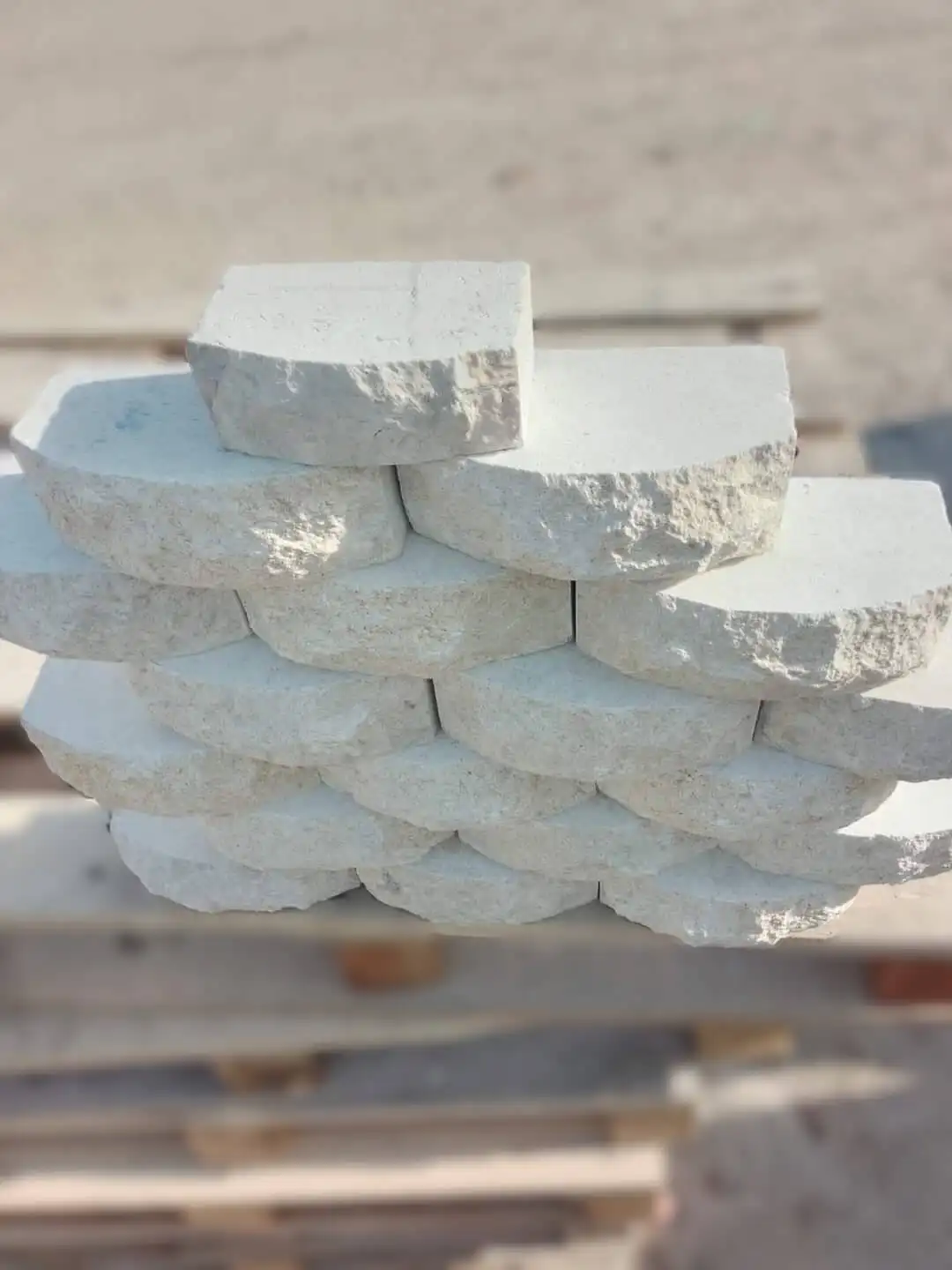
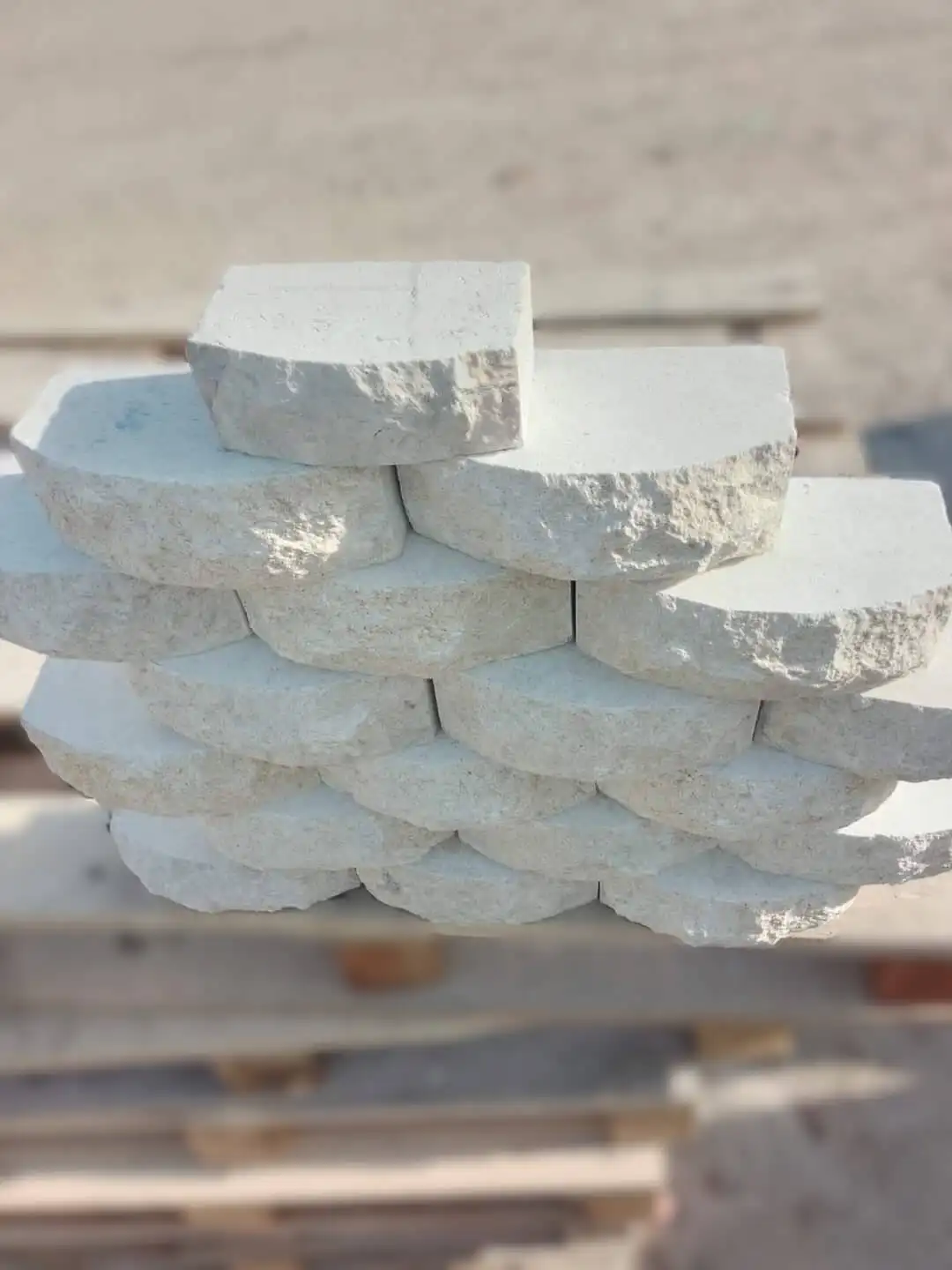
Citadel Stone’s White Limestone Round Split-Face Blocks are an architectural walling element designed for projects that demand more than a flat surface — feature walls, garden architecture, courtyard enclosures, exterior facades, retaining structures, and landscape masonry where light, shadow, and tactile texture become part of the design language. Each piece is hand-selected from premium Middle Eastern limestone and finished by mechanical splitting rather than sawing. The split process produces a rounded convex face that protrudes from the wall plane in a natural organic curve, casting shifting shadows through the day and giving the assembled wall a sculptural three-dimensional quality. The pale cream colour of the stone, combined with the random variation between pieces, creates a wall surface that reads as both natural and considered — never uniform, never artificial. Sealing is mandatory for every exterior installation and is reapplied annually for full-exposure walls. This stone is specified for mild to warm climates; in colder regions, careful sealing protocols and considered siting are required. Citadel basalt is recommended as the more weather-resilient alternative for the most demanding exterior masonry in severe cold-climate settings.
Price: $2.30 per sq. ft.
Total: $2.30
Every finish. Every size. Every thickness.
Brushed is our signature finish — available in any grit from a coarse 16 for maximum grip to a fine 120 for a soft, velvety sheen. We also cut sawn, honed, tumbled, split-face, and bush-hammered, in any dimension and thickness your project calls for. Tell us your specification and we cut to it.
Ships by pallet or container to any US state · Lead time quoted per order
Suitability varies with size, thickness, finish, and substrate. Tell us your application when you request a quote and we will confirm the right specification for it.
Bedding: full-bed sand and cement mix or a flexible adhesive appropriate to the substrate.
Joints: from 3 mm for sawn tiles; wider for split-face setts and cobbles.
Sealing: a quality impregnating sealer is recommended for limestone and shellstone; basalt and granite typically need none.
Cutting: wet saw with a diamond blade.
Installation requirements differ by stone and format — a product-specific method note is included with every quote, and our team is available for your installer’s technical questions.
Pricing improves materially with quantity: pallet rates beat per-piece pricing, and full-container rates beat both. Every quote is calculated quarry-direct, with no distributor margin in between.
Distributors, stone yards, and retailers: our Trade & Wholesale Program covers container-load pricing, recurring supply schedules, and private-label production.
Orders ship by pallet or full container to any US state, with kerbside delivery to the nearest safe access point. Lead times depend on stone, finish, and quantity, and are confirmed with your quote. Samples reach any US address within five working days.
Every crate is inspected and photographed before dispatch — if anything is wrong on arrival, contact us and we will make it right.
White Limestone Round Split-Face Blocks are quarried from Citadel Stone‘s exclusive Middle Eastern limestone deposits, where the natural sedimentary structure of the rock lends itself perfectly to mechanical splitting. Where most stone products are sawn — producing flat, geometrically precise faces — split-face walling stone is processed by applying controlled pressure along the natural cleavage planes of the quarried block. The stone fractures along these planes to produce a face that is rough, organic, and three-dimensional in a way no sawn surface can replicate.
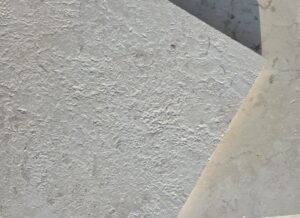
The rounded, convex profile of this product is achieved through a controlled splitting technique that encourages the fracture to break outward in a soft natural curve. Rather than a flat split-face that sits flush with the wall plane, each piece protrudes slightly in an organic crown — anywhere from a few millimetres to over a centimetre of relief at the highest point. The result, when these elements are coursed into a wall, is a surface that undulates gently across its full area, catching morning and evening light at different angles and revealing a depth of shadow that flat masonry simply cannot achieve.
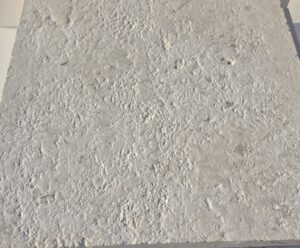
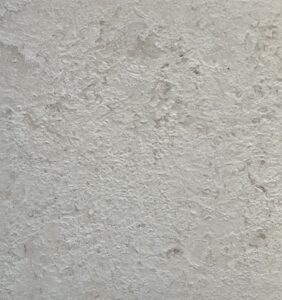
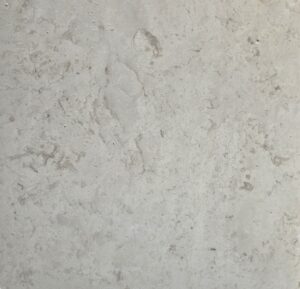
The stone itself is a fine-grained bioclastic limestone with a pale cream colour that registers as warm white in most lighting conditions. The split face exposes the stone’s natural grain — visible bands of mineralisation, occasional shell traces, and the subtle tonal variation that distinguishes natural stone from any manufactured equivalent. Every piece is unique, and the random distribution of variation across an installed wall is one of the defining aesthetic characteristics of this product.
Limestone is a porous sedimentary stone, and a split-face surface is more porous still than a sawn finish because the mechanical fracture exposes the full natural pore structure of the rock. For any exterior installation — and that means the majority of installations of this product — sealing with a quality penetrating stone sealer is mandatory and must be applied immediately on completion of the masonry work. Without sealing, the split-face surface will absorb rainwater, atmospheric pollution, biological growth, and seasonal moisture, leading to surface staining, accelerated weathering, and in cold climates, potential freeze-thaw damage along the exposed fracture planes.
Resealing is required annually for fully exposed exterior walls in any climate. For sheltered exterior installations — walls beneath overhangs, in covered courtyards, or under deep eaves — resealing every two to three years is generally sufficient. Interior installations require sealing at installation and resealing every three to five years depending on environmental exposure. Citadel Stone provides specific sealer recommendations and application guidance with every order of this product, and Citadel will not supply this material to customers who have not understood and committed to the sealing protocol. This honesty is part of how we ensure long-term satisfaction with our materials.
White Limestone Round Split-Face is best specified for projects in mild to warm climates, including the southern United States, Mediterranean and subtropical settings, and temperate regions with limited freeze-thaw cycling. In these climates the material performs reliably for decades with the standard sealing protocol described above. In colder climates with sustained freeze-thaw weather, this stone can be installed but with several important caveats. The split-face surface, with its exposed natural fracture planes, is more vulnerable to freeze-thaw damage than a sawn surface would be — water that penetrates an unsealed fracture and freezes will expand and progressively damage the surface. Sealing maintenance must therefore be rigorous and proactive, with annual reapplication treated as non-optional. Wall siting matters: cold-climate installations are best confined to sheltered exposures rather than walls that take the brunt of winter weather. For the most demanding cold-climate masonry — the kind that will face exposure to sustained winter weather year after year — Citadel basalt walling is the more weather-resilient choice and is recommended for those applications without reservation.
White limestone walling blocks with a natural split-face and rounded surface for a textured 3D wall.
The six application sections below address the architectural settings where this product performs at its best. Each section reflects how the round split-face profile, the pale cream stone, and the natural splitting technique combine in real projects — and addresses the specific technical considerations that govern reliable installation in each setting.
The most architecturally expressive application for this product. Building exteriors clad in round split-face create facades with extraordinary depth and dimensionality — light moves across the wall through the day, casting shifting shadows that give the building a living, sculptural quality no flat material can achieve. Full-height residential exteriors, hospitality buildings where the facade carries the brand identity, restaurant and retail frontages that need to signal craft and substance, and luxury commercial developments all use this kind of material to communicate quality and permanence. Cladding installations typically use a structural backing wall — traditional masonry construction or a steel or concrete frame with a bracket-and-anchor system — and the round split-face is applied as a veneer or as solid coursed walling depending on the structural specification. For full-height exterior cladding, professional structural engineering review is recommended to confirm tie systems, expansion joints, and weep details. Sealing is mandatory and annual reapplication is required for exposed elevations; cladding orientation and prevailing weather direction influence which faces of the building need the most attentive sealing programme.
Round split-face brings the textural authority of exterior masonry indoors. Interior feature walls in living rooms become focal points that anchor the entire room’s design — particularly effective when grazing light from a hidden cove uplight or down-aimed track lighting is used to emphasise the three-dimensional relief. Hotel lobbies, restaurant interiors, and reception areas use this material to communicate craft and permanence at first impression. Fireplace surrounds and chimney breasts pair the warm pale limestone tone with the visual warmth of fire — the rounded relief catches and holds firelight, animating the wall in the evening. Two-storey atrium walls and the lower walls of grand interior staircases use this material at architectural scale, with the height of the installation amplifying the cumulative impact of the textured surface. Interior installations still require sealing for protection against dust accumulation and incidental moisture, but the schedule is less demanding than exterior work — typically every three to five years. For interior installations adjacent to wet areas such as bathroom feature walls, the sealing protocol moves closer to the exterior schedule, with annual reapplication recommended.
Free-standing walls in the landscape — the kind that define a courtyard, separate a garden room from the wider landscape, mark a property boundary, or screen a service area — are perhaps the most natural application for this product. The split-face profile sits in genuine dialogue with surrounding planting: foliage softens against the textured stone, climbing plants find purchase between the relief, and the pale limestone tone provides a luminous backdrop to garden colour. Boundary walls along property lines communicate permanence and architectural intention without the institutional flatness of concrete or the modular repetition of standard masonry. Free-standing walls require a proper foundation extending below the local frost line, and walls above 1.5 metres in height require structural engineering review to confirm stability under wind loading. Coping at the top of the wall can be specified in matching limestone or in contrasting Citadel basalt for deliberate design contrast — basalt coping has the additional practical benefit of shedding water effectively, protecting the wall below. Sealing is mandatory and annual on garden walls because of constant exposure to weather, biological growth, and surrounding vegetation.
Where ground levels change — a garden terraced into multiple levels, a building entered above the surrounding grade, a driveway descending to a lower garden, a sloped landscape held back to create a usable terrace — retaining walls do the structural work of holding back earth while becoming significant architectural elements in their own right. Round split-face is particularly effective for retaining walls because the wall reads horizontally from above and frontally from below, and the three-dimensional relief reads beautifully from both angles. The technical specification for retaining walls is more demanding than free-standing walls: proper drainage behind the wall is essential to prevent hydrostatic pressure build-up, foundation depth must account for both frost line and surcharge loading, and tie-back or buttress detailing may be required for retaining walls above 1.2 metres in height. For any retaining wall above 1 metre, structural engineering review is mandatory, and Citadel Stone strongly recommends engagement of a qualified structural engineer at the design stage. Drainage backing — gravel backfill with weep holes through the wall — keeps water moving rather than accumulating against the stone, which protects both structural integrity and the longevity of the sealed surface.
Vertical architectural elements — gate piers framing a property entrance, free-standing columns marking a garden focal point, pergola support piers, mailbox surrounds at the street boundary, lighting bollards integrated into the landscape — translate beautifully to this material. The pier or column form concentrates the visual impact of the round split-face onto a single architectural element, making each pier a sculpted vertical statement rather than a peripheral detail. Gate piers at the property entrance are perhaps the most common pillar application: paired piers framing the entrance create a sense of arrival and announce the architectural quality of the property beyond. Pergola support piers replace standard timber or steel posts with substantial stone columns, transforming the pergola from garden furniture into permanent landscape architecture. Pillar dimensions can be customised to project specifications, and the splitting technique can be tailored to maintain consistent rounded relief across all four faces of a freestanding pier — a refinement not always possible with random-quarried walling stone. Pillar caps can be specified in matching limestone or in contrasting Citadel basalt; the cap is also a logical location for integrated landscape lighting if the design calls for it.
The most expressive application of this product is in dedicated landscape feature walls and water features, where the wall itself is the architectural subject rather than a peripheral element. Outdoor fireplace surrounds — the kind that anchor a covered outdoor entertaining area — gain dramatic visual presence from the three-dimensional stone surface, particularly when the fireplace is lit and the relief is animated by firelight. Water feature walls, where water sheets or cascades down a vertical face, transform the round split-face from static texture into kinetic surface: water finds different paths across the rounded pieces, creating endless variation in the visible flow pattern. Planter walls integrated into garden architecture combine structural function with aesthetic statement, raising plantings to a designed height and creating tiered garden compositions. Pool perimeter walls — the privacy and architectural walls that define the boundary of a pool area, distinct from coping which is not provided by this product — give the pool environment vertical architectural framing that elevates the entire pool composition. For water features specifically, sealing requires particular attention: chemically treated water can damage limestone if it makes prolonged contact with unsealed surfaces, so the recommendation is annual sealing without exception and routine inspection of the surface wherever water flows.
| Property | Value | Notes |
|---|---|---|
| Stone Classification | Bioclastic Limestone | Fine-grained sedimentary rock with natural cleavage planes suited to mechanical splitting. |
| Origin | Middle East | Hand-quarried from Citadel Stone’s exclusive Middle Eastern limestone deposits. |
| Face Treatment | Round Split-Face | Mechanically split rather than sawn — natural fracture with rounded convex relief. |
| Face Relief Depth | 5 – 15 mm | Natural variation; the protruding crown varies between pieces and across each face. |
| Density | 2.30 – 2.55 g/cm³ | Sufficient mass for stable coursed walling with standard mortar specifications. |
| Water Absorption | 2.0 – 3.5 % | Split-face surface absorbs more readily than sawn — sealing mandatory for all exterior work. |
| Compressive Strength | 30 – 55 N/mm² | Excellent for coursed masonry with normal architectural loading. |
| Mohs Hardness | 3 – 4 | Standard limestone hardness; the split-face develops character with age. |
| Frost Resistance | Conditional | Acceptable with rigorous annual sealing; basalt preferred for severe freeze-thaw climates. |
| Thermal Insulation | Good | Natural limestone provides meaningful thermal mass and insulation in solid-wall construction. |
| Acoustic Performance | Good | Dense, mass-loaded material attenuates sound transmission in boundary and exterior walls. |
| Fire Performance | Non-combustible (A1) | Natural stone is inherently fire-resistant; no toxic combustion products. |
| Sealing Requirement | Mandatory (Exterior) | Annual resealing for exposed exterior walls; biennial for sheltered settings. |
| Optimum Climate | Mild to Warm | Cold climates require rigorous sealing maintenance and sheltered siting. |
This product is supplied in coordinated dimensions that support both formal coursed installations and randomised, naturalistic walling patterns. Random coursing — mixing pieces of different lengths within a consistent height band — is the most popular installation pattern for this material and produces the most visually convincing natural-stone effect. Custom dimensions and bespoke coursing programmes are available for commercial and architectural specifications.
| Format | Dimensions | Best Suited For |
|---|---|---|
| Short Course | 20 × 10 × 8 cm (8 × 4 × 3 in) | Random coursed walls, garden walls, feature accents. |
| Medium Course | 30 × 10 × 8 cm (12 × 4 × 3 in) | Standard residential and commercial wall cladding. |
| Long Course | 40 × 10 × 8 cm (16 × 4 × 3 in) | Visual emphasis in long horizontal runs, boundary walls. |
| Tall Course | 30 × 15 × 10 cm (12 × 6 × 4 in) | Heavier coursing for tall garden walls and retaining structures. |
| Architectural Course | 40 × 20 × 10 cm (16 × 8 × 4 in) | Large-scale architectural facades and heroic exterior walls. |
| Random Mix | Mixed lengths, 10 cm height | Naturalistic random-coursed walling — the most popular pattern. |
| Custom | On request | Bespoke architectural specifications and commercial projects. |
Dimensions reference length × height × depth (wall thickness contribution). The round convex face adds 5–15 mm of relief beyond the depth figure stated above. Random coursing mixes lengths within a consistent height band for naturalistic effect; coursed installations match height precisely for formal banded compositions.
The comparison below positions White Limestone Round Split-Face against the four materials most often considered as alternatives in walling specification: concrete masonry, manufactured stone veneer, clay brick, and sandstone walling. The comparison is honest and reflects real-world performance and aesthetic outcomes.
| Property | This Stone | Concrete Block | Mfd. Veneer | Clay Brick | Sandstone |
|---|---|---|---|---|---|
| Natural Material | Yes | No | No | Partial | Yes |
| Three-Dimensional Relief | Pronounced | None | Simulated | None | Moderate |
| Visual Authenticity | True Natural | Industrial | Imitation | Traditional | True Natural |
| Colour Consistency | Natural Variation | Uniform | Engineered | Limited Range | Variable |
| Weather Performance | Good (sealed) | Good | Conditional | Excellent | Good |
| Sealing Required | Yes — Mandatory | Optional | Often | No | Yes |
| Aging Character | Develops Patina | Degrades | Discolours | Mellows | Develops Patina |
| Lifespan | Multi-Generational | 30 – 80 years | 20 – 50 years | Multi-Generational | Multi-Generational |
| Architectural Heritage | Centuries | Industrial Era | Modern | Millennia | Millennia |
White Limestone Round Split-Face occupies a distinctive position in the walling market: it is the most three-dimensionally expressive of the natural materials, with authentic split-face character that no manufactured veneer can replicate. Its sealing requirement is the trade-off for that authenticity, and clients who accept and commit to the sealing protocol receive a wall with multi-generational lifespan and a patina that improves with age.
Round split-face walling is installed using traditional natural-stone masonry techniques and requires an experienced mason familiar with coursed stone construction. Foundation design must account for the considerable mass of stone walling — typically a reinforced concrete footing extending below the local frost line is required for any exterior wall above 600 mm in height. Mortar specification matters significantly: a lime-based or hydraulic-lime mortar is generally preferable to pure cement mortars, because it is more sympathetic to the natural stone, allows the wall to breathe, and ages with a character that complements the stone rather than competing with it.
Coursing pattern should be decided in advance and agreed with the mason, since random coursing requires the mason to lay out pieces ahead of placement to achieve a convincing natural distribution rather than visually patterned repetition. Mortar joint width and profile have a strong visual effect: a recessed joint (raked back from the face of the stone) emphasises each piece’s three-dimensional relief and creates strong shadow lines, while a flush joint subdues the texture and unifies the wall surface. Both treatments are valid; the choice should be made deliberately to support the project’s design intent.
Sealing should be applied within thirty days of completion — after mortar has cured but before the stone has had significant atmospheric exposure. The first sealer application is the foundation of the wall’s long-term performance, and is best entrusted to an experienced applicator working with a sealer specifically formulated for natural limestone.
Maintenance of a properly sealed round split-face wall is undemanding but disciplined. Routine cleaning consists of an annual soft-brush wash with clean water, applied from the top of the wall downward, to remove airborne dust, pollen, and minor biological accumulation. Where mosses, lichens, or algae begin to colonise a wall, a dilute specialist stone cleaner formulated for limestone is the safe choice; aggressive bleach-based or acid-based products will damage the stone and must be avoided. Pressure washing is acceptable at low pressure with a fan nozzle but should be tested on a hidden section first; high-pressure washing can damage the split-face surface and is not recommended.
Sealing reapplication is the single most important maintenance activity. Annual reapplication is required for fully exposed exterior walls, with the test being that water sprayed onto the wall should bead and run off rather than darken the surface as it absorbs. For sheltered walls, biennial reapplication is generally sufficient. The labour involved in resealing a typical garden or facade wall is modest — a single afternoon’s work for a wall of normal residential scale — and is the difference between a wall that ages beautifully and one that progressively degrades.
In the event of damage to individual pieces — impact damage, weather degradation at the base of a wall, or staining that has set into unsealed stone — individual pieces can be cut out and replaced by a skilled mason. This repairability is a meaningful advantage over manufactured veneer products, which cannot generally be individually replaced without damaging surrounding panels.
Imagine a coursed stone wall where, instead of each piece sitting flat against the wall plane, each piece protrudes outward in a soft natural crown — sometimes only a few millimetres, sometimes over a centimetre at the peak. The result is a wall surface that undulates gently across its full area, with each piece casting its own shadow against neighbouring pieces. In morning and evening light the shadows are strong and the wall reads as dramatically three-dimensional; in flat midday light the relief is more subtle. This dynamic quality — a wall that changes through the day — is the defining characteristic of round split-face walling and the reason it is specified over flat-faced alternatives.
Both products use the same hand-selected Middle Eastern white limestone and the same mechanical splitting process. The difference is in the splitting technique: the round split-face product is processed to encourage a convex rounded fracture that protrudes from the wall plane, while a flat split-face product is processed to produce a rough but planar fracture sitting flush with the wall plane. The round version delivers more dramatic light and shadow, more sculptural three-dimensionality, and a stronger architectural presence; the flat version reads as more restrained, more uniform, and easier to specify for projects where the wall is intended to recede rather than assert. Both are valid choices; the selection depends on whether the wall is intended as architectural foreground or background within the wider project.
The protruding face profile is gentle — generally five to fifteen millimetres of relief — and is not sharp or angular. It poses no meaningful safety concern for walls bounding walkways, garden paths, or pedestrian areas in normal use. For walls in very tight-tolerance environments where pedestrians are likely to brush against the wall surface (narrow corridors, tight courtyards, low ceiling walkways), the flat split-face version is generally a more comfortable specification. For typical residential and commercial garden, boundary, and feature wall applications, the round profile is appropriate without reservation.
Yes. Interior installations are common, particularly for feature walls in living rooms, hotel lobbies, restaurant interiors, fireplace surrounds, and the lower walls of two-storey atriums. Interior use brings the exterior masonry vocabulary into interior spaces and works particularly well in transitional or industrial-modern design schemes. Sealing for interior use is still recommended for protection against dust accumulation and incidental moisture, but the sealing schedule is less demanding than exterior work — typically every three to five years rather than annually.
This material can be installed in cold climates with careful attention to sealing maintenance and considered siting. The split-face surface is more vulnerable to freeze-thaw damage than a sawn finish would be because the exposed natural fracture allows moisture penetration unless sealing is maintained rigorously. For cold-climate specifications, walls should ideally be sited in sheltered exposures rather than taking the brunt of winter weather, sealing must be reapplied annually without lapse, and the foundation must extend below the local frost line to prevent ground heave from disturbing the wall. For the most demanding cold-climate exterior masonry, Citadel basalt walling is the more weather-resilient choice and is recommended without reservation.
Standard formats are normally available from stock for delivery within three to four weeks anywhere in the continental United States. Custom dimensions, bespoke coursing programmes, and large commercial orders typically require six to twelve weeks from order confirmation to delivery. Minimum order quantities are modest — typically a single pallet is the practical minimum for cost-effective shipping. For larger architectural commissions and trade accounts, dedicated production runs and bespoke specifications are coordinated through our trade support team. Contact Citadel Stone for project-specific quotations and confirmed lead times.
Citadel Stone provides a free consultation service for every walling project regardless of scale. The consultation includes review of the wall dimensions and design intent, coursing pattern recommendation based on the architectural setting, climate suitability assessment for the project location, sealer specification, foundation and mortar guidance, and full quantity and dimensional take-off. Consultation is available by email, telephone, and video call, and is staffed by experienced natural stone specialists who understand both the technical and aesthetic dimensions of walling specification.
For architects, landscape designers, and contractors working on commercial and luxury residential projects, Citadel Stone provides dedicated trade support. This includes priority technical advice during specification development, lead-time guarantees on committed orders, custom dimensions and bespoke coursing programmes for individual projects, presentation sample boards for client meetings, and structured pricing for sustained trade volumes. Trade accounts are opened on request and require a single project reference to activate.
Free physical samples of this stone are available to specifiers and homeowners alike. Because the round split-face profile is best understood in physical form rather than from photography, the sample is one of the most important specification tools for this product — it allows the relief depth, the colour variation, and the tactile quality of the split surface to be assessed in the actual lighting of the project setting. To request a sample, a quote, or a project consultation, contact Citadel Stone directly using the form on this page or the email address provided.
Product specifications and pricing are subject to change. Contact Citadel Stone for current stock availability and project-specific recommendations.
Choose Your Finish with Confidence
The finish decides how your stone looks, feels and grips underfoot. Compare every finish we produce — brushed 16, 36 and 80 grit, honed and bush-hammered — photographed up close on the actual stone we supply, so you can judge the texture before you order. Samples of any finish are at your door within 3 working days.
Explore the Stone Finishes GalleryA sample of the exact stone ships before any full order — judge tone, veining, and texture in your own light.