
Why 600×600 Format Drives Arizona Design Decisions
Choosing the right 600×600 paver stone types in Arizona does more than fill a footprint — it defines the visual language of your entire outdoor space. Designers working on desert-modern homes in the East Valley have long understood that the large format creates a canvas, and the stone type determines whether that canvas reads as warm and organic or cool and architectural. The format is fixed at 600x600mm; what shifts dramatically is how each material interacts with the surrounding landscape, the home’s palette, and the regional design vocabulary Arizona has developed over decades.
This comparison cuts across five primary material categories: natural travertine, limestone, basalt, sandstone, and porcelain. Each brings a distinct aesthetic signature that either amplifies or conflicts with the desert Southwest design idiom — and that alignment (or tension) should be your first filter before you even open a specification sheet.
Travertine and the Desert Aesthetic: A Natural Partnership
Travertine’s warm ivory, walnut, and gold tones map directly onto the earth tones that define Sonoran Desert architecture. The material’s cross-cut veining and naturally occurring voids give it a textural complexity that holds its own against ornamental grasses, agave clusters, and desert willow — plant palettes that dominate Arizona xeriscaping. In Chandler, where newer developments blend stucco exteriors with desert-native landscaping, travertine at 600×600 creates a visual continuity between the home’s warm façade tones and the ground plane.
- Travertine cross-cut finish reads as formal enough for entry courtyards while staying organic enough for naturalistic pool decks
- Vein-cut travertine introduces horizontal banding that visually elongates rectangular patios in traditional Southwest layouts
- Filled and honed travertine suits modern minimalist desert homes where consistent surface texture matters
- Unfilled travertine amplifies the rustic colonial aesthetic common in older Chandler and Gilbert neighborhoods
From a technical standpoint, travertine’s porosity in the 3–7% range means you’ll need a penetrating sealer applied every 18–24 months under Arizona UV exposure — but that maintenance cycle is well understood and manageable compared to what most homeowners assume.
Limestone for Modern Minimalist and Spanish Colonial Styles
Limestone occupies a fascinating middle ground in the Arizona design spectrum. Its muted grey-beige and cream tones suit the clean geometry of contemporary desert architecture — think flat rooflines, cantilevered shade structures, and minimalist planting beds. But the same material scaled to 600×600 slabs works equally well in Spanish colonial courtyards where antique-finish limestone picks up the aged plaster and terracotta palette that’s been a part of Arizona residential design since the territorial period.
The finish choice is where your design intent really gets locked in. A brushed limestone at 600×600 delivers a slightly roughened surface that catches light softly, creating warmth in a courtyard setting. A honed or sawn finish on the same stone reads crisper, more architectural, and pairs naturally with the clean-lined desert-modern homes that have dominated new builds in Mesa and Gilbert over the past decade. For projects comparing natural stone versus porcelain 600×600 in AZ, limestone typically wins the authenticity argument for clients invested in the regional design tradition — its material variation and natural character are simply not replicated convincingly in porcelain at this scale.
- Cream limestone at 600×600 integrates with white or warm-grey stucco without competing for visual attention
- Grey limestone in sawn finish supports the palette of contemporary desert-modern architecture
- Antique or tumbled limestone edges pair with traditional Spanish colonial gate pillars and raised planters
- Limestone’s lower thermal mass compared to basalt makes it more comfortable underfoot in fully sun-exposed Arizona patios
Basalt: Contrast, Drama, and Tropical Crossover
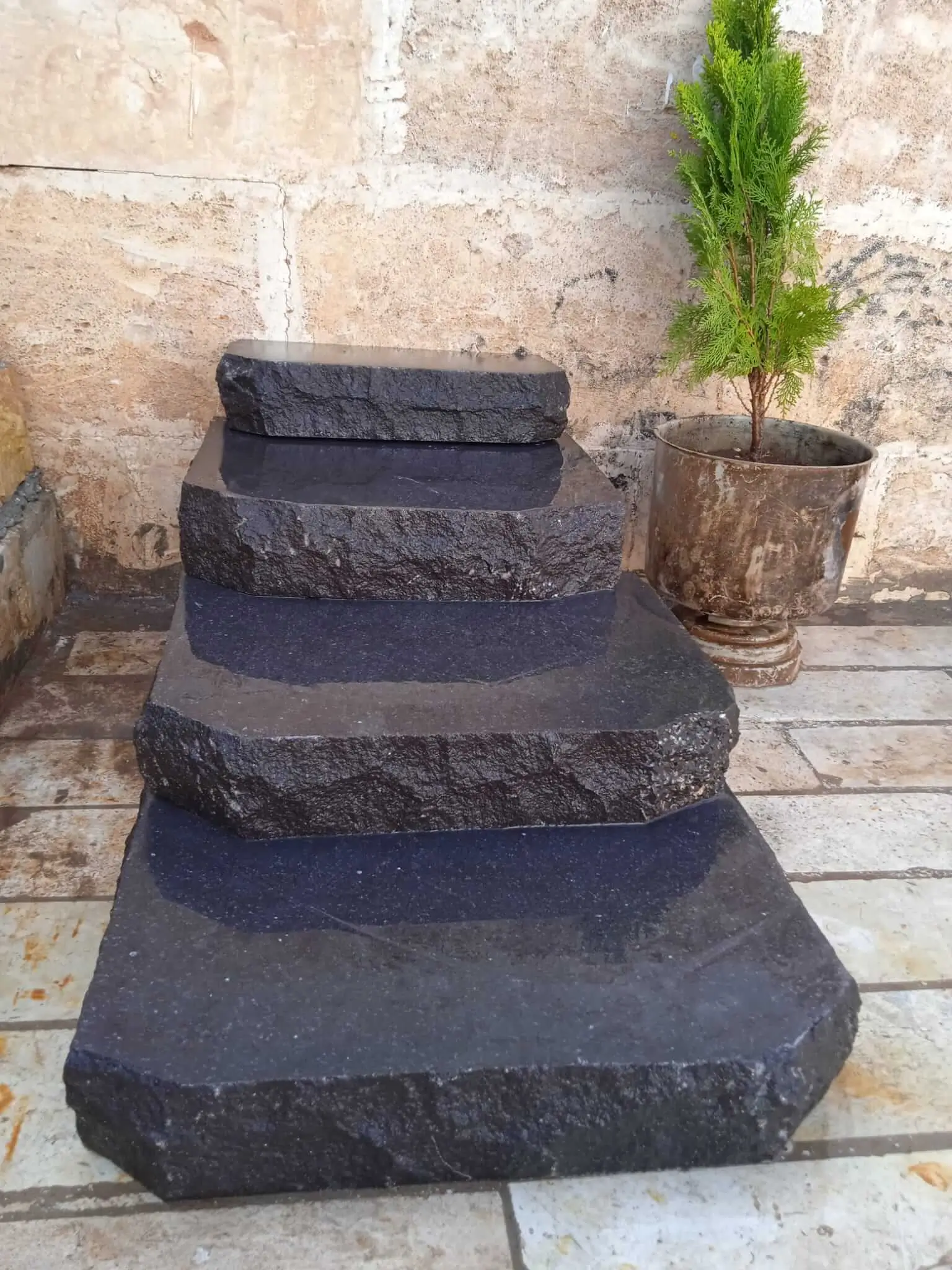
Basalt is the outlier in the Arizona stone conversation, and deliberately so. Its dark charcoal to near-black tones create a strong visual contrast against tan gravel, white aggregate, and the light-coloured stucco that covers the majority of Arizona homes. That contrast is exactly what landscape designers reach for when they want to define zones, create drama around a pool perimeter, or anchor a planting bed with a strong material statement.
Projects in Gilbert that incorporate tropical planting — bird of paradise, pygmy date palm, lantana — frequently specify basalt 600×600 pavers because the material bridges the gap between desert and tropical design idioms. The dark, fine-grained surface reads as sophisticated and contemporary, and it pairs exceptionally well with stainless steel, concrete, and glass elements in high-end outdoor living designs. Thermally, you’ll need to address surface heat: basalt at peak Arizona summer sun will reach surface temperatures that require careful placement relative to bare-foot traffic zones, so shade coverage and positioning matter more with this material than with lighter alternatives.
- Basalt 600×600 creates strong material contrast in desert xeriscaping, particularly around water features
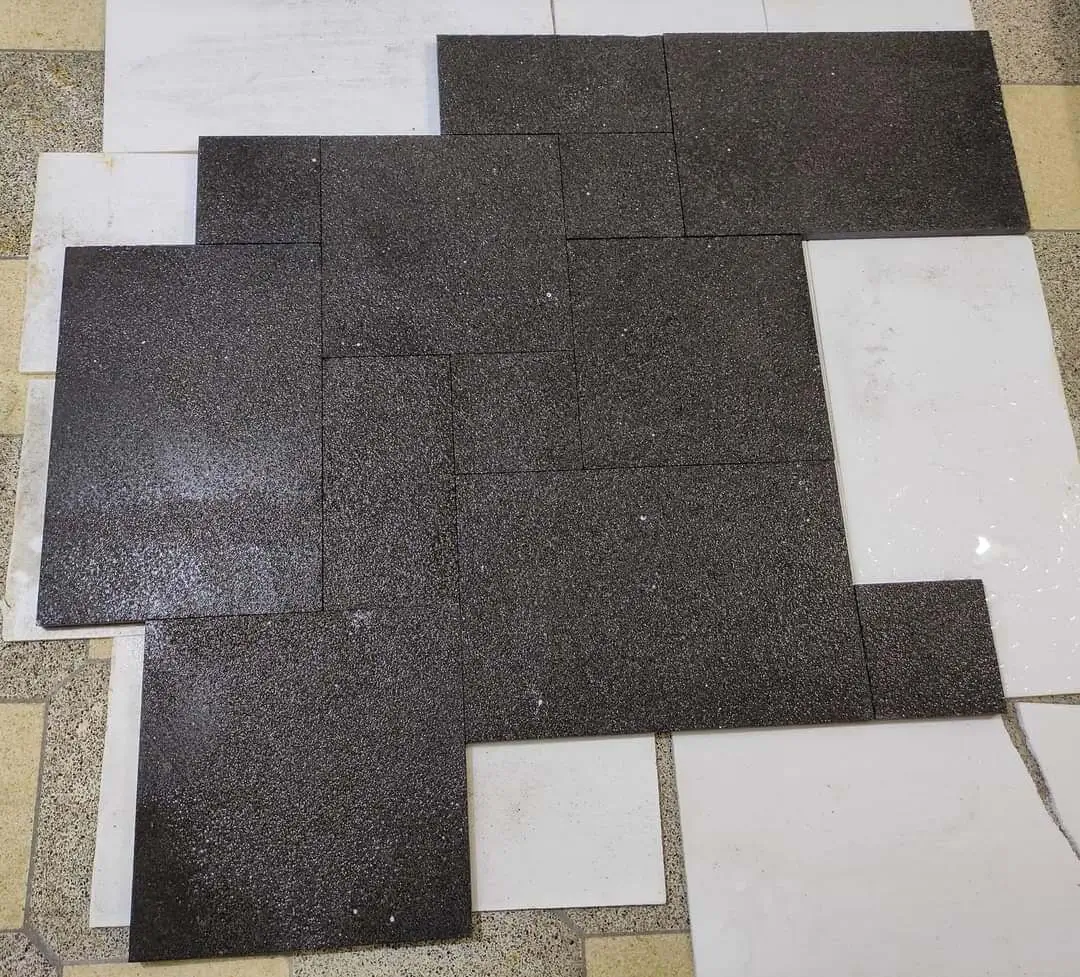
- Flamed basalt finish introduces surface texture that moderates the stark formality of the polished version
- Bush-hammered basalt at 600×600 performs well in pool surrounds where slip resistance is a primary concern
- The material’s density (around 2,900 kg/m³) means your base and delivery logistics need to account for higher load per pallet than travertine or limestone
Sandstone: Warmth and Regional Character
Arizona sandstone — or imported sandstone specified to complement the local palette — captures the layered rust, ochre, and terracotta tones that the region’s geology produces naturally. At 600×600, sandstone creates a paving surface that feels genuinely rooted in the Southwestern landscape rather than imported from a different design tradition. The material’s visual variation across a large-format slab is part of its appeal: no two pieces read identically, and at 600×600 that variation is scaled up in a way that makes the ground plane feel alive rather than uniform.
Sandstone suits informal desert garden designs, ranch-style homes, and transitional spaces between manicured outdoor rooms and wilder desert planting. The material’s relatively open structure — absorption rates typically in the 4–9% range — means you should specify a high-quality impregnating sealer with UV inhibitors from day one of installation. Arizona’s UV index accelerates surface degradation in unsealed or under-sealed sandstone, so sealing isn’t optional; it’s the specification decision that separates a 15-year installation from a 25-year one. For the best 600×600 paver finish options across Arizona in sandstone, sawn and natural cleft are the two finishes that handle UV exposure most consistently across the product range. This Arizona residential paver material comparison consistently shows sandstone performing best when finish selection is treated as a climate-driven specification rather than a purely aesthetic one.
Porcelain 600×600: Precision, Performance, and Its Design Limits
Porcelain earns its place in the Arizona 600×600 conversation because of its dimensional consistency and low maintenance profile. At 600x600mm, porcelain achieves tolerances within ±0.5mm across the face, which allows for near-invisible joint widths that designers targeting ultra-clean, contemporary interiors-to-exteriors transitions specify routinely. That precision is genuinely difficult to achieve with natural stone, where thickness variation of 2–3mm across a slab is standard and requires a more skilled installer to compensate.
When comparing large format pavers in Arizona, porcelain performs best in contexts where visual consistency, low porosity, and stain resistance are the primary drivers. The material’s absorption rate below 0.5% means it requires no sealing, and its colour won’t shift under Arizona UV the way some softer stones can. Where porcelain loses ground to natural stone is in its design authenticity and tactile character. The material reads as manufactured — intentionally so — which suits ultra-modern architecture but conflicts with the regional warmth that travertine, limestone, or sandstone deliver naturally. The distinction shows most clearly when porcelain is placed adjacent to desert planting or warm stucco: the contrast is sharp in a way that can feel disconnected rather than designed. Explore our Arizona large format paver range to compare how natural stone and porcelain options sit within the same format family.
- Porcelain rectified edges allow 2–3mm joints that natural stone cannot consistently achieve
- Matte and lappato porcelain finishes at 600×600 provide the best balance of aesthetics and slip resistance for Arizona outdoor use
- Polished porcelain outdoors is a specification risk in Arizona — solar glare off a polished surface in a west-facing patio is an experience most homeowners regret
- Porcelain’s lower thermal mass compared to dense natural stone means it heats and cools faster, which can be an advantage in partially shaded applications
Matching Finish to Design Context Across Arizona Projects
The finish applied to any 600×600 paver stone type shifts its design register considerably, and Arizona’s strong sun amplifies finish differences more than most climates. A honed travertine reads entirely differently from a tumbled travertine at the same colour and format — and in an Arizona courtyard under noon sun, the honed version can produce glare that honed limestone at the same reflectance won’t, because of travertine’s crystalline structure. These are the distinctions that matter when specifying for real Arizona conditions rather than reviewing finish samples under showroom lighting.
Projects in Scottsdale frequently mix finish types within the same 600×600 material to delineate zones — a honed field tile transitioning to a flamed border creates a subtle but effective spatial signal that reads as designed rather than default. That approach works particularly well with limestone and basalt, where the colour difference between honed and flamed of the same stone is minimal but the texture contrast is significant. At Citadel Stone, we conduct warehouse-level quality checks on finish consistency across batches because variation within a consignment is the detail that separates a professional installation from one that looks mismatched after grout lines are complete.
- Honed finish: clean, contemporary, moderate glare under full Arizona sun — best for shaded patios and covered entertaining areas
- Brushed or sandblasted finish: best balance of traction, texture interest, and UV durability for Arizona’s fully exposed surfaces
- Flamed finish: maximum traction, coarser texture, ideal for pool surrounds and paths with grade change
- Tumbled finish: informal, warm, period-appropriate for Spanish colonial and rustic ranch design contexts
- Polished finish: restrict to covered applications or interior-adjacent transitions where sun exposure is controlled
Base Preparation, Material Weight, and Supply Logistics
The structural base under 600×600 paver stone types in Arizona doesn’t change dramatically by material choice — you’re still targeting a compacted aggregate base of 100–150mm for pedestrian applications and 150–200mm for light vehicular — but the material’s density determines your delivery logistics and the labour rate your contractor quotes. Basalt at 600×600 and 20mm thickness runs approximately 28–30 kg per slab; travertine at the same format and 20mm is closer to 19–22 kg. That weight difference matters when truck access to the site is constrained, as it is on many finished-landscape projects where the paving is going in after fencing and planting are already established.
For projects where the truck can’t get close to the work area, your installer’s material-handling cost increases proportionally with stone density, and the realistic contingency for a basalt installation is higher than for travertine or limestone on the same footprint. At Citadel Stone, we keep warehouse stock across the primary Arizona format and material combinations, which typically brings lead times to 1–2 weeks rather than the 6–8 week import cycle that catches projects off-schedule. A second warehouse location serving the greater Phoenix metro area means the same short lead times apply whether your project is in the East Valley or the West Side. Verifying warehouse availability before locking in a project start date is the logistics step that most homeowners skip until it becomes a problem.
Side-by-Side: Which 600×600 Stone Type Fits Your Arizona Design
Pulling this comparison together into a working decision framework for Arizona residential and commercial projects, the material choice maps clearly onto design intent when you approach it from the landscape and architectural angle first. This Arizona residential paver material comparison applies equally to new-build specifications and retrofit projects where the existing architecture sets the palette constraints.
- Desert xeriscaping with warm earth tones: travertine or warm-toned sandstone in brushed or tumbled finish
- Modern minimalist desert architecture: limestone in honed or sawn finish, or porcelain for zero-maintenance applications
- Spanish colonial and traditional Southwest: limestone antique finish, travertine vein-cut, or sandstone natural cleft
- Tropical planting schemes and high-contrast design: basalt in flamed or bush-hammered finish
- Interior-to-exterior continuity with large glass openings: porcelain at 600×600 for dimensional precision and format match
- Pool surrounds across all design styles: favour flamed or bush-hammered finishes in any material for slip resistance compliance
The full sourcing picture — including thickness specifications, comparing large format pavers for sale in Arizona across supplier tiers, and purchasing criteria specific to this region — is covered in the How to Choose 600×600 Pavers in Arizona: The Complete Buyer’s Guide, which complements the design comparison laid out here with detailed purchasing process guidance.
Final Perspective
The 600×600 format is large enough to make material character the dominant visual fact in any Arizona outdoor space — which means the stone type decision carries more design weight at this scale than it would at 300×300 or 400×400. Selecting among 600×600 paver stone types in Arizona is not choosing a background material; it’s selecting the primary design element of the ground plane. That elevation in material importance is exactly why the decision deserves the same rigour you’d apply to your wall cladding or roofline detail. Matching the stone’s inherent aesthetic to Arizona’s regional design traditions — whether that’s the organic warmth of desert modernism, the layered palette of Spanish colonial, or the strong geometry of contemporary architecture — is the specification decision that determines whether a project feels cohesive or assembled. The material performance data supports every option in this comparison; the design alignment is what separates a finished project that earns compliments from one that simply functions. Contractors and homeowners in Scottsdale, Peoria, and Tempe use Citadel Stone’s stone-type comparison data to match 600×600 paver hardness ratings to Arizona’s residential and commercial load requirements across patio and driveway applications.