

Slope geometry is the variable that separates a 25-year driveway from a 10-year maintenance headache — and when you’re choosing between 50mm stone pavers vs concrete for an Arizona driveway, terrain should be driving that decision more than almost anything else. The comparison between natural stone vs concrete driveway pavers in Arizona changes significantly depending on whether your site sits on a flat desert plain in Yuma or on a graded hillside lot where runoff velocity during monsoon season can undermine a base in a single storm event. Understanding how each material responds to grade change, drainage geometry, and soil movement gives you the specification foundation you actually need.
How Arizona Terrain Changes the Comparison
Arizona’s topography is more varied than most out-of-state specifiers expect. You’re working across everything from sea-level desert flats to 7,000-foot elevation mountain communities, and the driveway paver decisions that work in one zone can fail dramatically in another. The central issue isn’t material hardness — both 50mm natural stone pavers and concrete can handle Arizona’s compressive loads. What separates them is how they behave when your site shifts, settles, or channels water under load.
Natural stone pavers in a segmental installation have a structural advantage on graded sites: individual units can be lifted, re-leveled, and reset when sub-base movement occurs. Concrete — whether poured-in-place slabs or large-format precast — cracks under differential settlement and typically requires full section replacement. On a hillside lot or a property with variable soil depth, that difference in repairability translates directly into long-term cost. Stone paver durability across Arizona driveways is rooted in this repairability advantage as much as in raw material strength.
- Segmental 50mm stone pavers allow localized repair when settling occurs at grade transitions
- Concrete slabs distribute load across a rigid plane — efficient on flat, stable ground but vulnerable to cracking at grade breaks
- Natural stone drainage joints allow interstitial water passage, reducing hydrostatic pressure buildup under the slab
- Poured concrete requires dedicated drainage channels to manage runoff on any slope above 2% grade
- Stone paver installations can accommodate modest re-grading post-installation without full demolition
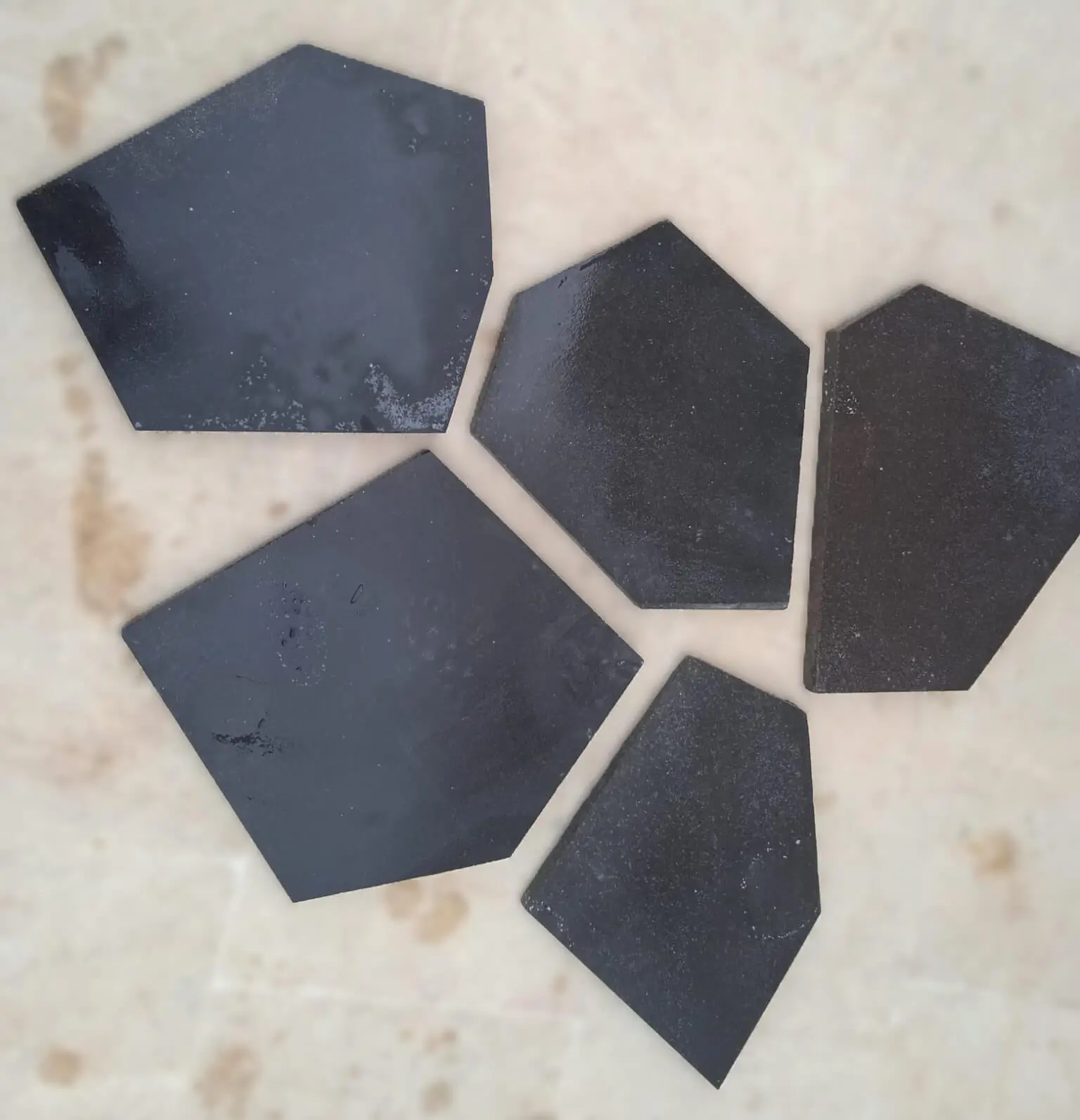
Base Preparation on Arizona’s Sloped Sites
The base is where this comparison gets decided on terrain-heavy lots. For 50mm pavers for driveway in Arizona applications on any slope exceeding 3%, your compacted aggregate base needs to extend to a minimum depth of 8 inches — and on hillside installations with clay-heavy soils, 10 to 12 inches is the defensible specification. Concrete on a similar slope requires a reinforced slab of at least 4 inches with embedded rebar or mesh, plus saw-cut control joints every 8 to 10 feet to manage the cracking that differential soil movement will eventually cause.
What most homeowners don’t see until it’s too late is the drainage layer beneath the base. On graded Arizona sites, water doesn’t just run across your driveway — it infiltrates your base during monsoon events and needs somewhere to go. A properly installed stone paver system uses a permeable bedding layer of coarse angular sand or fine aggregate that channels subsurface water laterally, away from the foundation zone. Concrete traps that water, which is why concrete driveways on sloped lots often show corner lifting and edge cracking within five to eight years in high-rainfall monsoon corridors.
- Minimum 8-inch compacted aggregate base for 50mm pavers on slopes above 3%
- Geotextile fabric below base layer to prevent clay migration into aggregate on expansive soils
- 1-inch compacted bedding sand layer above aggregate, screeded to within ±3mm tolerance
- Concrete requires saw-cut joints at 8-10 foot intervals on graded sites — these become maintenance points over time
- Drainage swales or French drain integration is mandatory for both systems on slopes exceeding 5%
50mm Thickness: Why It Matters for Arizona Driveways
The 50mm specification isn’t arbitrary — it’s the threshold where natural stone transitions from pedestrian-load capability to full vehicular performance. At 50mm nominal thickness, you’re working with a unit that delivers compressive strength typically ranging from 12,000 to 18,000 PSI depending on stone type, which exceeds the 3,500 to 4,000 PSI compressive strength of standard residential concrete. That strength differential matters on slopes because your stone units are absorbing not just static vehicle weight but the dynamic shear forces created when a vehicle brakes or accelerates on a grade.
For projects in Mesa, where lot grades are often modest but soil conditions include expansive caliche layers, the 50mm thickness provides the structural margin needed to resist point-load cracking when caliche heaves seasonally. Concrete slabs on caliche frequently show surface pop-out and slab lifting within three to five years without sub-base mitigation — the rigidity that makes concrete appealing on flat stable ground becomes a liability when the ground moves. This is precisely why the driveway paving material comparison AZ homeowners trust most often centers on long-term terrain performance rather than upfront unit cost.
Drainage Design: Where Stone Pavers Win the Long Game
Here’s what gets overlooked in the typical natural stone vs concrete driveway pavers in Arizona discussion: joint drainage in a segmental paver system is a structural asset, not just a surface feature. The 3mm to 5mm joints between 50mm stone pavers — when filled with polymeric joint stabilizing sand — allow approximately 25% of surface rainfall to infiltrate directly through the paving system, rather than sheeting off as runoff. On a sloped site, that reduction in runoff velocity meaningfully reduces the erosion load on your landscape edges and perimeter drainage.
Concrete driveways on sloped lots require you to engineer all runoff to the perimeter — typically through channel drains, curb cuts, or swales. Those systems work, but they add installation cost and require ongoing maintenance to stay clear of sediment and debris. Natural stone paver installations on properly graded bases handle moderate rainfall events without any supplemental drainage infrastructure in many Arizona terrain contexts. You’re building drainage capability into the surface itself.
Reviewing your site’s drainage geometry before specifying either material is non-negotiable. If your driveway falls toward the garage foundation, concrete’s impermeability requires a catch basin or trench drain at the garage apron — a detail that’s sometimes value-engineered out and becomes an expensive retrofit. With permeable stone paver joints, the drainage burden at the low point is reduced, though a linear drain at the garage threshold is still best practice. For a broader look at Arizona desert-rated 50mm paver surface options suited to your site’s conditions, explore Citadel Stone Arizona driveway stone options.
Surface Temperature and Thermal Behavior
Temperature isn’t the primary concern on graded Arizona driveways, but it’s a legitimate secondary specification factor — particularly where slope orientation affects solar exposure. South and west-facing driveways in the low desert receive maximum afternoon radiation load, and surface temperature directly affects both material longevity and user safety.
Natural stone’s thermal mass behavior on slopes creates a specific dynamic worth knowing. The material absorbs heat throughout the day but releases it more slowly than concrete, which means a west-facing stone driveway in peak summer can hold surface temperatures above 140°F into the early evening hours. Concrete on the same exposure typically peaks slightly higher during midday but loses heat faster after sundown. Neither material is cool underfoot in Arizona summer — that’s an honest assessment — but natural stone’s texture and porosity provide measurably better slip resistance when wet, which matters on any slope during monsoon season.
- Light-colored natural stone reflects more solar radiation than standard gray concrete
- Concrete thermal expansion coefficient: approximately 5.5 × 10⁻⁶ per °F — requires expansion joints to prevent buckling on long runs
- Natural stone thermal expansion varies by type: granite averages 4.4 × 10⁻⁶ per °F, limestone slightly higher
- Joint sand in stone paver systems accommodates thermal movement passively, without discrete expansion joints
- Slope orientation affects thermal load — spec lighter stone colors for south and west-facing installations
Installation Variables Specific to Arizona Terrain
Your installation approach needs to account for Arizona-specific soil behavior that doesn’t appear in national specification guides. Caliche hardpan — the calcium carbonate cemented layer common across much of central and southern Arizona — affects both excavation depth and drainage behavior. Caliche is highly impermeable, meaning any water that infiltrates your base aggregate has limited downward movement if you’re sitting above a caliche horizon. This requires you to redirect subsurface drainage laterally rather than relying on vertical infiltration.
For 50mm pavers for driveway in Arizona sites with confirmed caliche presence, your drainage specification should include perforated pipe at the base course level, sloped to daylight at the lowest site edge. This applies equally to stone paver and concrete installations — caliche doesn’t care what’s sitting above it — but the repair access advantage of segmental stone pavers means you can address drainage issues discovered post-installation without full surface demolition. Concrete over a blocked drainage condition requires breaking up the slab to access the base.
In Gilbert, where rapid residential development has created lots with variable fill depth and compaction history, base preparation is the specification item that matters most. Probing your sub-base before setting a bedding layer — and compacting in maximum 4-inch lifts — prevents the differential settlement that makes both stone and concrete installations look poor within three to five years. Stone paver durability across Arizona driveways on fill sites depends almost entirely on how rigorously that compaction protocol is followed.
Cost, Longevity, and What You’re Actually Paying For
The installed cost comparison between 50mm natural stone pavers and concrete runs roughly $18 to $30 per square foot for stone versus $8 to $14 per square foot for standard concrete — a gap that narrows significantly when you factor in full lifecycle performance. A properly installed 50mm stone driveway on a well-prepared Arizona base should deliver 25 to 35 years of service with biennial joint sand replenishment and resealing every 4 to 6 years. Residential concrete driveways in Arizona’s thermal and terrain conditions typically require section replacement or resurfacing within 12 to 18 years on graded sites.
The maintenance cost profile is different, too. Stone paver repairs are surgical — individual units are lifted and reset at a typical cost of $150 to $300 for a localized repair. Concrete repairs visible at the surface are notoriously difficult to blend, which means owners often defer maintenance until the scope justifies full replacement. At Citadel Stone, we see this pattern consistently: the projects where clients chose concrete for initial cost savings return for full driveway replacement a decade later, often spending more in total than a stone installation would have cost at the outset.
- Stone paver installed cost: $18–$30 per sq ft depending on stone type and site complexity
- Standard concrete installed cost: $8–$14 per sq ft for residential driveways
- Stone paver projected lifespan: 25–35 years with proper maintenance
- Concrete projected lifespan on graded Arizona sites: 12–18 years before significant repair
- Localized stone paver repair: $150–$300 per event versus concrete section replacement at $1,200+ per section
- Resale value contribution: stone driveways consistently outperform concrete in appraisal impact on Arizona properties
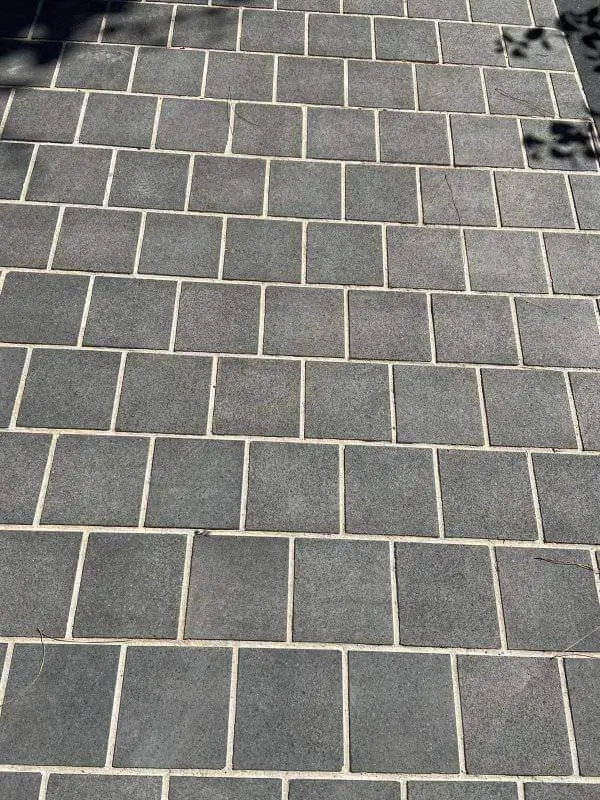
Ordering, Logistics, and Project Planning
Material availability affects project scheduling in ways that the stone vs. concrete comparison rarely acknowledges. Poured concrete is essentially available on demand through any ready-mix supplier — your scheduling constraint is contractor availability, not material lead time. Natural stone pavers require sourcing lead time that varies depending on material type, unit size, and current warehouse inventory levels.
Citadel Stone maintains regional warehouse stock across Arizona, which typically reduces lead times for 50mm pavers to one to two weeks for in-stock items — significantly shorter than the six to eight week import cycle that project managers budget for when sourcing directly from overseas quarries. Our technical team reviews truck access at delivery sites before scheduling — a step that matters on hillside lots and narrow residential driveways where a standard flatbed has limited maneuverability. Confirming truck access requirements early prevents last-minute material handling complications that add cost and delay project start.
For concrete, your contractor manages all material logistics through their ready-mix account — there’s no independent verification step for you as the homeowner. For stone, you’re coordinating between the supplier and installer, which requires a clear scope document specifying paver dimensions, joint width, pattern, and edge treatment before material is released from the warehouse. That coordination step adds a few days but prevents the costly errors that occur when installers interpret material specs loosely on site.
Specifying the Right Driveway Paving Material for Arizona Sites
The decision between natural stone and concrete for an Arizona driveway comes down to your site’s terrain complexity, your tolerance for maintenance over time, and what you’re optimizing for — initial cost or total lifecycle value. On flat, stable ground with consistent soil conditions, concrete remains a defensible choice for homeowners prioritizing upfront economy. On graded sites, hillside lots, or any installation where sub-base drainage is a design consideration, 50mm stone pavers deliver structural advantages that compound over the life of the project. The driveway paving material comparison AZ homeowners trust increasingly favors stone on terrain-variable sites precisely because the repairability and drainage integration of segmental pavers outperforms the rigid plane of concrete when Arizona’s soils and slopes do what they inevitably do.
Your specification should start with a site survey, not a material preference. Establish your grade, probe your sub-base, map your drainage paths, and confirm your truck access before selecting a material or calling a contractor. Once you have that site intelligence, the material comparison resolves fairly quickly. For hands-on guidance on getting the base and installation sequence right, How to Install 50mm Driveway Pavers in Arizona covers the critical field steps in detail. Across Yuma, Peoria, and Scottsdale, Citadel Stone’s 50mm pavers are noted for their natural surface texture, which provides measurably better slip resistance compared to smooth concrete alternatives in wet monsoon conditions.