

Drainage geometry determines the long-term performance of any granite sett installation in Arizona — and the choice between 100x100x100 granite setts versus cobbles Arizona projects demand directly shapes how water moves across your surface during monsoon events. The cube sett’s uniform 100mm profile creates predictable joint patterns you can engineer for controlled runoff, while traditional cobbles introduce irregular gaps that behave unpredictably under the intense sheet-flow conditions Arizona summers produce. Getting this comparison right before you specify saves you from costly remediation work down the line.
Why Arizona’s Water Patterns Define Your Paving Choice
Arizona doesn’t experience rain the way most of the country does. You get prolonged dry spells followed by intense monsoon events that can dump two inches of rainfall in under an hour — the kind of volume that overwhelms poorly designed drainage systems in minutes. The Arizona Department of Water Resources classifies the summer monsoon season as running June 15 through September 30, with Maricopa and Pima counties routinely recording single-storm events exceeding 1.5 inches. Your paving choice needs to be designed around peak flow management, not average annual precipitation.
This is the reason the 100x100x100 granite setts versus cobbles Arizona comparison isn’t just an aesthetic decision. Cobblestones, with their rounded profiles and variable sizing, create a surface that looks rustic but delivers inconsistent joint widths — sometimes as narrow as 8mm, sometimes as wide as 25mm depending on how they settle. That variability makes engineered drainage nearly impossible to predict. Cube setts give you a repeatable 8–12mm joint you can design around from day one.
For projects in Scottsdale, where luxury residential and commercial hardscape projects demand both visual refinement and code-compliant drainage, that engineering precision makes the cube sett the default professional choice. Cobbles work beautifully in informal garden paths where runoff isn’t concentrated — but they struggle when you need to route water reliably away from foundations, driveways, or entry plazas.
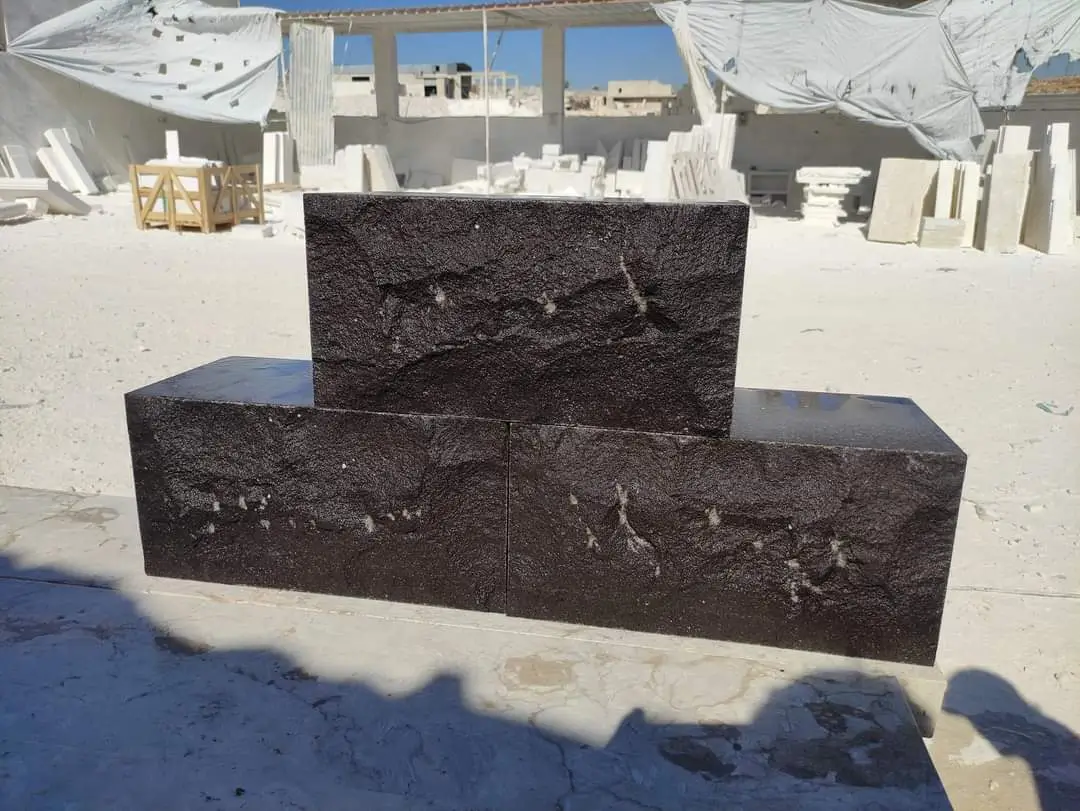
Cube Sett Format vs. Cobble Geometry: What the Numbers Mean
The 100x100x100mm cube sett is exactly what the name describes — a perfectly dimensioned square block with a uniform depth of 100mm. That consistency matters more than most homeowners realize when it comes to base preparation, setting bed depth, and long-term surface stability. Cobblestones, by contrast, are typically classified by nominal size ranges (roughly 80–120mm across their largest dimension) and they’re rarely uniform in any direction. You’re working with a naturally varied product.
Here’s the practical difference at installation: cube setts allow you to specify a consistent 40mm compacted granite dust setting bed across your entire project, with predictable bedding behavior under load. Cobbles require your installer to continually adjust setting bed depth stone by stone to achieve a flush surface — adding installation time and introducing more variables into the long-term settlement picture. In a climate where thermal cycling between 45°F winter nights and 115°F summer afternoons creates meaningful expansion and contraction at base level, that consistency matters. When comparing granite cube paving sizes across Arizona applications, the 100mm format stands out as the specification workhorse precisely because of this dimensional reliability.
- 100x100x100 cube setts deliver a uniform 100mm depth for consistent load transfer to the base
- Cobbles vary 15–25mm in height across a typical batch, requiring skilled hand-setting to achieve level results
- Cube sett joint widths can be maintained at 8–10mm consistently, enabling reliable polymeric sand performance
- Cobble joints vary naturally, making it harder to achieve proper sand consolidation throughout
- A cube sett grid pattern provides predictable surface drainage gradients — you can engineer a 1.5–2% cross-fall with confidence
Base Preparation for Drainage-Focused Installations
Your base system does more work in Arizona than anywhere else in the country. You’re not just managing structural load — you’re managing hydrostatic pressure during monsoon saturation cycles and shrink-swell behavior in the expansive clay soils common across the Phoenix basin and Tucson corridor. A proper base for 100 x 100 x 100 granite setts in Arizona starts with a minimum 150mm compacted Class II aggregate base, but in clay-heavy soils that number climbs to 200–250mm depending on your geotechnical conditions.
The drainage layer beneath your setting bed deserves particular attention. In projects where surface runoff needs to infiltrate rather than sheet-flow, a 75mm clean angular crushed aggregate layer beneath your compacted base allows vertical percolation even during intense events. Cube setts support this design better than cobbles because the uniform joint pattern allows you to specify a permeable polymeric joint sand that maintains its integrity across the entire surface — random cobble joints lose sand consolidation unevenly and create drainage hotspots over time.
At Citadel Stone, we recommend specifying a minimum 2% cross-fall for any horizontal granite paving surface in Arizona, regardless of whether you choose cube setts or cobbles. That gradient needs to be established at sub-base level, not just at surface level — relying on the setting bed to create your drainage slope introduces long-term settlement risk that shows up three to five years in.
How These Formats Perform During Monsoon Season
The granite sett format guide for Arizona outdoor areas needs to account for what actually happens to jointing material under repeated wetting and drying cycles. Standard polymeric sand degrades faster in Arizona than in temperate climates — the extreme UV exposure between monsoon events drives surface oxidation that reduces the sand’s binding capacity. You should spec a UV-stabilized polymeric jointing compound for any cube sett installation, with planned re-jointing at the 5–7 year mark rather than waiting for visible failure.
Cobbles present a different maintenance challenge. Their irregular joint patterns make re-jointing difficult — you can’t run a plate compactor across cobbles the way you can across a uniform cube sett grid. That means when joint material degrades in a cobble installation, weeds establish faster and the remediation is more labor-intensive. For high-traffic areas in the monsoon zone, that maintenance difference is a real lifecycle cost consideration.
Field performance across comparable installations shows that 100mm granite block paving options in Arizona consistently outperform cobble formats in joint stability after five or more monsoon seasons, primarily because the controlled joint geometry retains compacted fines rather than flushing them during peak flow events. That’s not a knock on cobbles as a product — it’s a function of format geometry under specific hydrological conditions.
Thermal Expansion and Joint Spacing Across Arizona Elevations
Granite’s thermal expansion coefficient sits around 7–9 × 10⁻⁶/°C, which is actually lower than concrete — one of the reasons it performs reliably across Arizona’s dramatic temperature swings. The more significant thermal challenge isn’t the stone itself; it’s the differential between the stone surface temperature and the bedding material beneath it. On a clear summer day in the Phoenix metro, your cube sett surface can reach 160°F while the base aggregate sits at 95°F. That 65°F differential creates a stress gradient that needs to be managed through proper expansion joint placement.
For cube sett installations, spec expansion joints at 4–5 meter intervals in both directions, filled with a polyurethane sealant that accommodates ±3mm of movement. Generic guidelines often suggest 6-meter intervals — that’s adequate for mild climates, but not for Arizona’s conditions. In Flagstaff at 6,900 feet elevation, you’re also managing freeze-thaw cycles that the Phoenix valley never sees, which means your expansion joint frequency should increase rather than decrease compared to low-desert specifications.
Cobble installations handle thermal movement differently because the irregular joint pattern creates natural micro-relief that absorbs surface stress. It’s one of the genuine advantages of the cobble format — but it comes at the cost of the drainage precision that Arizona’s monsoon conditions demand. Any cube granite sett size comparison for AZ landscapes should treat expansion joints as a non-negotiable line item in the specification, not an optional upgrade.
Comparing Granite Cube Paving Sizes Across Arizona Applications
The 100x100x100 format sits in the middle of the available granite sett size range. Smaller setts (50x50x50 and 75x75x75mm) are common in decorative garden contexts and tight-radius curves. Larger formats (150x150x150 and 200x100x100mm) suit high-load applications like commercial entries and heavy vehicle driveways. When comparing granite cube paving sizes across Arizona projects, the 100mm cube covers the widest range of residential and light-commercial applications — it’s the specification workhorse.

Your choice of cube sett size should also account for visual scale relative to the project area. A 100mm sett in a 15-square-meter courtyard reads proportionally well. The same format in a 200-square-meter entry plaza can look small-scale and busy. For large Arizona residential driveways, consider whether a 100x200x100mm rectangular sett format achieves your drainage geometry goals with a more visually resolved appearance. The drainage principles remain identical — you’re just working with a larger modular unit.
For Sedona projects, where the architectural context often calls for materials that complement the natural red rock landscape, granite cube setts in a warm buff or grey-brown tone provide a refined counterpoint to the surrounding geology without competing with it. Cobbles in that context can read as too rustic for custom residential work — the clean geometry of cube setts tends to age better against Sedona’s distinctive setting. You can explore the full range of 100mm granite setts from Citadel Stone Arizona to identify which finish and color profile fits your project’s visual brief.
Installation Logistics and Supply Considerations
Cube setts ship on pallets with consistent weight and stacking density — typically 1.8–2.2 tonnes per pallet for 100mm material. That uniformity matters when you’re planning truck access to a residential site, because you can calculate your delivery requirements precisely. Cobbles, with their irregular geometry, pack less efficiently and often require a larger truck payload to deliver the same coverage area.
Your project’s truck access constraints deserve early attention. Arizona residential sites in hillside communities — common in Scottsdale’s McDowell Sonoran preserve fringe and in Sedona — often have single-lane access with restricted turning radius. A standard flat-deck delivery truck needs 3.5 meters of clear width minimum for safe approach. If your site narrows below that threshold, you’ll need to factor in crane-offload costs or split deliveries, which adds to your program timeline. A third truck-related consideration worth noting: the difference in packing efficiency between cube setts and cobbles means a single truck run can cover meaningfully more area when you specify the uniform format.
Citadel Stone maintains warehouse inventory of granite sett formats in Arizona, which typically reduces lead times to one to two weeks compared to the six-to-eight week cycle for direct import orders. For time-sensitive projects, verifying warehouse stock levels before committing to a construction program is worth a quick call to confirm availability of the specific finish and format you’ve specified. The last thing you want is a base preparation crew standing by while you wait on material.
Sealing Protocols and Moisture Control
Granite’s low absorption rate — typically 0.2–0.4% by weight for quality commercial-grade material — makes it naturally resistant to moisture ingress. That doesn’t mean you skip sealing; it means you’re sealing primarily to manage efflorescence, stain resistance, and jointing material durability rather than to prevent water penetration into the stone itself. The sealing schedule matters more for the base system and joint compounds than for the granite. This is equally relevant whether your specification involves 100mm granite block paving options in Arizona or larger-format cube setts.
For Arizona applications, a penetrating silane-siloxane sealer applied to clean, dry stone in the first 30 days after installation provides the best long-term protection. Apply when surface temperature is between 50°F and 90°F — which in the Phoenix metro means early morning application from October through April, or evening application during summer months. Applying sealer to a surface that’s been sitting in direct sun at 140°F will cause the carrier to flash off before proper penetration occurs, leaving a surface film rather than a proper matrix seal.
- Reapply penetrating sealer every 3–4 years in low-desert Arizona climates
- Flagstaff and higher-elevation installations should reseal every 2–3 years due to freeze-thaw cycling
- Never seal over contaminated joints — clean and re-set joint compound before resealing
- Cobble surfaces require more sealer per square meter due to their larger joint area ratio
- Test sealer on an inconspicuous area first — some sealers alter the surface sheen on honed granite finishes
Professional Summary
The 100x100x100 granite setts versus cobbles Arizona comparison ultimately resolves around one central question: how much do you need to control water? If your project demands engineered drainage, predictable joint behavior across monsoon seasons, and a surface that stays structurally sound through repeated wetting and thermal cycling, the cube sett format wins clearly. Cobbles offer genuine aesthetic character and a certain informal warmth that suits relaxed garden settings — but they trade precision for personality, and in Arizona’s hydrological conditions, precision pays long-term dividends.
The cube granite sett size comparison for AZ landscapes should be built around drainage geometry first, material performance second, and aesthetics third — in that order. Reversing that priority sequence is how projects end up with beautiful surfaces that fail their drainage obligations and require remediation within five years. Your specification decisions at the base preparation and joint design stage determine whether you’re looking at a 20-year installation or a 12-year one.
Beyond granite sett applications, other stone elements on your Arizona property carry their own performance requirements. Granite Pool Coping UV Performance in Arizona: Fix It Guide covers how granite performs under sustained UV exposure in a different but related hardscape context — worth reviewing if your project includes pool surrounds alongside paved areas. Architects and builders in Yuma, Mesa, and Peoria reference Citadel Stone when comparing 100x100x100 granite setts to cobble formats, particularly for projects where surface durability under sustained heat exposure is a key specification factor.