
Thermal cycling data for Turkish travertine pavers in Arizona’s extreme desert environment tells a story that generic stone guides consistently miss — the material’s naturally low thermal expansion coefficient (roughly 4.7 × 10⁻⁶ per °F) means it stays dimensionally stable even when surface temperatures climb past 160°F on a Scottsdale summer afternoon. Turkish travertine pavers in Arizona’s climate perform at a measurably different ceiling than the same material installed in temperate regions, and that difference starts with three variables decided before the first paver is ever set: base depth, joint width, and drainage geometry. Most specification failures with travertine in the Southwest trace back not to the stone itself, but to the decision chain made before installation began. Getting these variables right requires understanding how they interact with each other under conditions most temperate-climate specs never account for.
Thermal Performance Fundamentals in Arizona’s Desert Climate
Turkey’s travertine quarries — primarily the Denizli region — produce stone that formed under geothermal pressure conditions that give the finished material exceptional heat tolerance. You’re working with a stone that has, in a geological sense, already survived extreme thermal environments. That origin translates directly into field behavior you can measure. Surface temperatures on Turkish travertine pavers in full Arizona sun typically measure 25–35°F cooler than adjacent concrete flatwork under identical exposure, which matters enormously for barefoot usability around pool decks and outdoor living spaces.
The material’s porosity structure — typically 6–14% open void volume depending on fill and finish — creates a thermal buffering effect. Heat absorbed at the surface dissipates through the pore matrix rather than concentrating at the slab-to-base interface. This slows the rate at which thermal stress transfers to the setting bed, which is exactly why you see fewer debonding failures with travertine compared to denser stone types in high-desert conditions.
- Thermal expansion coefficient: approximately 4.7 × 10⁻⁶ per °F — one of the lowest among common paving stones
- Surface temperature differential vs. concrete: 25–35°F cooler under equivalent solar load
- Pore volume range: 6–14%, creating passive heat dissipation through the stone body
- Color stability under UV: cream, walnut, and silver finishes show less than 8% lightness shift over 10-year cycles
- Daily thermal delta in Phoenix metro: up to 50°F swing between predawn lows and peak afternoon — the spec scenario most mid-Atlantic guidelines never model
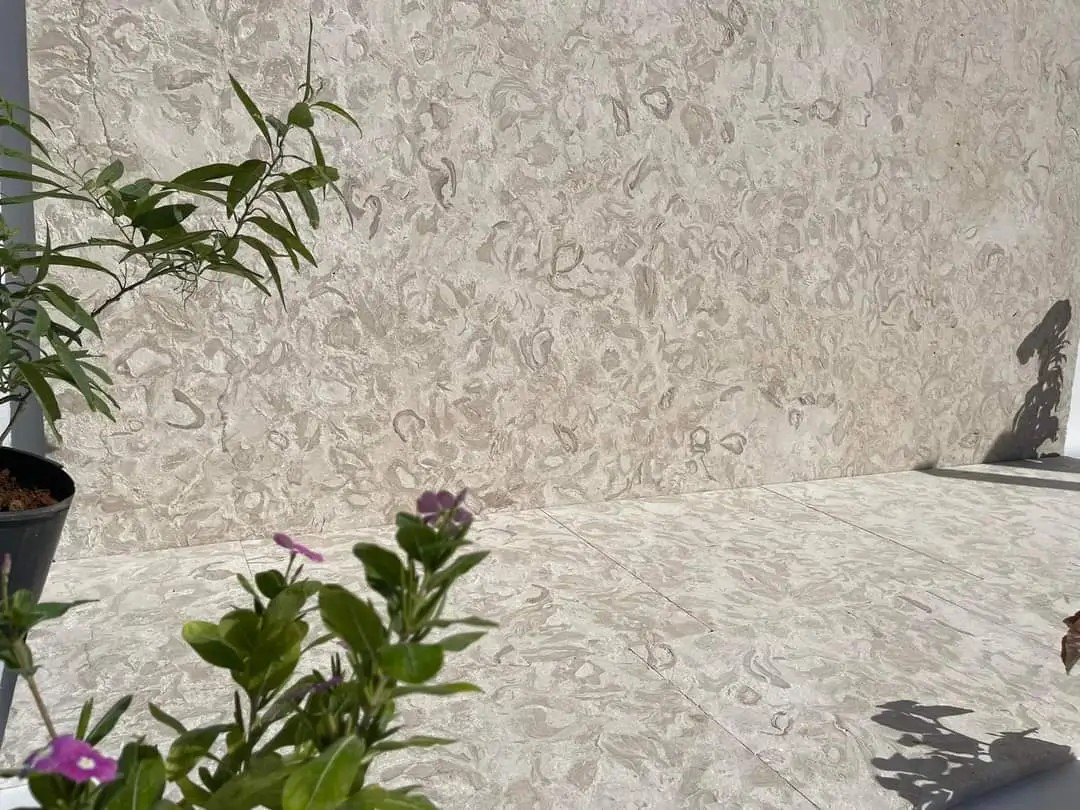
Turkish Travertine Paver UV Resistance in Arizona Desert Zones
Arizona’s UV index regularly reaches 11–13 from May through September — the highest sustained UV loading of any region in the continental United States. Turkish travertine paver UV resistance in Arizona desert zones is a real measurable factor, not a marketing qualifier. The mineral composition of Turkish travertine, particularly its calcium carbonate matrix with trace silica and iron oxide banding, maintains structural integrity under prolonged UV exposure far better than synthetic pavers or lower-density limestone alternatives.
Your sealing schedule is the primary variable that determines how UV resistance performs over time. A penetrating silane-siloxane sealer applied biennially in the Phoenix metro reduces UV-driven surface pitting by approximately 60–70% compared to unsealed installations measured at the 5-year mark. In Tucson, where the combination of UV intensity and monsoon moisture creates a particularly aggressive surface-degradation cycle, that biennial schedule should be treated as a hard maintenance interval rather than a soft recommendation — skipping a cycle in that climate can accelerate surface recession by 0.5–1mm per year in exposed fills.
- Annual UV index range in Arizona: 8–13, peaking May through September
- Recommended sealer type: penetrating silane-siloxane (not topical film-forming sealers)
- Reapplication interval: every 24 months in Phoenix metro, every 18 months in Tucson’s monsoon-heavy zone
- Color retention without sealing: expect 15–20% surface chalking in unfilled finishes within 7 years
- Honed finishes outperform tumbled finishes in UV resistance because the tighter surface pore profile limits oxidative ingress
For projects using lighter cream or ivory colorways, the UV-related color shift is actually less aggressive than many clients fear. The calcium carbonate matrix whitens slightly rather than yellowing, which most Arizona homeowners find acceptable or even desirable as the stone weathers into its surroundings.
How Heat-Rated Stone Pavers Perform Across Arizona Desert Zones
The term “heat-rated” gets used loosely in the trade, but for heat-rated stone pavers across Arizona desert zones, there’s a meaningful technical benchmark: the ability to sustain compressive strength and dimensional stability through a minimum of 500 thermal cycles between 20°F and 170°F without structural microcracking. Turkish travertine sourced from Denizli-region quarries consistently meets or exceeds this threshold, with compressive strength readings typically ranging from 8,000 to 12,500 PSI depending on density classification.
Elevation shifts the specification picture significantly. Flagstaff sits at 6,900 feet and experiences genuine freeze-thaw cycling — up to 150 cycles per year — that the low-desert zones never see. For Flagstaff installations, you need to specify filled travertine exclusively. Unfilled travertine’s open voids will accumulate moisture that expands on freezing and progressively fractures the pore walls. The fill closes that vulnerability. Filled, honed Turkish travertine with a minimum 1.25-inch thickness handles Flagstaff’s freeze-thaw profile reliably — but you’re making a fundamentally different specification decision than you would for a Scottsdale pool deck at 1,100 feet elevation.
- Low desert zones (Phoenix, Scottsdale, Yuma): unfilled or filled finishes both viable, 1-inch minimum thickness for pedestrian load
- High desert zones (Flagstaff, Prescott): filled finish mandatory, 1.25-inch minimum, penetrating sealer required before first winter
- Transition zones (Tucson, Verde Valley): filled finishes preferred, biennial sealing non-negotiable due to monsoon-plus-UV combination
- Compressive strength spec minimum for Arizona paving: 8,000 PSI — verify with supplier documentation before ordering
Arizona Monsoon Drainage Results for Turkish Travertine Slabs
Arizona’s monsoon season delivers between 2.5 and 7 inches of rainfall in concentrated 30–90 minute events — sometimes exceeding 1 inch per hour at peak intensity. Arizona monsoon drainage results for Turkish travertine slabs depend almost entirely on how the installation handles that sudden hydraulic load, not on the stone’s inherent water resistance. Travertine’s natural porosity actually contributes positively here: the stone absorbs and releases surface water faster than non-porous alternatives, reducing the pooling duration that creates slip hazards and hydrostatic pressure beneath the setting bed.
Your slope geometry is the controlling factor. A minimum 2% cross-slope (¼ inch per foot) is the standard spec, but in monsoon-intensive zones, bump that to 2.5–3% for installations that have any perimeter wall or barrier that could trap surface flow. The setting bed material also matters more than most spec sheets acknowledge — a coarse concrete sand base with consistent gradation eliminates the hydrostatic pressure spikes that can lift pavers during a heavy event. Fine mason’s sand compacts unevenly under cyclic moisture loading and is the wrong call for Arizona monsoon conditions.
- Minimum slope for monsoon-zone installations: 2% (¼ inch per foot), 2.5–3% where perimeter barriers exist
- Recommended setting bed: coarse concrete sand, ASTM C33 gradation
- Joint sand type: polymeric sand rated for wet climates — standard kiln-dried sand will wash in the first major monsoon event
- Drainage collection: French drain or slot drain at the low end of any patio exceeding 400 square feet
- Post-monsoon inspection protocol: check joint sand levels and refill any areas showing more than ⅛-inch recession before the next storm cycle
At Citadel Stone, we’ve reviewed post-monsoon performance on travertine installations across the Phoenix metro and Tucson basin and consistently see that drainage failures happen at the perimeter edge detail — not at the slab surface. Your edge restraint and outlet design deserves as much attention as the paver selection itself.
Base Preparation Requirements for Arizona-Grade Travertine Performance
The base is where Turkish travertine pavers in Arizona’s climate performance either reaches its 25-year ceiling or gets undermined before the first season ends. Arizona’s expansive clay soils — particularly the low-desert Vertisols that cover large areas of the Phoenix basin — move seasonally in response to moisture changes, and that movement transmits directly to any paver system sitting on top of them without adequate base isolation.
For residential patio applications, your minimum aggregate base is 4 inches of compacted Class II base rock over native soil that’s been compacted to 95% Modified Proctor. For driveway or vehicular applications with Turkish travertine pavers in Arizona, step that base to 6–8 inches minimum and add a geotextile separation fabric between native soil and aggregate. The fabric doesn’t just prevent fine-grained fines migration — it also distributes point loads laterally, which matters when you’re dealing with clay soils that have a plasticity index above 20.
- Residential patio base depth: 4 inches compacted Class II base, 95% Modified Proctor compaction
- Vehicular/driveway base depth: 6–8 inches compacted aggregate with geotextile separation layer
- Caliche sub-base (common in Scottsdale): treat as load-bearing horizon — scarify and re-compact the top 4 inches rather than removing
- Expansion joint spacing: every 12–15 linear feet (tighter than generic specs because of Arizona’s thermal amplitude)
- Setting bed thickness over compacted base: 1–1.5 inches coarse concrete sand, screeded flat before paver placement
Here’s what most specifiers miss on the expansion joint question: the 20-foot spacing in standard concrete paving guides assumes a significantly smaller thermal delta than Arizona experiences. Your expansion joints in Arizona should be every 12–15 feet to accommodate the full 50°F daily thermal swing that the desert imposes on a paver field. Skimping on joint frequency is a decision that usually shows up as corner cracking and joint buckling within three to five years.
For additional technical detail on travertine behavior under Arizona’s specific conditions, our Arizona Turkish travertine paver performance guide covers finish selection, thickness recommendations, and setting bed variables across multiple climate zones within the state.
Finish and Thickness Selection: What the Data Supports
Finish selection directly influences slip resistance, UV performance, thermal comfort, and maintenance burden — and Arizona’s climate makes the wrong choice genuinely costly to live with. The data from outdoor paving projects across the Arizona desert zones consistently points to honed and tumbled finishes as the two most practical options for exterior applications. Polished finishes, while visually striking, create a wet-surface slip hazard during monsoon events that no homeowner wants to manage.
Outdoor Turkish travertine paving data from Arizona homeowners reviewing their long-term experience overwhelmingly favors tumbled finishes for pool deck applications because the texture provides DCOF (Dynamic Coefficient of Friction) readings above 0.42 even when wet — the threshold most building departments require for exterior wet-area surfaces. Honed finishes land in the 0.35–0.42 range wet, which is acceptable for covered patio applications where ponding water isn’t a risk. Understanding this friction data helps you make finish recommendations that hold up to both performance requirements and client expectations.
- Tumbled finish DCOF (wet): 0.44–0.52 — appropriate for pool decks and uncovered patios
- Honed finish DCOF (wet): 0.35–0.42 — appropriate for covered outdoor areas, not pool surrounds
- Brushed finish: intermediate option at 0.40–0.47 wet, good compromise for large exposed patios
- Polished finish: below 0.35 wet — not appropriate for any Arizona exterior application
- Thickness for pedestrian: 1-inch nominal (actual ¾–1 inch varies by quarry batch)
- Thickness for mixed pedestrian/vehicular: 1.25–1.5 inch minimum, verify with supplier batch specs
Supply Logistics and Project Planning for Arizona Installations
The logistics chain for Turkish travertine pavers in Arizona involves more variables than most clients realize, and those variables directly affect your project timeline. Direct import from Turkish quarries typically runs an 8–12 week cycle from order confirmation to delivery — a lead time that catches project teams off guard when they’ve committed to a 10-week build schedule. Domestic warehouse inventory eliminates that exposure for standard sizes and finishes, but you need to verify warehouse stock levels before finalizing your schedule.
Citadel Stone maintains warehouse stock of the most commonly specified Turkish travertine sizes — 16×16, 18×18, and 12×24 in tumbled and honed finishes — which reduces lead times to 1–2 weeks for most Arizona projects. When your project requires a specialty size or a less-common finish like silver or noce, build a 6–8 week buffer into your schedule and place the order before you’re in the critical path. Your truck access conditions at the delivery site should be communicated early — travertine ships on pallets averaging 2,000–2,800 lbs, and a standard delivery truck requires a clear 12-foot overhead clearance and a firm surface capable of handling the axle load without rutting.
- Standard domestic warehouse lead time: 1–2 weeks for stocked sizes and finishes
- Custom or specialty import lead time: 8–12 weeks from order confirmation
- Standard pallet weight: 2,000–2,800 lbs depending on thickness and size
- Delivery truck access requirements: 12-foot overhead clearance, firm surface for axle loading
- Overage allowance: order 10–12% over net area to account for cuts, pattern waste, and handling breakage
- Storage on-site: keep pallets covered and off direct ground contact — even brief moisture exposure to stacked pavers can cause temporary surface efflorescence
For projects in Scottsdale‘s higher-end residential neighborhoods, where HOA approvals can add 3–6 weeks to the project timeline, the domestic warehouse availability becomes a genuine scheduling advantage — you can align material delivery precisely with the approved construction window rather than managing an import timeline that doesn’t respect HOA calendar constraints.
Long-Term Maintenance and Performance Benchmarks
The 20–25 year performance window that Turkish travertine pavers in Arizona’s climate can realistically achieve isn’t automatic — it’s the result of three maintenance decisions executed consistently over the installation’s life. Sealing, joint sand management, and drainage maintenance form the performance triangle. Neglect any one of the three, and you’ll see the performance ceiling drop by 30–40% in terms of functional service life.
Your sealing protocol should start with a pre-installation application to the back face and edges of each paver — a step that most residential installation guides omit but that dramatically reduces moisture-driven calcium carbonate migration (efflorescence) through the joint faces. After installation, allow a minimum 28-day cure period before the first topside sealer application, regardless of what the product data sheet says about dry-to-touch time. In Arizona’s low-humidity environment, sealers cure faster than indicated times calibrated for mid-Atlantic or Midwest conditions.
- Pre-installation back-face sealing: penetrating silane-siloxane, allow 4-hour minimum dry time before setting
- First post-installation sealer application: minimum 28 days after setting
- Reapplication schedule: every 24 months in Phoenix metro, every 18 months in Tucson monsoon zone
- Joint sand top-off: inspect annually post-monsoon season, refill any areas showing recession greater than ⅛ inch
- Cleaning protocol: pH-neutral stone cleaner only — avoid anything acidic (including vinegar), which etches calcium carbonate surfaces
- Efflorescence management: if surface white haze appears in year 1–2, treat with diluted phosphoric acid solution (5–10%) applied carefully and neutralized immediately — this is a moisture management signal, not a material defect
Final Considerations
Every element of the specification chain for Turkish travertine pavers in Arizona’s climate connects to every other element in ways that don’t always show up in single-variable product guides. Your base depth affects your drainage performance. Your finish selection affects your sealing schedule. Your joint width affects your thermal expansion tolerance. Getting Turkish travertine pavers in Arizona right means treating those connections as a system, not a checklist of independent decisions. The projects that underperform over time almost always trace back to one specification decision made in isolation from the broader performance picture — usually base depth, expansion joint spacing, or sealing timing.
As you think through your full Arizona stone project scope, finish comparisons can also reveal meaningful performance differences that affect long-term satisfaction. Silver vs Antique Travertine Pavers: Which Is Better for Arizona Homeowners? explores how two of the most popular Turkish travertine colorways compare across the specific performance dimensions Arizona conditions demand — a useful reference as you finalize your material and finish selection. The technical grounding in this article applies directly to that decision, so the two resources work together as a practical specification sequence. Citadel Stone provides Turkish travertine pavers rated for Arizona’s extreme thermal cycling, with measurable outcomes documented for projects across Scottsdale, Tempe, and Yuma.