
Travertine marble pavers in Arizona perform at a level most material schedules don’t fully account for — specifically, the way their internal pore structure manages heat load differently from dense stone or concrete. Surface temperatures on unfilled travertine run 18–24°F cooler than adjacent concrete under direct afternoon exposure, and that gap widens as ambient temps push past 105°F. That distinction matters enormously when you’re specifying outdoor living surfaces for the low desert, where barefoot comfort is an actual performance requirement, not just a preference. What this article covers goes beyond the basics — it gets into the real performance data, thickness requirements, finish selection trade-offs, and the supply logistics that determine whether your project stays on schedule.
Why Travertine Behaves Differently in Extreme Heat
The thermal mass story with travertine is more nuanced than most product sheets suggest. Unlike dense granite or engineered concrete, travertine’s interconnected pore matrix acts as a micro-buffer — it absorbs radiant heat at a slower rate and releases it more gradually through the afternoon hours. That’s not just comfortable underfoot; it also reduces the peak thermal cycling stress that degrades mortar beds and grout joints over time.
Natural stone paver performance data AZ contractors have gathered over multiple installation cycles consistently shows travertine outperforming both tumbled limestone and concrete pavers in thermal fatigue resistance across the 10–15 year mark. The reason comes down to the coefficient of thermal expansion — travertine sits at approximately 4.7–5.5 × 10⁻⁶ per °F, which keeps joint movement manageable even across Arizona’s extreme diurnal swings of 40–55°F between nighttime lows and afternoon peaks.
Here’s what most specifiers miss: the thermal performance advantage only holds when you match finish type to orientation. A polished finish on a west-facing patio amplifies afternoon glare and increases surface temp by retaining more radiant energy. A honed or brushed marble finish travertine pavers across Arizona projects should use consistently for west and south exposures — it scatters solar radiation instead of concentrating it.
Travertine Surface Durability for Arizona Patios
Travertine surface durability for Arizona patios depends heavily on three variables that don’t always make it into spec documents: fill type, sealer penetration depth, and base drainage geometry. Unfilled travertine has a natural beauty, but in high-traffic patio applications, the open voids collect debris, trap moisture during monsoon season, and create surface irregularities that become trip hazards over time. For residential patios, epoxy-filled travertine is the better long-term specification.
The Mohs hardness rating of 3–4 for travertine means it won’t resist metal chair feet, concrete planter bases, or heavy grill equipment without surface wear. That’s not a dealbreaker — it’s just a detail you need to communicate to your client upfront so the maintenance protocol matches expectations. Travertine is not granite, and treating it like one leads to disappointed clients and callbacks.
- Epoxy-filled travertine resists void collapse under furniture point loads better than cementitious fill
- Minimum 1.25-inch thickness for residential patio applications, 1.5 inches for areas with rolling loads
- Penetrating silane-siloxane sealers outperform topical acrylics in high-UV Arizona conditions
- Biennial resealing schedules maintain water absorption rates below 3% — the threshold where surface degradation accelerates
- Grout joint width of 1/16 to 1/8 inch works for honed finishes; tumbled travertine requires 1/4 to 3/8 inch to accommodate edge irregularity
In Flagstaff, elevation introduces a variable the low desert doesn’t face — freeze-thaw cycling. At 6,900 feet, you’re looking at 100+ freeze events annually, which means travertine surface durability for Arizona patios at elevation requires a different approach: fully filled pavers, tighter joint spacing, and a sealer rated for freeze-thaw exposure rather than UV resistance alone.
Heat-Rated Travertine Paving Slabs: What the Performance Data Shows
The phrase “heat rated” gets used loosely in the market, so it’s worth being specific about what the data actually measures. Heat rated travertine paving slabs in Arizona testing typically references three benchmarks: peak surface temperature under ASTM E1952 thermal mass testing protocols, thermal shock resistance (the ability to handle rapid temperature swings without microcracking), and color stability under prolonged UV exposure.
Natural stone paver performance data AZ field monitoring has documented that ivory and walnut-finish travertine maintains surface temperatures 22–28°F below dark-finish concrete under peak summer sun. Silver travertine, which has a lighter base tone, performs even better — readings as low as 30°F cooler in direct comparison testing. These aren’t marketing numbers; they come from infrared surface thermometry taken at 2:00 PM in July across multiple Arizona installations.
- Ivory travertine: peak surface temp approximately 118–124°F at 2 PM in July (Phoenix metro)
- Walnut travertine: 122–130°F under identical conditions — darker tone increases absorption
- Charcoal travertine: 135–142°F — still lower than standard concrete at 148–158°F
- Silver/cream finishes: 112–118°F — the cooler end of the travertine range
- Thermal shock resistance: travertine handles 80°F surface-to-irrigation-water differentials without cracking when properly installed with correct joint spacing
Selecting heat rated travertine paving slabs in Arizona also means understanding the relationship between slab thickness and thermal mass. Thicker slabs — 2 inches versus 1.25 inches — accumulate more heat through the day but also release it more slowly into the evening. For pool decks where barefoot comfort matters past 6 PM, thinner slabs with lighter finishes often outperform thicker ones despite the counterintuitive logic.
Base Preparation for Arizona Soil Conditions
The base system under travertine marble pavers in Arizona does more failure-prevention work than the stone itself. Arizona’s caliche hardpan layers, expansive clay pockets in certain soil profiles, and extreme moisture variation between dry season and monsoon combine to create base movement that can fracture even high-quality pavers if the sub-base isn’t engineered for it.
Your aggregate base specification should start at 4 inches of compacted Class II base rock for standard residential patios, stepping up to 6 inches for pool decks and 8 inches for driveways. Compaction to 95% modified Proctor density is non-negotiable — anything below that and you’ll see differential settlement within three monsoon seasons. In areas with active expansive clay, a geotextile separation fabric between native soil and base aggregate prevents clay migration into the base layer.
Projects in Sedona deal with a different challenge — the red sandstone subsoil drains well but has inconsistent load-bearing capacity where decomposed granite meets the deeper rock formation. That transition zone requires careful compaction testing rather than assuming the native material provides adequate sub-base support.
- Residential patio: 4-inch compacted base + 1-inch sand setting bed + 1.25-inch travertine minimum
- Pool deck: 6-inch compacted base + 1.25-inch sand setting bed or mortar + 1.25–1.5-inch travertine
- Driveway application: 8-inch compacted base + mortar-set 1.5–2-inch travertine minimum
- Expansion joints every 12–15 feet in both directions — not the 20-foot spacing you’ll see in generic specs
- Perimeter edge restraint critical for sand-set installations; polymer-modified base prevents washout during heavy monsoon events
Finish Selection for Travertine Marble Pavers
The finish decision on travertine marble pavers in Arizona affects three distinct outcomes simultaneously: slip resistance, surface temperature, and maintenance intensity. Most clients focus on aesthetics, which is natural — but your job is to make sure the finish they love also performs in the environment they’re installing it into.
A marble finish travertine pavers across Arizona projects should match the application context — not just the design board. Polished finishes deliver the high-end visual, but DCOF (Dynamic Coefficient of Friction) values typically run 0.42–0.48 when wet, which barely clears the 0.42 minimum in ANSI A326.3 for wet areas. That’s too close to the threshold for pool decks and any surface with irrigation overspray. Honed finishes consistently test at 0.55–0.65 DCOF wet — genuinely safer and still visually refined.
- Tumbled finish: DCOF 0.65–0.75 wet — ideal for pool decks, highest slip resistance
- Brushed/antiqued: DCOF 0.58–0.68 wet — good balance of safety and aesthetics for patios
- Honed: DCOF 0.55–0.65 wet — suitable for covered patios, indoor-outdoor transitions
- Polished: DCOF 0.42–0.50 wet — appropriate for interior applications or covered dry zones only
- Sandblasted: DCOF 0.68–0.78 wet — highest texture, most rustic appearance, best for inclined surfaces
For outdoor dining areas and patios where wheeled furniture or heavy foot traffic is common, a marble finish travertine pavers across Arizona installations should default to honed or brushed — the texture helps maintain DCOF above 0.55 even when the surface is covered in fine desert dust, which acts as a lubricant on smoother finishes.
You can review our Arizona travertine marble paving research for detailed finish performance data organized by application type and climate zone across the state.
Travertine Paver Suppliers in Arizona: Logistics and Lead Times
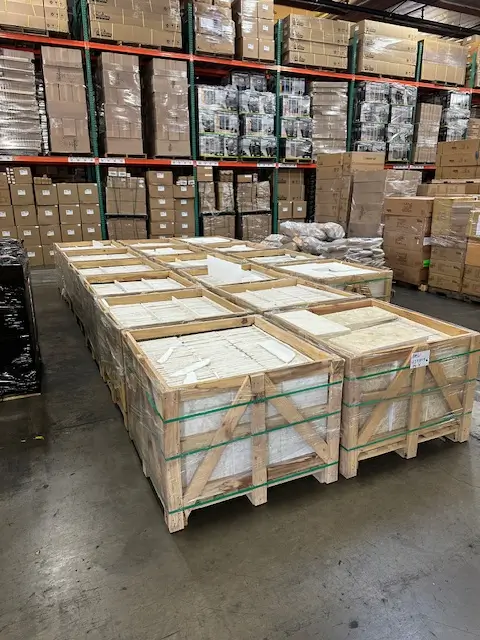
Supply chain realities matter as much as material specs when you’re managing project timelines. Travertine paver suppliers in Arizona fall into two broad categories: those sourcing directly from Turkish and European quarries with domestic warehouse inventory, and those drop-shipping from import distributors with 6–10 week lead times. The difference isn’t always obvious from a website or a price quote.
Your best approach is to ask explicitly about current warehouse stock levels before committing to an installation date. A supplier with domestic warehouse inventory can typically turn around a residential order — 200 to 600 square feet — within 1–2 weeks. Travertine paver suppliers in Arizona operating through import-only channels often quote 4–6 weeks, which creates scheduling pressure if your project has a concrete pour or pool fill deadline upstream.
At Citadel Stone, we maintain warehouse inventory of travertine marble pavers in Arizona across multiple thickness profiles and finish types, which allows us to confirm stock before your project schedule is committed. Our technical team also runs quarry-level density and absorption testing on incoming material — a step that filters out the lower-grade fill that sometimes enters the supply chain under premium product descriptions.
- Verify warehouse stock levels before finalizing your installation schedule
- Confirm lot consistency — mixed-lot travertine produces visible tone variation across the finished surface
- Request absorption rate documentation: values above 6% indicate lower-density material that requires more aggressive sealing
- Truck delivery logistics matter for tight residential access — confirm vehicle clearance and off-loading capability before scheduling
- Order 10–12% overage for pattern cuts and future repairs — matching material from a different quarry run rarely achieves a seamless blend
Truck delivery scheduling to sites with restricted access — narrow driveways, overhead clearance issues, or weight-restricted roads — needs to be addressed at the ordering stage, not when the truck arrives. Suppliers with local warehouse operations can often accommodate smaller delivery vehicles where national distributors cannot. For oversized or commercial orders, truck routing and staging area requirements should be confirmed with the supplier’s logistics team at the time of order placement.
Sealing and Maintenance Protocols for Arizona Conditions
Sealing travertine marble pavers in Arizona isn’t optional — it’s the maintenance protocol that separates a 10-year installation from a 25-year one. The combination of intense UV, high dust load, organic debris during monsoon, and high-pH pool water creates a multi-vector attack on unprotected stone that accelerates surface erosion and staining significantly faster than temperate climate installations.
Penetrating silane-siloxane sealers are the correct chemistry for Arizona conditions — they bond within the stone’s pore matrix rather than forming a topical film, which means UV degradation doesn’t cause peeling or cloudiness the way acrylic topical sealers do after 18–24 months of Arizona sun exposure. Apply initial sealer after a full 28-day cure if set in mortar, or after 72 hours for sand-set applications. Two coats with a 30-minute interval between applications provides adequate protection depth.
In Yuma, which logs more annual sunshine hours than almost any other U.S. city, natural stone paver performance data AZ monitoring shows sealer degradation occurring roughly 30–40% faster than in Phoenix due to the combination of higher UV intensity and extremely low humidity. That means an annual sealer inspection — with reapplication every 18 months rather than every 2 years — is the appropriate maintenance interval for Yuma installations.
- Initial sealing: apply within 72 hours of installation completion for sand-set; 28-day cure for mortar-set
- Reapplication frequency: every 18–24 months in low desert zones; every 12–18 months at Yuma-level UV exposure
- Water test for resealing timing: if water absorbs within 3–5 minutes rather than beading, resealing is due
- Pool water chemistry: maintain pH 7.2–7.6 to prevent high-alkalinity etching on travertine surfaces near water features
- Cleaning: pH-neutral stone cleaner only — acidic cleaners etch the calcium carbonate matrix, creating permanent surface dullness
Pattern Layout and Design Considerations
The pattern you select for travertine marble pavers in Arizona affects not just aesthetics but also long-term structural behavior. Running bond (brick pattern) distributes point loads more efficiently than stack bond because joint lines never align over extended runs — which matters in areas where furniture legs or planters create repetitive point loading.
Versailles pattern — the four-size interlocking layout — is the most popular choice for large Arizona patio installations, and for good reason: the varied sizing breaks up the visual repetition of large flat areas, and the interlocking geometry creates mechanical interlock that stabilizes the field. That said, Versailles requires precise cutting at borders, which adds installation time and waste — factor 15% material overage rather than 10% when specifying this pattern.
- Running bond: most efficient load distribution, easiest installation, best for rectangular spaces
- Versailles pattern: highest visual impact, best for large open areas, requires 15% overage
- Diagonal (45-degree) layout: visually expands narrow spaces but increases perimeter cuts significantly
- Ashlar pattern: random rectangular sizing creates organic appearance, requires careful layout planning to avoid small slivers at borders
- Consider solar orientation in pattern direction — running bond lines perpendicular to the home’s main façade typically reads better from interior sightlines
Natural stone paver performance data AZ installation records show that Versailles pattern installations have a marginally lower call-back rate for lippage complaints compared to large-format single-size layouts, likely because the size variation draws less attention to minor height differentials between individual pieces.
What Matters Most
Narrowing your specification decisions down to what actually drives long-term outcome means prioritizing base system quality, finish selection for your specific application, and a sealing protocol matched to your local UV load — in that order. The stone itself is reliable when you source from verified material with documented absorption rates and consistent density. Travertine marble pavers in Arizona have a genuine performance advantage in extreme heat, but that advantage gets undermined quickly by undersized base systems or mismatched finish types that create slip risk or accelerated wear.
For a closer look at how similar travertine materials perform in a different application format across the state, Travertine Stepping Stones in Arizona: What Data Shows covers thermal performance and sizing considerations that complement the patio and pool deck data discussed here. Both articles reflect the same core principle: material performance in Arizona’s climate is predictable when you spec it correctly from the start.
Your specification decisions shape not just how the installation looks at handoff, but how it performs through a decade of monsoon seasons, intense UV cycles, and daily thermal swings. Getting the base, finish, and sealing protocol right from day one is the difference between a surface that rewards the investment and one that demands ongoing remediation. Citadel Stone tracks real-world travertine marble paver outcomes across Arizona projects, providing homeowners in Sedona, Yuma, and Chandler with heat resistance benchmarks for informed outdoor surface decisions.