
Rectangular paver layout patterns in Arizona demand a level of terrain literacy that most general installation guides simply skip over. The pattern you choose — running bond, stacked, or herringbone — isn’t just a design preference. On sloped sites, hillside terraces, and the undulating desert foothills common across the state, your layout geometry directly controls how water moves across the surface and how load transfers through the base. Get that wrong, and it doesn’t matter how beautiful the pattern looks on day one.
Why Arizona Terrain Shapes Layout Decisions More Than Anything Else
Arizona isn’t flat. That sounds obvious until you’re standing on a Scottsdale hillside property trying to spec a rectangular patio that drains cleanly, looks intentional, and doesn’t shift after the first monsoon season. The state’s elevation range — from below 100 feet in the Yuma desert to over 7,000 feet in the White Mountains — creates radically different base preparation demands, and your layout pattern is the visible surface expression of decisions made several inches underground.
On any site with more than a 2% cross-slope, the directionality of your rectangular paver pattern becomes a hydraulic engineering decision. Running bond laid parallel to the slope creates continuous grout lines that can channel water too aggressively if joint sand isn’t properly compacted. Stacked bond perpendicular to the slope distributes runoff more evenly across the face — but only when your base has been graded with precise cross-falls. Your stone paver design options in Arizona aren’t truly unlimited once you factor in slope management.
Here’s what most homeowners and even some contractors overlook: rectangular pavers installed on sloped terrain require a base that’s engineered for differential settlement, not just load-bearing. On hillside sites in the Phoenix metro fringe, where decomposed granite transitions to bedrock within 18 inches, you’ll commonly see 4-inch aggregate bases performing beautifully — while identical specs on adjacent clay-rich soils fail within two seasons. The terrain tells you the spec; the pattern then has to work within it.

Running Bond on Sloped Arizona Sites
Running bond — where each row offsets by half a unit length — is the dominant rectangular paver layout pattern Arizona installers reach for first, and for good reason. The staggered joint structure distributes point loads laterally rather than concentrating stress at continuous linear joints, which is critical on any site where sub-base thickness varies due to uneven rock or caliche layers beneath.
On sloped installations, running bond oriented perpendicular to the fall line gives you the best combination of visual linearity and drainage control. The offset joints create micro-interruptions in surface water flow that slow sheet runoff — a detail that matters significantly during Arizona’s monsoon events, where 1.5 inches of rain in 45 minutes isn’t unusual. You’re essentially building a series of subtle hydraulic breaks into the pattern itself.
- Running bond perpendicular to slope reduces surface water velocity by distributing runoff across multiple joint lines
- The 50% offset creates structural interlocking that resists paver migration on grades up to approximately 8%
- Joint widths of 3/16 to 1/4 inch perform better than tight-set joints on sloped surfaces — they accommodate minor differential settlement without cracking
- On grades exceeding 5%, your aggregate base should step up from the standard 4-inch depth to 6 inches minimum to manage shear forces
- Running bond parallel to the fall line is workable on grades under 3% but requires more aggressive cross-fall management in the base
In Tucson, where many residential lots sit at the base of mountain bajadas with 4–6% natural grades, running bond oriented across the slope has become the standard practice among experienced stone contractors — not because it’s the easiest to install, but because it’s the pattern most forgiving of the base inconsistencies that bajada soils create.
Stacked Bond Pattern: When It Actually Works in Arizona
Stacked bond — where all vertical joints align in continuous lines — gets a bad reputation in high-movement climates, and some of that reputation is earned. The running bond versus stacked pavers Arizona debate often ends with professionals dismissing stacked entirely, but that’s an overcorrection. On the right terrain, stacked bond offers design clarity and installation efficiency that running bond can’t match.
The key qualifier is terrain stability. Stacked bond performs best on sites where sub-base conditions are consistent — flat desert plains with compacted caliche, engineered pads over concrete sub-bases, or raised terrace areas where the structural work has been done in the retaining system rather than in the paver base. On these sites, the aligned joints aren’t a vulnerability; they’re a feature that makes future repairs and leveling straightforward.
- Stacked bond requires a more precisely prepared base because continuous joints have no lateral load distribution — any settlement telegraphs immediately to the surface
- On flat sites with slopes under 1.5%, stacked bond drains effectively with a properly crowned base at 1/8 inch per foot
- The linear geometry of stacked patterns simplifies cutting at borders and edges, reducing waste on rectangular spaces
- For raised terrace installations where the terrace wall handles grade management, stacked bond is a legitimate high-performance choice
- Avoid stacked bond on decomposed granite sub-bases without a stabilizer — the aligned joints amplify any differential movement
Stacked bond also has a distinct advantage for rectangular layout styles in AZ outdoor spaces where the design brief calls for a clean, contemporary aesthetic. The grid pattern emphasizes the geometry of the space rather than the material’s texture — a legitimate design priority on modern residential projects where the architecture is rectilinear and the landscape should echo it.
Base Preparation: The Real Differentiator Between 10-Year and 25-Year Installations
Your pattern choice is the visible layer of a system that lives underground. Natural stone patio pattern choices across Arizona fail or succeed based on what’s beneath the stone, not on top of it. This is where terrain type creates the biggest performance gap between otherwise identical installations.
Arizona’s soils are wildly inconsistent. Caliche hardpan — the calcium carbonate cemented layer common across the Sonoran Desert — can appear at 6 inches or 36 inches, and its depth and density vary within a single lot. On sites where caliche is present and intact, it functions as an excellent natural sub-base. But when caliche has been disturbed by previous grading or utility work, it becomes a settlement liability because it doesn’t recompact to its original density.
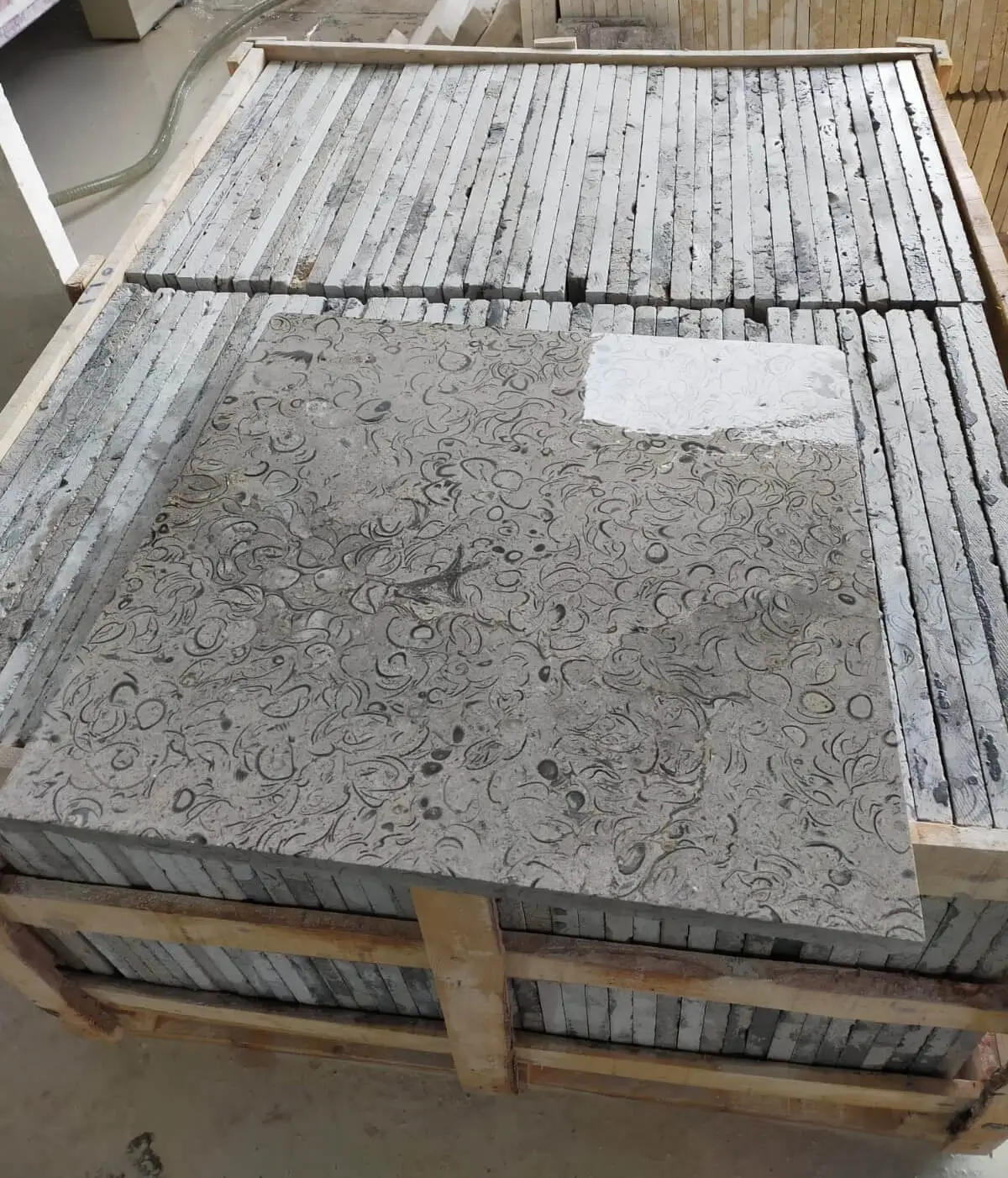
- On undisturbed caliche sites: 3–4 inches of compacted crushed aggregate over the caliche surface is typically sufficient for pedestrian paver applications
- On disturbed soils: minimum 6 inches of aggregate base, compacted in two lifts at 95% modified Proctor density
- For hillside installations with grades over 5%: consider a geotextile fabric layer between native soil and aggregate to prevent fine migration upward during monsoon saturation events
- Sand setting bed depth should be held to 1 inch maximum — thicker sand beds on sloped sites allow paver creep over time as the bed consolidates under traffic
- Cross-fall in the base should match or slightly exceed the planned surface cross-fall to ensure drainage continuity through the system
For projects being planned in advance, confirming warehouse stock of the rectangular pavers before finalizing your base preparation schedule is worth doing early — not because stock runs out often, but because delivery timing affects your construction sequencing. A truck arriving on-site before the base is ready creates unnecessary handling and rehandling of heavy stone.
How Elevation Changes Affect Pattern Performance Across the State
Here’s a detail that rarely appears in pattern selection guides: Arizona’s elevation range introduces freeze-thaw cycling in the upper elevation zones that completely changes the performance calculus for rectangular paver layout patterns. The Flagstaff area at 7,000 feet experiences genuine freeze-thaw cycles — sometimes 40 or more per year — while the Phoenix valley at 1,100 feet gets perhaps two or three marginal freeze events annually. These are fundamentally different engineering environments.
In Phoenix, thermal expansion is your primary structural concern, and the pattern implications are about joint width management under sustained heat loading. Surface temperatures on dark natural stone can exceed 160°F in mid-summer, creating expansion forces that work against tight-set stacked joints far more aggressively than against the staggered geometry of running bond.
At higher elevations, the calculus shifts. Freeze-thaw cycling acts on the moisture retained in joint sand and within the pore structure of the stone itself. Running bond’s distributed joint pattern handles freeze-induced heave more gracefully than stacked bond’s continuous lines because the movement has more pathways to distribute before it creates visible displacement. Your base also needs to go deeper at elevation — 6 to 8 inches of aggregate is standard practice in freeze-thaw zones — and the aggregate specification should call for angular crushed material rather than rounded river rock, which resists lateral migration better under cyclical frost pressure.
Grade Management and Pattern Orientation: The Decisions That Define Drainage
Choosing between running bond and stacked bond for a sloped Arizona site means thinking through how each pattern interacts with your drainage design — not just how it looks in a rendered site plan. The rectangular layout styles in AZ outdoor spaces that perform best over time are the ones where pattern orientation was treated as a drainage decision from the start.
For reference, explore how Citadel Stone paver layouts for Arizona are specified for different terrain types — the technical details there align closely with what field experience on Arizona hillside projects demands.
Grade management starts with establishing your primary drainage direction and then confirming that neither the pattern’s joint lines nor its bond direction creates a competing flow path. On terraced hillside installations — common in the foothills neighborhoods outside Scottsdale — each terrace level needs its own independent drainage path. Running bond oriented perpendicular to the terrace wall keeps joint lines from directing water toward the wall face, which is where hydrostatic pressure problems originate.
- Primary drainage direction should be established in the design phase, not adjusted during installation
- Running bond joint orientation should be considered relative to the fall line — not just the architectural geometry of the space
- Stacked bond on terraced sites requires channel drains or scuppers through the retaining walls to intercept water before it builds lateral pressure
- On split-level projects where multiple grades intersect, use running bond at transitions — its distributed joint structure handles the differential settlement that occurs where graded planes meet
- Pattern direction changes at steps or level changes should be gradual — abrupt orientation shifts at grade breaks concentrate both visual tension and structural stress at the same location
Natural Stone Selection for Rectangular Pattern Layouts
Rectangular pavers in Arizona perform differently depending on the stone species, and the pattern you’re targeting can actually narrow your material options in useful ways. Running bond is forgiving of minor dimensional variation because the offset joints distribute small inconsistencies in face dimensions across the field. Stacked bond, with its continuous joint lines, requires more dimensional precision — stones that are 1/16 inch long in face dimension create a cumulative alignment error that becomes visually obvious by the time you’re 10 feet into a run.
Travertine and limestone in the 3cm nominal thickness range are the most commonly specified materials for rectangular layout patterns in Arizona’s residential market, and both are well-suited to either bond pattern when cut from consistent stock. Basalt is gaining ground on contemporary projects where the charcoal tone and tight grain structure support the clean geometry of stacked layouts. At Citadel Stone, we source our rectangular stone inventory with Arizona’s terrain demands in mind — tighter dimensional tolerances than the industry standard, because field experience has shown us how much those fractions matter on long stacked-bond runs.
- Travertine: excellent for running bond on sloped sites — its natural texture provides slip resistance and its dimensional consistency is high for natural stone
- Limestone: dense, smooth-finish options work well in stacked bond on engineered flat surfaces; tumbled finishes are better for sloped applications
- Basalt: tight grain structure and high compressive strength make it ideal for contemporary stacked patterns on stable bases
- Sandstone: acceptable for running bond on flat sites but avoid on sloped applications — its layered structure can delaminate when exposed to sustained moisture at joint edges
- Quartzite: the most dimensionally stable option for high-heat zones — thermal expansion coefficient is lower than most alternatives, which matters for tight stacked-bond joints in Phoenix-area projects
Installation Sequencing on Challenging Arizona Terrain
The sequence of decisions on a sloped rectangular paver installation is as important as any individual choice within it. Projects that struggle at year three usually had the right materials and the right pattern — but the installation sequencing created moisture traps or drainage conflicts that only became apparent after the first few monsoon seasons.
Starting from the lowest point and working uphill is the cardinal rule for sloped installations, and it applies to both running and stacked bond equally. This ensures your reference lines are set against the drainage endpoint rather than the high point, which means your cross-falls are established correctly from the first course. Working downhill from a high point creates the temptation to adjust cross-fall late in the installation — and late adjustments almost always compromise the drainage geometry you set up in the base.
Our technical team at Citadel Stone recommends confirming truck access to the installation site before finalizing delivery scheduling — not just for the pavers themselves, but for base aggregate. On hillside projects, aggregate delivery often requires a separate smaller truck if the primary access road has tight turning geometry, and that adds 2–3 days to the base preparation timeline that project schedules rarely account for.
- Set string lines from low point to high point to establish fall direction before laying any stone
- Snap chalk lines for bond pattern reference before beginning — especially critical for stacked bond where misalignment compounds over distance
- Install border courses first on sloped sites — they anchor the field pattern and prevent creep during the setting phase
- Allow 72 hours minimum after base compaction before beginning paver installation in summer months — Arizona heat dries out the setting bed faster than in temperate climates, and partially dried sand compacts unevenly under early stone placement
- Polymeric joint sand should be applied in sections no larger than 200 square feet in summer conditions — larger sections dry before proper compaction is achievable
Putting It All Together: Rectangular Paver Layout Patterns in Arizona
Selecting between running bond and stacked bond for rectangular paver layout patterns in Arizona isn’t a stylistic coin flip — it’s a terrain-driven engineering decision that should start with your site’s slope data and soil profile before you open a material catalog. Running bond earns its position as the default choice because it handles the variability of Arizona’s terrain — the shifting caliche layers, the monsoon drainage demands, the hillside grade changes — with more built-in tolerance than stacked patterns can offer on challenging sites. Stacked bond has a genuine place on flat, engineered, or terrace-supported installations where the structural work lives in the retaining system rather than the paver base itself.
As you weigh your pattern options, it’s also worth understanding how paver dimensions factor into long-term performance. 600×600 Paver Stone Types vs Others: Arizona Homeowners covers how stone species and face dimensions intersect with rectangular paver layout patterns in Arizona — a complementary dimension of the rectangular paver decision that shapes both your pattern options and your cutting waste. Flagstaff, Peoria, and Gilbert homeowners working with Citadel Stone have found that the consistent face dimensions of these rectangular pavers reduce cutting waste significantly when executing linear stacked layout designs.