
The local vs national limestone Mesa debate isn’t really about loyalty — it’s about lead times, quality consistency, and who picks up the phone when a pallet arrives short. Most project managers in the Phoenix metro have strong opinions on this after getting burned at least once by an overpromised national account that couldn’t deliver in time for a concrete pour date. The right sourcing decision depends on variables that are specific to your project, your timeline, and the way your supplier actually handles Arizona’s climate demands on natural stone inventory.
Why Supplier Proximity Matters More Than You’d Think
Distance isn’t just a number on a freight quote — it’s a proxy for how well a supplier understands the material you’re receiving. A regional supplier who sources limestone regularly through Arizona-specific channels has already sorted out which quarries produce slabs with acceptable absorption rates for high-UV exposure. That tacit knowledge rarely shows up in a national catalog description. Your local supplier has likely already rejected the material that would have failed your project.
Delivery logistics are where the gap widens fast. When your truck route crosses two state lines, a delayed manifest or a weather hold at a distribution center can push your delivery window by days. For landscaping and hardscape contractors working on punchlist timelines in Mesa, that kind of delay cascades quickly — especially when your concrete sub is already scheduled.
National Suppliers: The Real Advantages
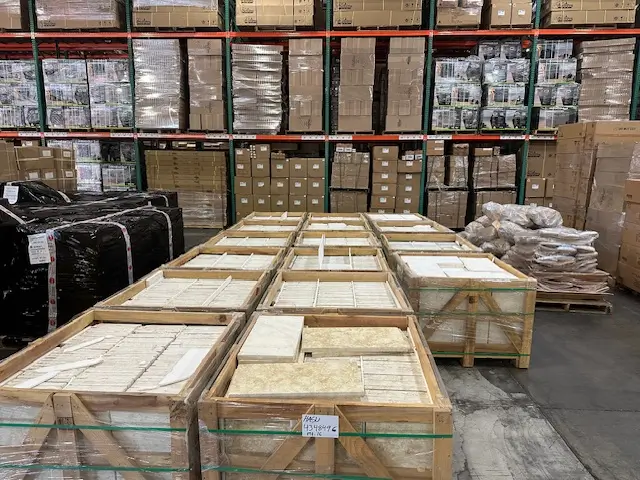
National distributors aren’t all talk. The strongest argument for going national is breadth — if you need 4,000 square feet of a specific cut in a less common finish, a national warehouse network might be the only realistic source. Regional suppliers carry what moves fast in Arizona, which means popular cream tones and standard 12×24 formats are always in stock, but unusual sizes or finishes may require a lead time that erases the local advantage anyway.
Pricing leverage is real at scale. National accounts that serve large commercial contractors often negotiate per-pallet pricing that a smaller local operation simply can’t match. The limestone sourcing options in Arizona expand when you factor in national suppliers who import directly from Turkish or Portuguese quarries at volume. For large projects where spec flexibility is low and budget pressure is high, the national option deserves a genuine comparison.
- Larger inventory depth for uncommon sizes and finishes
- Competitive pricing at commercial scale through direct import channels
- Consistent documentation packages for LEED or specification compliance
- National account management for multi-site projects
Local Benefits That Show Up in Every Arizona Project
The local benefits aren’t soft — they’re measurable. Lead times from a regional warehouse typically run one to two weeks for standard limestone inventory, compared to the four to eight weeks common with national distribution when stock needs to be repositioned from a distant fulfillment center. For projects with hard completion dates, that six-week swing is the difference between finishing on schedule and issuing a change order.
You also get more accurate pre-delivery quality checks when the supplier handles the material themselves. At Citadel Stone, we inspect limestone paving slabs before they leave the warehouse — checking for delamination, color consistency across the batch, and moisture content levels that affect adhesive curing times. That kind of hands-on review rarely happens at a national distribution hub where throughput volume discourages individual pallet inspection.
Local suppliers also carry institutional knowledge about regional soil and installation conditions. For a limestone paver supplier in Arizona who operates daily in this climate, the performance recommendations are calibrated to actual conditions — not reprinted from a generic installation guide written for a Mid-Atlantic climate zone.
Mesa Supplier Comparison: What to Actually Evaluate
Running a solid Mesa supplier comparison means going beyond price-per-square-foot. The variables that matter most are warehouse proximity, stock depth for your specific format, technical support availability, and the supplier’s track record with Arizona-grade limestone that can handle 115°F surface temperatures without spalling or joint failure.
- Confirm warehouse stock levels before locking in your project schedule — don’t accept verbal commitments on availability
- Ask whether the truck delivering your material is direct from their facility or routed through a third-party freight carrier
- Request samples from the actual lot you’ll receive, not a display sample that may come from a different quarry pull
- Verify the supplier’s familiarity with Arizona’s caliche sub-base conditions and how it affects base prep recommendations
- Check return and replacement policies for damaged pieces — national suppliers often have more rigid claim windows than local vendors
The Mesa supplier comparison also needs to account for post-sale support. Local suppliers can send a technical rep to your site. A national call center can’t walk your installation and spot a drainage slope problem before it becomes a warranty claim.
Understanding Your Limestone Sourcing Options in Arizona
Arizona’s limestone sourcing options break into three main channels: domestic quarry-direct suppliers, regional distributors carrying a mix of domestic and imported stone, and national importers who ship container-load volumes. Each channel has a different quality control profile, and understanding where your material comes from affects how you spec it.
Domestic limestone — primarily from Texas Hill Country and regional deposits — tends to have tighter density consistency and better documentation for absorption rates. Imported limestone from Turkey, Spain, or Israel can be excellent quality but requires more careful batch verification because quarry-to-quarry variation within the same country can be significant. A regional supplier who regularly imports from the same quarry consistently has already done that vetting work.
For projects in Yuma, where extreme heat and high alkalinity in soil and water accelerate surface degradation, material sourcing decisions directly affect your sealing schedule and long-term performance. A supplier who understands western Arizona’s conditions will steer you toward denser limestone grades with lower absorption coefficients — not because it’s more expensive, but because it’s the right material for the environment.
Cost Comparison: Local vs National Arizona Advantages
The Arizona national advantages for cost are real in specific scenarios but misunderstood in general practice. National suppliers often quote lower material costs per square foot, but those quotes rarely account for freight, liftgate fees, fuel surcharges, or the cost of a missed delivery window. When you build out a fully-loaded cost comparison, local suppliers frequently land within five to ten percent of national pricing — and that gap disappears entirely when you factor in one redelivery event.
For residential and mid-scale commercial projects under 2,000 square feet, the economics almost always favor local sourcing. The overhead on freight for smaller orders through national channels erodes the material price advantage quickly. Citadel Stone’s affordable limestone paving options are priced specifically for Arizona market conditions, which means you’re not absorbing the freight markup built into national catalog pricing for western delivery zones.
- Get landed cost quotes — material price plus all freight and handling — before comparing suppliers
- Ask about minimum order sizes; national suppliers often require full-pallet minimums that create waste on smaller jobs
- Factor in the cost of your own time managing a national account relationship versus a local rep who knows your projects
Quality Control Differences Between Local and National Channels
Here’s what most specifiers miss: the quality control gap between local and national isn’t about the stone itself — it’s about batch traceability. Local suppliers who handle their own warehouse stock can tell you exactly which quarry pull a given pallet came from. National distributors consolidating orders from multiple fulfillment centers may not be able to guarantee you’re receiving material from the same production run, which creates visible color variation across your installation.
For large-format limestone projects where visual consistency matters — pool surrounds, entry plazas, interior flooring with exterior transitions — batch traceability is a non-negotiable spec requirement. Your local supplier either pulled from one consistent lot or they didn’t, and you can verify that before the truck leaves the yard. That verification is much harder to execute with a national account where material may stage at three different warehouses before reaching your jobsite.
When National Sourcing Actually Makes Sense
There are project profiles where national sourcing wins cleanly. Multi-site commercial rollouts with standardized specifications across several states — say, a restaurant chain deploying a consistent exterior hardscape package — benefit from a national supplier who can guarantee the same material ships to every location from centralized inventory. Local suppliers can’t match that kind of scale consistency.
Projects in Gilbert running on commercial developer timelines occasionally need specialty limestone formats that exceed what regional distributors stock. When your spec calls for a 24×48 slab in a brushed finish with a specific calibration tolerance, national importers who control their own quarry relationships are the only realistic source. In those scenarios, a longer lead time is already baked into the project schedule, and the selection advantage outweighs the proximity benefit.
- Multi-state commercial projects requiring specification consistency across locations
- Specialty formats or finishes unavailable through regional inventory
- Projects where the owner has a pre-existing national account with favorable contract pricing
- Large-volume orders where per-unit pricing at national scale justifies the freight overhead
The Bottom Line
The local vs national limestone Mesa decision comes down to what your project actually needs — not which channel has better marketing. For most residential and mid-scale commercial work in the Phoenix metro, local sourcing outperforms national on lead time, quality verification, and total landed cost. National sourcing earns its place on large commercial projects, specialty specifications, and multi-site rollouts where regional inventory depth isn’t sufficient.
Run a real comparison using landed cost — not catalog price — and ask hard questions about batch traceability, warehouse proximity, and what happens when something goes wrong on delivery day. Those questions separate suppliers who can actually serve your project from those who can only serve your inquiry. Understanding how supplier credentials translate to installation outcomes is equally important for Arizona projects; Limestone Paver Supplier Credentials for Scottsdale Quality Standards provides a useful reference point for evaluating what separates accountable regional suppliers from national distributors in this market. Our team helps you plan your layout before you buy limestone slabs in Arizona to minimize cutting.