
Limestone tile sizes in Tempe aren’t a one-size-fits-all decision — the format you choose directly affects grout joint behavior, thermal mass distribution, and how your installation responds to the 110°F summer ground temperatures this region routinely hits. Specifiers who treat size selection as an aesthetic-only call end up with installations that look right for two years and start showing stress fractures by year five. Your format choice is a structural and thermal engineering decision as much as a design one.
Why Tile Format Drives Long-Term Performance
The dimensional relationship between tile size and joint spacing controls how a limestone installation manages thermal expansion. Larger formats — think 24×24 or 24×36 — distribute movement across fewer joints, which means each joint carries more cumulative stress. In Tempe’s climate, where surface temperatures swing 60 to 80 degrees between early morning and peak afternoon, that joint stress adds up fast.
Smaller modular formats — 12×12, 12×24 — create more frequent relief points, which is why they often outperform oversized slabs in exposed outdoor applications without shade coverage. The right tile format variety for your project depends heavily on whether you’re working in a covered or uncovered environment, and what your substrate material is below the setting bed.
- 24×24 and larger: best suited for interior or covered exterior spaces with controlled thermal cycling
- 12×24: the most versatile format for Arizona dimensional choices in both indoor and outdoor residential applications
- 12×12: reliable for high-traffic commercial entries where point load distribution matters
- Random ashlar patterns (mixed 6×12, 12×12, 12×24): excellent for natural aesthetic while maintaining manageable joint geometry
- Plank formats (6×24, 8×24): gaining traction in contemporary Tempe design but require closer attention to lippage thresholds
Standard Limestone Tile Sizes for Arizona Projects
Understanding which limestone tile sizes Tempe designers and contractors rely on most heavily helps you narrow your specification before diving into custom dimensions. The market has consolidated around several proven formats that balance supply reliability with performance data.
For residential pool surrounds and patios in the East Valley, 12×24 remains the dominant format — it’s long enough to read as contemporary but narrow enough that thermal movement stays within predictable parameters. The 18×18 format holds strong in transitional-style projects where the near-square proportion reads as classic without feeling dated. For projects in San Tan Valley, where large open patios without overhead shade are common, the 12×24 format’s narrower width profile helps prevent differential expansion between tile center and edge that wider formats experience more aggressively under direct solar loading.
- 12×12 nominal (actual 11.75×11.75): high grout joint frequency, excellent movement management
- 12×24 nominal: current design favorite for indoor-outdoor flow transitions in Arizona residential
- 18×18 nominal: balanced proportion, strong in traditional and transitional design contexts
- 24×24 nominal: premium interior specification, requires careful substrate prep for outdoor use
- 24×36 nominal: statement formats for large covered loggias and grand entry applications
- 6×24 plank: contemporary appeal, demands precision leveling compound work
Thickness matters alongside footprint. The 3/8-inch nominal tile works well for interior wall applications and light floor duty. For outdoor horizontal surfaces taking foot traffic and occasional furniture loads, 5/8-inch minimum is the appropriate specification — and for vehicular-rated applications, 1.25-inch pavers are the correct product category, which differs from tile entirely.
Dimensional Tolerances and Field Reality
Limestone size options in Arizona come with a tolerance range that most spec sheets understate. Natural limestone carries inherent dimensional variation — even within a single quarry run, you’ll see ±1/16 inch on thickness and ±1/8 inch on face dimensions for honed tiles. This isn’t a defect; it’s the nature of cut stone. The challenge is that many setters calibrated on rectified porcelain tile don’t account for this and end up with lippage issues that compromise the finished surface.
Rectified limestone — where tiles are mechanically precision-cut after initial sizing — narrows that tolerance to approximately ±1/32 inch on face dimensions. You pay a premium for rectification, typically 15 to 25 percent more per square foot, but it makes tight-joint installations (1/16-inch joints) achievable without constant individual adjustment. For large format limestone tile sizes, rectification isn’t optional — it’s a practical necessity when Tempe tile dimensions demand consistency across broad floor planes.
- Standard natural-cut limestone: ±1/8 inch face tolerance, 3/16-inch minimum recommended joint width
- Rectified limestone: ±1/32 inch face tolerance, allows 1/16-inch joints on interior applications
- Gauged limestone (consistent thickness): critical for floor-heating applications where uneven thickness creates hot and cold spots
- Hand-cut or artisan finishes: dimensional variation is intentional, requires experienced setters
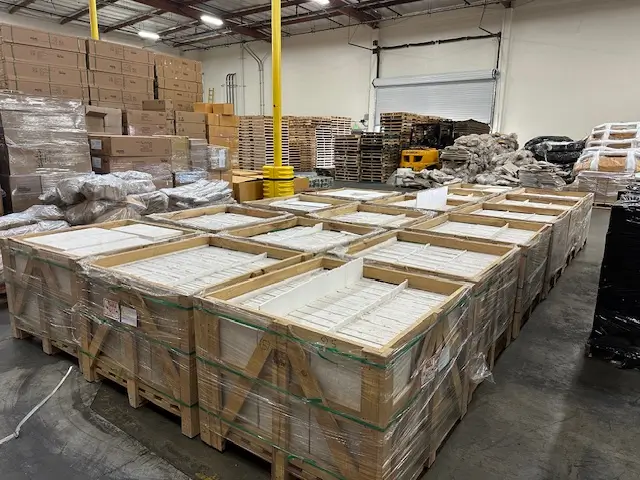
At Citadel Stone, we verify dimensional consistency at the warehouse level before orders ship — cross-checking samples from multiple production lots when a project requires tight color and dimension matching. This step catches batch inconsistencies that would otherwise show up as lippage or joint width variation after installation.
Format Selection by Application Type
Tile format variety isn’t just about aesthetics — each application context has performance requirements that narrow your format choices before design preferences enter the conversation.
For interior floors in Tempe commercial projects, 24×24 limestone works well when the slab is properly leveled to a flatness tolerance of FL 25 or better. Deviation beyond that specification causes tile rocking and eventual grout joint cracking, regardless of how premium the material is. For residential interior floors with typical concrete slab construction, 12×24 or 18×18 gives you more forgiveness against the minor substrate variation common in poured-in-place residential construction.
- Interior floors (residential): 12×24 or 18×18 for optimal substrate tolerance management
- Interior floors (commercial, properly leveled slab): 24×24 viable with appropriate setting mortar
- Interior wall cladding: 12×24 in vertical stack or offset; lighter 3/8-inch tile acceptable
- Covered exterior patios: 18×18 or 24×24 with appropriate expansion joint layout
- Uncovered exterior in Tempe: 12×12 or 12×24 preferred for thermal cycle management
- Pool surrounds: 12×24 horizontal, 6×12 or 6×24 for coping faces and spillways
Visit our limestone paving slab facility for the complete range of Arizona-stocked formats and current availability by thickness and finish type.
Pattern Layouts and Size Combinations
Limestone tile dimensions become a design multiplier when you approach them as a pattern system rather than individual units. The random ashlar pattern — combining three or four complementary formats like 6×12, 12×12, 12×18, and 12×24 — creates the visual character of irregular flagstone with the installation precision of cut tile. This approach to tile format variety is one of the most effective ways to achieve a naturalistic surface without sacrificing dimensional control.
Projects in Avondale have seen strong uptake of the 3-2-1 ashlar ratio, where three units of the largest size are paired with two medium and one small format to create a naturalistic but disciplined layout. This approach is particularly effective for exterior courtyard applications where you want limestone to read as a continuous natural surface rather than a grid. The key is working with your installer on joint line continuity — an experienced eye prevents the “brick-like” horizontal banding that shows up when the pattern isn’t properly randomized.
- Running bond offset (1/3 or 1/2 offset): works with 12×24; requires attention to lippage at offset joints
- Versailles pattern (4 size combination): premium visual, requires careful planning of cut tiles at borders
- Random ashlar (3-4 size): most forgiving for dimensional variation, reads as natural stone
- Linear plank stack: bold contemporary statement, demands precision substrate prep
- Diagonal layout: adds visual scale to smaller rooms but increases material waste by 10–15 percent
Thickness Specifications and Load Requirements
The limestone tile sizes Tempe conversation often focuses on face size while thickness gets treated as an afterthought — that’s backwards from a structural standpoint. Thickness determines deflection behavior, and limestone’s modulus of rupture (typically 1,200 to 1,800 PSI for dense domestic limestone) means that an undersized tile spanning a void or bridging a substrate irregularity will crack under point load stress.
For standard interior residential floor applications, 5/8-inch (nominal 16mm) is the practical minimum. For any application with rolling loads — hand trucks in commercial kitchens, housekeeping carts in hospitality settings, maintenance vehicles in covered walkways — 3/4-inch to 1-inch nominal tile is required, or pavers should be specified rather than tiles. Limestone tile suppliers in Arizona typically stock 3/8-inch, 1/2-inch, 5/8-inch, and 3/4-inch in the most popular formats; custom thicknesses require direct quarry ordering with 8–12 week lead times from overseas sources.
- 3/8 inch (10mm): interior wall tile and countertop applications only
- 1/2 inch (12mm): light-duty interior floors with full mortar bed and no point loads
- 5/8 inch (16mm): standard interior floor specification for residential and light commercial
- 3/4 inch (20mm): recommended for exterior covered surfaces and commercial floor applications
- 1 inch (25mm) and above: exterior uncovered, pool decks, heavy-duty applications
Sourcing and Lead Times for Tempe Projects
Limestone size options in Arizona are well-represented for common formats, but lead time reality varies sharply based on what you’re specifying. Standard 12×24 and 18×18 in popular finishes like honed or brushed typically ship within 1–2 weeks from local warehouse stock. Move to 24×36, custom thicknesses, or less common surface treatments and you’re looking at import cycle times of 6–10 weeks from European or Turkish quarries.
Projects in Yuma face an additional logistics consideration — truck delivery to the far west corridor adds transit time and, for smaller orders, can affect minimum delivery quantities. It’s worth consolidating orders across phases where your project allows it, since partial truckload shipping costs can erode material savings on smaller batches. Your GC or project manager should confirm warehouse stock levels in writing before the project schedule locks around material availability — verbal confirmations aren’t sufficient for scheduling purposes.
- In-stock Arizona formats: 12×12, 12×24, 18×18, 24×24 in most standard finishes
- Lead time from Arizona warehouse: 1–2 weeks for standard formats
- Import lead time for specialty formats or custom sizes: 6–10 weeks
- Minimum order quantities for truck delivery: typically 200–300 SF for residential; confirm with supplier
- Reserve 10–15 percent overage in your order for cuts, breakage, and future repairs
Finish Options and Their Impact on Size Selection
The finish you select interacts with tile format in ways that affect both installation difficulty and long-term maintenance. Honed finishes on large-format limestone tile sizes amplify any lippage because the consistent sheen makes height differences between adjacent tiles highly visible. Brushed or antiqued finishes are more forgiving — the surface texture creates enough visual break that minor height variation reads as character rather than defect. These Arizona dimensional choices carry real consequences for how a finished floor wears over time.
Tumbled finishes, which are common in Arizona for traditional and Spanish Colonial design styles, typically come in smaller formats — 4×4 through 12×12 — because the tumbling process that creates the worn-edge effect isn’t practical on large tiles. When your design intent calls for a tumbled aesthetic on a larger format, a hand-tooled or chiseled edge treatment applied to a standard cut tile achieves the visual result, though it adds labor cost to the specification.
- Honed (flat, matte sheen): most common; amplifies lippage visibility; requires tight substrate flatness
- Brushed/antiqued: textured surface hides minor installation variation; good for exterior use
- Polished: reflects light dramatically; shows every surface irregularity; generally not recommended for outdoor Arizona applications
- Tumbled: smaller formats only; authentic aged character; requires experienced setter for tight joint work
- Sandblasted: slip-resistant texture; appropriate for pool surrounds and wet areas
Decision Points
Getting limestone tile sizes right in Tempe comes down to reconciling your design vision with the thermal and structural realities of the installation environment. The format conversation starts with substrate flatness, thermal exposure, and load conditions — not with what looks good in a product photograph. Your finish choice narrows the viable format range, and your schedule determines whether your preferred format is achievable within the project timeline.
Plan your material orders with warehouse stock verification before the project schedule commits to installation dates. Specialty limestone tile formats and custom thickness specifications that require import sourcing will add 6–10 weeks to your lead time — a gap that reshuffles every downstream trade if it isn’t built into the schedule from the start. As you work through your size specification, reviewing related supply chain details like Limestone Supplier Lead Times for Gilbert Project Scheduling can help you set realistic expectations for procurement timelines across similar Arizona limestone projects.
The specification decisions that define a successful limestone installation aren’t the ones made at the design table — they’re the ones confirmed in the field before the first tile goes down. Verify your format, confirm your thickness, check your substrate flatness tolerance, and lock in your warehouse stock before mobilization. We are the limestone paver supplier in Arizona that landscape architects call for custom specification.