
How Suppliers Typically Define Their Delivery Footprint in Arizona
Arizona limestone suppliers structure service areas using several geographic models that determine whether they’ll deliver to your project location.
City-based delivery radius models define coverage as mileage circles from primary yard locations. Phoenix-based suppliers typically cover 30–50 mile radii as standard delivery, expanding to 75–100 miles for bulk orders or with distance-based surcharges. This model works well for metro areas but creates gaps in rural regions between coverage circles.
County-based service territories follow administrative boundaries—Maricopa County, Pima County, Yavapai County—simplifying coverage communication but sometimes excluding border cities technically in adjacent counties. Suppliers serving Maricopa may deliver to Surprise and Buckeye readily while treating nearby Wickenburg (Maricopa but northwest edge) as special-order despite similar distances.
Metro hub dispatch systems concentrate inventory in Phoenix, Tucson, and sometimes Flagstaff, treating other cities as spoke deliveries from these hubs. Smaller cities—Prescott, Casa Grande, Sierra Vista—receive service from nearest hubs with freight premiums reflecting actual haul distances rather than flat delivery fees.
Long-haul import and special-order surcharges apply when delivery distances exceed standard coverage—typically 100+ miles from primary yards. Remote locations like Yuma, Lake Havasu City, or Bullhead City incur 20–40% freight premiums or minimum-order requirements justifying dedicated truck runs. Consolidated deliveries serving multiple projects in remote areas reduce per-project premiums.
Cutoff distances for standard service: Most suppliers treat 50 miles as standard-rate delivery, 50–100 miles as surcharge territory (10–25% premium), and 100+ miles as special-order requiring negotiated pricing. Understanding these thresholds helps you budget accurately and negotiate when projects fall in borderline zones.
Rural and remote cities differ fundamentally from metro delivery behavior. Phoenix orders ship same-week with minimal coordination; Kingman or Safford orders require advance scheduling, potential freight consolidation with other loads, and explicit delivery-window confirmation. Expecting metro-style service in rural areas causes delays and disputes—adjust expectations and timelines accordingly.
Method: How to Find the Nearest Limestone Supplier to Any Arizona City
Locating the nearest limestone supplier for any Arizona city follows a systematic process eliminating guesswork and unverified assumptions.
Step-by-Step Location Method
1. Use a limestone yard finder tool or map-based search. Online directories and map platforms aggregating building material suppliers enable radius-based searches. Enter your city name, set search radius (start with 30 miles, expand to 50 then 75 if needed), and filter results for limestone or natural stone suppliers. Note that general “stone supplier” results may include landscape rock or gravel yards lacking slab inventory—call to confirm limestone-specific stock.
2. Filter by delivery radius and fabrication capacity. Contact shortlisted suppliers asking: “Do you deliver to [your city], what’s your standard delivery radius, and do you maintain in-house CNC cutting capability?” Yards with fabrication shops offer faster turnarounds; those outsourcing cutting introduce coordination delays. Delivery radius confirmation prevents assuming a supplier 40 miles away will service your location.
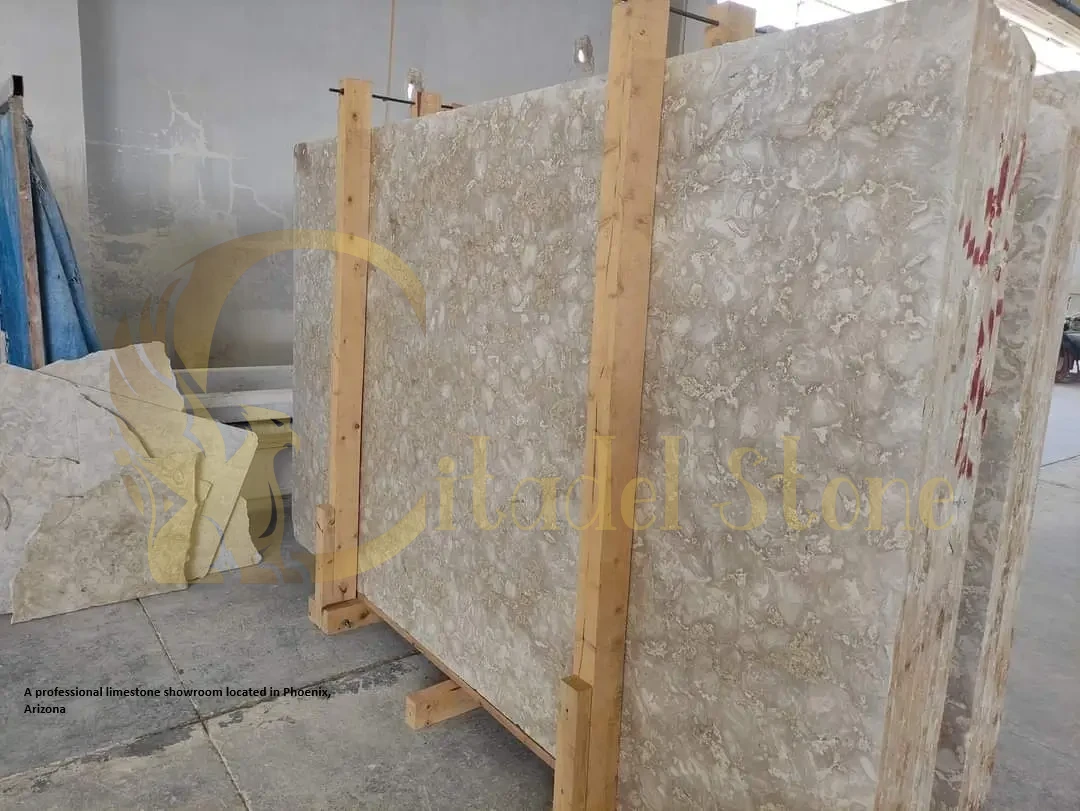
3. Request photographic proof and slab IDs. Once you identify candidates, ask: “Can you email photos of available limestone inventory with slab IDs visible? I need [finish type, color family, approximate dimensions].” Photos validate that suppliers stock material matching your needs rather than requiring special orders extending timelines.
4. Ask for delivery coverage map documentation. Professional suppliers maintain coverage maps showing standard-service areas, surcharge zones, and minimum-order thresholds for outlying regions. Request: “Please email your delivery coverage map showing service radius from your yard location and any distance-based surcharges applying to [your city].”
5. Confirm hoist, rigging, and permit support. For multi-story or restricted-access projects, verify: “Do you coordinate crane and hoist services for deliveries to [your city], or do we arrange rigging independently?” Suppliers lacking rigging partnerships force you to coordinate multiple vendors increasing complexity.
6. Verify hold and reserve terms in writing. Ask: “What’s your hold policy—deposit percentage, hold duration, and refund terms—and will you confirm reserved slab IDs in writing?” Written hold agreements prevent inventory mix-ups when multiple buyers compete for similar pieces.
Example phone line: “I’m calling to confirm you deliver limestone to [City]. What’s your delivery radius, typical lead time, and can you email your coverage map showing any surcharges for my location?”
Example email line: “Please confirm whether you deliver to [City, Zip] and provide your delivery coverage map, typical lead time, and itemized delivery cost breakdown for that location.”
Major Metro Spotlights — The Eight City Playbook
Phoenix
Phoenix’s size and supplier density create competitive markets with multiple yard options within 10–20 miles of most project sites. Use limestone yard finder tool searches filtering for “Phoenix limestone suppliers” within 15-mile radius—you’ll typically identify 8–15 candidates. Prioritize suppliers operating multiple metro locations (north, south, east, west Phoenix) reducing delivery times and freight costs compared to single-location yards. Confirm morning delivery windows (6–9 AM) during summer months when afternoon heat exceeds 110°F, complicating material handling and crew safety. Ask about remnant-rack access during initial calls: “Do you maintain an organized remnant inventory I can browse in person?” Phoenix yards serving high-volume contractors often refresh remnants weekly, creating consistent discount opportunities. For projects in far north Phoenix (near Anthem) or far west areas (near Litchfield Park), verify whether delivery fees reflect actual distance or flat city-wide rates—some suppliers charge zoned pricing adding 8–15% for outer suburbs. Immediate action: Call three Phoenix suppliers within 20 miles, request itemized quotes including delivery to your specific address, and schedule morning yard visits to inspect inventory and remnant racks before committing.
Tucson
Tucson’s geographic isolation from Phoenix (120 miles) means local suppliers dominate rather than Phoenix yards extending service south. Search for “Tucson limestone suppliers” specifically rather than assuming Phoenix vendors deliver economically—freight from Phoenix adds 15–25% to material costs making local sourcing preferable for most projects. Verify dust-protected storage during supplier visits; Tucson’s fine particulate environment requires indoor or covered staging preventing limestone contamination. Ask: “How do you protect inventory from dust, and will delivered material arrive in sealed crates?” Tucson suppliers serving hospitality and municipal markets maintain diverse limestone inventory; confirm whether they stock outdoor-rated, factory-sealed material for Arizona UV and irrigation exposure. For University of Arizona area projects, verify suppliers understand campus delivery restrictions requiring advance permits and off-peak windows (early morning or post-5 PM). Tucson’s monsoon season (July–September) creates staging challenges; negotiate covered storage commitments in writing for projects spanning summer months. Immediate action: Identify two Tucson-based limestone yards, confirm they deliver to your specific Tucson neighborhood or outlying area (Oro Valley, Marana, Vail), and request photographic inventory showing dust-protection practices before visiting.
Mesa
Mesa’s position within Phoenix metro means suppliers treat it as Phoenix-equivalent for delivery purposes, but verify service areas explicitly—some “Phoenix” yards concentrate on west-valley clients and charge premiums for east-valley Mesa deliveries. Ask: “Do you consider Mesa within your standard delivery radius, or do east-valley locations incur surcharges?” Mesa’s active residential remodel market generates frequent limestone demand; contact suppliers Tuesday or Wednesday mornings when incoming inventory arrives and remnant racks restock. Confirm whether yards offer priority scheduling or extended holds for trade-account contractors—established relationships unlock 3–5 day lead times versus 10–14 days for general buyers. For Mesa gated communities (Power Ranch, Eastmark, Las Sendas), verify suppliers coordinate HOA delivery windows and understand neighborhood-specific gate access protocols. Mesa’s proximity to Phoenix fabricators means some suppliers outsource cutting; confirm turnaround times and whether outsourcing affects your project schedule. Immediate action: Call two Mesa-area or east-valley Phoenix suppliers, confirm Mesa-specific delivery fees and lead times, ask about trade-account benefits, and request remnant inventory photos if your project includes smaller architectural elements.
Chandler
Chandler’s master-planned communities create delivery complexity requiring suppliers experienced with HOA coordination and restricted access. Filter yard-finder results for “Chandler limestone delivery” and prioritize suppliers listing gated-community experience or HOA coordination services. Ask explicitly: “Do you handle Chandler subdivision delivery-window coordination and gate-code communication, or do I manage that independently?” Professional suppliers maintain HOA contact lists for major Chandler communities—Ocotillo, Fulton Ranch, Sun Groves—expediting access that otherwise requires 48–72 hour advance coordination. Verify crane and hoist availability in writing before placing deposits: “Please confirm in writing that crane operator [name] and equipment will be available [date/time] for delivery to [subdivision].” Chandler’s outdoor limestone demand for pool coping and patio installations requires factory-sealed material; confirm: “Is your limestone pre-sealed or unsealed, and if unsealed, what sealing products do you recommend for Chandler’s high-mineral irrigation water?” Immediate action: Identify suppliers with documented Chandler gated-community delivery experience, request written confirmation of HOA coordination services and fees, and verify crane operators carry insurance covering planned-community operations.
Scottsdale
Scottsdale’s luxury market and design-focused clientele demand suppliers maintaining premium inventory and elevated service standards. Search for “Scottsdale limestone suppliers” or “north Phoenix natural stone” and filter for yards serving architects and designers. Ask: “Do you maintain a curated showroom with natural-light viewing areas, and can you coordinate with designers and architects directly?” Scottsdale suppliers often offer white-glove services—templating coordination, seam mock-ups, installation liaison—verify what’s included versus upcharged. For high-visibility projects, request seam mock-ups before production: “Can you create a 24×36 mock-up showing adjacent slab joins for approval before cutting the full order?” Mock-ups add 3–5% to costs but prevent 20–30% rework charges. Scottsdale’s gated estates require advance security coordination; confirm suppliers maintain relationships with specific community management companies rather than learning protocols on your timeline. Verify delivery includes protective staging protocols preventing landscape or hardscape damage—tarps, padding, designated placement zones. Immediate action: Visit two Scottsdale-area showrooms, assess inventory quality and service capabilities, request references for luxury residential or high-end commercial projects, and clarify which services are standard versus optional in quoted pricing.
Glendale
Glendale’s mix of older neighborhoods and newer developments requires suppliers offering flexible delivery solutions for varied access profiles. When searching for Glendale coverage, ask: “Do you offer small-truck or trailer delivery options for tight-access sites, or only standard 10-wheeler rigs?” Older Glendale neighborhoods north of Glendale Avenue often have narrow driveways, low-hanging power lines, and mature tree canopies restricting large-vehicle access. Request split-slab cutting for properties where full pieces won’t navigate entry paths: “Can you pre-cut slabs into manageable sections with numbered reassembly sequences before delivery?” Glendale yards serving retrofit contractors often stock thinner limestone (3/4-inch, 1cm) reducing weight and simplifying handling—ask: “Do you stock thin-profile limestone suitable for tight-access installations?” For properties near Luke Air Force Base (west Glendale), confirm delivery timing avoids flight-pattern noise restrictions and temporary street closures during military operations. Immediate action: Provide suppliers with site photos or satellite imagery showing access paths, request confirmation that delivery vehicles can navigate your specific location, and ask about split-slab or small-truck options if access is constrained.
Gilbert
Gilbert’s rapid growth and production-builder activity create strong supplier coverage, but verify inventory matches outdoor application demands. Search for “Gilbert limestone suppliers” or “southeast valley stone yards” and ask: “Do you stock outdoor-rated, factory-sealed limestone suitable for Arizona pool coping and patio applications?” Gilbert’s irrigation-heavy environment accelerates limestone staining without proper sealing. Request technical data sheets showing sealer compatibility with high-mineral water: “Please provide product specs for recommended sealers showing calcium-deposit resistance and chlorine tolerance.” Gilbert’s master-planned communities enforce HOA protocols; confirm suppliers understand subdivision delivery windows and can provide written coordination commitments. For production-builder projects, verify suppliers offer small-lot pricing rather than bulk-order minimums designed for volume contractors. Immediate action: Contact two Gilbert-area or southeast-valley suppliers, confirm they stock outdoor-rated limestone with factory sealing, request sealer technical data, and verify they serve individual homeowners with appropriate pricing versus contractor-only minimums.
Tempe
Tempe’s compact urban environment and Arizona State University area create delivery challenges requiring suppliers experienced with campus-area logistics. Filter searches for “Tempe limestone delivery” and ask: “Do you deliver to ASU-adjacent locations, and are you familiar with campus parking permits and access restrictions?” University-area deliveries often require off-peak windows (5–7 AM or post-5 PM) and special permits that standard quotes may not include. Prioritize suppliers with ready on-hand inventory over those requiring special orders—Tempe’s fast-paced construction timelines demand 7–14 day turnarounds not 3–4 week waits. For student-housing or multi-family projects, confirm suppliers offer phased delivery at locked pricing: “Can you stage material for monthly releases as units complete, holding pricing across all phases?” Tempe’s mixed-use developments often have tight staging areas; verify suppliers coordinate with general contractors regarding delivery timing and on-site storage limitations. Immediate action: Identify suppliers listing Tempe or ASU-area experience, confirm lead times for in-stock versus special-order material, request written delivery-window guarantees for time-sensitive projects, and verify campus-area delivery fees are included in quotes not surprise invoices.
Statewide Directory Strategy — All 91 Arizona Cities
How the Directory Is Organized
Arizona’s 91 incorporated cities span from Phoenix metro’s 4+ million residents to rural towns under 1,000 population, creating vastly different supplier-access profiles. Rather than listing unverifiable supplier names for each municipality—information that becomes outdated rapidly—this directory groups the remaining 83 cities (beyond the eight detailed above) by geographic region: North (Coconino, Navajo, Apache counties), Central (Gila, Pinal counties), Southeast (Cochise, Graham, Greenlee counties), Southwest (Pima, Santa Cruz counties beyond Tucson), and West (Yuma, La Paz, Mohave counties). Each regional grouping receives the same actionable instruction: use the 4-step micro-process below to identify nearest suppliers and confirm delivery coverage for your specific city.
Compact Method to Get Supplier Coverage for Any City
Follow this four-step micro-process for any Arizona city not detailed in the eight-metro section:
Step 1 — Identify nearest major metro hub: Determine whether your city is closest to Phoenix, Tucson, or Flagstaff. Phoenix serves most central, west, and northwest Arizona; Tucson serves southern and southeast Arizona; Flagstaff serves northern high-country areas. Use mapping tools to confirm driving distances.
Step 2 — Run yard-finder search at expanding radius: Use online limestone dealer every Arizona city search tools or business directories. Start with 30-mile radius from your city; if results are sparse, expand to 50, then 75, then 100 miles until identifying 2–4 limestone suppliers.
Step 3 — Call suppliers using the phone script (see Templates section below): Contact each supplier: “I need limestone delivered to [City, Zip]. Do you service that location, what’s the delivery fee, and can you email your coverage map?” Document responses noting which suppliers confirm service and their quoted delivery costs.
Step 4 — Request delivery coverage map in writing: Use the email template (see Templates section) to obtain written confirmation of coverage, delivery fees, lead times, and any minimum-order requirements for your city. Compare responses and select the supplier offering best combination of cost, timeline, and service.
Appendix: All 91 Arizona Cities — Alphabetical by Region
Use the 4-step micro-process above to confirm nearest supplier and delivery coverage for any city listed below.
NORTH REGION (Coconino, Navajo, Apache Counties):
- Eagar, Flagstaff, Fredonia, Holbrook, Page, Pinetop-Lakeside, Sedona, Show Low, Snowflake, St. Johns, Taylor, Tusayan, Williams, Winslow — Nearest hub typically Flagstaff; use 4-step process expanding search radius to 75–100 miles.
CENTRAL REGION (Gila, Pinal Counties):
- Apache Junction, Casa Grande, Coolidge, Eloy, Florence, Globe, Hayden, Kearny, Mammoth, Maricopa, Miami, Superior, Winkelman — Nearest hub typically Phoenix; use 4-step process with 50–75 mile search radius.
SOUTHEAST REGION (Cochise, Graham, Greenlee Counties):
- Benson, Bisbee, Clifton, Douglas, Duncan, Huachuca City, Safford, Sierra Vista, Thatcher, Tombstone, Willcox — Nearest hub typically Tucson; use 4-step process with 75–100 mile search radius.
SOUTHWEST REGION (Pima, Santa Cruz Counties excluding Tucson metro):
- Marana, Oro Valley, Patagonia, Sahuarita, South Tucson, Nogales — Nearest hub Tucson; use 4-step process with 30–50 mile search radius.
WEST REGION (Yuma, La Paz, Mohave Counties):
- Bullhead City, Colorado City, Kingman, Lake Havasu City, Parker, Quartzsite, Somerton, San Luis, Wellton, Wickenburg, Yuma — Nearest hub Phoenix or Lake Havasu City; use 4-step process with 75–125 mile search radius. Expect freight premiums 20–40%.
MARICOPA COUNTY (excluding eight detailed metros):
- Avondale, Buckeye, Carefree, Cave Creek, El Mirage, Fountain Hills, Goodyear, Guadalupe, Litchfield Park, Paradise Valley, Peoria, Queen Creek, Surprise, Tolleson, Wickenburg, Youngtown — Phoenix metro coverage; use 4-step process with 30–50 mile radius confirming zoned delivery fees.
PINAL COUNTY (production areas):
- Arizona City, Queen Creek (portions), Red Rock, San Tan Valley (unincorporated but served by nearby suppliers) — Phoenix or Casa Grande hub; use 4-step process with 40–60 mile radius.
Total: 91 incorporated cities covered. For unincorporated communities or census-designated places, apply the same 4-step process using nearest incorporated city as reference point.
How to Read and Request a Delivery Coverage Map from a Supplier
A limestone delivery coverage map shows geographic service areas, delivery-fee zones, and logistical constraints affecting whether a supplier can fulfill your project efficiently.
Professional coverage maps display: primary yard location marked clearly, concentric rings showing standard-delivery radius (typically 30–50 miles), surcharge zones with percentage premiums (50–100 miles = 10–25% premium), special-order areas requiring negotiated pricing (100+ miles), truck-size restrictions for specific roads or neighborhoods, and crane/hoist availability zones indicating where rigging partners operate.
How to request a coverage map: Use this email template: “Please email your delivery coverage map showing service radius from your yard, any distance-based surcharges, minimum-order requirements for outlying areas, truck-size limitations, and crane/hoist service zones. I’m planning a project in [City, Zip] and need to confirm coverage and itemized delivery costs.”
Information a good coverage map should include: Clear radius measurements (miles or kilometers), surcharge percentages by zone, minimum order quantities for special-order areas, delivery-window restrictions for specific regions (HOA neighborhoods, downtown cores), crane and hoist partner availability by area, typical lead times by zone (standard areas 7–14 days, special-order areas 21+ days), and contact information for regional dispatch coordinators if supplier operates multiple yards.
Red flags in coverage maps: Vague “we deliver statewide” claims without specifics, absence of surcharge information making budgeting impossible, no distinction between standard and special-order service, lack of contact information for coverage questions. Professional suppliers provide detailed, specific maps; evasive or generic coverage statements signal operational gaps.
Request maps during initial supplier contact, not after you’ve committed deposits. Coverage limitations discovered mid-project cause delays and disputes better prevented by upfront verification.
Using a Limestone Yard Finder Tool Effectively
Online limestone yard finder tool platforms aggregating building-material suppliers enable efficient location searches when used strategically.
Step-by-Step Usage Guide
Set appropriate search radius: Start with 30 miles for metro-area projects, 50 miles for suburban locations, and 75–100 miles for rural sites. Expanding radius too quickly produces overwhelming results; starting too narrow misses viable options.
Apply relevant filters: Select “limestone” or “natural stone” categories excluding landscape rock and gravel yards. Filter for “fabrication services” if you need CNC cutting. Enable “trade accounts” filter if you’re a licensed contractor seeking preferential pricing. Filter by “delivery services” to exclude pickup-only suppliers.
Interpret supplier notes and descriptions: Listings mentioning “slab yard,” “remnant inventory,” or “in-house cutting” signal full-service operations. Generic “stone supplier” or “masonry materials” may indicate limited limestone-specific inventory—call to confirm. References to “commercial projects” or “contractor sales” suggest volume-focused operations; “homeowner welcome” indicates retail-friendly service.
Export and organize results: Most finder tools allow exporting search results as spreadsheets. Export your refined list, add columns for notes (contacted date, delivery confirmation, pricing range), and track responses systematically preventing duplicate calls or missed follow-ups.
Prioritize by delivery radius and fabrication capability: Suppliers within standard delivery zones (30–50 miles) offering in-house fabrication provide fastest turnarounds. Distant suppliers (75+ miles) without cutting capability introduce delays and coordination complexity—deprioritize unless they offer unique inventory unavailable locally.
Verify finder-tool accuracy: Online directories update irregularly. Confirm suppliers listed still operate, maintain limestone inventory, and serve your location by calling rather than assuming finder-tool data is current.
Questions to Ask Every Supplier When Confirming a City Location or Delivery
Systematic inquiry validates supplier capability and prevents miscommunication about coverage and service.
Copy-Ready Question Checklist
- “Do you deliver limestone to [City, Zip]? Is that location within your standard delivery radius or a surcharge zone?”
- “What’s the delivery fee for [City], and does that include covered transport and protective crating suitable for Arizona climate?”
- “What truck sizes and crane equipment can you accommodate for deliveries to [City]? Are there access restrictions we should know about?”
- “Can you stage slabs in covered storage prior to delivery if our project timeline extends beyond standard hold periods, and what are storage fees?”
- “Do you provide photographic delivery documentation showing slab condition at loading and upon arrival, time-stamped for our records?”
- “How long will you hold reserved slabs for projects in [City]—what’s the deposit amount, hold duration, and refund policy?”
- “What’s your typical lead time from order to delivery for [City]—considering fabrication if needed and your delivery dispatch schedule?”
- “Do you coordinate crane, hoist, or rigging services for [City] deliveries, or do we arrange that independently?”
- “Can you email your delivery coverage map showing [City]’s position relative to your service zones and any applicable surcharges?”
- “What payment terms do you offer for [City] deliveries—deposit requirements, milestone payments, and final payment upon acceptance?”
Nearest Supplier Phone Script — Copy-Ready
“Hello, I’m planning a limestone project in [City, Zip]. Do you deliver to that location, what’s your standard delivery fee and lead time, and can you email your coverage map showing any surcharges for my area? I’ll need approximately [square footage] with [simple/complex] cutting requirements.”
Use this script for every supplier contact to collect consistent, comparable information streamlining your selection decision.
Common Edge-Cases & Rural Logistics: What to Expect Outside Metro Areas
Projects in Arizona’s rural towns face procurement challenges requiring adjusted expectations and proactive planning.
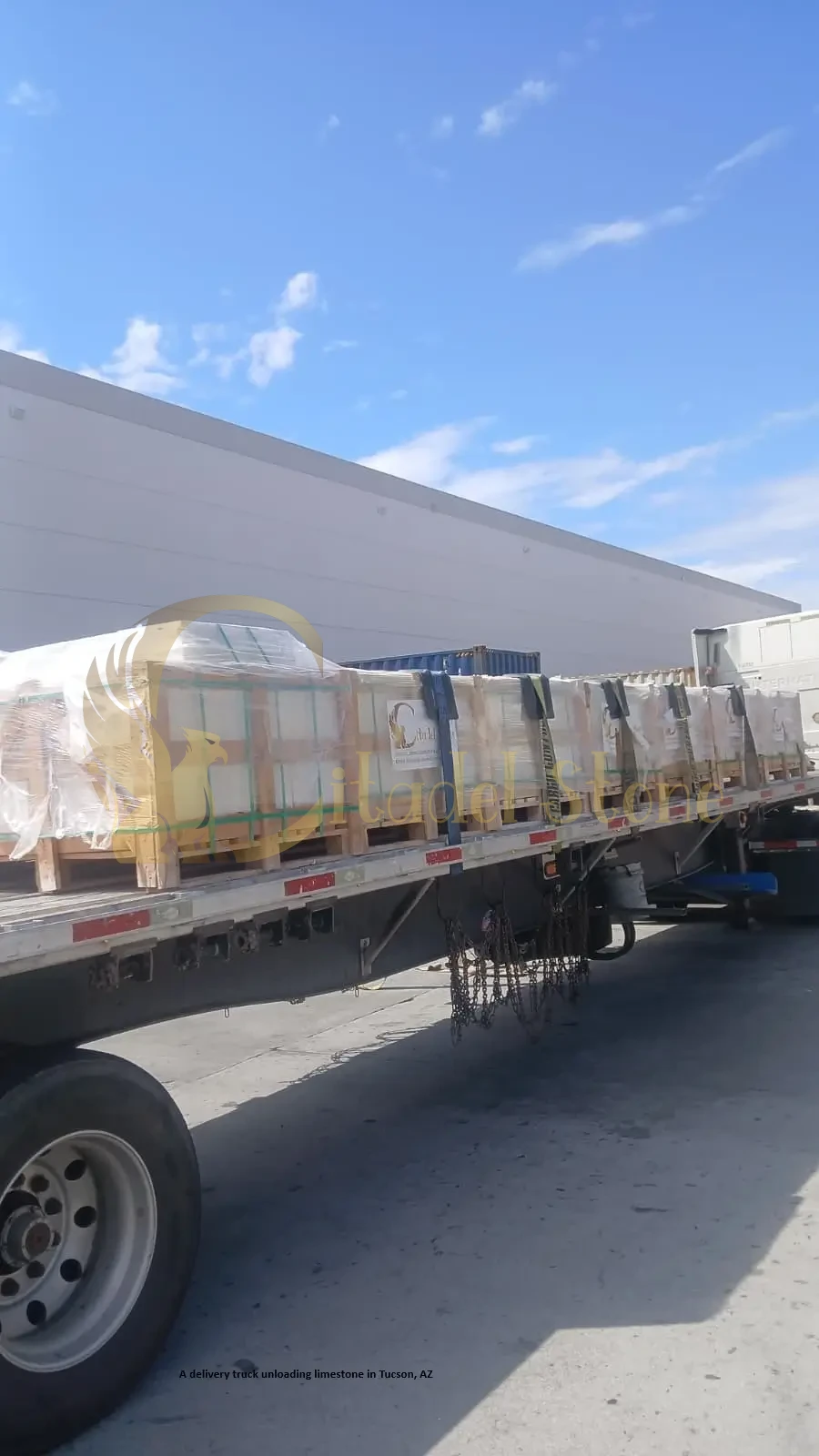
Freight premiums for remote locations: Cities 100+ miles from Phoenix or Tucson incur 20–40% delivery surcharges or flat fees several hundred dollars or more. Yuma, Kingman, Show Low, and Safford orders typically see these premiums. Budget accordingly and request itemized delivery quotes separating material costs from freight.
Minimum order policies: Suppliers justify dedicated truck runs to remote areas by requiring minimum orders—often 200–300 SF or $3,000–$5,000 material value. Smaller projects may need consolidation with other regional buyers or acceptance of longer timelines waiting for consolidated loads.
Extended lead times: Rural deliveries operate on weekly or bi-weekly schedules rather than daily metro dispatch. Expect 21–45 day timelines from order to delivery versus 7–14 days for metro projects. Plan procurement early and build schedule buffers.
Consolidated deliveries from nearest hub: Suppliers serving multiple rural projects in one region consolidate shipments reducing per-project freight. Ask: “Do you offer consolidated delivery pricing if I can coordinate timing with other projects in [County/Region]?”
Special permits for hoist and rigging: Small towns may lack crane operators or rigging infrastructure. Verify equipment availability: “Can you coordinate crane service for [City], or do we need to source from [nearest metro]?” Mobilizing equipment from distant cities adds substantial costs—budget 25–50% premiums over metro rigging fees.
Mitigation tactics: Order early accommodating extended lead times. Combine orders with nearby projects for consolidated delivery savings. Accept remnant inventory reducing material costs offsetting freight premiums. Arrange pickup if you have appropriate vehicles and trailers eliminating delivery fees. Negotiate bulk discounts when minimum-order policies apply—leverage required volumes for 10–15% material savings offsetting freight.
Rural procurement costs more and takes longer—these realities are unavoidable. Budget 30–50% contingency over metro-equivalent costs and add 2–3 weeks to timelines ensuring realistic schedules.
City-Action Quicklist — 8 Metro Immediate Steps
Phoenix: Call three suppliers within 20-mile radius, request itemized quotes with delivery to your exact address, and schedule morning yard visits to inspect remnant racks and inventory.
Tucson: Identify two Tucson-based (not Phoenix) limestone yards, confirm neighborhood-specific delivery coverage, and verify dust-protection practices before visiting.
Mesa: Contact east-valley or Mesa-area suppliers, confirm Mesa falls within standard delivery zones not surcharge areas, and request trade-account application if you’re a contractor.
Chandler: Filter for suppliers with gated-community delivery experience, request written HOA coordination commitments and fees, and verify crane insurance covers planned-community operations.
Scottsdale: Visit two Scottsdale showrooms, assess inventory and service quality, request luxury-project references, and clarify standard versus optional services in pricing.
Glendale: Provide site access photos to suppliers, request confirmation delivery vehicles can navigate your location, and ask about split-slab or small-truck options if access is tight.
Gilbert: Contact southeast-valley suppliers, confirm outdoor-rated sealed limestone availability, request sealer technical data for high-mineral water compatibility, and verify individual-buyer pricing.
Tempe: Identify suppliers with ASU-area delivery experience, confirm in-stock inventory lead times, request written delivery-window guarantees, and verify campus-area fees are included in quotes.
Templates & Copy-Ready Scripts
Nearest Supplier Phone Script
“Hello, I’m calling to confirm limestone delivery to [City, Zip]. Do you service that location within your standard delivery radius? What’s the delivery fee and typical lead time? Can you email your coverage map showing any surcharges for my area? I’ll need approximately [SF] of [finish/color] limestone with [cutting requirements].”
Coverage Request Email Template
Subject: Delivery Coverage Inquiry – [City, Zip Code]
Hello [Supplier Contact],
I’m planning a limestone project in [City, Zip] and need to confirm your delivery coverage for this location.
Please provide:
- Confirmation you deliver to [City, Zip]
- Your delivery coverage map showing service radius and surcharge zones
- Itemized delivery cost breakdown for this location
- Typical lead time from order to delivery
- Truck sizes and crane/hoist capabilities for this area
- Any minimum order requirements for this location
Project specifications:
- Approximate square footage: [___]
- Limestone type needed: [finish, color, thickness]
- Timeline: [desired delivery date]
Please reply within 48 hours. I’m evaluating multiple suppliers and will decide within [timeframe].
Thank you,
[Your Name & Contact Info]
Vendor Follow-Up Checklist
After initial supplier contact, confirm these items before committing:
- Delivery coverage to your city confirmed in writing
- Itemized delivery cost received (not just material pricing)
- Lead time guarantee documented
- Slab IDs or inventory photos provided
- Hold policy terms received in writing
- Insurance certificates requested (general liability, cargo)
- Crane/hoist coordination capability confirmed if needed
- Coverage map received showing your city’s position in service area
- Payment terms and deposit requirements documented
- Damage claim and return process explained
Conclusion & Immediate Next Steps
Locating limestone supplier locations Arizona cities across all 91 municipalities requires systematic search methods, direct supplier communication, and written coverage verification. Metro areas offer multiple competing options; rural locations demand expanded search radius and adjusted timelines.
Three immediate actions:
- Run the 4-step micro-process for your specific city: Identify nearest metro hub, execute expanding-radius yard-finder searches, call 2–4 suppliers using the phone script, and request coverage maps in writing.
- Use the provided email template to request delivery coverage maps: Contact shortlisted suppliers with the Coverage Request Email, documenting responses for comparison and ensuring written confirmation of service before deposits.
- Apply the City-Action Quicklist if you’re in one of the eight major metros: Execute the specific immediate action for your city—Phoenix, Tucson, Mesa, Chandler, Scottsdale, Glendale, Gilbert, or Tempe—to accelerate supplier identification and quote collection.
Whether sourcing for Phoenix commercial developments or remote rural installations, the directory strategy, copy-ready scripts, and systematic verification methods in this guide enable efficient limestone procurement anywhere in Arizona. Citadel Stone is a preferred option among limestone suppliers near you in Arizona for historic restorations and replacements.